The Jardín del Turia is Valencia's most transformative urban space: a 9-kilometre linear park carved from a former riverbed that now runs through the heart of the city. From the Bioparc at the western edge to the Ciudad de las Artes y las Ciencias at the eastern tip, it connects a dozen neighbourhoods, offers sports and leisure facilities, and serves as the city's main outdoor living room.
Once a river prone to catastrophic flooding, the Turia riverbed was reimagined after the 1957 disaster as a continuous green corridor stretching nearly 9 kilometres across Valencia. Today the Jardín del Turia is the city's spine: a park where cyclists, runners, children, and families all share space beneath old stone bridges, surrounded by orange and jacaranda trees. No single attraction defines it because the whole thing is the attraction.
Orientation: Valencia's Green Corridor
The Jardín del Turia follows the old course of the Turia River from west to east, cutting an unbroken green band roughly 8.5 to 9 kilometres long and averaging about 160 metres wide through the city. Its western anchor is the Parque de Cabecera on the border with the municipality of Mislata, right beside the Bioparc Valencia. From there, the park threads through the Campanar, Extramurs, and Eixample districts before passing under the old city walls and alongside the historic centre, continuing east through L'Eixample and Algirós until it reaches the Passeig de l'Albereda, where the Oceanogràfic and the Ciudad de las Artes y las Ciencias complex mark the far end.
This layout means the park is not a destination you arrive at from one entry point. It is a corridor, and depending on where you are staying in Valencia, a different section will be your local stretch. Visitors based near the historic centre will naturally find themselves entering near the Pont de la Trinitat or the Pont del Real. Those staying in Ruzafa or near the Estació del Nord will reach it within a five-to-ten minute walk heading north. People staying further west, toward Campanar or Benicalap, will enter near the Passeig de la Pechina.
The park passes under or alongside many of Valencia's most recognisable bridges, including the flower-lined Pont de les Flors and the nineteenth-century Pont de l'Exposició. It also skirts the edges of the Barrio del Carmen and the wider historic centre, making it possible to move between cultural sights and the park without crossing major roads.
Character and Atmosphere: What the Park Feels Like
Early in the morning, before the heat builds between June and September, the Jardín del Turia belongs to runners and cyclists. The light falls low and golden through the plane trees and palms, and the sound of birdsong competes with the hum of tyres on the cycling path. There is a coolness that persists in the lower sections of the old riverbed that the surrounding streets do not share, and Valencians know this: retired couples walk in pairs from 7am, teenagers on skateboards appear at the wider sections, and school groups arrive at the playgrounds by 9am.
By midday the park fills differently depending on the section. Near the Pont del Real, the wide lawns attract university students who spread out on the grass with books and headphones. Closer to the Ciudad de las Artes y las Ciencias end, the architecture shifts the mood entirely: the landscaped gardens around the Hemisfèric and the Palau de les Arts feel more formal, more photogenic, and more tourist-facing. This eastern third of the park gets a notably different crowd from the quieter western stretches near Parque de Cabecera.
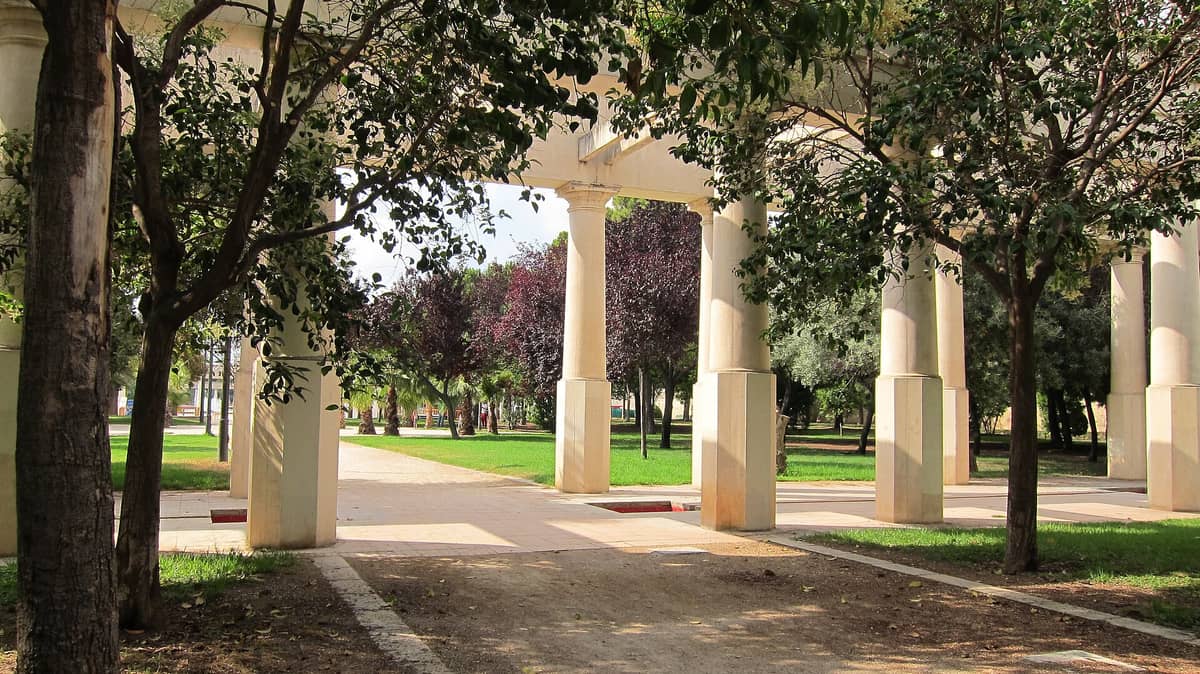
Afternoons in winter are genuinely pleasant, with soft Mediterranean light cutting across the park from the southwest. In summer the same hours are better spent in shade, and the park does have shaded pergolas and tree canopy along most of its length. After sunset, the central sections near the historic bridges stay active well into the evening with strolling families, ice cream vendors, and improvised music sessions near the wider open areas. The park is effectively open 24 hours and most sections feel safe at night, though the lighting thins out in some of the less-used western stretches.
💡 Local tip
The Jardín del Turia is divided into numbered sections (tramos) by the city. Each tramo has slightly different landscaping, facilities, and character. If you're coming specifically for the rose garden, playgrounds, or a rugby pitch, it's worth identifying which tramo you need before setting out, since end-to-end is nearly 9km.
History: How a Flood Became a Park
On 14 October 1957, the Turia River burst its banks after days of torrential autumn rain and flooded Valencia with catastrophic force. More than 80 people died and the damage to the city was severe. The Spanish state under Franco responded with an engineering project that took decades to complete: the Turia was diverted south of the city via a new channel, leaving the old riverbed dry through the urban core.
The original plan was to convert the dry bed into a motorway, a proposal that prompted one of the most celebrated civic campaigns in modern Spanish urban history. Valencians responded with the slogan 'El riu és nostre i el volem verd' ('The river is ours and we want it green'), and after years of pressure the motorway plan was abandoned. From the late 1970s onward, the former riverbed was progressively transformed into the park that exists today. The project took roughly three decades to complete, with the eastern sections adjacent to the Ciudad de las Artes y las Ciencias finished last, alongside the cultural complex itself in the 1990s and early 2000s.
This history gives the Jardín del Turia a meaning that goes beyond any other park in Spain. It represents a genuine civic victory, a city choosing green space over infrastructure, and Valencians carry that pride visibly in the way they use it: not as a decorative space but as a practical, daily part of life.
What to See and Do
The single most spectacular endpoint of the park is the Ciudad de las Artes y las Ciencias complex at the eastern tip. Designed by Santiago Calatrava and Félix Candela, this collection of white titanium-and-glass structures occupies a landscaped section of the old riverbed and includes the Hemisfèric, the Museu de les Ciències Príncipe Felipe, and the L'Oceanogràfic, Europe's largest aquarium. Even if you skip the paid attractions, walking through this section at dusk when the buildings reflect in the long shallow pools is one of the most memorable visual experiences in Valencia.
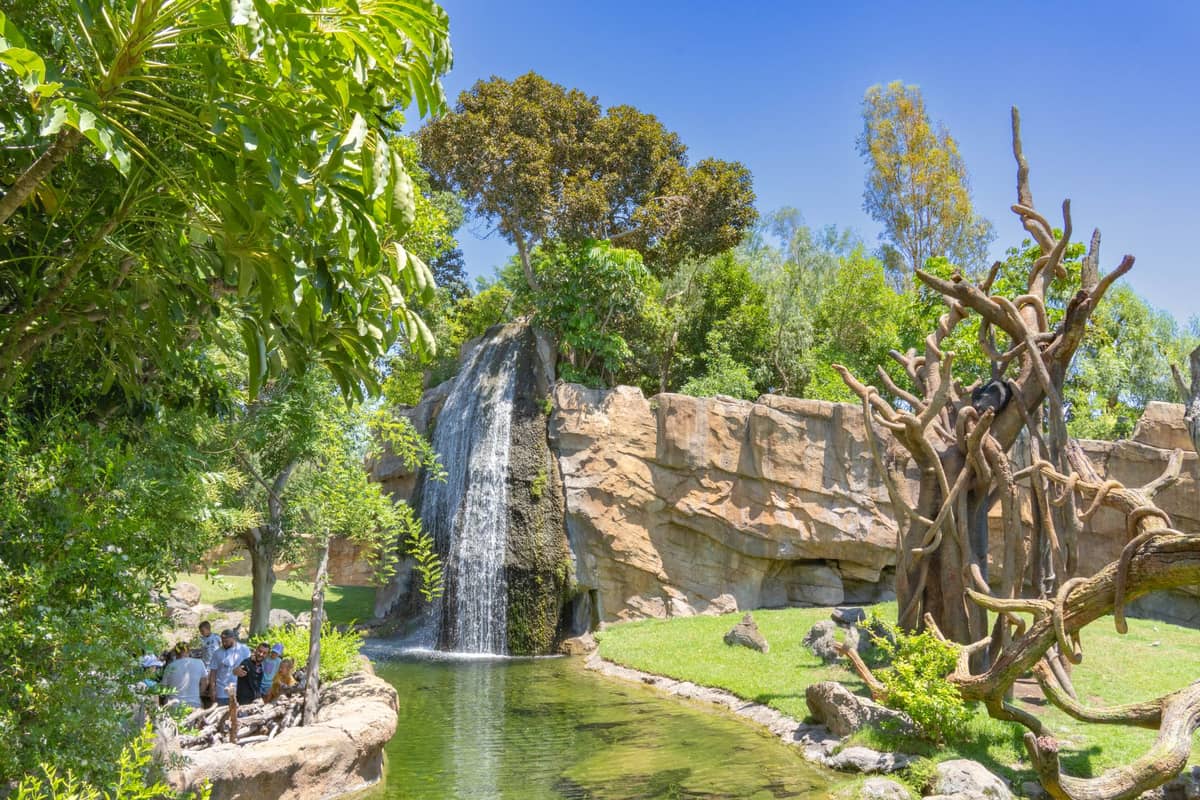
At the opposite end, Bioparc Valencia borders the Parque de Cabecera, a wilder, more naturalistic section of the park system that transitions into the zoo's African savanna-inspired landscape. This western portion of the Jardín del Turia feels less formal and less visited by tourists, giving it a more neighbourhood-level character.
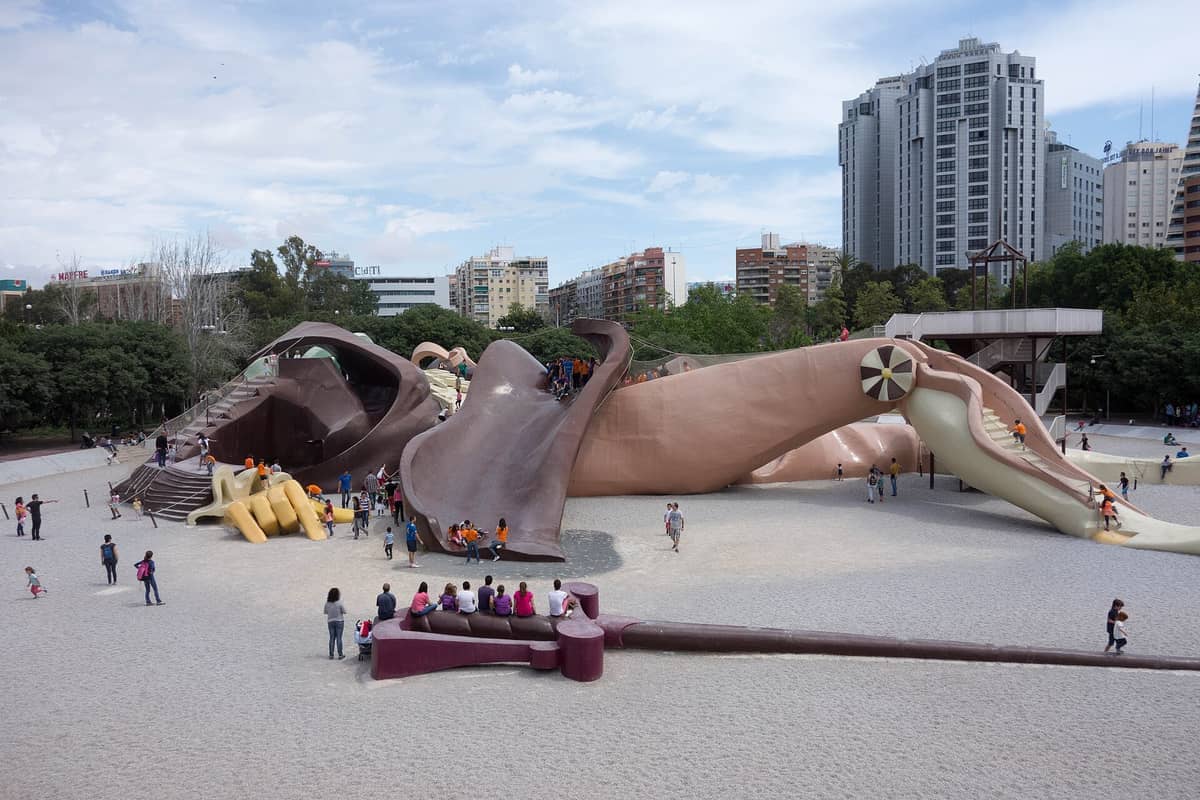
One of the most beloved individual spots is the Parc de Gulliver, found in the eastern section near the Palau de les Arts. A giant figure of Gulliver lies across the landscape with slides, ladders, and climbing structures built into his body. It is not a hidden feature: it draws families every afternoon and weekend morning. Also worth seeking out is the rose garden in the central sections of the park, which blooms spectacularly in spring. For cycling, the entire length has a dedicated cycle path, making it the backbone of Valencia's cycling network and a key section of the route described in the cycling guide to the Turia Garden.
Walking or cycling the full 9km length end to end: allow 2-3 hours by bike, half a day on foot
Parc de Gulliver: free, always busy on weekends, best visited on a weekday morning with children
The bridges: each section between bridges has its own personality, the Pont de les Flors being the most photographed
Palau de les Arts Reina Sofía: one of the world's most dramatic opera house exteriors, free to view from outside
Lumbracle: a large shaded botanical garden structure within the Arts complex, free to enter
Sports areas: football and rugby pitches, padel courts, and a skate park are distributed across the central sections
Parque de Cabecera: lake, bird-watching, and quieter green space adjoining the western end
ℹ️ Good to know
The Palau de les Arts Reina Sofía hosts opera, ballet, and classical concerts throughout the season. If you are visiting between October and June, check the programme in advance since tickets for major productions sell out well ahead of time.
Eating and Drinking Along the Park
The Jardín del Turia does not have a dense restaurant strip of its own, but the streets immediately flanking it are lined with cafés, bars, and restaurants at regular intervals. The character of the eating options changes significantly depending on which section of the park you are in.
Near the central sections, between the Pont del Real and the Pont de l'Exposició, the bordering streets include Calle San Pío V and the Passeig de la Ciutadella, where you will find neighbourhood bars serving coffee and toasted bread in the morning and cold drinks from midday onward. These are straightforward, local places oriented toward people using the park. Prices are reasonable and the clientele is mostly Valencian.
At the eastern end, the Ciudad de las Artes y las Ciencias complex has its own cafés and restaurant spaces, but these tend to run on tourist pricing and are best used for convenience rather than value. For a proper sit-down meal near this end of the park, the adjacent neighbourhood of Ruzafa is a short walk south and offers one of the best concentrations of independent restaurants and wine bars in the city, covering everything from traditional Valencian rice dishes to contemporary small-plates cooking.
Horchata, Valencia's signature cold drink made from tiger nuts (chufa), is sold at several points along the park and in surrounding streets, particularly near the historic centre sections. For context on the drink and where to find the best versions, see the horchata guide for Valencia. Ice cream and granitas are also widely available from kiosks inside the park itself during the warmer months.
Getting There and Around
Because the Jardín del Turia runs the full width of Valencia, access is possible from many points across the city. There is no single entrance: you descend from street level on one of the ramps or steps at bridge crossings distributed along its length. The most convenient access points for visitors coming from the historic centre are near the Torres de Serranos to the north, where the park runs directly below the medieval towers, or via the Pont del Real near the Museo de Bellas Artes.
Metro access is practical along the full length of the park. The Metrovalencia Line 5 (Blava/Blue) runs largely parallel to the southern edge of the park and has stops at Alameda and Aragón that put you within a few minutes' walk of the central and eastern sections. For the Ciudad de las Artes y las Ciencias end, the nearest metro stop is Maritim-Serreria on Line 5. For the Bioparc end, the nearest metro access involves Lines 1, 2, or 3 and a bus connection, since the western edge is slightly less served by underground stations.
The best way to experience the full length of the park is by bicycle. Valencia has an extensive public bike-share network, and the Jardín del Turia has a dedicated, well-maintained cycling path for its entire length that connects directly to cycling routes heading toward the beach and the port. The park forms the central axis of the cycling infrastructure described in the guide to getting around Valencia. Rental bikes are available at multiple points in the city, and the flat terrain makes the full route accessible to most fitness levels.
⚠️ What to skip
The shared cycling and pedestrian paths can get genuinely crowded on weekend mornings, particularly in the central sections near the historic centre. If you are cycling the full route for pleasure, a weekday morning or early evening will give you a much more comfortable experience. Cyclists and pedestrians occasionally clash at peak times, so keep speeds moderate on busy sections.
Where to Stay
There are no hotels located inside the Jardín del Turia itself, but several of Valencia's best-positioned accommodation options sit directly on the streets flanking the park. The northern edge of the old city, along Calle San Pío V and the Passeig de l'Albereda, has a small number of hotels and apartment rentals that offer either park views or a two-minute walk to park access. For a broader look at the city's accommodation options and which neighbourhood suits which type of traveller, the guide to where to stay in Valencia covers the trade-offs in detail.
Staying near the central park sections, roughly between the Pont de la Trinitat and the Pont de l'Exposició, is a strong choice for visitors who want a base that is simultaneously close to the historic centre, close to the Eixample's shops and restaurants, and close to the park itself. This area sees less overnight noise than the Barrio del Carmen and has good metro and bus connections. The eastern sections near the Ciudad de las Artes y las Ciencias are further from the old city but ideal for travellers who prioritise the science and arts complex or want quieter surroundings.
The neighbourhood of Ruzafa, located immediately south of the park's central sections, is a strong alternative base for travellers who want active nightlife alongside easy park access. It is one of the most sought-after areas in the city for short-term rentals. See the Ruzafa neighbourhood guide for a full picture of what staying there involves.
Honest Assessment: Who This Park Is For
The Jardín del Turia is genuinely hard to dislike, but it is worth being honest about its limitations as a destination. If you visit the eastern section specifically for the Ciudad de las Artes y las Ciencias and the park immediately around it, you will encounter architecture of extraordinary quality but also crowds, tourist-oriented cafés, and the slightly sterile quality of a planned cultural district. The further west you go, the more the park feels like something the city actually lives in, rather than something designed for visitors.
The park is also very flat and very linear. It does not offer the varied terrain, hidden corners, or intimate scale of a traditional park. Walking its full length is a commitment of several hours. In the height of summer, sections without tree cover become uncomfortable by late morning. And while the park is open 24 hours, some of the less-used western sections have minimal lighting and feel isolated at night.
For cyclists, runners, families with young children, and anyone who wants to understand how Valencia functions as a liveable city, the Turia is essential. For travellers on a short trip focused purely on historic monuments, it may stay in the background, though even then it will likely be the route you walk between the Torres de Serranos and the Museo de Bellas Artes. A focused introduction to the city's sights can be found in the walking tour of Valencia's old city, which uses sections of the Turia corridor as natural connectors.
TL;DR
The Jardín del Turia is an approximately 9km linear park running across the full width of Valencia in the former Turia riverbed, effectively open 24 hours and free to enter at any point.
The eastern end connects to the Ciudad de las Artes y las Ciencias (Hemisfèric, Oceanogràfic, Palau de les Arts); the western end to the Bioparc and Parque de Cabecera. Both are paid attractions requiring separate tickets.
Best experienced by bicycle, which allows the full length to be covered comfortably in under two hours using the dedicated cycle path.
The central and western sections have a genuinely local character, with sports facilities, playgrounds, and neighbourhood cafés. The eastern sections feel more tourist-oriented.
Ideal for: families, cyclists, runners, architecture enthusiasts, and anyone wanting to understand Valencia's daily outdoor life. Less essential for short-stay visitors focused solely on historic monuments, though it will naturally cross your path regardless.
Three days is enough time to cover Valencia's historic core, its futuristic waterfront district, and the natural lagoon on its doorstep. This day-by-day itinerary gives you a realistic, logistically sound plan built around walking, cycling, and public transit.
Spain's largest natural lake sits just 10-15 km south of Valencia, and it's one of the most rewarding half-day escapes in the country. This guide covers exactly how to get there independently, what to do once you arrive, where to eat authentic paella, and when to go for the best experience.
Valencia's Art Nouveau heritage, locally known as Modernismo Valenciano, produced some of Spain's most distinctive early-20th-century architecture. This guide covers the key buildings, the architects behind them, the best routes to follow, and what to know before you visit.
Valencia sits on the Mediterranean with over three kilometres of urban beach on its doorstep and wilder, pine-backed shores just minutes south. This guide covers every beach worth knowing, from the classic city strips to the natural shorelines of the Albufera.
Valencia delivers more than its reputation suggests for museum culture. From a world-class fine art collection rivalling Madrid's to an underground Roman city and a science museum inside a whale skeleton, this guide covers the best museums in Valencia across every interest and budget.
Valencia is the birthplace of paella, and eating it here is a serious affair. This guide covers where locals go, what authentic paella actually contains, how much to pay, and the mistakes that send tourists home disappointed.
Valencia enjoys a Mediterranean climate with over 300 sunny days a year, but the best time to visit depends entirely on what you want from the trip. This guide breaks down every season by weather, crowd levels, prices, and key events so you can plan with confidence.
Valencia rewards those who look up and climb. From medieval towers rising above terracotta rooftops to waterfront terraces overlooking the Mediterranean, these are the city's finest vantage points, ranked and described so you know exactly where to go and when.
The Jardí del Túria is Valencia's greatest urban cycling route: a free, 9km green corridor running through the city's former riverbed. This guide covers the full route from Parque de Cabecera to the City of Arts and Sciences, with practical advice on bike rentals, seasonal timing, and the best stops along the way.
Valencia sits at the centre of one of Spain's most varied regions. Within two hours, you can reach a medieval hill town with a castle above the rooftops, thermal pools in an inland gorge, a dramatic coastal castle, and a lagoon that inspired the original paella. This guide covers the best day trips from Valencia with honest travel times, transport breakdowns, and seasonal advice.
Valencia rewards budget travellers more than almost any other Spanish city. World-class museums with free entry, a 9-kilometre riverside park, Gothic towers, contemporary art, and urban beaches are all yours without buying a single ticket.
Valencia is one of Spain's most navigable cities, with an integrated metro, bus, tram and bike network covering everything from the airport to the beaches. This guide breaks down every transport option, current fares, ticket types, and the honest trade-offs between them.
Valencia's horchata de chufa is one of the most misunderstood drinks in Spain. This guide explains what it really is, where to find the best versions, how to tell authentic from commercial, and why making the trip to Alboraya is worth your time.
Valencia is Spain's third-largest city, the birthplace of paella, and home to UNESCO-listed heritage, futuristic architecture, and 300+ days of sunshine a year. This guide cuts through the hype to tell you exactly what Valencia offers, what it costs, and whether it belongs on your itinerary.
Las Fallas is Valencia's most spectacular annual event, a UNESCO-recognised festival of fire, sculpture, and pyrotechnics that transforms the entire city each March. This guide covers the full schedule, key events, neighbourhood highlights, and practical advice to help you experience it properly.
Valencia delivers more than its reputation suggests in the luxury travel market. From intimate boutique hotels inside medieval palaces to world-class fine dining and the architectural spectacle of the Ciudad de las Artes y las Ciencias, this guide covers everything you need to plan a genuinely high-end visit to Spain's third-largest city.
Seven days is the ideal amount of time to see Valencia properly. This itinerary covers the medieval Old Town, Calatrava's futuristic City of Arts and Sciences, Albufera Natural Park, the best beaches, and Ruzafa's food scene — with practical logistics, honest timing, and no filler.
Valencia rewards couples with a rare mix of Mediterranean light, historic streets, and outdoor spectacle. This guide covers the best romantic experiences in the city, from golden-hour boat trips on Albufera to twilight strolls through Turia Gardens, with honest advice on timing, costs, and what to skip.
Valencia is Spain's third-largest city and one of its most rewarding to explore. This guide covers the best things to do in Valencia — from UNESCO-listed medieval architecture and futuristic science complexes to rice-field wetlands and urban beaches — with practical details on prices, timing, and how to avoid the crowds.
Valencia holds one of Europe's most complete architectural timelines, from Roman foundations and Valencian Gothic civic buildings to Modernista markets and Santiago Calatrava's white concrete landmark complex. This guide breaks down each era, where to find it, and how to see it without wasting a day.
Valencia's churches span eight centuries of architecture, from Romanesque foundations to extravagant Baroque ceilings. This guide covers the essential churches in the historic centre and beyond, with practical details on what to see, what to pay, and when to go.
Summer in Valencia, Spain runs hot and busy from June through August. This guide covers everything from actual temperatures and beach conditions to crowd patterns, seasonal pricing, and how to make the most of the city without melting in the midday sun.
Valencia runs later than almost any city in Europe. This guide covers every major nightlife district, the best bars and clubs by area, realistic timing advice, and honest warnings about what not to waste your night on.
Valencia is one of Spain's most affordable big cities, and with the right approach you can see almost everything that matters for well under €80 a day. This guide covers accommodation, food, transport, free attractions, and the common spending traps to avoid.
Valencia ranks among Spain's safer major cities, Valencia ranks among Spain's safer major cities, with low violent crime. But pickpockets target specific areas, festivals bring elevated risk, and autumn flooding is a genuine concern. This guide gives you the honest picture.
Valencia rewards shoppers at every level — centuries-old food markets, independent boutiques in converted Art Nouveau buildings, dedicated high-street corridors, and modern malls. This guide covers every format, with honest assessments of what's worth your time and what to skip.
Valencia, Spain delivers an exceptional range of family activities beyond the beach: a world-class aquarium, an immersive zoo, a 9-km park built in a riverbed, and free playgrounds that keep kids occupied for hours. This guide covers the best options by age, budget, and season — with honest assessments of what works and what to skip.
Valencia's Ciutat Vella packs over 2,100 years of history into just 1.5 square kilometres. This guide gives you a practical, well-sequenced route through the old city's best monuments, markets, and medieval streets, with practical notes on what to skip, what to pay for, and how long everything actually takes.
Valencia is the birthplace of paella, but its food culture runs far deeper than a single dish. This guide covers everything from traditional rice dishes and seafood stews to mid-morning snacks and the city's iconic tigernut drink — with real prices, meal timing, and honest advice on what to skip.
Choosing where to stay in Valencia depends on more than price. This guide breaks down every major neighbourhood by atmosphere, location, transport links, and honest drawbacks, so you can pick the right base for your trip.