Ciudad de las Artes y las Ciencias is Valencia's defining modern landmark: a 350,000-square-metre complex of sculptural white buildings spread along the former Turia riverbed in the southeast of the city. Designed largely by Santiago Calatrava, it houses Europe's largest oceanographic aquarium, a science museum, an IMAX cinema, and a world-class opera house. The surrounding neighbourhood, officially part of the Quatre Carreres district, is quieter and more residential than the complex itself suggests.
Ciudad de las Artes y las Ciencias is where Valencia makes its most dramatic modern architectural statement. Stretched across the dry bed of the diverted Turia River, the complex of gleaming white structures by Santiago Calatrava is unlike anything else in Spain. It functions as a self-contained cultural world, but it also anchors a quieter residential neighbourhood that most visitors pass through without stopping.
Orientation
The complex sits in the southeastern quarter of Valencia, in the Quatre Carreres district. It occupies the widened final stretch of the Jardí del Túria, the linear park developed from the late 1970s into the 1980s on the former Turia riverbed after the river was diverted south of the city following the catastrophic 1957 floods. Walking southeast from the old city, you follow the park for roughly three kilometres before the scale of the buildings begins to assert itself.
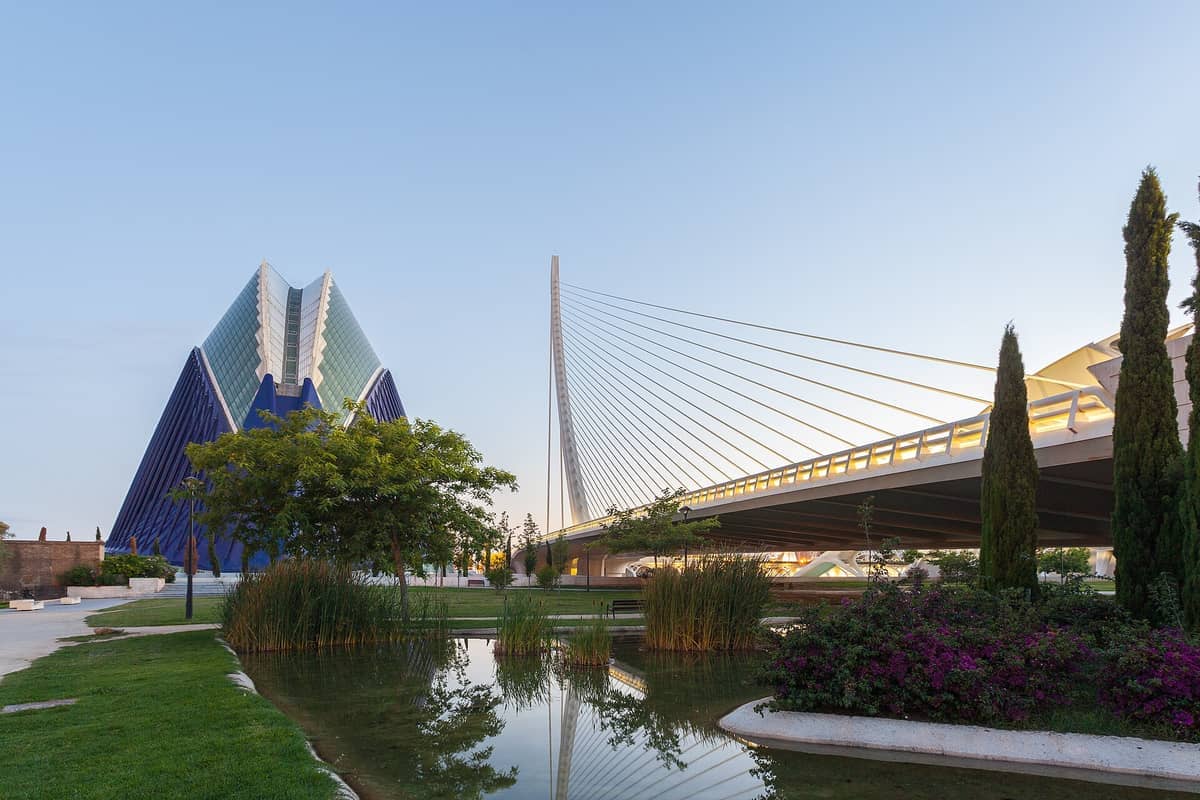
The neighbourhood officially known as Ciudad de las Artes y las Ciencias is bounded by Penya-Roja to the north, Na Rovella to the west, Fuente San Luis to the south, and La Punta to the east. The complex itself runs along Avenida Profesor López Piñero and Carrer d'Eduardo Primo Yúfera, with the golden-topped Pont de l'Assut de l'Or bridge marking the eastern end. The western anchor of the site is within cycling distance of Ruzafa, Valencia's most food-focused neighbourhood, and about 25 minutes on foot from the edge of the historic centre.
The Jardí del Túria acts as the spine connecting this area to the rest of the city. Cyclists and joggers use it daily, and it is one of the most pleasant ways to arrive at the complex without touching a road. Coming from the north, you pass the Gulliver playground and the rose garden before the Calatrava buildings reveal themselves in full.
💡 Local tip
The most rewarding approach to the complex is on foot or by bike along the Jardí del Túria from the city centre. The buildings reveal themselves gradually, giving you a better sense of the scale and setting than arriving by bus from the main road.
Character and Atmosphere
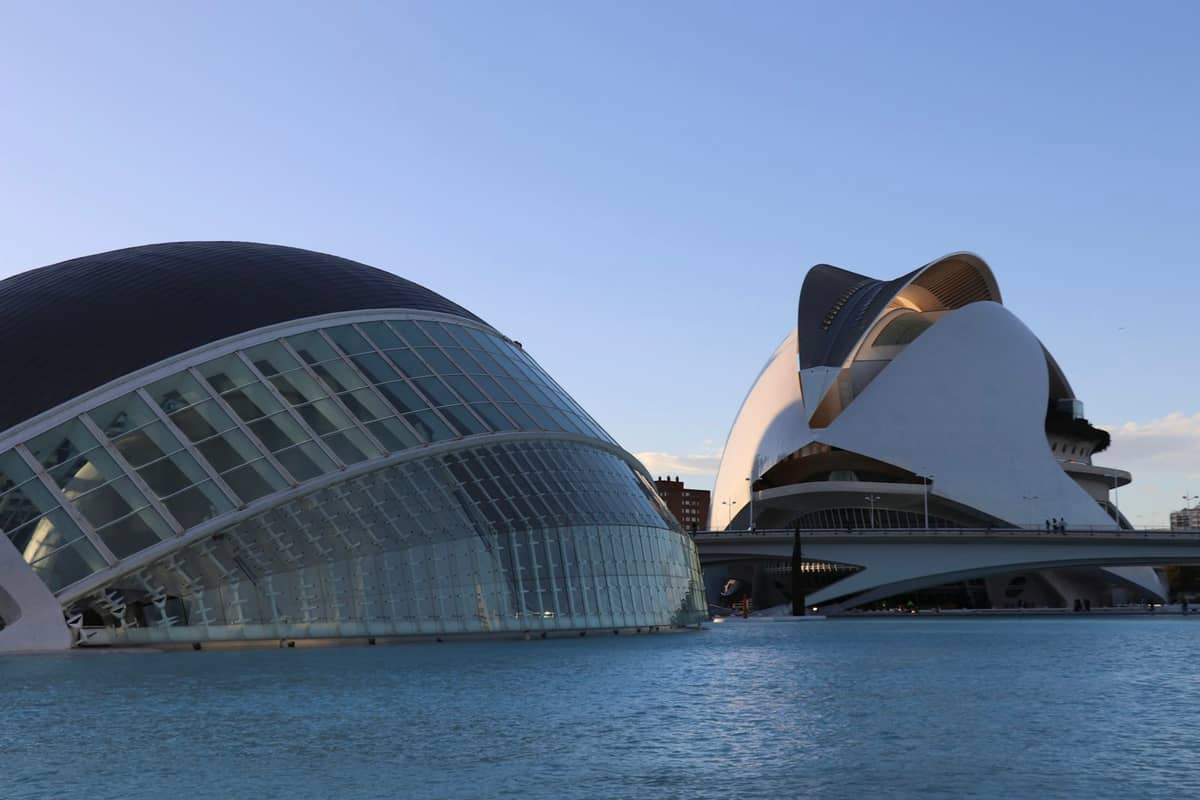
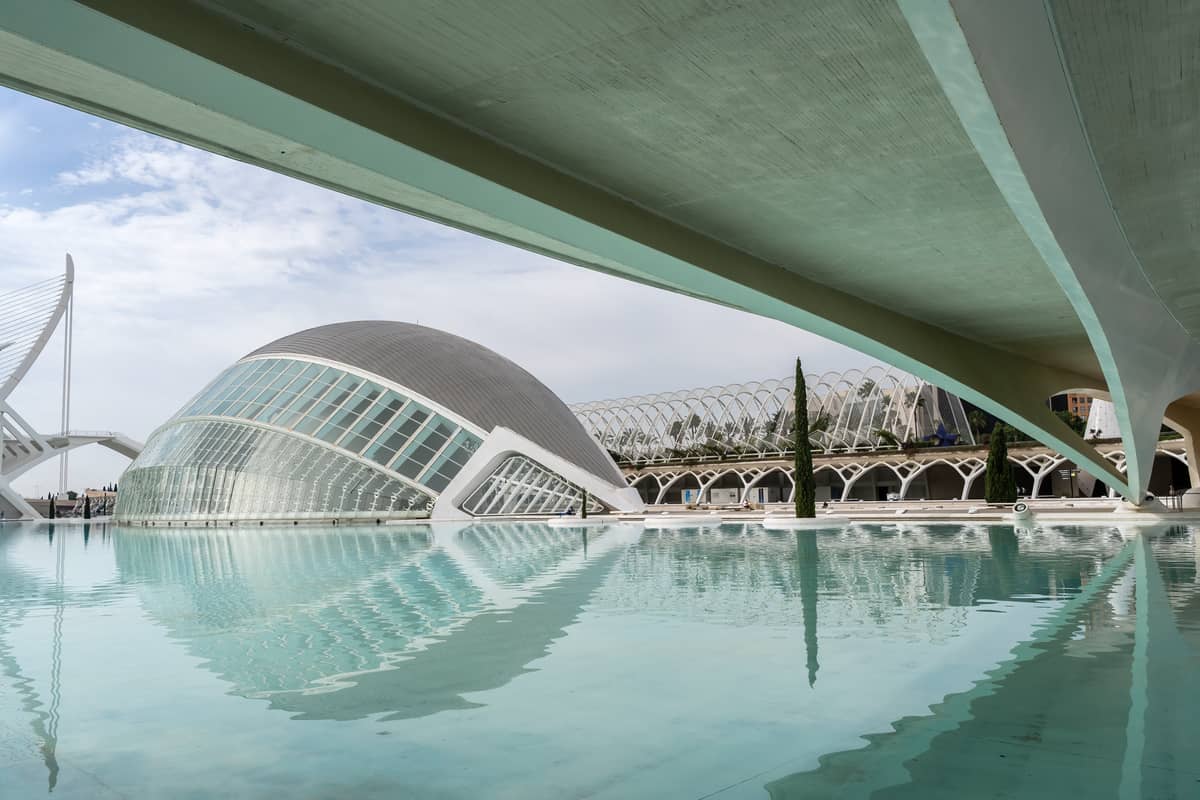
The complex and the neighbourhood around it occupy entirely different emotional registers. Inside the complex, the atmosphere is controlled and purpose-built: wide reflecting pools, pristine white concrete, and the steady flow of school groups, families, and tourists moving between ticketed attractions. On sunny mornings the water reflects the curved ribbed shell of the Hemisfèric with almost surreal clarity. By midday in summer, the open esplanade can be punishing, with limited shade between buildings.
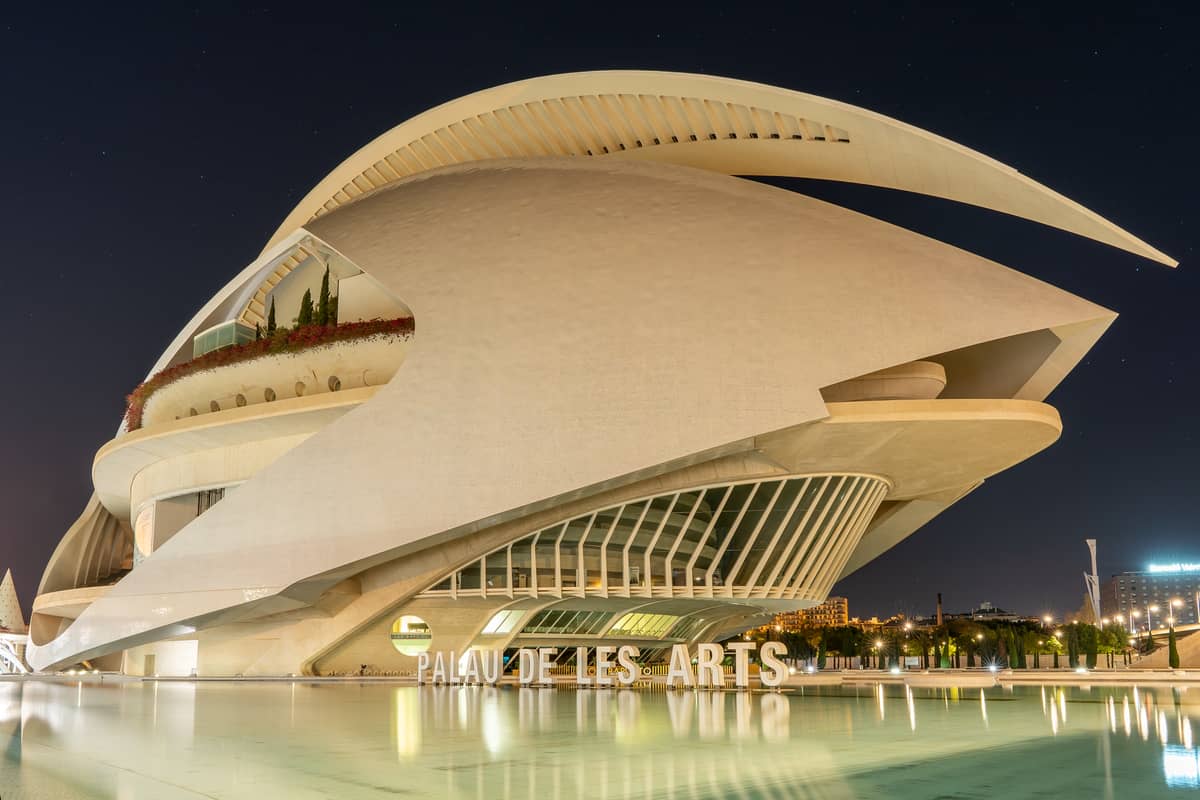
After dark the complex transforms. The buildings are dramatically lit, the crowds thin considerably, and the reflection pools take on a cinematic quality. The Palau de les Arts Reina Sofía glows orange-gold, and the walkways between buildings are quiet enough to hear your own footsteps. If you are in Valencia for more than two nights, it is worth coming here once during the day for the attractions and once in the evening simply to walk through.
The residential streets surrounding the complex tell a different story. This is a working-class Valencian neighbourhood with corner bars, neighbourhood bakeries, and locals who largely get on with daily life regardless of the tourists a few blocks away. There are few boutique hotels and almost no souvenir shops outside the complex itself. The transition from the architecture to the surrounding grid of apartment blocks is abrupt, and intentionally so: the complex was designed as an urban intervention, not a neighbourhood that grew organically.
What to See and Do
The complex contains five main structures, each with a distinct purpose. The Hemisfèric is an IMAX cinema and planetarium shaped like a giant eye, completed in 1998 and the first of the complex's buildings to open. Its design, a curved shell reflected in a surrounding pool, remains the most photographed image of the complex.
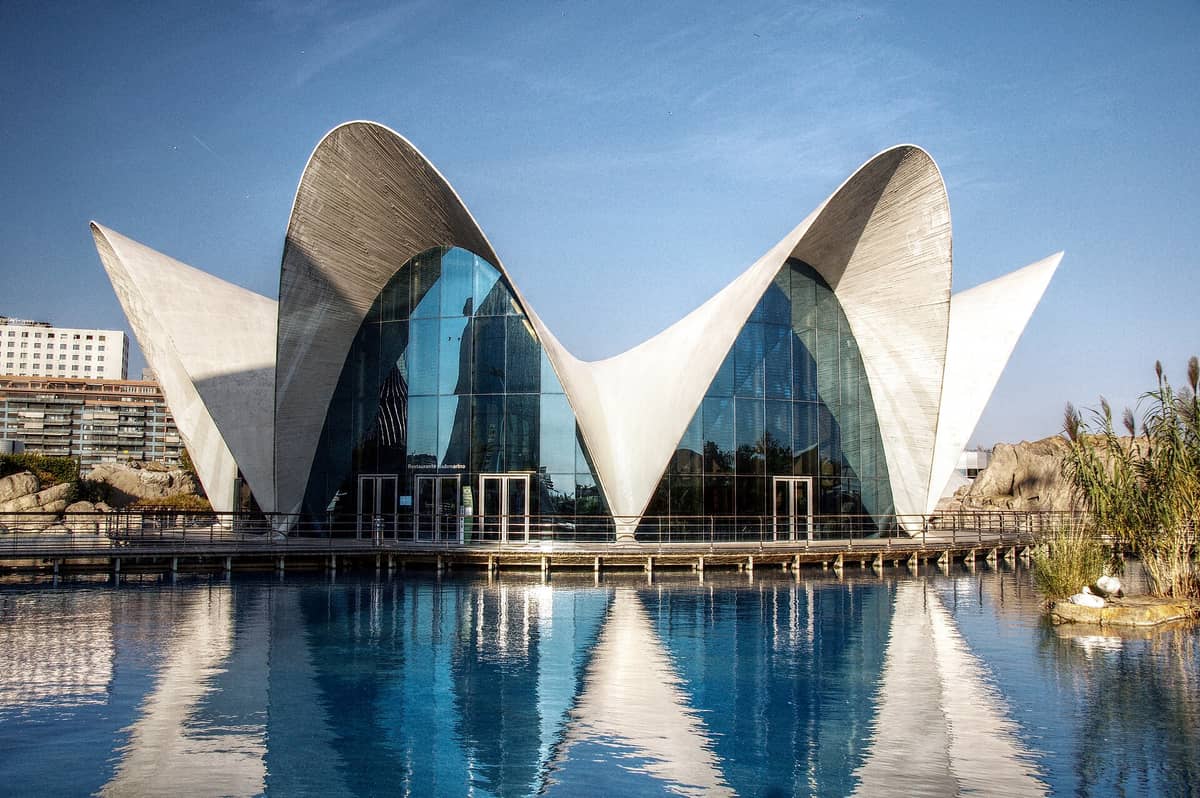
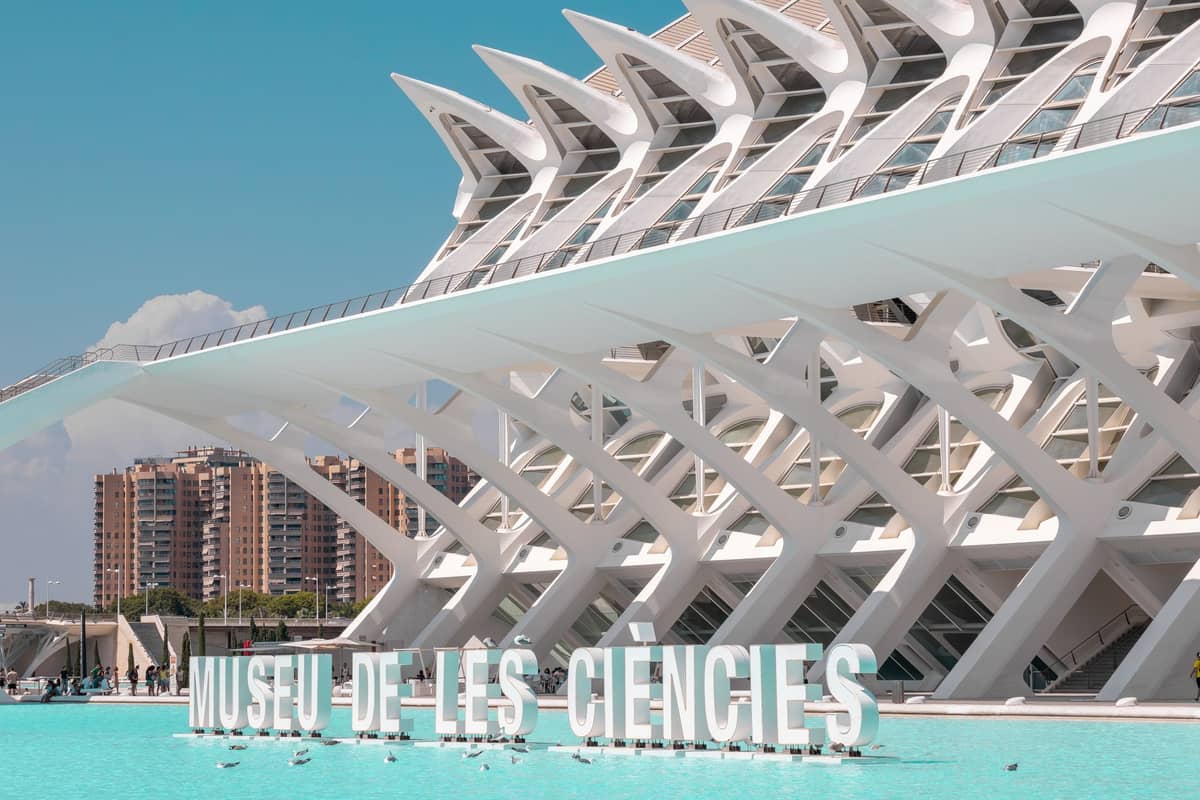
The Museu de les Ciències Príncep Felip is a hands-on science museum housed in a structure that resembles the skeleton of a whale. It is genuinely well-suited to visitors with children, with interactive exhibits across multiple floors covering physics, biology, and technology. Budget at least two hours here. The L'Oceanogràfic is Europe's largest aquarium, with indoor and outdoor sections covering Mediterranean, Arctic, and tropical marine environments. Sharks, beluga whales, and a dramatic underwater tunnel are among the highlights. It is the most expensive single attraction in the complex and also the most time-consuming: allow at least three hours.
The Palau de les Arts Reina Sofía is a fully operational opera house, one of the most technically sophisticated in Europe, and a landmark in its own right. If your visit coincides with a production, attending a performance here is one of the more memorable things you can do in Valencia. Check programming in advance and book tickets early, particularly for spring and autumn seasons.
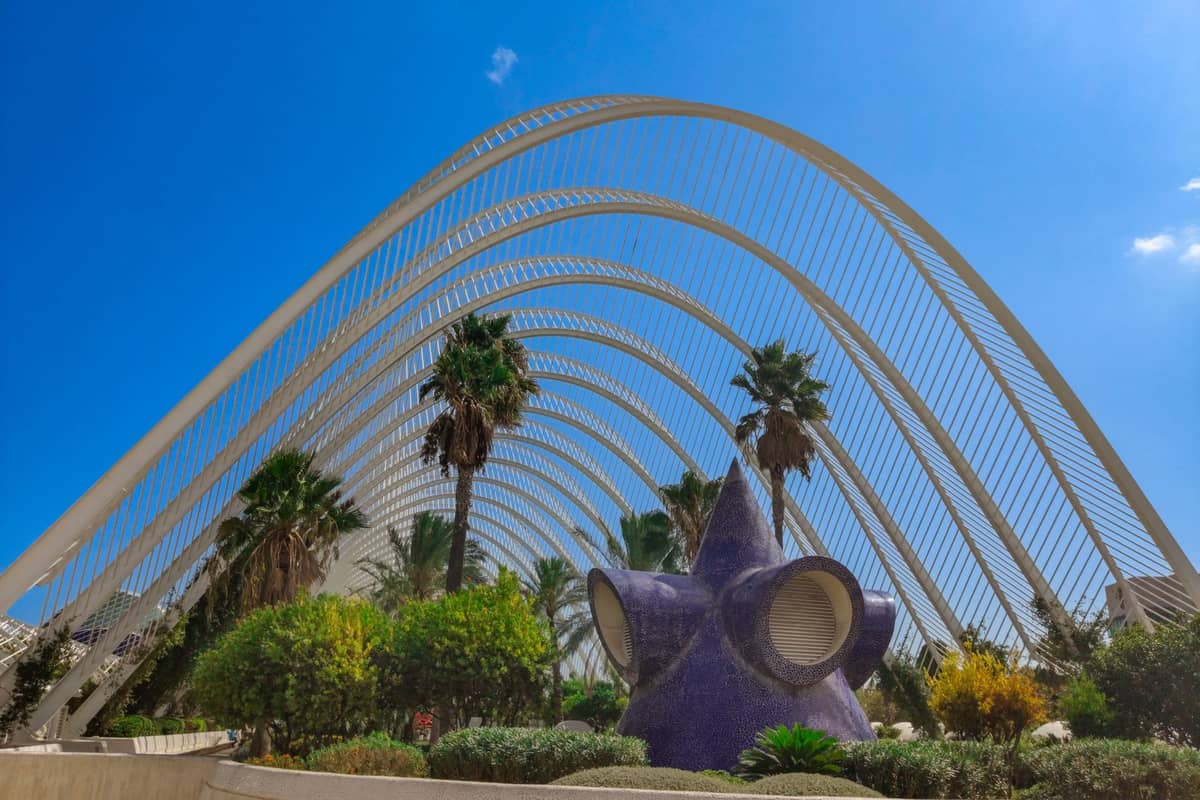
The Àgora is a multipurpose covered space used for exhibitions, tennis tournaments, and events. The Umbracle is a long pergola structure housing a sculpture walk and a rooftop terrace bar that operates on weekend evenings. It is one of the few spaces in the complex you can enter for free and is notably cooler than the open esplanade, thanks to its planted canopy.
Hemisfèric: IMAX cinema and planetarium, ticketed
Museu de les Ciències Príncep Felip: hands-on science museum, best for families and curious adults
L'Oceanogràfic: Europe's largest oceanographic aquarium, full half-day minimum
Palau de les Arts Reina Sofía: opera, ballet, and classical concerts
Umbracle: free-access sculpture walk and rooftop bar on weekends
Pont de l'Assut de l'Or: Calatrava's cable-stayed bridge, excellent for photographs
ℹ️ Good to know
Combination tickets covering multiple attractions at Ciudad de las Artes y las Ciencias are available and significantly cheaper than paying for each separately. If you plan to visit two or more attractions, check the official website for current combo options before you arrive.
Eating and Drinking
Eating options within the complex itself are limited and overpriced relative to what you will find two blocks away. The cafeterias inside the museums are convenient but unremarkable. The Umbracle terrace bar is a reasonable choice for a drink in the evening, with views across the complex and a DJ atmosphere on weekends, but it is not a place for a meal.
For proper food, the practical advice is to head west toward Ruzafa, which is a 15-20 minute walk or a short bus ride. Ruzafa has some of the best restaurants, cafés, and market food in the city, including the Mercado de Ruzafa. If you want to eat near the complex without a long walk, the residential streets around Carrer de la Sequia de Montcada have neighbourhood bars and modest restaurants serving menú del día lunches aimed at locals rather than tourists.
Valencia's signature dishes are worth seeking out during your visit. Paella originated in the fields around the Albufera lake, just south of the city, and the best versions are made with local rice. For context on where to eat it well and what to look for, the best paella in Valencia guide covers the city's most reliable options. Horchata, the cold drink made from tiger nuts, is another Valencia speciality worth trying: look for granular, freshly made versions rather than bottled.
⚠️ What to skip
Avoid eating lunch inside the complex on busy days in July and August. The cafeterias can have long queues, limited seating, and prices that are noticeably higher than equivalent food a short walk away. Pack a snack or plan to eat before or after your visit.
Getting There and Around
The most enjoyable way to reach the complex from the city centre is by bicycle along the Jardí del Túria. Valencia has a well-developed public bike share system (Valenbisi) with docking stations near the complex, and the route from the historic centre is almost entirely car-free and flat. The ride takes around 20-25 minutes from Plaza del Ayuntamiento.
By bus, EMT lines 13, 14, 15, 19, 35, 40, and 95 serve stops near the complex, connecting it to the city centre, the train stations, and the beach neighbourhoods. Line 35 connects directly to the Joaquín Sorolla high-speed rail station. The bus network operates from around 06:00 to 22:00 on most lines, with night bus services continuing after that on selected routes.
There is no metro station within the complex itself, though the Metrovalencia network (lines 3 and 5) serves the wider south of the city. For general guidance on moving around Valencia, the getting around Valencia guide covers metro, bus, and cycling options in detail. Taxis and ride-hailing services can drop off along Avenida Profesor López Piñero, but note that the internal pedestrian areas are not accessible by car.
Within the complex, all the main attractions are accessible on foot across the pedestrian esplanade. Walking from the Hemisfèric at the western end to L'Oceanogràfic at the eastern end takes about 15 minutes at a relaxed pace. In summer, this walk across white concrete with no shade cover can be draining: carry water and plan your route between buildings accordingly.
Where to Stay
The neighbourhood immediately surrounding the complex is not a primary accommodation hub. There are a small number of hotels along the approach roads, but for a wider choice, most travellers stay in the city centre, Ruzafa, or the beach neighbourhoods. For a full overview of accommodation options across the city, the where to stay in Valencia guide breaks down each area by character and price range.
Staying near the complex makes sense primarily if you have young children and plan to spend multiple days at the attractions, or if you are attending events at the Palau de les Arts on consecutive nights. The area is quieter than the city centre, which suits some travellers, but it offers less in terms of restaurants, nightlife, and day-to-day neighbourhood life. For most visitors, the complex is an easy day trip or evening excursion from wherever you are staying elsewhere in the city.
For travellers who want proximity to both the complex and a lively surrounding neighbourhood, staying in Ruzafa puts you within a 20-minute walk of the complex's western entrance while keeping you in one of the city's most interesting residential areas. The 3 days in Valencia itinerary offers a practical framework for balancing the complex with the rest of the city.
Know Before You Go
The complex covers roughly 350,000 square metres, and trying to see everything in a single day is exhausting and ultimately unrewarding. Most visitors do better choosing two attractions and giving them proper time, rather than rushing through four. L'Oceanogràfic and the Museu de les Ciències together make a full day. The Palau de les Arts is best experienced through an actual performance rather than just viewed from the outside.
Summer visits require preparation: temperatures on the exposed esplanade regularly exceed 35°C, and the reflecting pools amplify the heat. Spring and autumn are the most comfortable seasons for spending extended time outdoors here. For context on timing your visit, the best time to visit Valencia guide covers seasonal conditions across the city. The complex is generally less crowded on weekday mornings in September and October than at any other point in the year.
The neighbourhood itself raises no specific safety concerns. Like any part of a major Spanish city, standard precautions apply: watch your belongings in crowded areas and be alert around tourist-heavy spaces. The streets surrounding the complex are residential and quiet in the evenings, which some visitors find reassuring and others find inconvenient if they want to walk to a restaurant after dark.
TL;DR
A world-class architectural and cultural complex on the former Turia riverbed: the most visually dramatic part of modern Valencia.
Best for: families with children, architecture and design enthusiasts, opera and classical music fans, anyone wanting to understand Valencia's 21st-century ambitions.
L'Oceanogràfic (Europe's largest aquarium), the Museu de les Ciències, and the Palau de les Arts Reina Sofía are the headline attractions; each deserves at least half a day.
Reach it by bike along the Jardí del Túria for the best approach, or by EMT bus from the city centre; no metro station serves the complex directly.
Not ideal as a base: stay in Ruzafa or the city centre and visit the complex as a focused excursion rather than a neighbourhood to live in.
Top Attractions in Ciudad de las Artes y las Ciencias
Three days is enough time to cover Valencia's historic core, its futuristic waterfront district, and the natural lagoon on its doorstep. This day-by-day itinerary gives you a realistic, logistically sound plan built around walking, cycling, and public transit.
Spain's largest natural lake sits just 10-15 km south of Valencia, and it's one of the most rewarding half-day escapes in the country. This guide covers exactly how to get there independently, what to do once you arrive, where to eat authentic paella, and when to go for the best experience.
Valencia's Art Nouveau heritage, locally known as Modernismo Valenciano, produced some of Spain's most distinctive early-20th-century architecture. This guide covers the key buildings, the architects behind them, the best routes to follow, and what to know before you visit.
Valencia sits on the Mediterranean with over three kilometres of urban beach on its doorstep and wilder, pine-backed shores just minutes south. This guide covers every beach worth knowing, from the classic city strips to the natural shorelines of the Albufera.
Valencia delivers more than its reputation suggests for museum culture. From a world-class fine art collection rivalling Madrid's to an underground Roman city and a science museum inside a whale skeleton, this guide covers the best museums in Valencia across every interest and budget.
Valencia is the birthplace of paella, and eating it here is a serious affair. This guide covers where locals go, what authentic paella actually contains, how much to pay, and the mistakes that send tourists home disappointed.
Valencia enjoys a Mediterranean climate with over 300 sunny days a year, but the best time to visit depends entirely on what you want from the trip. This guide breaks down every season by weather, crowd levels, prices, and key events so you can plan with confidence.
Valencia rewards those who look up and climb. From medieval towers rising above terracotta rooftops to waterfront terraces overlooking the Mediterranean, these are the city's finest vantage points, ranked and described so you know exactly where to go and when.
The Jardí del Túria is Valencia's greatest urban cycling route: a free, 9km green corridor running through the city's former riverbed. This guide covers the full route from Parque de Cabecera to the City of Arts and Sciences, with practical advice on bike rentals, seasonal timing, and the best stops along the way.
Valencia sits at the centre of one of Spain's most varied regions. Within two hours, you can reach a medieval hill town with a castle above the rooftops, thermal pools in an inland gorge, a dramatic coastal castle, and a lagoon that inspired the original paella. This guide covers the best day trips from Valencia with honest travel times, transport breakdowns, and seasonal advice.
Valencia rewards budget travellers more than almost any other Spanish city. World-class museums with free entry, a 9-kilometre riverside park, Gothic towers, contemporary art, and urban beaches are all yours without buying a single ticket.
Valencia is one of Spain's most navigable cities, with an integrated metro, bus, tram and bike network covering everything from the airport to the beaches. This guide breaks down every transport option, current fares, ticket types, and the honest trade-offs between them.
Valencia's horchata de chufa is one of the most misunderstood drinks in Spain. This guide explains what it really is, where to find the best versions, how to tell authentic from commercial, and why making the trip to Alboraya is worth your time.
Valencia is Spain's third-largest city, the birthplace of paella, and home to UNESCO-listed heritage, futuristic architecture, and 300+ days of sunshine a year. This guide cuts through the hype to tell you exactly what Valencia offers, what it costs, and whether it belongs on your itinerary.
Las Fallas is Valencia's most spectacular annual event, a UNESCO-recognised festival of fire, sculpture, and pyrotechnics that transforms the entire city each March. This guide covers the full schedule, key events, neighbourhood highlights, and practical advice to help you experience it properly.
Valencia delivers more than its reputation suggests in the luxury travel market. From intimate boutique hotels inside medieval palaces to world-class fine dining and the architectural spectacle of the Ciudad de las Artes y las Ciencias, this guide covers everything you need to plan a genuinely high-end visit to Spain's third-largest city.
Seven days is the ideal amount of time to see Valencia properly. This itinerary covers the medieval Old Town, Calatrava's futuristic City of Arts and Sciences, Albufera Natural Park, the best beaches, and Ruzafa's food scene — with practical logistics, honest timing, and no filler.
Valencia rewards couples with a rare mix of Mediterranean light, historic streets, and outdoor spectacle. This guide covers the best romantic experiences in the city, from golden-hour boat trips on Albufera to twilight strolls through Turia Gardens, with honest advice on timing, costs, and what to skip.
Valencia is Spain's third-largest city and one of its most rewarding to explore. This guide covers the best things to do in Valencia — from UNESCO-listed medieval architecture and futuristic science complexes to rice-field wetlands and urban beaches — with practical details on prices, timing, and how to avoid the crowds.
Valencia holds one of Europe's most complete architectural timelines, from Roman foundations and Valencian Gothic civic buildings to Modernista markets and Santiago Calatrava's white concrete landmark complex. This guide breaks down each era, where to find it, and how to see it without wasting a day.
Valencia's churches span eight centuries of architecture, from Romanesque foundations to extravagant Baroque ceilings. This guide covers the essential churches in the historic centre and beyond, with practical details on what to see, what to pay, and when to go.
Summer in Valencia, Spain runs hot and busy from June through August. This guide covers everything from actual temperatures and beach conditions to crowd patterns, seasonal pricing, and how to make the most of the city without melting in the midday sun.
Valencia runs later than almost any city in Europe. This guide covers every major nightlife district, the best bars and clubs by area, realistic timing advice, and honest warnings about what not to waste your night on.
Valencia is one of Spain's most affordable big cities, and with the right approach you can see almost everything that matters for well under €80 a day. This guide covers accommodation, food, transport, free attractions, and the common spending traps to avoid.
Valencia ranks among Spain's safer major cities, Valencia ranks among Spain's safer major cities, with low violent crime. But pickpockets target specific areas, festivals bring elevated risk, and autumn flooding is a genuine concern. This guide gives you the honest picture.
Valencia rewards shoppers at every level — centuries-old food markets, independent boutiques in converted Art Nouveau buildings, dedicated high-street corridors, and modern malls. This guide covers every format, with honest assessments of what's worth your time and what to skip.
Valencia, Spain delivers an exceptional range of family activities beyond the beach: a world-class aquarium, an immersive zoo, a 9-km park built in a riverbed, and free playgrounds that keep kids occupied for hours. This guide covers the best options by age, budget, and season — with honest assessments of what works and what to skip.
Valencia's Ciutat Vella packs over 2,100 years of history into just 1.5 square kilometres. This guide gives you a practical, well-sequenced route through the old city's best monuments, markets, and medieval streets, with practical notes on what to skip, what to pay for, and how long everything actually takes.
Valencia is the birthplace of paella, but its food culture runs far deeper than a single dish. This guide covers everything from traditional rice dishes and seafood stews to mid-morning snacks and the city's iconic tigernut drink — with real prices, meal timing, and honest advice on what to skip.
Choosing where to stay in Valencia depends on more than price. This guide breaks down every major neighbourhood by atmosphere, location, transport links, and honest drawbacks, so you can pick the right base for your trip.