Hemisfèric Valencia: Inside the Giant Eye of the City of Arts and Sciences
The Hemisfèric is the signature building of Santiago Calatrava's City of Arts and Sciences complex, housing one of Europe's most impressive IMAX cinemas and a full digital planetarium. With a concave screen of roughly 900 m² and seating for 306, it delivers a genuinely overwhelming visual experience. This guide covers what to expect inside, the best time to visit, and how to fit it into a day at the complex.
Quick Facts
- Location
- Av. del Professor López Piñero, 3, 46013 València (City of Arts and Sciences complex)
- Getting There
- City bus lines serving the Ciudad de las Artes y las Ciencias, or cycle/walk along the Turia Gardens from the historic centre
- Time Needed
- 1.5 to 2.5 hours including screening (add more time if combining with other CAC buildings)
- Cost
- From approximately about €9 per person; combination tickets with other CAC venues available (verify current prices at cac.es or via the official ticketing portal).
- Best for
- Families, architecture enthusiasts, science and space fans, first-time visitors to Valencia
- Official website
- www.cac.es
What Is the Hemisfèric?
L'Hemisfèric is the IMAX cinema, planetarium, and laser show venue at the heart of Valencia's Ciudad de las Artes y las Ciencias. Inaugurated on 16 April 1998, it was the first building of the City of Arts and Sciences complex to open to the public, arriving several years before Santiago Calatrava's other structures on the site were complete. In a complex full of architectural spectacles, the Hemisfèric still draws the eye first.
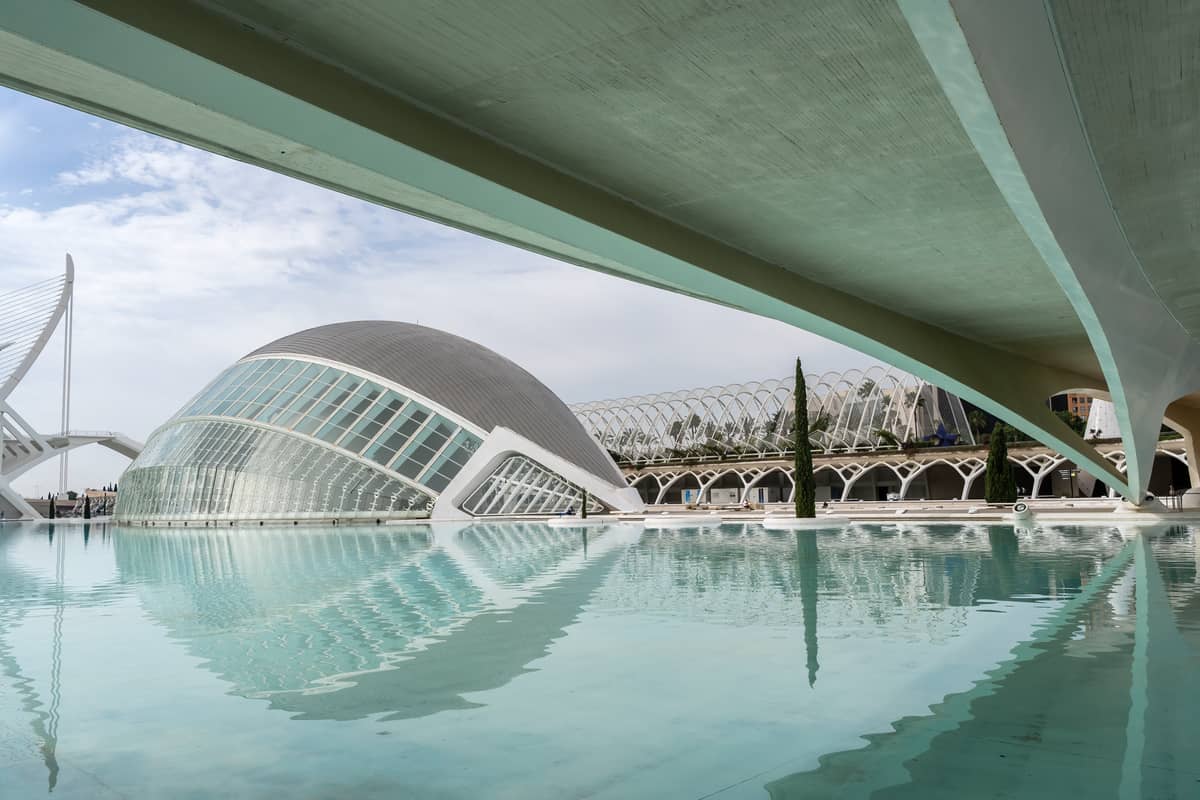
From the outside, the building takes the form of a vast eye: a hemispherical white shell that opens like an eyelid to reveal the curved projection hall beneath, all of it reflected in the surrounding shallow pool. The proportions are genuinely arresting. At roughly 100 metres long and 55 metres wide, it is larger than it looks in photographs. Standing at pool level in the early morning, when the water is still and the white concrete glows against the sky, the reflection doubles the structure into something that reads more like a natural formation than a building.
Inside, the 306-seat projection hall curves upward into a concave screen of approximately 900 m². The IMAX format means the image is not just in front of you but above and to the sides, pressing into peripheral vision. The planetarium function adds dome projections of the night sky, and programming rotates between nature documentaries, space exploration films, and specially produced dome experiences. The screening schedule changes seasonally, so checking the official website before visiting is not optional — it is essential.
💡 Local tip
Check the live screening schedule at cac.es before you go. The Hemisfèric typically runs several different films in rotation on any given day, and specific screenings sell out, particularly on weekends and during school holiday periods. Booking online in advance avoids the queue and the disappointment of a sold-out show.
The Architecture: Calatrava's Eye
Santiago Calatrava is a Valencian architect and engineer, and the City of Arts and Sciences is, in many respects, his most concentrated statement. The Hemisfèric is the oldest piece of that statement. Its design is rooted in biomorphic architecture, a movement that treats buildings as analogues of living organisms rather than neutral containers for function. The eye metaphor is not incidental: the outer shell opens and closes mechanically, and the entire exterior geometry references the human iris and eyelid with deliberate precision.
The surrounding water pool is structural as well as aesthetic. It lowers the perceived mass of the building, reinforces the symmetry, and acts as a thermal buffer. In summer, when Valencia temperatures climb well above 30°C, the water around the complex creates a noticeably cooler microclimate at ground level. For visitors exploring the full complex, this matters practically: the walk between the Hemisfèric and the Museu de les Ciències Príncipe Felipe or the L'Oceanogràfic involves extended time in the open air, and the shade and moisture around the pools offer real relief.
The Hemisfèric is covered in more depth alongside the broader context of Calatrava's urban intervention in our Valencia architecture guide. For those interested in how it compares to Valencia's older structures, the contrast with the Gothic and Baroque heritage of the historic centre is striking.
Tickets & tours
Hand-picked options from our booking partner. Prices are indicative; availability and final rates are confirmed when you complete your booking.
Valencia Silk Museum tickets and audio guide
From 7 €Instant confirmationFree cancellationSaint Nicholas Church Entrance Tickets and Audioguide
From 11 €Instant confirmationHistoric Valencia walking tour
From 27 €Instant confirmationFree cancellationNatural thermal springs and Girlfriend Waterfall tour from Valencia
From 89 €Instant confirmationFree cancellation
What to Expect During a Visit
Arriving at the Hemisfèric, you approach from the main promenade of the City of Arts and Sciences complex, walking along a broad paved avenue flanked by the reflecting pool on both sides. The entrance is on the southeast face of the building. If you have purchased tickets online, the check-in process is quick. If not, there is a ticket window on-site, though queues develop on weekends, particularly in the late morning when multiple family groups tend to arrive simultaneously.
The interior lobby is cool, white, and relatively spare. The design aesthetic continues the exterior's preference for curves over angles. From the lobby you descend into the projection hall, which is steeply raked: even the back rows sit at a significant angle relative to the screen, which curves up and over your head. First-time visitors to a dome cinema often underestimate this. The reclining seats help compensate for the angle, and most screenings are short enough — typically 40 to 50 minutes — that physical discomfort is not a significant factor for most people. That said, visitors prone to motion sensitivity should be aware that close-range dome projection at IMAX scale can trigger disorientation.
Programming at the Hemisfèric covers a spectrum from short-format nature films to planetarium shows. The space documentaries, particularly those with real NASA footage rendered in IMAX, are the most consistently well-received. Audio is available in multiple languages, and Spanish-language screenings dominate the schedule; it is worth checking whether an English or Valencian session is available for your time slot.
ℹ️ Good to know
General opening hours are listed as Monday to Sunday, 10:00 to 19:00 (with longer opening until later in the evening on some days), but actual programming times depend on the screening schedule, which varies by day and season. Opening hours may extend during summer. Always confirm on the official website before planning your visit.
When to Visit: Time of Day and Season
The exterior of the Hemisfèric is at its most photogenic in two windows: early morning and the hour before sunset. In the morning, the low sun hits the white concrete from the east, saturating the reflection in the pool with pale gold light. Crowds are minimal before 10:30 on weekdays. By 11:30, tour groups and families begin to arrive in numbers, and the promenade becomes considerably more congested.
In summer, the afternoon heat makes the exterior uncomfortable for extended photography or simply standing around. The shaded interior of the projection hall becomes a practical reason to attend a midday screening as much as a cultural one. Winter visits, by contrast, offer the clearest light for exterior photography, with Valencia's Mediterranean climate keeping temperatures mild even in January and February. The complex is rarely completely quiet, but Tuesday and Wednesday mornings in autumn or winter come closest.
If you are planning a broader visit to Valencia and want to assess how the Hemisfèric fits into a multi-day itinerary, the 3-day Valencia itinerary places it within the context of the full City of Arts and Sciences complex, which warrants at least half a day on its own.
Getting There
The Hemisfèric sits within the City of Arts and Sciences complex on the southeast edge of the former Turia riverbed. Several city bus lines connect the complex to the historic centre and the main train station. Alternatively, the Turia Gardens extend as a linear park directly to the complex: cycling or walking along the old riverbed from the city centre takes around 20 to 30 minutes and is a genuinely pleasant approach, giving you a clear sense of how the complex sits at the terminus of the park.
Taxis and rideshares drop off at the main entrance to the complex with no difficulty. There is also a surface car park. For a full breakdown of transport options across the city, including metro lines and bus routes, see the guide to getting around Valencia.
Photography, Practicalities, and Accessibility
Photography inside the projection hall during screenings is not permitted. Outside, the entire complex is freely accessible for photography during opening hours, and the Hemisfèric is the single most-photographed structure in the complex. The most effective shot is from the north end of the pool, using a wide-angle lens and a low position to maximise the reflection. On calm mornings, the surface of the pool is genuinely mirror-flat. After 10:00, visitors moving along the promenade create ripples in the water, and the reflection becomes less clean.
The exterior grounds are fully step-free, and the building is designed to contemporary public accessibility standards with lifts serving the interior levels. The steeply raked seating inside the projection hall is worth considering for visitors with significant mobility limitations, as the descent to lower-tier seats involves steps. The Hemisfèric can be contacted through the City of Arts and Sciences central reservations line for specific accessibility enquiries.
For families with children, the Hemisfèric works well from around age five upward. Younger children sometimes find the scale and intensity of the dome projection overwhelming. The shorter nature documentary screenings tend to be better suited to younger visitors than the full planetarium experiences. Baby-changing facilities are available in the lobby bathrooms.
⚠️ What to skip
The Hemisfèric is not a standard cinema — the dome format and close-range projection at IMAX scale can cause motion discomfort in sensitive viewers. If you or a member of your group is susceptible to motion sickness, choose a seat toward the rear of the hall, which reduces the degree to which the image fills your visual field.
Is It Worth Your Time? An Honest Assessment
The Hemisfèric is not an art museum or a historic monument. It is a working IMAX cinema and planetarium that happens to sit inside one of the most architecturally significant buildings of the late 20th century. If you have strong interest in either the format or the architecture, the visit earns its time. If you are primarily ticking off Valencia's headline attractions and have limited hours, the exterior is fully visible and photographable without purchasing a ticket, and that alone covers the architectural side of the experience.
The programming quality varies. When the current IMAX title is strong — particularly anything produced specifically for the dome format rather than converted from a flat-screen original — the experience is genuinely hard to replicate. When the programming feels dated or the screening is in a language you do not speak, the value equation shifts. Check the current schedule and film titles critically before booking, rather than treating the ticket as a default part of visiting the complex.
Visitors who are primarily interested in Valencia's cultural and museum landscape may find comparable or greater engagement at the IVAM contemporary art museum or the Museo de Bellas Artes, both of which offer free or low-cost entry with permanent collections. The Hemisfèric is a different kind of offer: experiential and sensory rather than contemplative.
Insider Tips
- Book the first screening of the day (usually around 10:00 or 10:30) if you want a near-empty projection hall. Midday and early-afternoon screenings fill up fast on weekends and during Spanish school holidays.
- The north end of the Hemisfèric pool, roughly 80 metres from the building, gives the widest-angle exterior shot with the full reflection. Arrive before 10:00 on a calm day for the cleanest water surface.
- Combination tickets that bundle the Hemisfèric with L'Oceanogràfic or the Museu de les Ciències reduce the per-venue cost meaningfully if you plan to spend a full day at the complex. Compare prices on the CAC website before buying individual tickets.
- The lobby area of the Hemisfèric has reliable air conditioning and free seating, making it a useful midday refuge during Valencia's peak summer heat even if you are between sessions.
- If you are visiting with children who have not experienced a dome cinema before, tell them in advance that the screen is above them, not just in front. The sudden transition from lobby to the full projection hall can be disorienting for very young visitors.
Who Is Hemisfèric For?
- Families with children aged five and older looking for an engaging, weather-proof activity
- Architecture and design enthusiasts interested in Calatrava's biomorphic style up close
- First-time visitors to Valencia wanting to understand the scale and ambition of the City of Arts and Sciences complex
- Space and science enthusiasts who want to experience a dedicated planetarium dome screening
- Visitors on hot summer afternoons seeking a cool, visually impressive indoor experience
Nearby Attractions
Other things to see while in Ciudad de las Artes y las Ciencias:
- CaixaForum València
Opened in June 2022 inside Santiago Calatrava's landmark L'Àgora building, CaixaForum València is the cultural arm of the 'la Caixa' Foundation in the City of Arts and Sciences complex. It hosts rotating international exhibitions across art, science, and society, with accessible pricing and a location that rewards a longer visit to the surrounding complex.
- L'Oceanogràfic
L'Oceanogràfic is Europe's largest aquarium, occupying 100,000 square metres in Valencia's Ciudad de las Artes y las Ciencias. With marine ecosystems ranging from the Mediterranean to the Antarctic, it offers a full half-day experience for visitors of almost any age or interest.
- L'Umbracle
Part elevated promenade, part open-air sculpture gallery, and part gateway to one of Valencia's most famous nightlife venues, L'Umbracle is a free attraction within the City of Arts and Sciences complex that rewards visitors at almost any hour. By day, it offers shade, contemporary art, and sweeping views of Santiago Calatrava's architectural ensemble. By night, it transforms into something else entirely.
- Museu de les Ciències Príncep Felip
The Museu de les Ciències Príncep Felip is one of Valencia's most architecturally striking attractions, housed inside Santiago Calatrava's soaring skeleton-like structure at the Ciudad de las Artes y las Ciencias. It combines hands-on science exhibits with one of the most photogenic interiors in Spain. Here is what the experience is actually like, and whether it belongs on your itinerary.