IVAM (Institut Valencià d'Art Modern): Valencia's Modern Art Anchor
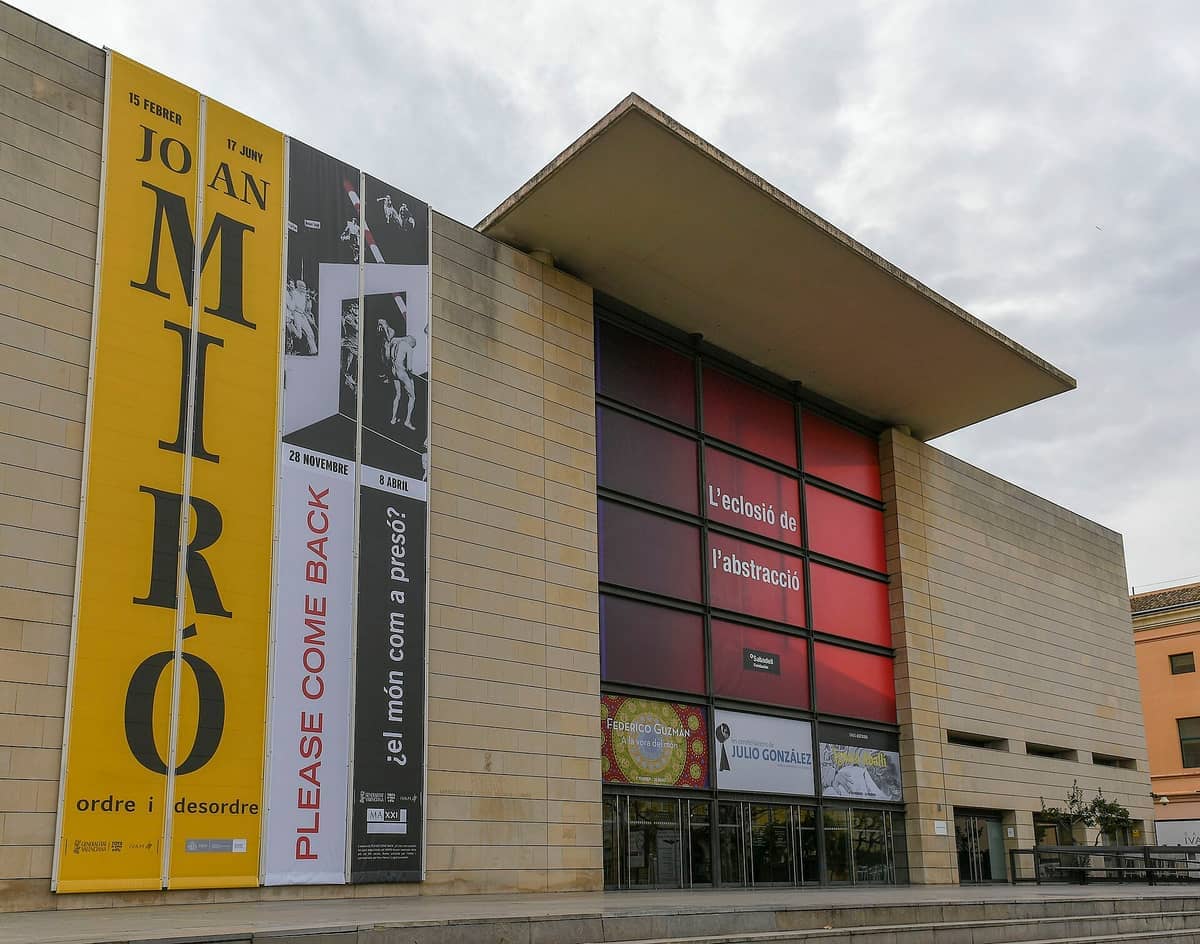
The IVAM, or Institut Valencià d'Art Modern, is Valencia's flagship museum of modern and contemporary art, housed in a purpose-built concrete complex on the edge of the historic Barrio del Carmen. With a permanent collection built around sculptor Julio González and a rotating programme of international exhibitions, it delivers more than its reputation suggests for a regional institution.
Quick Facts
- Location
- C/ Guillem de Castro, 118, 46003 València – edge of Barrio del Carmen, next to the Torres de Quart
- Getting There
- Bus lines C1, 28, 79, 80, 94 and 95 stop nearby; short walk from the historic centre
- Time Needed
- 1.5 to 3 hours depending on current exhibitions
- Cost
- €5 general admission; free Wednesday afternoons (16:00–19:00) and all day Sunday
- Best for
- Modern art lovers, architecture fans, budget-conscious visitors on free days
- Official website
- ivam.es/en
What Is IVAM and Why Does It Matter?
The Institut Valencià d'Art Modern, universally known as IVAM, was created by law in 1986 and its main building, the Centre Julio González, opened to the public in 1989. It was the first public museum of modern art established in Spain, predating the Museo Reina Sofía in Madrid by several years. That history matters: IVAM was a deliberate act of cultural ambition by the newly autonomous Valencian government, a statement that this Mediterranean city intended to be taken seriously on the international art stage.
The building sits at the western edge of the old city, right where the medieval walls once stood. The Torres de Quart, two 15th-century defensive towers, loom immediately to the south. The contrast between those rough stone fortifications and the museum's clean modernist concrete is jarring in the best possible way. If you are walking through the Barrio del Carmen toward the Turia park, you will pass it almost unavoidably.
The IVAM shares its neighborhood with several other cultural institutions that reward an afternoon of combined visits. The Centre del Carme Cultura Contemporània is a short walk east, housed in a former convent, and offers a striking architectural contrast to IVAM's modernist form. Together, they make Barrio del Carmen one of the more concentrated zones for contemporary culture in the city.
💡 Local tip
Free entry runs all day Sunday and Wednesday afternoons from 16:00 to 19:00. Sunday mornings tend to draw more visitors; Wednesday afternoons are noticeably quieter and often the best time to see the permanent collection without competition for space.
The Permanent Collection: Julio González and Beyond
The museum takes its subtitle, Centre Julio González, from the Catalan-born sculptor (1876–1942) whose work forms the backbone of its permanent holdings. González is one of the foundational figures of 20th-century sculpture, credited with pioneering the use of welded iron as a fine art medium. His influence on artists from Picasso to David Smith was direct and documented. IVAM holds the world's most significant institutional collection of his work, including drawings, paintings, and the iron sculptures that defined his late career.
The permanent galleries occupy a long, low-ceilinged hall of exposed concrete that was designed specifically to accommodate large-scale works. Natural light enters through calibrated skylights, and the effect on González's welded forms, particularly as afternoon light shifts across their surfaces, is worth planning around. The collection also extends to works by other early 20th-century modernists, Russian avant-garde prints, and photographic archives that document the development of European modernism across several decades.
Do not treat the permanent collection as a warm-up for temporary shows. It is the reason the museum exists and contains works of genuine international significance. Visitors who speed through it to reach whatever is advertised on the billboard outside routinely miss the best of what IVAM has to offer.
Tickets & tours
Hand-picked options from our booking partner. Prices are indicative; availability and final rates are confirmed when you complete your booking.
Valencia Silk Museum tickets and audio guide
From 7 €Instant confirmationFree cancellationSaint Nicholas Church Entrance Tickets and Audioguide
From 11 €Instant confirmationHistoric Valencia walking tour
From 27 €Instant confirmationFree cancellationNatural thermal springs and Girlfriend Waterfall tour from Valencia
From 89 €Instant confirmationFree cancellation
Temporary Exhibitions: The Museum's Current Personality
IVAM runs an ambitious programme of temporary exhibitions that cycles through roughly four to six major shows per year. The curatorial direction has historically leaned toward political and social themes in contemporary art, photography as a documentary medium, and retrospectives of artists underrepresented in major European museums. The quality is uneven in the way that most regional museums are uneven: some shows are genuinely important, others feel like the result of cultural exchange agreements rather than curatorial conviction.
Check the IVAM website before visiting. The difference between a strong temporary programme and a fallow period is significant enough to affect whether the entry fee feels justified. On free-entry days, that calculation becomes less critical.
ℹ️ Good to know
The museum publishes its full exhibition schedule at ivam.es/en/. Temporary exhibitions may occasionally carry a small supplementary charge on top of general admission, though many are included; verify before you arrive.
How the Experience Changes by Time of Day
The IVAM opens at 10:00. If you want to experience the González sculptures in something close to silence, aim to arrive shortly after opening, before potential school or tour groups.
Midday light through the skylights in the main gallery reaches its peak intensity between roughly 12:00 and 14:00. The concrete interior stays cool even in summer, making IVAM a genuinely useful refuge during Valencia's hottest months when spending two hours outdoors becomes uncomfortable by early afternoon. In winter, the building holds warmth well and the reduced visitor numbers in January and February mean you can often have entire gallery wings to yourself.
The Wednesday free-entry afternoon draws a local crowd rather than a tourist crowd. From 16:00 onward you will see students, older residents, and young professionals dropping in after work. The atmosphere shifts noticeably from museum formality toward something more casual. It is the version of IVAM that Valencians themselves use, which is worth experiencing for that reason alone.
Practical Walkthrough: Getting There and Getting Around Inside
IVAM sits at Carrer de Guillem de Castro, 118, at the northwestern boundary of the Barrio del Carmen. On foot from the Plaza del Ayuntamiento it is roughly a 15-minute walk through the old city. From the Turia garden, the museum entrance is visible from the riverbed path. Several city bus lines serve the Guillem de Castro corridor; check current EMT Valencia route maps for the most direct option from your accommodation.
The entrance leads into a reception hall where bags can be stored in free lockers. The main permanent collection gallery runs in a single long axis, so navigation is straightforward. A smaller annex building, the Galeria de la Muralla, is integrated into the complex and preserves sections of Valencia's original medieval wall in situ beneath glass floors. This architectural detail is easy to miss if you do not ask at reception about access. It connects the IVAM's contemporary purpose to the deep history of the historic centre it occupies.
The museum shop near the exit is well-stocked for an institution of this size: exhibition catalogues, design books, and a selection of prints. The adjacent café is modest but functional, with outdoor seating on a small terrace facing the Torres de Quart.
💡 Local tip
Photography is generally permitted in the permanent collection without flash. Temporary exhibitions may have different rules depending on artist agreements. Look for posted notices at each gallery entrance rather than assuming blanket permission.
Honest Assessment: What IVAM Does Well and Where It Falls Short
IVAM's strength is specific: if you have genuine interest in early 20th-century European sculpture, the González collection is one of the finest you will find anywhere. The building itself, designed by Carlos Salvadores and Emilio Jiménez, is a serious piece of institutional modernist architecture that repays attention. The free-entry policy is genuinely generous, and the Wednesday afternoon slot in particular makes this one of the better free cultural experiences in the city.
The weaknesses are worth naming. The temporary programme can feel disconnected from the permanent identity of the museum. The permanent collection display has not been substantially rehung in recent memory, which means return visitors will find it familiar. Compared to the spectacle of the Ciudad de las Artes y las Ciencias across the city, IVAM is architecturally understated, and visitors expecting grand interiors will find it plain. That plainness, though, is what lets the González sculptures read clearly without visual competition.
Visitors with no background interest in modernist sculpture or contemporary art will likely find the visit underwhelming. The museum does not invest heavily in interpretive aids aimed at casual audiences, and the permanent collection makes demands on the viewer. If that is not your orientation, the entry fee and time are probably better directed elsewhere, though the free-entry options reduce the stakes considerably.
For a fuller picture of Valencia's museum landscape, the best museums in Valencia guide covers how IVAM compares to the Museo de Bellas Artes, the Museo de Prehistoria, and the ceramics museum, which will help you prioritise according to your interests.
Insider Tips
- The Galeria de la Muralla, a lower-level gallery built over surviving sections of Valencia's medieval wall, is technically part of the museum but frequently overlooked. Ask at the front desk whether it is currently open and accessible during your visit.
- Wednesday afternoon free entry (16:00–19:00) is the least crowded free slot. Sunday free admission attracts significantly more visitors, especially after midday.
- The outdoor terrace of the museum café faces the Torres de Quart towers directly. It is a quieter alternative to the more popular café terraces inside the old city, and the juxtaposition of medieval stonework and modernist concrete is worth sitting with for a few minutes.
- If the light matters to you, the main González gallery reads best in early afternoon when sunlight enters the central skylights at a low angle. Morning visits are cooler and calmer but the light is flatter.
- IVAM sometimes hosts evening events, lectures, and film screenings that are not visible from the main exhibition schedule. Check the full programme on the website, particularly if you are visiting in autumn when the cultural calendar tends to be most active.
Who Is IVAM – Institut Valencià d'Art Modern For?
- Visitors with genuine interest in 20th-century European sculpture and modernist art movements
- Budget-conscious travelers who want serious cultural content without a significant entry cost
- Architecture enthusiasts interested in late-1980s Spanish institutional modernism
- Travelers looking for a cool, calm indoor option during Valencia's hot summer afternoons
- People exploring the Barrio del Carmen on foot who want to add cultural depth to a neighborhood walk
Nearby Attractions
Other things to see while in Barrio del Carmen:
- Casa-Museo Benlliure
Tucked into a narrow street in the historic El Carme quarter, the Casa-Museo Benlliure preserves the home and studio of José Benlliure Gil exactly as the painter left it. With original furnishings, Italian treasures, and a rear garden studio, it offers an unusually intimate glimpse into 19th-century Valencian artistic life — at a price that makes it one of the most accessible museums in the city.
- Centre del Carme Cultura Contemporània (CCCC)
The Centre del Carme Cultura Contemporània occupies a historic monastery complex in the heart of El Carme. Today it hosts rotating contemporary art exhibitions, all free to enter, inside one of Valencia's most atmospheric historic complexes.
- Iglesia de San Nicolás
Hidden in plain sight on Calle Caballeros, the Iglesia de San Nicolás is one of Valencia's oldest churches and its most visually overwhelming interior. A Gothic shell completely transformed by Renaissance frescoes, it rewards visitors who look up the moment they step through the door.
- Museo de Prehistoria de Valencia
Housed inside the historic La Beneficència complex in Valencia's Barrio del Carmen, the Museu de Prehistòria de València traces human life in the region from the Paleolithic through the Visigothic period. Founded in 1927, it remains a respected provincial archaeology museum, and at €2 admission (free on weekends), it consistently overdelivers.