Iglesia de San Nicolás de Bari y San Pedro Mártir: Valencia's Painted Masterpiece
Hidden in plain sight on Calle Caballeros, the Iglesia de San Nicolás is one of Valencia's oldest churches and its most visually overwhelming interior. A Gothic shell completely transformed by Renaissance frescoes, it rewards visitors who look up the moment they step through the door.
Quick Facts
- Location
- Calle de los Caballeros, 35, 46001 Valencia (Barrio del Carmen)
- Getting There
- Walk 10 min from Plaza del Ayuntamiento
- Time Needed
- 45–75 minutes
- Cost
- €16 online / €18 at door; reduced €13/€15; children up to 12 free
- Best for
- Art lovers, architecture enthusiasts, history seekers
- Official website
- www.sannicolasvalencia.com
What Is the Iglesia de San Nicolás?
The Iglesia de San Nicolás de Bari y San Pedro Mártir stands on Calle Caballeros in the Barrio del Carmen, the most historically dense quarter of the city, and its exterior gives almost nothing away. The facade is weathered stone, modest against the narrow street. You could walk past it without a second glance.
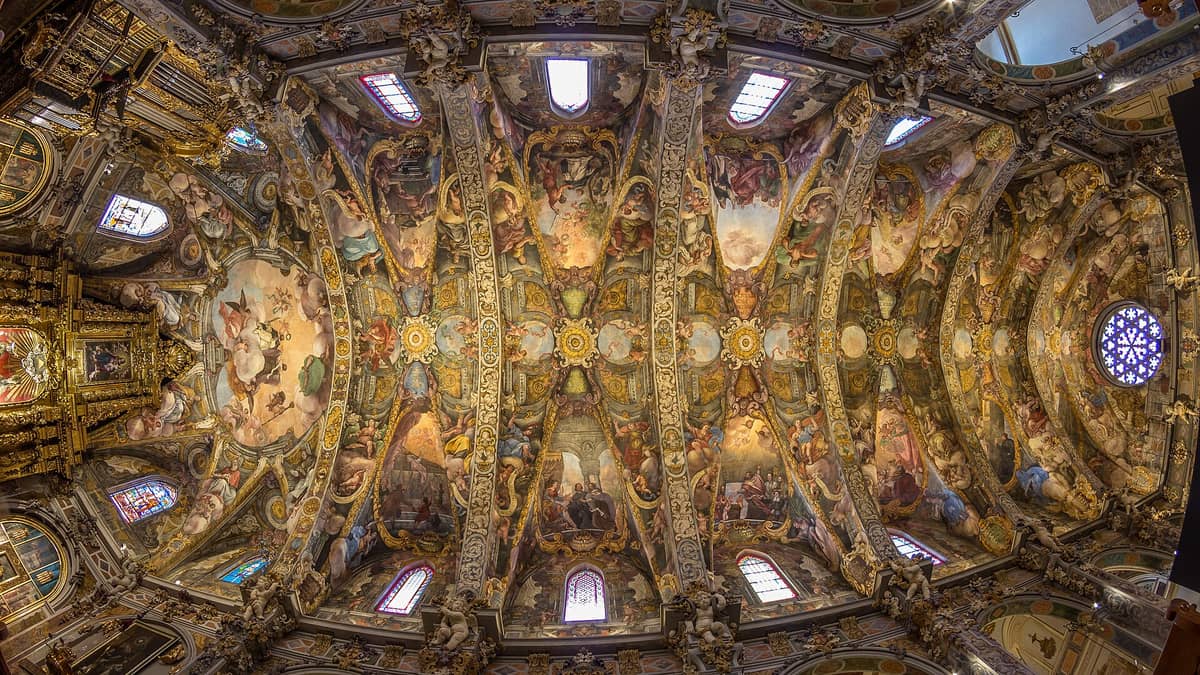
That restraint outside makes the interior all the more startling. The entire ceiling, from the ribbed Gothic vaults to the lunettes and arches, is covered in late 16th-century frescoes painted by Antonio Palomino and later completed by another hand. The effect is total: warm gold, deep ochre, and figures in motion in every direction above you. The comparison to the Sistine Chapel circulates because visitors instinctively reach for a reference point. It is what the experience produces.
💡 Local tip
Book tickets online in advance. The €2 saving is secondary to availability, and the church limits visitor numbers per entry window.
The Building's Long History
The church was built in Gothic style in the 13th and 14th centuries on the site of a former mosque, which itself occupied ground that had been consecrated to Christian worship before the Moorish period.
By the mid-16th century, the Gothic structure was complete but its interiors were bare by comparison to what they would become. Antonio Palomino, the leading Valencian painter of his generation, brought compositional skill and genuine devotional feeling to the work. After his death in 1579, the program was completed by another artist, and the result reads as unified.
The church was declared a Bien de Interés Cultural (protected national monument), a designation that preceded the long restoration campaign which returned the frescoes to their current legibility. Before restoration, centuries of candle smoke and water damage had dulled the colors almost beyond recognition.
Tickets & tours
Hand-picked options from our booking partner. Prices are indicative; availability and final rates are confirmed when you complete your booking.
Valencia English tour with entry to La Lonja, Catedral and San Nicolas
From 39 €Instant confirmationFree cancellationValencia Spanish tour with entry to La Lonja, Catedral and San Nicolas
From 49 €Instant confirmationFree cancellationValencia Italian tour with entry to La Lonja, Catedral and San Nicolas
From 49 €Instant confirmationFree cancellationValencia 48-hour touristic bus with entrance to San Nicolas chapel
From 30 €Instant confirmationFree cancellation
What You See Inside
The nave is single-aisle Gothic, relatively narrow, which means the ceiling feels closer and more enveloping than in a wider basilica. The moment your eyes adjust to the interior light, the ceiling becomes the room. The frescoes cover much of the interior and depict scenes from the lives of both patron saints, surrounded by allegorical and decorative passages that fill every available surface.
The altarpiece, a separately impressive object, tends to get less attention than the vaults but rewards a slow look. Side chapels hold devotional images and sculptures from different periods, and the overall layering of centuries is part of what makes the interior feel genuinely inhabited rather than museum-static. Mass is still celebrated here; the church is not a monument that has stopped being a church.
Near the entrance, information panels provide context in Spanish and English. Audio guides are available and add detail, but the space is legible without them if you are already comfortable with religious iconography.
ℹ️ Good to know
Photography is permitted inside for personal use. The low interior light means a phone camera will struggle without night mode. Bring or activate it before you enter. Tripods are not permitted.
How the Experience Changes by Time of Day
Morning visits, particularly on weekdays, offer the quietest conditions. The side windows let in low lateral light in the earlier hours, and the quality of that light on the frescoes is different from the flatter illumination of midday. The colors shift perceptibly, and the textures of the painted surface become more readable.
Late afternoon on weekdays is also workable but the entrance queue can build after 16:00, especially when tour groups have pre-booked back-to-back slots. Sunday afternoons from 13:00 onward can feel crowded despite the limited-entry system, partly because the surrounding neighborhood is busier on weekends and visitors combine the church with the Mercado Central or a walk through the Carmen.
The church is closed to tourist visits on Mondays without exception. Plan around this if your Valencia itinerary is short.
Getting There and Practical Logistics
The church sits in the Barrio del Carmen, which is most efficiently reached on foot from the historic center. From Plaza de la Virgen, the walk takes about four minutes along Calle Caballeros. From the Mercado Central, allow six to eight minutes. If you are arriving by metro, Àngel Guimerà station (Lines 1, 2, and 5) is the closest underground stop, roughly a ten-minute walk through the old city.
Calle Caballeros is a narrow pedestrian street. There is no car access or drop-off point directly outside. The nearest taxi drop-off is on Calle Quart or at the Torres de Quart roundabout, about two minutes on foot.
Opening hours for tourist visits: Tuesday through Friday 10:30 to 19:00, Saturday 10:00 to 18:30, Sunday 13:00 to 20:00, closed Monday. Hours shift around religious celebrations and during the Christmas period, so check the official website before visiting during public holidays.
Wheelchair access to the main nave is possible, though the surrounding streets are cobbled and uneven, which makes approach from some directions difficult. The reduced ticket category explicitly includes visitors with disabilities. For a broader look at accessible ways to experience Valencia's historic center, plan your route to approach from Calle Quart rather than through the narrower Carmen lanes.
Honest Assessment: Is It Worth the Ticket Price?
At €16 to €18, the Iglesia de San Nicolás is among the pricier single-site admissions in Valencia. For context, the Catedral de Valencia charges less and covers considerably more ground. The price reflects both the restoration investment and the deliberately managed visitor numbers, which is why the experience feels less crowded than many comparable heritage sites in larger Spanish cities.
If you are drawn to painted interiors, art history, or late-Renaissance religious painting, this is among the most rewarding 45 minutes Valencia offers. If your interest in churches is more architectural or historical than visual, the Catedral de Valencia and the La Lonja de la Seda may deliver better value for your priorities.
Those who find admission fees to churches conceptually uncomfortable should know this one does still function as an active parish. Tourist visits fund ongoing conservation work on the frescoes. The transaction is more straightforward than it might feel.
⚠️ What to skip
Tourist visiting hours are suspended during religious services. If you arrive outside the ticketed windows or during a special liturgical event, you will not be admitted. This is not a policy the staff can override at the door.
Pairing the Visit with the Surrounding Neighborhood
The Iglesia de San Nicolás sits at the heart of one of Valencia's most walkable and historically layered neighborhoods. Calle Caballeros itself was the main street of the medieval Muslim city, later the address of choice for Valencia's 15th-century nobility. A walk east from the church toward the cathedral passes the Torres de Serranos if you head north, or arrives at the Plaza de la Virgen within minutes.
Combining the church with the Mercado Central makes a natural morning pairing. The market operates until around 15:00 on weekdays, so a 10:30 church slot followed by the market works cleanly. Alternatively, the Centro del Carme, which houses contemporary art exhibitions in a former convent, is a short walk north and makes a coherent afternoon sequence for anyone interested in how Valencia layers old and new.
Insider Tips
- Stand just inside the entrance for a full minute before moving. The scale of the fresco program only registers once your eyes have adapted to the interior light and you have stopped moving. Most visitors immediately walk forward and miss this initial impact.
- The ticketed entry includes an audio guide device. Pick it up even if you only use it for a few stops. The explanation of how the two artists' styles differ, and which sections each painted, genuinely changes what you see.
- If you want the best light on the vaults, arrive as close to opening time as your schedule allows, particularly on a morning with low sun. The small clerestory windows cast warm directional light across the frescoes that disappears by mid-morning.
- The church is an active parish. If your visit coincides with a weekday morning or evening service (outside tourist hours), you can sometimes attend mass and see the space as a working church rather than a managed attraction. Check the parish schedule on the official website.
- Combine your visit with a walk along Calle Caballeros toward the Torres de Quart. The street is one of the oldest continuous urban axes in Valencia and the towers, which still bear embedded cannonballs from a 19th-century bombardment, take less than ten minutes to reach.
Who Is Iglesia de San Nicolás For?
- Travelers with an interest in Renaissance painting or religious art who want a concentrated, high-quality experience in a short time
- Architecture visitors who want to see Gothic structure transformed by later decorative campaigns, a process visible nowhere in Valencia more dramatically than here
- First-time visitors to Valencia who want to understand the city's medieval and early modern layers before moving outward to the newer districts
- Anyone who has visited the Sistine Chapel and wants to see how a comparable artistic ambition played out in a provincial Spanish city with its own distinct artistic tradition
- Travelers on a tighter itinerary who can spend 60–75 minutes and want one interior that will stay with them
Nearby Attractions
Other things to see while in Barrio del Carmen:
- Casa-Museo Benlliure
Tucked into a narrow street in the historic El Carme quarter, the Casa-Museo Benlliure preserves the home and studio of José Benlliure Gil exactly as the painter left it. With original furnishings, Italian treasures, and a rear garden studio, it offers an unusually intimate glimpse into 19th-century Valencian artistic life — at a price that makes it one of the most accessible museums in the city.
- Centre del Carme Cultura Contemporània (CCCC)
The Centre del Carme Cultura Contemporània occupies a historic monastery complex in the heart of El Carme. Today it hosts rotating contemporary art exhibitions, all free to enter, inside one of Valencia's most atmospheric historic complexes.
- IVAM – Institut Valencià d'Art Modern
The IVAM, or Institut Valencià d'Art Modern, is Valencia's flagship museum of modern and contemporary art, housed in a purpose-built concrete complex on the edge of the historic Barrio del Carmen. With a permanent collection built around sculptor Julio González and a rotating programme of international exhibitions, it delivers more than its reputation suggests for a regional institution.
- Museo de Prehistoria de Valencia
Housed inside the historic La Beneficència complex in Valencia's Barrio del Carmen, the Museu de Prehistòria de València traces human life in the region from the Paleolithic through the Visigothic period. Founded in 1927, it remains a respected provincial archaeology museum, and at €2 admission (free on weekends), it consistently overdelivers.