Valencia Cathedral (La Seu): The Complete Visitor's Guide
Rising above Plaza de la Reina in Valencia's historic centre, the Cathedral of Valencia is a remarkable layered monument built over seven centuries. From a Romanesque doorway to Gothic vaulting, a Baroque facade, and a relic claimed to be the Holy Grail, this is one of Spain's most architecturally complex and historically loaded churches.
Quick Facts
- Location
- Plaza de la Reina, s/n, 46003 València (Centro Histórico)
- Getting There
- Xàtiva metro station (Lines 1, 2, 3, 5 & 7) or Colón station (Lines 3, 5, 7 & 9), then a 10-minute walk through the old town
- Time Needed
- 1.5 to 2.5 hours for the cultural visit including the museum and bell tower
- Cost
- General: 10 € (includes audio guide + museum). Reduced: 6 € (pensioners, children under 12, visitors with disabilities). Free access to the central nave during liturgical hours.
- Best for
- History lovers, architecture enthusiasts, religious heritage travellers, and first-time visitors to Valencia
- Official website
- catedraldevalencia.es
What the Cathedral Actually Is — and Why It Matters
The Catedral de València, officially titled the Iglesia Catedral-Basílica Metropolitana de la Asunción de Nuestra Señora de Valencia, is the seat of the Archbishop of Valencia and one of the most architecturally layered religious buildings in Spain. Unlike the soaring Gothic unity of Burgos or the Baroque grandeur of Santiago de Compostela, Valencia Cathedral is a building that never quite resolved itself — and that is precisely what makes it worth studying. Seven centuries of additions, demolitions, renovations, and reversals have left their marks on every facade.
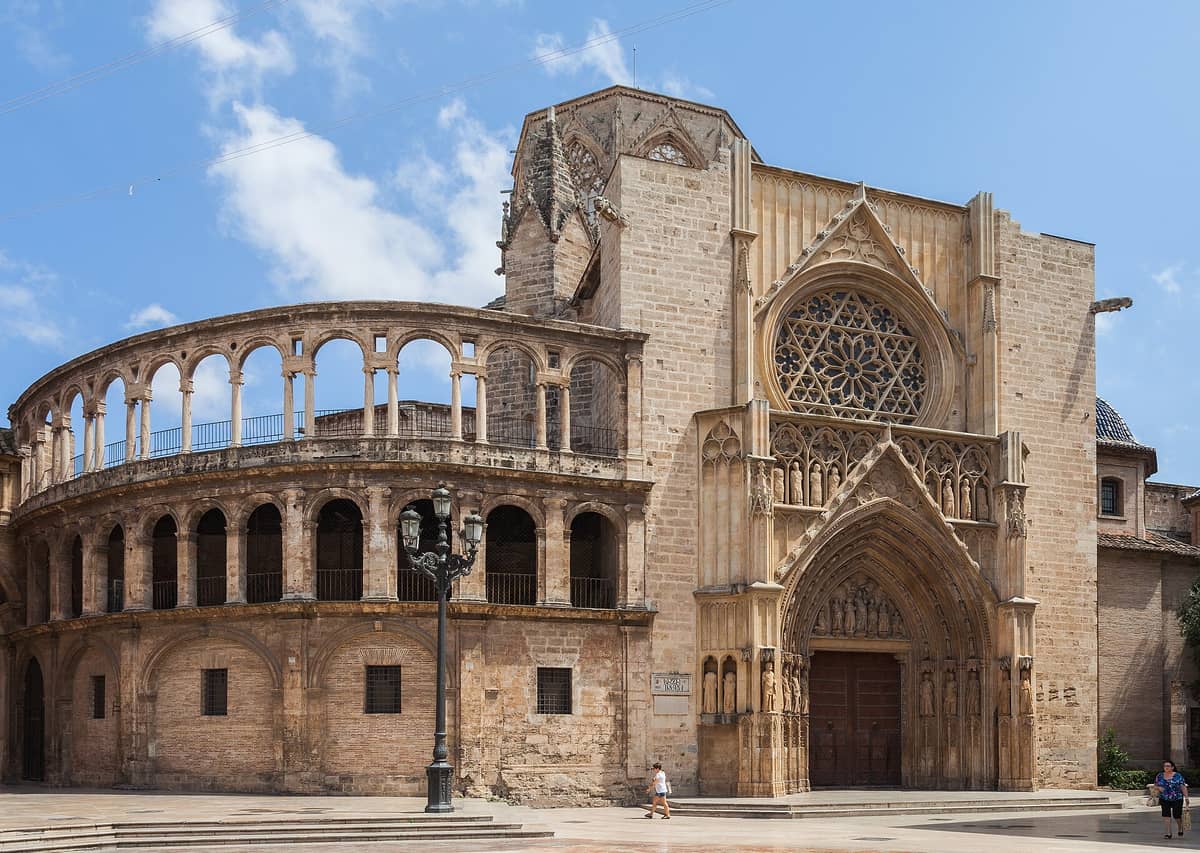
Construction began in 1262, following the Christian Reconquista of Valencia in 1238 under King James I of Aragon. The site chosen was not arbitrary: it replaced a mosque, which itself had been built over a Visigothic church. This layering of faiths on the same ground is not unusual for medieval Iberia, but few buildings in Spain make the archaeology of that history as visually readable as this one. The cathedral's three main doorways represent three different centuries and three entirely different aesthetic languages: the Romanesque Porta del Palau to the north, the French Gothic Puerta de los Apóstoles facing Plaza de la Virgen, and the Baroque Puerta de los Hierros opening onto Plaza de la Reina.
ℹ️ Good to know
Opening hours for the cultural visit: Mon–Fri 10:30–18:30, Sat 10:30–17:30, Sun & public holidays 14:00–17:30. In July–September, Saturday and Sunday hours extend to 18:30. Last entry is 45 minutes before closing. The cathedral closes to cultural visits on 1 Jan, 6 Jan, 19 Mar, Palm Sunday, Good Friday, 9 Oct, 8 Dec, and 25 Dec.
Moving Through the Building: What You'll See Inside
The interior is dominated by a single nave of considerable height, lit by a 15th-century octagonal lantern tower that floods the crossing with diffuse natural light. The effect is quietly dramatic. Unlike the darkness that characterises many medieval churches of similar scale, Valencia Cathedral has a luminosity that shifts through the day as the sun angle changes. In the morning, the east-facing apse catches direct light through its Gothic windows; by afternoon, the lantern does most of the work.
The ambulatory chapels contain significant works including paintings attributed to Francisco de Goya, though visitors focused solely on architecture may miss them if they move too quickly through the perimeter. The carved stone retables in several side chapels deserve close attention — the quality of late Gothic stonework here is exceptional, and the polychrome remains on some figures give a sense of how saturated with colour the building once would have appeared.
The cathedral museum occupies several rooms adjacent to the main body of the church and is included in the general admission ticket. It houses vestments, reliquaries, gold- and silverwork, and devotional paintings spanning several centuries. It is a small museum by major city standards, but the density of significant objects per room is higher than many visitors expect.
Tickets & tours
Hand-picked options from our booking partner. Prices are indicative; availability and final rates are confirmed when you complete your booking.
Valencia English tour with entry to La Lonja, Catedral and San Nicolas
From 39 €Instant confirmationFree cancellationValencia Spanish tour with entry to La Lonja, Catedral and San Nicolas
From 49 €Instant confirmationFree cancellationValencia Italian tour with entry to La Lonja, Catedral and San Nicolas
From 49 €Instant confirmationFree cancellationValencia Silk Museum tickets and audio guide
From 7 €Instant confirmationFree cancellation
The Holy Grail: What the Cathedral Claims and Why It's Taken Seriously
The cathedral houses a dark agate cup mounted in a gold-and-jewel setting that the church identifies as the Santo Cáliz — the chalice used by Christ at the Last Supper and, by extension, the Holy Grail. This claim sounds like the premise of a thriller novel, but the object has a documented history that historians treat with more seriousness than most Grail legends. The cup's upper section is a first-century Near Eastern agate vessel consistent in style and material with cups from that period and region. Its documented history in Spain begins in the 11th century, when it was held at the Monastery of San Juan de la Peña in Aragon before being brought to Valencia in 1437.
Whether or not one accepts the religious identification, the object itself is extraordinary. It sits in its own dedicated chapel, the Capilla del Santo Cáliz, in a setting that gives it appropriate solemnity. The chapel occupies what was originally the chapter house, a 14th-century room with pointed arches and an intricate stellar vault. Several popes have celebrated Mass with this cup, including John Paul II in 1982 and Benedict XVI in 2006. For visitors interested in the intersection of material culture, medieval religion, and historical mystery, this alone justifies the entry fee.
El Miguelete: Climbing the Bell Tower
The octagonal Gothic bell tower known as El Miguelete (Valencian: El Micalet) is the cathedral's most visible landmark and one of the defining features of Valencia's skyline. Its construction began in 1381 and was completed in 1429, making it a Gothic structure from the late 14th and early 15th centuries with a notably plain exterior that contrasts with the decorative ambition of the church below. Climbing the tower requires a separate ticket, and the ascent involves 207 steps with no lift — it is not accessible for visitors with limited mobility. For those who can manage it, the view from the top is among the best in the city centre. You can read more about the tower in the dedicated guide to El Micalet, and for other vantage points across the city, the best viewpoints in Valencia guide is worth consulting before you plan your day.
The tower is best climbed in the morning, before the midday heat makes the enclosed staircase uncomfortable in summer. On weekends, a queue forms at the tower entrance from around 11:00 onward. If you arrive when the cathedral opens at 10:30, you can often reach the tower platform before the first wave of group tours arrives.
How the Experience Changes by Time of Day
Arriving at 10:30 on a weekday — the moment the cathedral opens for cultural visits — gives you a noticeably different experience than arriving at midday. The first 45 minutes after opening tend to be quiet. The stone interior is cool, the light is gentler, and the audio guide's narration is easier to follow without ambient noise. By 12:00 on most days, the cathedral is moderately crowded, and by 13:00 in high season, group tours occupy significant stretches of the ambulatory.
Sunday afternoons present a specific consideration: the cultural visit does not begin until 14:00, and the hours are shorter. However, weekday morning Mass is celebrated in the central nave, and the nave is freely accessible to worshippers during these times. If you attend a service rather than a cultural visit, you experience the building as it was intended — with liturgical chant in the space, incense rising toward the lantern vault, and the relationship between the architecture and its purpose made visible. This is not a tourism experience; it is something more difficult to categorise and worth seeking out if the timing works.
💡 Local tip
The quietest time to visit is a weekday morning between 10:30 and 11:30. Avoid the 12:00–14:00 window in peak season if you want space to look at things without pressure. Summer Saturdays are particularly crowded from midday onward.
Getting There and the Surrounding Area
The cathedral sits at the heart of the historic centre of Valencia, facing Plaza de la Reina on its main Baroque facade and Plaza de la Virgen on its Gothic Puerta de los Apóstoles. Both squares are worth time in themselves. Plaza de la Virgen is one of the oldest public spaces in the city, site of the Tribunal de las Aguas — a water court that has governed irrigation rights in Valencia's huerta since medieval times and still meets every Thursday at noon on the cathedral steps.
From Xàtiva metro station (Lines 1, 3, 5), the walk to the cathedral takes around 10 to 12 minutes through the old town. From Colón station (Lines 3, 5), the walk is slightly longer but passes through pleasant pedestrianised streets. The cathedral is also a natural anchor point for a walking circuit that takes in the La Lonja de la Seda (the Silk Exchange, a UNESCO World Heritage site just five minutes away), the Mercado Central, and the Basilica de la Virgen de los Desamparados, which adjoins the cathedral directly. A guided walking tour of Valencia's old city will typically include all of these within a half-day itinerary.
The immediate area around the cathedral is heavily pedestrianised, which is good for navigation on foot but means there is nowhere to park a car close by. Visitors arriving by car should use one of the underground car parks near Plaza del Ayuntamiento or on the perimeter of the old town.
Practical Notes: What to Bring and What to Know
The audio guide included in the general ticket is available in multiple languages and is genuinely useful here — the building's complexity rewards explanation, and several of the most significant objects are easy to walk past without context. Dress modestly: bare shoulders and very short shorts are not appropriate inside a functioning cathedral. A light layer is worth carrying regardless of the outside temperature, since the stone interior stays noticeably cool even in summer.
Photography is permitted in most areas of the cultural visit, though flash photography is generally discouraged near paintings and the Santo Cáliz chapel. The best interior photography conditions are in the morning when the lantern tower light falls directly through the crossing. The Puerta de los Apóstoles, on the Plaza de la Virgen side, photographs well from the square in the afternoon when the light hits the carved stone figures directly.
Visitors with mobility restrictions should be aware that the tower climb is not accessible. The main cathedral interior is largely accessible at ground level, though some chapel thresholds involve small steps. For specific accessibility queries, contacting the cathedral directly via the official website before your visit is recommended, as the cited sources do not provide detailed step-free access information.
⚠️ What to skip
The cathedral is closed to cultural visits on several major dates including Good Friday, 9 October (Valencian Community Day), 8 December, and 25 December. Check the official site before visiting on any public holiday.
Honest Assessment: Is It Worth Your Time?
For a visitor spending several days in Valencia, the cathedral is genuinely worth the time and the entry fee. It is not the most impressive Gothic cathedral in Spain on raw architectural terms — Seville, Toledo, and Burgos have more spectacularly unified interiors — but Valencia Cathedral's layered complexity, the quality of its medieval stonework, the Santo Cáliz chapel, and its integration with the life of the surrounding squares make it more interesting to spend time in than a more conventionally grand building might be. For those who also want to understand the city's broader architectural heritage, the Valencia architecture guide provides useful context for everything you'll see inside and nearby.
Visitors who should consider skipping or minimising their time here: travellers with no interest in religious buildings or medieval history who are pressed for time, families with very young children who find enclosed historic interiors difficult to manage (though the bell tower view makes a good reward if the children are old enough to climb), and anyone who finds audio-guide-led cultural visits frustrating rather than illuminating. The free access to the nave during liturgical hours is worth knowing about for this last group — a brief, free look at the interior space may be more satisfying than a full paid visit.
Insider Tips
- The Tribunal de las Aguas meets every Thursday at noon at the Puerta de los Apóstoles — it's one of the oldest functioning legal institutions in Europe, and watching it costs nothing. Time your cathedral visit to coincide if you're in town on a Thursday.
- Buy tickets at the door rather than hunting for an advance-booking system — queues rarely justify pre-booking except during Holy Week and major festivals. The exception is if you're visiting during Las Fallas in March, when the city fills and crowds at every major monument multiply significantly.
- The Porta del Palau, the Romanesque doorway on the north side of the cathedral facing Plaza de la Almoina, is chronologically the oldest entrance and architecturally distinct from the other two. Most visitors enter from Plaza de la Reina and never see it — walk around the building first before going inside.
- The Centro Arqueológico de l'Almoina is directly adjacent to the cathedral and sits over Roman and Moorish ruins excavated beneath the square. It is separately ticketed and often overlooked, but the combination of the two visits gives a remarkably complete picture of what this site has been across 2,000 years.
- If you visit on a weekday morning when Mass is being celebrated, the central nave is freely open to anyone who enters respectfully. Sitting quietly at the back while the liturgy proceeds gives you an experience of the architecture in its intended context — and it costs nothing.
Who Is Catedral de València For?
- First-time visitors to Valencia wanting to understand the city's medieval history in a single building
- Architecture enthusiasts interested in how Romanesque, Gothic, and Baroque periods coexist in one structure
- Travellers with an interest in religious relics and medieval material culture, specifically the Santo Cáliz
- Those combining a visit with the surrounding historic squares, the Lonja, and the Mercado Central for a full morning in the old town
- Photographers looking for quality interior natural-light conditions and a photogenic bell tower view over the city centre
Nearby Attractions
Other things to see while in Centro Histórico:
- Basílica de la Virgen de los Desamparados
The Real Basílica de Nuestra Señora de los Desamparados stands at the heart of Valencia's historic centre, housing the revered image of the city's patron saint. Built between 1652 and 1667, it is free to enter and open every day, making it one of the most accessible and emotionally resonant stops in the old city.
- Centre Cultural La Nau
Housed in the University of Valencia's historic headquarters since the late 15th century, Centre Cultural La Nau is a historic landmark in the old town offering free exhibitions, concerts, and theatre. It rewards visitors who slow down and look closely.
- Centre Arqueològic de l'Almoina
Beneath a quiet plaza steps from Valencia Cathedral lies one of Spain's most compelling urban archaeology sites. The Centre Arqueològic de l'Almoina preserves around 2,500 square metres of Roman, Visigothic, and medieval remains, excavated over two decades and now visible through a striking modern structure.
- El Micalet (Cathedral Bell Tower)
Rising roughly 50 metres above Plaça de la Reina, the Torre del Micalet is the detached bell tower of Valencia Cathedral, built between 1381 and 1429. For €3, you climb a narrow stone staircase to a terrace at about 50 metres and get one of the clearest, most unobstructed panoramas of Valencia's historic roofline. It earns its place on a short itinerary, though it demands a bit of effort to reach the top.