Centre Arqueològic de l'Almoina: Valencia's Ancient City Beneath Your Feet
Beneath a quiet plaza steps from Valencia Cathedral lies one of Spain's most compelling urban archaeology sites. The Centre Arqueològic de l'Almoina preserves around 2,500 square metres of Roman, Visigothic, and medieval remains, excavated over two decades and now visible through a striking modern structure.
Quick Facts
- Location
- Plaça Dècim Juni Brut, s/n, 46003 València – historic centre, beside the Cathedral
- Getting There
- EMT city bus network; multiple lines stop near Plaza de la Reina, a 2-minute walk away
- Time Needed
- 45–90 minutes
- Cost
- €2 standard; €1 reduced; free on Sundays and public holidays
- Best for
- History enthusiasts, architecture lovers, anyone curious about what Roman Valencia actually looked like
- Official website
- cultural.valencia.es/es/museu/la-almoina-centro-arqueologico
What Is the Centre Arqueològic de l'Almoina?
The Centre Arqueològic de l'Almoina, also known as the Almoina Archaeological Museum, sits directly beneath the plaza adjacent to Valencia's Cathedral, in the heart of the historic centre. This is not a conventional museum of display cases and reconstructed pottery. It is an in-situ archaeological site: you descend below street level and walk among the actual ruins of the city that has existed on this spot for over 2,000 years.
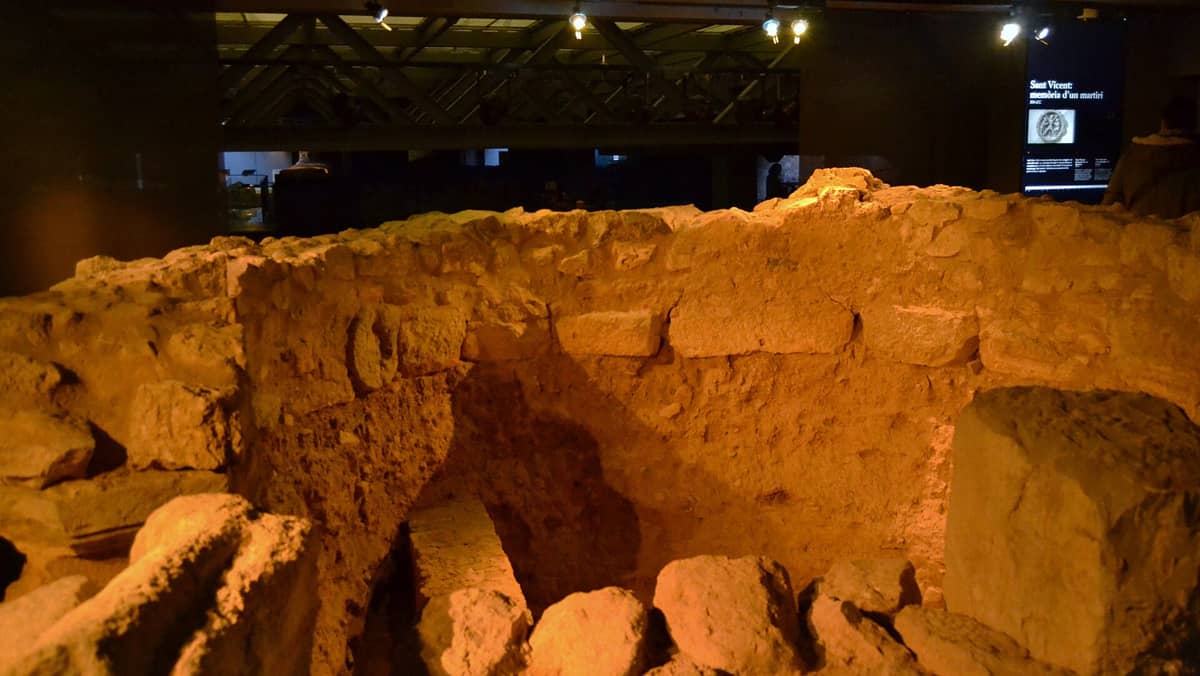
The site covers 2,500 square metres and presents visible remains from four distinct historical periods: Roman (from the 2nd century BCE), late-Roman and early Christian, Visigothic, and medieval Islamic and Christian layers up to the 14th century CE. What makes it genuinely unusual is the vertical compression of history. In one contained space, you can look from a Roman thermal bath across to a Visigothic episcopal complex, then turn and see the foundations of a medieval hospital, all at the same time.
💡 Local tip
Entry is free every Sunday and on public holidays. If your schedule allows, this is the best day to visit — the site is never so crowded that the freebie ruins the experience, and €2 saved is €2 toward a horchata.
The History Layered Into This Site
Valencia was founded as Valentia Edetanorum by Roman consul Decimus Junius Brutus in 138 BCE, and the Almoina site sits at what was the Roman city's civic core: the forum. The plaza's formal name, Plaça Dècim Juni Brut, directly commemorates that founder. Excavations carried out between 1985 and 2005 progressively uncovered the layers beneath a site that had previously served as the location of a medieval almshouse, the 'almoina' from which the centre takes its name.
The Roman remains are the most extensive and visually striking. You can see the layout of thermal baths (thermae), a cryptoporticus (a vaulted underground gallery used for storage and circulation), and parts of the forum's structural fabric. Several decorative elements, including carved stonework and fragments of mosaic, are displayed in context rather than removed to another building.
After Rome's political collapse in the 5th century, the site became the seat of Visigothic ecclesiastical power. A cathedral complex, baptistery, and episcopal palace were built directly over the Roman structures, making creative use of existing walls and foundations. This is one of relatively few sites in Spain where Visigothic architectural remains are preserved in situ at this scale. The transition from Roman civic space to Christian religious centre is physically readable in the stonework.
Medieval layers follow, reflecting Islamic Valencia (711–1238 CE) and then the Christian reconquest under Jaume I. The site continued in institutional use through the medieval period as an almshouse and hospital complex before eventually being forgotten beneath subsequent building. For context on how this fits into Valencia's broader architectural history, the Valencia architecture guide covers the full arc from Roman through Gothic and beyond.
Tickets & tours
Hand-picked options from our booking partner. Prices are indicative; availability and final rates are confirmed when you complete your booking.
Historic Valencia walking tour
From 27 €Instant confirmationFree cancellationValencia Food Tour with Tapas & Drinks with a Local
From 85 €Instant confirmationFree cancellationHortensia Herrero Art Centre Guided Tour
From 15 €Instant confirmationFree cancellationHortensia Herrero Art Centre Entry Ticket
From 12 €Instant confirmationFree cancellation
What the Visit Actually Feels Like
You enter the modern pavilion above ground, which is understated in design, intended not to compete visually with the Cathedral and Basilica opposite. The descent is via stairs or lift, dropping you into a temperature-controlled underground environment. The first impression is one of scale: the space is larger than expected, lit with targeted spotlights that pick out architectural details while keeping the overall atmosphere appropriately subdued.
Walkways are elevated glass and metal, allowing you to look down into excavated sections while keeping you at a consistent level above the ruins. The floor beneath is often three or four metres below, giving a sense of how deeply buried the Roman city became. There is a faint smell of cool stone and earth, more pronounced in the sections closest to the original ground level. It is quiet in a way that outdoor sites rarely are: no traffic noise, no wind, just the low hum of climate control and the occasional murmur of other visitors.
Interpretive panels are available in Spanish, Valencian, and English. The quality of explanation is solid rather than exceptional: you will understand what you are looking at, but the panels assume some basic familiarity with Roman urban structure. Visitors with no prior knowledge of Roman architecture may want to read a brief introduction beforehand. Audio guides may be available; check with the museum directly before your visit.
ℹ️ Good to know
Opening hours: Tuesday to Saturday 10:00–19:00, Sunday and public holidays 10:00–14:00. Last entry is 30 minutes before closing. The site is closed on Mondays and on days not listed; if visiting around public holidays, confirm in advance via museos@valencia.es or +34 96 208 41 73.
Best Time to Visit and How to Get There
Because the site is underground, weather is almost irrelevant to the experience. Rain, heat, or cold outside make no difference once you descend. This makes it an excellent option on days when Valencia's summer heat makes outdoor sightseeing uncomfortable, or when rain interrupts plans at the beaches or gardens.
Visitor numbers are rarely heavy enough to create a problem, but if you prefer to have the walkways to yourself, arriving at opening time (10:00) on a weekday gives the quietest conditions. Late Saturday afternoons can be busier, particularly during peak tourist months from June through August.
The museum is in the historic centre of Valencia, roughly 50 metres northeast of the Cathedral's main facade. From Plaza de la Reina, walk through the small passage toward the Cathedral apse and you will see the modern entrance pavilion. By public transport, numerous EMT bus lines serve the surrounding streets; the stop nearest to Plaza de la Reina is well-served. On foot from the Turia Garden, the site is about a 10-minute walk north through the old city streets.
Photography and Practical Notes
Photography is generally permitted without flash. The underground lighting is moody and directional, which can produce interesting results with a smartphone but rewards those with cameras that handle low light well. The contrast between the warmly lit stone ruins and the dark surrounding space is the main visual opportunity. Wide-angle shots capture the spatial scale; close-up details of carved stonework, drainage channels, and mosaic fragments work particularly well.
The elevated walkways are accessible via the lift from the entrance, making the main viewing areas reachable for visitors with mobility limitations. Some areas of the site may involve narrow walkways or steps within specific sections. For specific accessibility requirements, contact the museum directly before visiting.
⚠️ What to skip
The underground temperature stays cool year-round, typically cooler than the street above. In summer this is a relief, but if you visit in winter wearing light clothing, bring an extra layer. The contrast with outdoor temperatures can be striking.
How This Fits Into a Day in the Historic Centre
The Almoina sits within a cluster of major attractions in Valencia's old city. The Cathedral of Valencia is immediately adjacent, and the Basílica de la Virgen de los Desamparados is directly opposite. A morning that starts at the Almoina, then moves through the Cathedral (and up El Micalet bell tower if the queue allows), and ends with lunch in the nearby streets can cover a full sweep of Valencian history from Roman to Baroque without covering more than 200 metres.
For a longer loop through the old city, the walking tour of Valencia's old city makes the Almoina one logical stop among several, including the Gothic silk exchange La Lonja, the churches of the Barri del Carme, and the medieval city gates. The site fits naturally into any history-focused day without requiring much extra planning.
Honest Assessment: Who This Is For, and Who Might Skip It
The Centre Arqueològic de l'Almoina is not a polished, theatrical experience. It does not have elaborate reconstructions, costumed guides, or immersive audiovisual installations. What it offers is direct, unmediated contact with genuine archaeological remains in their original location. For visitors who find that compelling, it is quietly extraordinary. For travellers whose interest in history is casual, it may feel like a lot of stone in a dark room.
At €2 for a 45-to-90-minute visit, the price-to-substance ratio is strong. This is not a site that overpromises. If you have any genuine interest in Roman urbanism, early Christian architecture, or the long layered history of Mediterranean cities, the Almoina earns its place in your itinerary ahead of more tourist-famous stops.
Families with young children may find the interpretive approach a little text-heavy for keeping attention. The site lacks the interactive elements that help younger visitors engage with abstract historical material. Older children with a specific interest in history or archaeology are the exception and may find it fascinating.
Insider Tips
- Visit on a Sunday to enter free, then cross the plaza to see the Cathedral exterior and the Basilica facade at no cost either — the entire cluster of monuments around Plaza de la Almoina can be absorbed in a free morning if you time it right.
- The excavation uncovered a decapitated skeleton at the base of a Roman wall during the 1985–2005 digs, interpreted as a foundation sacrifice — it is documented in the site's interpretive materials and tends to capture attention in ways that stone walls alone sometimes don't.
- If you are combining this with a visit to the Cathedral, go underground first. The Almoina gives you the Roman and early medieval substrate; the Cathedral above is the 13th-century Christian layer built on top. The sequence makes historical sense read bottom-up.
- The plaza above the museum, Plaça Dècim Juni Brut, is named after the Roman consul who founded Valencia in 138 BCE — the same man whose forum is visible below your feet. Standing in the plaza and knowing that adds a small, satisfying charge to the place.
- For the best low-light photography of the ruins, position yourself on the north end of the elevated walkway where the thermal bath complex is lit from below. The angle shows the depth of the excavation and the texture of the Roman masonry most clearly.
Who Is Centre Arqueològic de l'Almoina For?
- History and archaeology enthusiasts who want to see Roman Valentia in its actual location, not reconstructed elsewhere
- Architecture lovers interested in the layering of Roman, Visigothic, and medieval structures in a single space
- Travellers seeking a quiet, uncrowded experience away from Valencia's more tourist-saturated sights
- Anyone needing a cool, sheltered activity during Valencia's hot summer afternoons
- Budget travellers: at €2 standard (free on Sundays), it is one of the best-value cultural experiences in the city
Nearby Attractions
Other things to see while in Centro Histórico:
- Basílica de la Virgen de los Desamparados
The Real Basílica de Nuestra Señora de los Desamparados stands at the heart of Valencia's historic centre, housing the revered image of the city's patron saint. Built between 1652 and 1667, it is free to enter and open every day, making it one of the most accessible and emotionally resonant stops in the old city.
- Catedral de València
Rising above Plaza de la Reina in Valencia's historic centre, the Cathedral of Valencia is a remarkable layered monument built over seven centuries. From a Romanesque doorway to Gothic vaulting, a Baroque facade, and a relic claimed to be the Holy Grail, this is one of Spain's most architecturally complex and historically loaded churches.
- Centre Cultural La Nau
Housed in the University of Valencia's historic headquarters since the late 15th century, Centre Cultural La Nau is a historic landmark in the old town offering free exhibitions, concerts, and theatre. It rewards visitors who slow down and look closely.
- El Micalet (Cathedral Bell Tower)
Rising roughly 50 metres above Plaça de la Reina, the Torre del Micalet is the detached bell tower of Valencia Cathedral, built between 1381 and 1429. For €3, you climb a narrow stone staircase to a terrace at about 50 metres and get one of the clearest, most unobstructed panoramas of Valencia's historic roofline. It earns its place on a short itinerary, though it demands a bit of effort to reach the top.