El Micalet: Valencia's Medieval Bell Tower and the Best Rooftop View in the Old City
Rising roughly 50 metres above Plaça de la Reina, the Torre del Micalet is the detached bell tower of Valencia Cathedral, built between 1381 and 1429. For €3, you climb a narrow stone staircase to a terrace at about 50 metres and get one of the clearest, most unobstructed panoramas of Valencia's historic roofline. It earns its place on a short itinerary, though it demands a bit of effort to reach the top.
Quick Facts
- Location
- Plaça de la Reina, s/n, 46001 Valencia (Centro Histórico)
- Getting There
- Metro Lines 3 & 5 to Colón, then 10-min walk; multiple EMT bus lines to Plaça de la Reina
- Time Needed
- 30–45 minutes including the climb
- Cost
- €3 general / €2 reduced. Open daily 10:00–18:45
- Best for
- Photographers, architecture enthusiasts, travellers wanting context for the old city layout
- Official website
- catedraldevalencia.es/en/cultural-visit/hours-and-admission
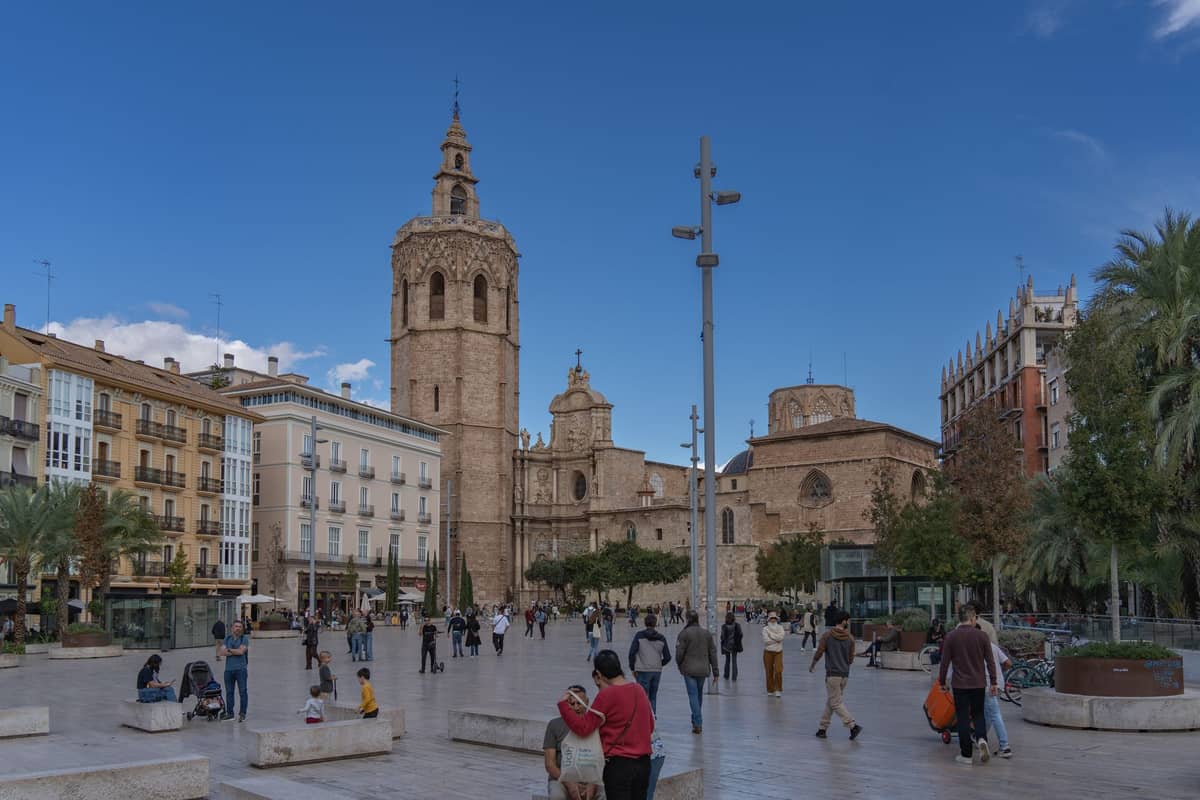
What Is El Micalet and Why Does It Matter?
The Torre del Micalet, known in Spanish as El Miguelete, is the freestanding bell tower attached to Valencia Cathedral. Construction began in 1381 and finished in 1429, making it a product of the late Gothic period when Valencia was one of the wealthiest trading cities in the western Mediterranean. The tower was never fully integrated into the cathedral's main structure, which is why it stands slightly apart, its octagonal silhouette visible from nearly every corner of the old city.
The name 'Micalet' comes from a large bell inside the tower, itself named after Saint Michael. That bell, cast in 1539, still rings on the hour and marks ceremonial occasions. Standing in Plaça de la Reina when it strikes is a genuinely loud, physical experience, the kind of thing that doesn't translate to a photograph.
At roughly 50 metres total height and with a viewing terrace a little below that, the tower is not Valencia's tallest structure, but it is the highest publicly accessible vantage point within the historic centre. That distinction matters: from here you see the old city as it was built, not obscured by modern towers on the periphery.
The Climb: What to Expect on the Way Up
Entry is through a low doorway at the base of the tower, directly off Plaça de la Reina. You purchase your ticket at the door. The staircase inside is a continuous spiral of 207 stone steps, worn smooth in the centre from centuries of foot traffic. The width narrows at certain points to barely one person across, which means traffic can back up if the tower is busy. There is no lift and no accessible alternative.
⚠️ What to skip
The terrace has a maximum capacity of 50 people. On busy weekend mornings in spring and summer, a short queue can form at the entrance. Arriving before 11:00 or after 16:00 on weekdays generally avoids the worst of it.
The walls of the stairwell are bare stone and cool to the touch even in August. You'll pass two small intermediate landings before emerging onto the terrace. The ascent takes most people around 8–12 minutes at a moderate pace, though it does raise your heart rate. Wear shoes with grip; the steps can be slippery when humidity is high after rain.
Visitors with knee problems, vertigo, or limited mobility should note honestly that this is a challenging climb with no alternative. The staircase is also quite dark in sections, lit only by narrow slits in the stone. Anyone uncomfortable in enclosed, dimly lit spaces should factor that in before purchasing a ticket.
Tickets & tours
Hand-picked options from our booking partner. Prices are indicative; availability and final rates are confirmed when you complete your booking.
Valencia Silk Museum tickets and audio guide
From 7 €Instant confirmationFree cancellationSaint Nicholas Church Entrance Tickets and Audioguide
From 11 €Instant confirmationHistoric Valencia walking tour
From 27 €Instant confirmationFree cancellationNatural thermal springs and Girlfriend Waterfall tour from Valencia
From 89 €Instant confirmationFree cancellation
The View from the Terrace
The terrace itself is open-air and relatively modest in size, reflecting that 50-person maximum. The railing is metal, not particularly high, so those with a fear of heights may feel exposed. But the view rewards the effort. Directly below, Plaça de la Reina fans out with its palm trees and café terraces. Further out, the terracotta rooflines of the Centro Histórico stretch in every direction, punctuated by church domes and the occasional modernist building from the 19th century.
To the northwest you can see the octagonal dome of the Cathedral itself and, on clear days, the towers of Torres de Serranos above the old city wall line. To the east, the horizon opens toward the sea, though the coast itself is not visible from this height. On exceptionally clear winter mornings, after rain has scrubbed the atmosphere, you can sometimes make out the silhouette of the mountains inland.
The view changes significantly depending on the light. At midday in summer, the bleached stone of the old city can look flat and overexposed in photographs. The richest light is in the hour before sunset, when the ochre and terracotta of the rooftiles catch warm, directional light. Morning visits offer a cooler climb and softer shadows, which suits wide-angle architectural photography better than midday.
💡 Local tip
For photography, a wide-angle or standard lens works best on the terrace. Telephoto lenses are awkward in the confined space. The Cathedral's dome makes a strong foreground element when shooting toward the north.
Historical and Architectural Context
The Micalet was built during a period of significant civic ambition in Valencia. By the late 14th century, the city was emerging as a major force in Mediterranean trade, and public monuments were ways of projecting that status. The tower's octagonal plan is characteristic of Valencian Gothic architecture, which drew on Catalan and southern French influences while developing its own regional character.
The tower sits adjacent to the Cathedral, which is itself a layered structure spanning Romanesque, Gothic, and baroque elements built over several centuries. If you want to understand the full architectural picture of the site, combining the Micalet visit with a tour of the Cathedral makes sense. Nearby, the Church of Santa Catalina has a baroque tower of its own that makes an interesting visual counterpoint from the Micalet terrace.
For a deeper look at Gothic civic architecture from the same era, La Lonja de la Seda (the Silk Exchange), a UNESCO World Heritage Site about a ten-minute walk away, is the most important surviving monument from Valencia's 15th-century golden age. The two sites pair well on a half-day walk through the Centro Histórico.
Visiting Hours and Practical Logistics
The tower is open year-round, but the schedule can shift seasonally. As of current information, it is generally open daily from 10:00 to 18:45, with the last entry shortly before closing; always confirm current hours on the Cathedral's official website before you go, as schedules can change for religious holidays and special events.
Admission is €3 for general entry, €2 reduced (for students and seniors, though eligibility criteria should be confirmed at the door), and €1 for residents of Valencia city and certain local educational or parish groups. Tickets are purchased on-site. There is no advance online booking for the tower alone as of current information, though this should be verified before visiting.
Getting there on foot is straightforward from most points in the Centro Histórico. The tower is directly on Plaça de la Reina, one of the central squares of the old city. By metro, Lines 3 and 5 to Colón station leave you roughly a ten-minute walk away. Multiple EMT city bus lines also stop close to the square.
ℹ️ Good to know
The Cathedral and Micalet can get crowded during Las Fallas (mid-March) and during peak summer weeks. If you're visiting Valencia in March, check whether any processions or events are using the square, as access can be temporarily affected.
How the Micalet Fits Into a Broader Itinerary
The Micalet works best as part of a morning in the old city rather than a standalone destination. After the climb, Plaça de la Reina is directly below with café terraces that do a reasonable coffee. From there, the Mercado Central is a seven-minute walk west, and the Basílica de la Virgen de los Desamparados is immediately adjacent to the Cathedral. A half-day circuit covering the Micalet, the Cathedral interior, and the market is a sensible and compact introduction to the historic centre.
If you want to orient yourself before visiting, the walking tour of Valencia's old city covers the Cathedral district in detail and gives useful context for understanding what you're looking at from the terrace.
One honest note: the Micalet is not a view that will redefine your understanding of Valencia. The city's most dramatic architecture, including the City of Arts and Sciences, is not visible from this point. What it does offer is a clear, mid-height perspective on the medieval city that no street-level walk can replicate. For travellers trying to understand the spatial logic of the old quarter, that perspective is genuinely useful.
Insider Tips
- The bell rings on the hour. If you time your exit from the terrace to coincide with the hour, you'll hear it from street level rather than from directly inside the tower, which is a more tolerable volume.
- The staircase is one-directional by convention: upward traffic takes priority. If you meet someone coming down, flatten yourself against the outer wall and let them pass.
- Weekday visits between 14:00 and 16:00 tend to be the quietest period, as the lunchtime crowds thin out and the afternoon tourist wave hasn't fully arrived.
- The terrace is exposed with no shade. In summer, even a 15-minute stay in direct midday sun is uncomfortable. Bring water and wear a hat if visiting between June and September.
- Combine with the Cathedral's Holy Grail chapel for a richer visit to the site. The chalice kept there is one of the oldest surviving candidates for the historical Holy Grail, and the combined ticket covers more of the Cathedral complex.
Who Is El Micalet (Cathedral Bell Tower) For?
- Travellers on a first visit who want to understand the layout of Valencia's old city before exploring on foot
- Architecture and history enthusiasts interested in Valencian Gothic construction
- Photographers looking for rooftop light over terracotta rooftiles, particularly in late afternoon
- Visitors combining a morning at the Cathedral, the Basílica, and the Mercado Central
- Budget travellers: at €3, it is one of the most affordable elevated views in any major Spanish city
Nearby Attractions
Other things to see while in Centro Histórico:
- Basílica de la Virgen de los Desamparados
The Real Basílica de Nuestra Señora de los Desamparados stands at the heart of Valencia's historic centre, housing the revered image of the city's patron saint. Built between 1652 and 1667, it is free to enter and open every day, making it one of the most accessible and emotionally resonant stops in the old city.
- Catedral de València
Rising above Plaza de la Reina in Valencia's historic centre, the Cathedral of Valencia is a remarkable layered monument built over seven centuries. From a Romanesque doorway to Gothic vaulting, a Baroque facade, and a relic claimed to be the Holy Grail, this is one of Spain's most architecturally complex and historically loaded churches.
- Centre Cultural La Nau
Housed in the University of Valencia's historic headquarters since the late 15th century, Centre Cultural La Nau is a historic landmark in the old town offering free exhibitions, concerts, and theatre. It rewards visitors who slow down and look closely.
- Centre Arqueològic de l'Almoina
Beneath a quiet plaza steps from Valencia Cathedral lies one of Spain's most compelling urban archaeology sites. The Centre Arqueològic de l'Almoina preserves around 2,500 square metres of Roman, Visigothic, and medieval remains, excavated over two decades and now visible through a striking modern structure.