Torres de Serranos: Valencia's Medieval Gateway Worth the Climb
Standing at the northern edge of the old city, the Torres de Serranos are the best-preserved gateway of Valencia's medieval Christian walls. Built between 1392 and 1398, these twin Gothic towers offer some of the finest rooftop views over the Turia gardens and the historic centre, all for a ticket price that undercuts almost every other monument in the city.
Quick Facts
- Location
- Plaza de los Fueros, s/n, 46003 Valencia (Barrio del Carmen)
- Getting There
- Closest metro: Túria (Line 1) or Ángel Guimerà. EMT bus lines 1, 5, 8, 26, 28, 95, and C1 stop nearby.
- Time Needed
- 30–45 minutes for a thorough visit including the tower climb
- Cost
- €2 general / €1 reduced. Free on Sundays and public holidays.
- Best for
- Architecture lovers, panoramic views, budget sightseeing, photography
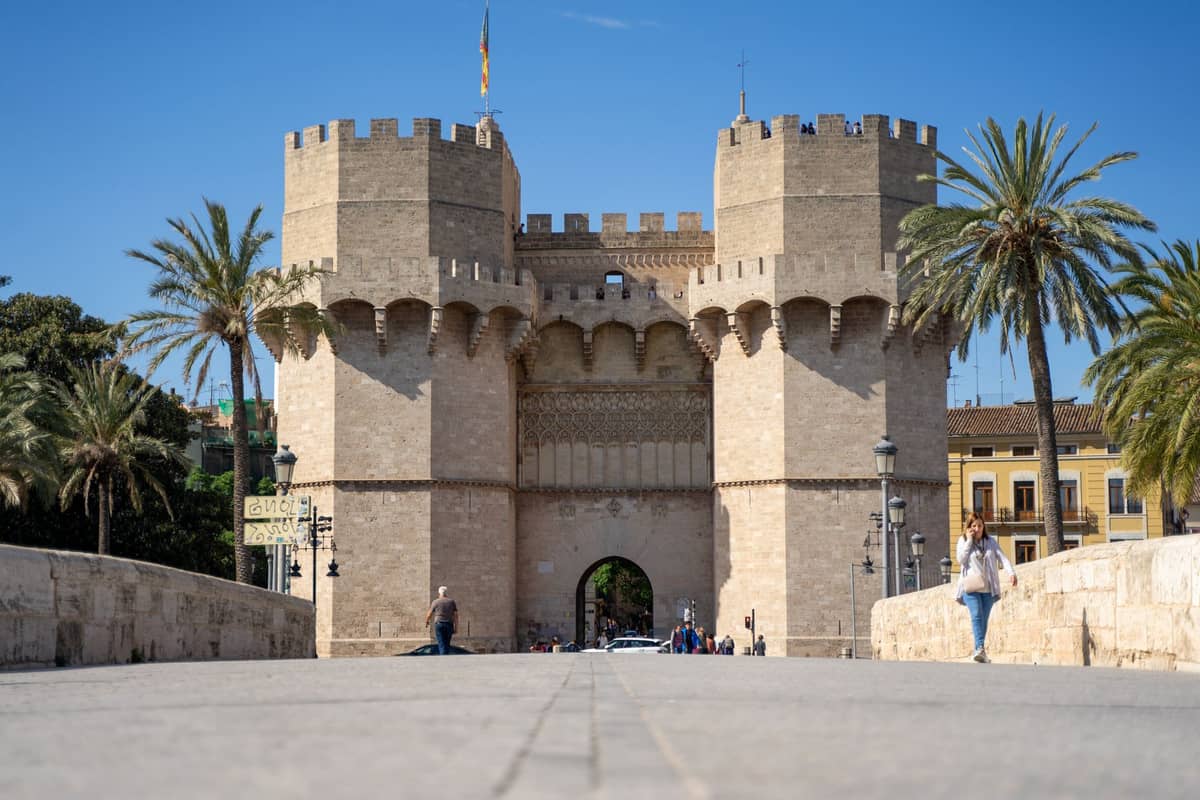
What You're Actually Looking At
The Torres de Serranos are two massive pentagonal towers connected by an ornate Gothic archway, forming what was once the principal northern gate into medieval Valencia. Each tower rises roughly 30 metres, and the stonework, weathered to a warm honey-gold after six centuries, gives the whole structure a weight that photographs rarely capture. The gate originally pierced Valencia's second Christian wall, which enclosed a city that had expanded well beyond its Roman and Moorish boundaries. Construction ran from 1392 to 1398, placing this firmly in the late Gothic period, and the architect Pere Balaguer gave it an unusual grace for a military structure: pointed arches, delicate tracery on the battlements, and an interior courtyard that was designed as much for ceremony as for defence.
The towers are among the best-surviving examples of Gothic civic architecture in Spain. Unlike many fortified gates that were demolished as cities modernised, the Serranos towers survived partly because of a grim secondary use: they served as a city prison from the 16th century until 1887. The cells and confines that once held prisoners are now open galleries, and the stone walls still bear the marks of long occupation. During the Spanish Civil War, the city's most valuable artworks were reportedly stored here for protection, adding another layer to an already complicated history.
The towers sit at the northern boundary of the Barrio del Carmen, where the old city meets the green corridor of the Turia gardens. That positioning is not coincidental: this was the road that led north toward the Serranos mountains, hence the name, and merchants, pilgrims, and royal processions all passed through this archway for centuries.
💡 Local tip
Sunday visits are free, but the tower platforms can get busy between 11:00 and 13:00. Arrive at opening time (10:00) on a Sunday for the best combination of no cost and manageable crowds.
The Experience: Ground Level to the Top
Entering from the Plaza de los Fueros, the scale of the gate becomes clear only once you step through the arch and look upward. The vaulted passageway connecting the towers still feels like a threshold: the noise of the street drops noticeably, and the temperature lowers a degree or two in the shade of the stone. Pigeons nest in the upper cornices, and on still mornings you can hear them before you see the towers above.
Inside, stone staircases wind up through each tower to connecting walkways and, eventually, the upper platform. The climb is not demanding, but the stairs are narrow and uneven in places, worn smooth by foot traffic over centuries. There is no elevator. The interior rooms along the way are largely bare, stripped of fixtures, but the scale of the walls and the depth of the window embrasures give a precise sense of how these spaces once functioned, half fortress, half administrative gateway.
The upper terrace is the payoff. From the battlemented walkway, you look directly south over the old city roofline: terracotta tiles, the bell tower of the Miguelete, and on clear days, a glimpse of the sea horizon to the east. Below and to the north, the Turia riverbed stretches away as a wide green park, framing the view in a way that makes it easy to understand how the city once ended exactly here, at this wall.
⚠️ What to skip
Access to the upper platform can be suspended without notice in adverse weather conditions, including rain, fog, and strong wind. If your visit is weather-dependent, check local conditions before travelling to the site. There is no partial refund system noted for weather closures.
Tickets & tours
Hand-picked options from our booking partner. Prices are indicative; availability and final rates are confirmed when you complete your booking.
Serranos Towers guided tour with skip-the-line entry
From 13 €Instant confirmationFree cancellationValencia Silk Museum tickets and audio guide
From 7 €Instant confirmationFree cancellationSaint Nicholas Church Entrance Tickets and Audioguide
From 11 €Instant confirmationHistoric Valencia walking tour
From 27 €Instant confirmationFree cancellation
How Time of Day Changes Everything
Early morning, around opening at 10:00, the towers are quiet and the light falls from the east across the facade in a way that brings out the texture of the cut stone. This is the best window for photography: no crowds on the platform, soft directional light, and the Turia gardens below still mostly empty of joggers and cyclists. The shadows in the archway are deep enough at this hour to make interior shots difficult without a wide-aperture lens, but the exterior and rooftop reward patience.
Midday in summer is genuinely uncomfortable on the exposed upper terrace. Valencia's summer sun is direct and there is no shade above the parapet. If you are visiting between June and September, the morning slot is not just preferable, it is practically necessary for anyone who wants to linger up top. The stone radiates heat from about 13:00 onward, and the platform empties quickly for that reason. In spring and autumn, midday visits are perfectly comfortable and the light is good.
Late afternoon, roughly 16:00–18:00, brings a second wave of visitors as the streets of Carmen fill up again. The westward light at this hour turns the stone almost orange, which looks striking from street level but creates harsh contrast on the terrace. If you are on a walking itinerary through the old city, the towers fit naturally as an early stop before the neighbourhood warms up with evening activity.
For a broader understanding of the city's best elevated vantages, the best viewpoints in Valencia guide compares the Serranos terrace against other options including El Miguelete and the Science Museum roof.
Historical and Architectural Context
Pere Balaguer, the architect credited with the design, built the Serranos gate nearly a century before the city commissioned the Silk Exchange (La Lonja de la Seda), a few streets to the south. Both projects reflect the ambition of a city at the height of its medieval commercial power, when Valencia was one of the most prosperous trading centres in the western Mediterranean. The Serranos towers are militarily functional but clearly designed to impress: the battlements are decorative as much as defensive, and the carved stonework on the arches was meant to announce the city's sophistication to anyone arriving from the north.
By the time the Spanish Civil War began in 1936, the towers had already outlasted their defensive purpose by several centuries. Their role as a repository for Valencia's art treasures during the conflict, including works from the Prado evacuated from Madrid, gave them an unexpected modern chapter. The irony of a medieval prison sheltering Velázquez and Goya from 20th-century artillery is not lost on anyone who reads the information panels inside the gate.
The towers are one anchor of a dense concentration of medieval and Gothic architecture in this part of the city. The La Lonja de la Seda, a UNESCO World Heritage Site, is roughly a 10-minute walk south, and the Cathedral is within easy reach on the same walking loop. For a structured overview of Valencia's surviving Gothic and Art Nouveau buildings, the Valencia architecture guide provides context for the whole city.
Opening Hours, Prices, and Getting There
The Torres de Serranos are open Monday to Saturday from 10:00 to 19:00, and on Sundays and public holidays from 10:00 to 14:00. Last entry is 30 minutes before closing. The monument is shut on 1 January, 6 January, 1 May, and 25 December.
General admission is €2. Reduced tickets at €1 are available for groups, students with a Jove card, pensioners, and children aged 7 to 12. Children under 7 enter free. Entry is free for everyone on Sundays and public holidays, which makes this one of the more accessible monuments in the city for budget travellers.
The towers are located at Plaza de los Fueros, s/n, in the Barrio del Carmen section of Valencia's historic centre (Ciutat Vella). The nearest metro stop is Túria on Line 1, or Angel Guimerà, both requiring a short walk of around 10–12 minutes through the old town. Multiple bus lines including 5, 6, 8, 9, and 70 pass close to the historic centre. If you are already exploring Carmen on foot, the towers are impossible to miss once you reach the northern edge of the neighbourhood. For detailed transit options across the city, the guide to getting around Valencia covers metro, bus, and cycling routes.
ℹ️ Good to know
The Turia Garden path runs directly below the towers. If you are cycling or walking through the park, the Serranos towers make a natural and very low-cost detour. Lock your bike at the park perimeter and walk up through the gate.
Practical Details Worth Knowing Before You Go
Wear shoes with a grip: the interior staircase treads are smooth stone, polished by centuries of foot traffic, and can be slippery if there has been any moisture. There is no handrail along the full length of the narrower sections. The upper terrace has a low-to-moderate parapet, which is adequate for most adults but worth noting if you are visiting with young children or anyone uneasy with heights.
Photography is permitted throughout. The best shots from the terrace use a wide-angle lens to capture both the gate structure below and the city panorama. The view north over the Turia is cleanest in the morning before the gardens fill up. For street-level shots of the facade, the square in front of the arch provides enough distance to frame the full height of both towers.
The Turia Garden directly below the towers is Valencia's 9-kilometre linear park converted from the former river course after the 1957 flood diversion. If you want to extend your visit into the park, the cycling guide to the Turia Garden covers the full route and what you pass along the way.
The monument is not wheelchair accessible due to the narrow stone staircases. The ground-level archway and exterior are accessible, and the historical information panels are placed at the base, but the tower platforms require the staircase climb. There is no lift.
Insider Tips
- The free Sunday window runs only until 14:00, which is also when the site closes. Arrive at 10:00 on a Sunday to get the full experience at no cost and avoid the midday rush that peaks around noon.
- The exterior facade photographs best in the morning when the sun falls from the east. Late afternoon from the square in front of the gate gives a warm but very contrasty shot due to backlighting.
- The Torres de Quart, the city's other surviving medieval gateway, stands at the opposite (western) end of the same medieval wall circuit. Visiting both on the same afternoon walk gives a complete picture of Valencia's fortifications, and Torres de Quart is free to enter.
- If you are in Valencia during Las Fallas in March, the towers serve as the symbolic backdrop for the Crida ceremony, where the Fallera Mayor announces the start of the festival from the top of the gate. It is a rare moment when the monument is packed and theatrically lit at night.
- The square in front of the gate (Plaza de los Fueros) is quiet by Valencia standards and has benches. It is a useful rest stop on any walking route through Carmen, with the towers providing shade on the northern side in the afternoon.
Who Is Torres de Serranos For?
- Architecture and history enthusiasts wanting a Gothic landmark that rewards close inspection, not just photographs from a distance
- Budget travellers: at €2, or free on Sundays, this is one of the cheapest meaningful attractions in the city
- Photographers looking for elevated, unconventional views of Valencia's rooftops and the Turia corridor
- Walkers doing a loop through the Barrio del Carmen and the historic centre, for whom the towers mark a natural turning point
- Anyone combining a visit to the Turia Garden park with old-city sightseeing, since the towers sit directly above the park's northern edge
Nearby Attractions
Other things to see while in Barrio del Carmen:
- Casa-Museo Benlliure
Tucked into a narrow street in the historic El Carme quarter, the Casa-Museo Benlliure preserves the home and studio of José Benlliure Gil exactly as the painter left it. With original furnishings, Italian treasures, and a rear garden studio, it offers an unusually intimate glimpse into 19th-century Valencian artistic life — at a price that makes it one of the most accessible museums in the city.
- Centre del Carme Cultura Contemporània (CCCC)
The Centre del Carme Cultura Contemporània occupies a historic monastery complex in the heart of El Carme. Today it hosts rotating contemporary art exhibitions, all free to enter, inside one of Valencia's most atmospheric historic complexes.
- Iglesia de San Nicolás
Hidden in plain sight on Calle Caballeros, the Iglesia de San Nicolás is one of Valencia's oldest churches and its most visually overwhelming interior. A Gothic shell completely transformed by Renaissance frescoes, it rewards visitors who look up the moment they step through the door.
- IVAM – Institut Valencià d'Art Modern
The IVAM, or Institut Valencià d'Art Modern, is Valencia's flagship museum of modern and contemporary art, housed in a purpose-built concrete complex on the edge of the historic Barrio del Carmen. With a permanent collection built around sculptor Julio González and a rotating programme of international exhibitions, it delivers more than its reputation suggests for a regional institution.