La Lonja de la Seda: Valencia's Gothic Silk Exchange Explained
Built between 1482 and 1548, La Lonja de la Seda is Valencia's most significant civic monument and a UNESCO World Heritage Site. The late Gothic Contract Hall, its twisted stone columns rising to a vaulted ceiling, stands as one of medieval Europe's finest commercial buildings. Entry costs just €2, and on Sundays it's free.
Quick Facts
- Location
- Calle de la Lonja, 2, 46001 València — El Mercat area, historic centre
- Getting There
- Short walk from Plaza del Ayuntamiento metro/bus stops; adjacent to Mercado Central
- Time Needed
- 45–75 minutes
- Cost
- €2 standard / €1 reduced / Free on Sundays and public holidays
- Best for
- Architecture lovers, history enthusiasts, UNESCO site collectors
What Is La Lonja de la Seda?
La Lonja de la Seda — formally the Lonja de la Seda de València, also known as the Lonja de los Mercaderes — was built between 1482 and 1548 as Valencia's silk and commodity exchange. It sits on Plaza del Mercado in the historic centre, directly across from the Church of Santos Juanes and beside the Mercado Central. The UNESCO World Heritage Committee inscribed it in 1996 (Site ID 782), recognising it as an outstanding example of late Gothic civil architecture in Europe.
To understand why this building matters, you need a little context. In the late fifteenth century, Valencia was one of the wealthiest trading cities in the western Mediterranean. The silk trade, in particular, generated enormous fortunes. The city commissioned a new exchange to reflect that status — not a church, not a palace, but a merchant hall. The result, designed and built under master builder Pere Compte, is a building that treats commerce as something worthy of monumental architecture.
The official English name is the Silk Exchange, though 'silk market' appears in some references. Neither fully captures what the building was: a legally recognized trading floor where contracts were sealed, debts recorded, and merchants gathered under the explicit protection of civic law.
ℹ️ Good to know
Opening hours: Monday–Saturday 10:00–19:00. Sunday and public holidays 10:00–14:00. Closed on certain public holidays including 1 January, 6 January, 1 May, and 25 December.
The Contract Hall: What You'll Actually See
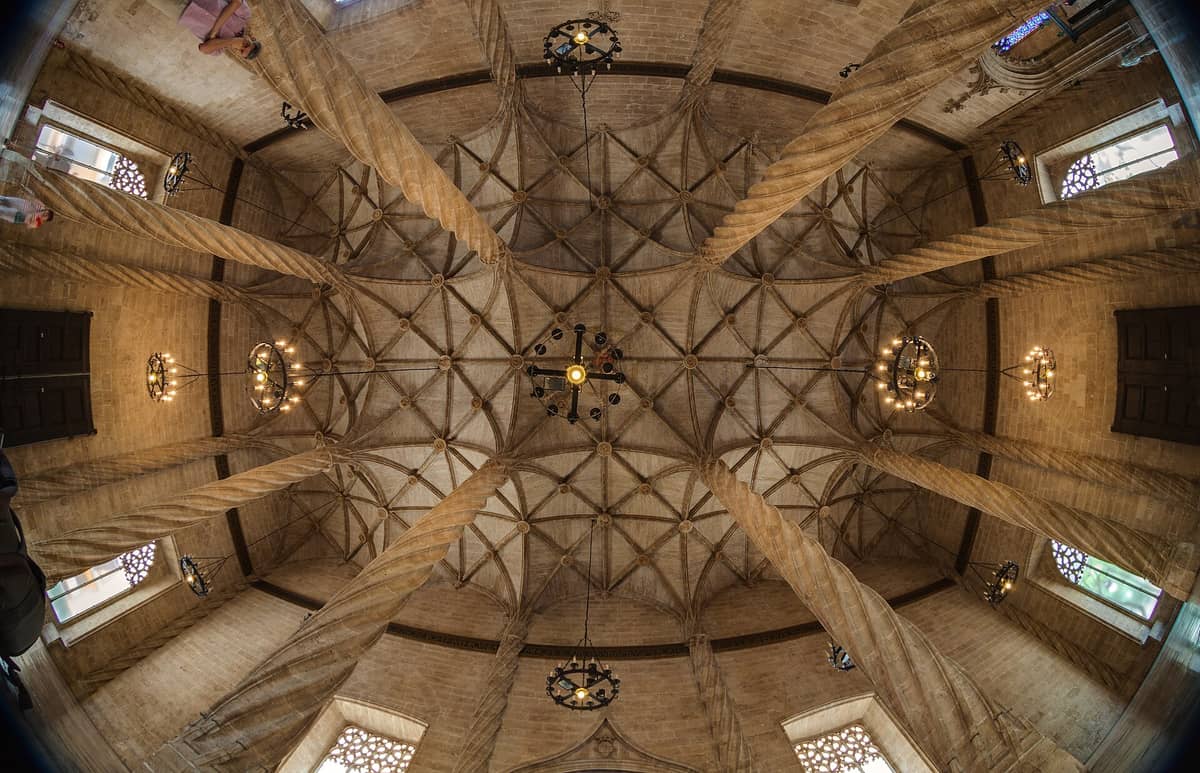
The centrepiece of the visit is the Sala de Contratación — the Contract Hall. Step inside and the scale of the room stops most visitors mid-stride. Eight slender helical columns, twisted like ropes of stone, rise roughly 17 metres before fanning out into interlocking ribs that form the vaulted ceiling. There are no intervening walls, no visual clutter. The floor is original stone, worn smooth at the foot of each column by centuries of foot traffic. In the morning, light enters from the tall windows on the eastern side and falls in long rectangles across the floor.
The columns are the detail most people remember. The spiral carving is not decorative in the ornamental sense — it is structural, distributing load while creating the visual impression that the ceiling floats. The stonework is cream-grey Valencian limestone, pale enough to reflect light, dense enough to have survived more than five centuries without significant structural intervention.
Running along the upper walls of the hall is a Latin inscription from Cicero's letters, referencing honest trade and the dignity of commerce. The original merchants who conducted business here were required to trade under the literal inscription of civic ethics. That detail, small and easy to miss, says more about the building's intent than almost anything else.
💡 Local tip
Photography tip: The Contract Hall photographs best in the morning (before noon) when eastern light fills the space. By early afternoon, the room flattens into even, cool shadow. A wide-angle lens or a phone camera stepped back to the far wall captures the column rhythm best.
Tickets & tours
Hand-picked options from our booking partner. Prices are indicative; availability and final rates are confirmed when you complete your booking.
La Lonja de la Seda guided tour with fast track entry
From 13 €Instant confirmationFree cancellationValencia English tour with entry to La Lonja, Catedral and San Nicolas
From 39 €Instant confirmationFree cancellationValencia Spanish tour with entry to La Lonja, Catedral and San Nicolas
From 49 €Instant confirmationFree cancellationValencia Italian tour with entry to La Lonja, Catedral and San Nicolas
From 49 €Instant confirmationFree cancellation
The Tower, Chapel, and Patio de los Naranjos
The building is more complex than a single hall. A separate tower contains a Gothic chapel on the upper floor, originally used for religious observances by the merchants and their guild. The tower interior is accessed via a narrow staircase and the chapel is small — intimate rather than grand. It is easy to overlook if you spend all your time in the Contract Hall, which is a mistake worth avoiding.
The Patio de los Naranjos (Courtyard of the Orange Trees) connects the main hall to the Consulado del Mar, a later addition used for maritime commercial disputes. The courtyard is planted with orange trees in a formal grid, a common element in Valencian ecclesiastical and civic architecture. On cooler mornings the air in the courtyard carries the faint citrus scent of the trees. It is quieter than the main hall, and during summer it provides shade that makes it a natural pause point in any visit.
The Consulado del Mar wing dates to the sixteenth century, slightly later than Pere Compte's original work. Its ground floor was used as a prison for merchants who defaulted on their debts — a reminder that this was not merely a ceremonial space but a fully functioning legal and financial institution.
How the Experience Changes by Time of Day
The Lonja is busy on weekend mornings, particularly between 11:00 and 13:00, when tour groups from the Mercado Central drift over. The Contract Hall can feel crowded at these times, with audio guides competing against tour guides in three or four languages simultaneously. If you have any flexibility, a weekday morning at opening time (10:00) is the closest you will get to having the hall to yourself.
Sunday entry is free, which draws more casual visitors. The reduced hours (closing at 14:00) mean the building fills quickly after 11:00. If you plan to visit on a Sunday, arrive at opening or accept that you will be sharing the space generously.
Late afternoon on weekdays — after 16:00 — tends to be calmer. The light in the Contract Hall is less dramatic by then, but the crowd dynamic makes the space easier to appreciate at your own pace. The building is not large enough to absorb heavy visitor numbers without the atmosphere shifting noticeably.
💡 Local tip
The Valencia Tourist Card includes free entry. If you are already planning to visit multiple paid attractions, the card often pays for itself quickly. Check current pricing and inclusion terms before purchasing.
Historical and Architectural Context
La Lonja de la Seda belongs to a category of secular Gothic architecture that is less well known internationally than the great cathedrals, but arguably more significant as an expression of civic and mercantile culture. Compare it to Valencia's own Cathedral and the difference in intent is clear: the Cathedral reaches upward in service of the divine; the Lonja spreads outward in service of commerce. Both are Gothic, but they express entirely different systems of power.
Pere Compte, the master builder credited with the design, was the leading Gothic architect in the Valencian Crown in the late fifteenth century. His work at the Lonja shows the mature phase of Valencian Gothic, where structural logic and decorative restraint work together rather than competing. The building avoids the layered ornamental excess of Plateresque architecture (which was emerging in Castile at the same time) and instead relies on proportion and the quality of the stonework.
For visitors interested in how this style developed across the city, the architecture guide for Valencia provides broader context, though the Lonja predates the later architectural movements the city is also known for by several centuries.
Construction spanned more than sixty years across multiple phases, which is reflected in slight stylistic variations between the Contract Hall (the oldest section, completed around 1498) and later additions. The building functioned as a trading exchange for roughly two hundred years before economic and political changes shifted the commercial center of gravity elsewhere in the city.
Getting There and Practical Notes
The Lonja sits in the El Mercat area of the historic centre, a short walk from Plaza del Ayuntamiento. Bus and metro services reach Plaza del Ayuntamiento from most parts of the city, and from there the Lonja is a five-to-seven minute walk north-west. The Mercado Central is immediately adjacent, which makes combining both into one morning visit logical and efficient.
The building is medieval in construction. Floors are uneven stone, and some sections require navigating narrow staircases without handrails. Visitors with reduced mobility should be aware that the heritage context means full modern accessibility adaptation is not in place. For specific accessibility queries, contact the city tourist office or visit Valencia's official tourism site before arriving.
There is no café or bookshop inside the building. The surrounding streets have several cafés and the Mercado Central itself is one of the best places in the city to eat at midday. Plan the Lonja visit before or after time at the market rather than as an isolated stop.
⚠️ What to skip
The Lonja closes on certain public holidays (1 January, 6 January, 1 May, 25 December). Check the municipal tourism site before visiting on or near a public holiday, as closures are not always flagged prominently at the entrance.
Is La Lonja de la Seda Worth Your Time?
At €2 for standard entry — and free on Sundays — the Lonja presents almost no financial barrier. The more relevant question is whether Gothic civic architecture interests you enough to spend 45 to 75 minutes here. If your answer is yes, or even uncertain, the Contract Hall will likely resolve the question within the first two minutes of walking in.
Visitors primarily drawn to Spanish architecture through its Baroque or Modernista expressions sometimes find the Lonja austere by comparison. There is no gilded altar, no tiled façade, no dramatic external silhouette. The building rewards attention to structure, proportion, and historical imagination rather than surface spectacle. That is not a weakness, but it is worth knowing before you go.
Families with young children can visit, but the lack of interactive content means engagement depends heavily on the adults explaining context. The Valencia with kids guide covers more family-oriented alternatives nearby if the Lonja is not the right fit for younger visitors.
Insider Tips
- Arrive at 10:00 on a weekday to have the Contract Hall almost entirely to yourself. The difference in atmosphere compared to a Saturday at 11:30 is substantial.
- Look up at the ceiling before looking at the columns. Starting with the vault and then tracing the lines down to their source gives you a much better sense of how the structural system works.
- The Latin inscription running along the upper walls of the Contract Hall is from Cicero. Take a moment to read it — or photograph it and translate it later. It reframes what the building was actually for.
- The Consulado del Mar wing is often rushed or skipped. The ground floor prison cells, where defaulting merchants were held, are a jarring counterpoint to the elegance of the main hall above.
- Combining the Lonja with the Mercado Central and the Museo Nacional de Cerámica on the same morning covers three of Valencia's most architecturally significant interiors within a short walking radius.
Who Is La Lonja de la Seda For?
- Architecture and medieval history enthusiasts who want to see Gothic civil design at its European peak
- UNESCO World Heritage site visitors with a serious interest in the monument's context
- Photographers working on interior architectural subjects — the Contract Hall columns are among the most photogenic spaces in Valencia
- Budget-conscious travellers: free on Sundays, negligible cost otherwise
- Visitors combining a morning at the Mercado Central with a cultural stop that requires minimal additional time
Nearby Attractions
Other things to see while in Centro Histórico:
- Basílica de la Virgen de los Desamparados
The Real Basílica de Nuestra Señora de los Desamparados stands at the heart of Valencia's historic centre, housing the revered image of the city's patron saint. Built between 1652 and 1667, it is free to enter and open every day, making it one of the most accessible and emotionally resonant stops in the old city.
- Catedral de València
Rising above Plaza de la Reina in Valencia's historic centre, the Cathedral of Valencia is a remarkable layered monument built over seven centuries. From a Romanesque doorway to Gothic vaulting, a Baroque facade, and a relic claimed to be the Holy Grail, this is one of Spain's most architecturally complex and historically loaded churches.
- Centre Cultural La Nau
Housed in the University of Valencia's historic headquarters since the late 15th century, Centre Cultural La Nau is a historic landmark in the old town offering free exhibitions, concerts, and theatre. It rewards visitors who slow down and look closely.
- Centre Arqueològic de l'Almoina
Beneath a quiet plaza steps from Valencia Cathedral lies one of Spain's most compelling urban archaeology sites. The Centre Arqueològic de l'Almoina preserves around 2,500 square metres of Roman, Visigothic, and medieval remains, excavated over two decades and now visible through a striking modern structure.