Mercado Central de Valencia: What to Expect Inside One of Europe's Great Food Markets
The Mercado Central de Valencia, an Art Nouveau landmark inaugurated in 1928, is where the city does its daily shopping beneath iron-framed domes and stained glass. Free to enter, open Monday to Saturday from 7:30 to 15:00, it is both a working market and an architectural spectacle worth planning your morning around.
Quick Facts
- Location
- Plaça Ciutat de Bruges, s/n, 46001 València — historic centre, opposite La Lonja de la Seda
- Getting There
- Walkable from most of the old city; city bus lines serve nearby Plaça del Mercat
- Time Needed
- 45 minutes to browse; 90 minutes if you linger and shop
- Cost
- Free entry; purchases at vendor prices
- Best for
- Food lovers, architecture enthusiasts, early risers, photographers
- Official website
- www.mercadocentralvalencia.es
First Impressions: A Building That Stops You in the Street
The Mercado Central de Valencia announces itself before you even reach the entrance. Standing at the corner of Plaça Ciutat de Bruges, the market's facade is a sweep of ceramic tiles, wrought iron, and ornamental stone that looks more like a civic palace than a grocery hall. The central dome, topped with a ceramic weathervane in the shape of a parrot and a dragonfly, catches whatever light Valencia chooses to offer that morning.
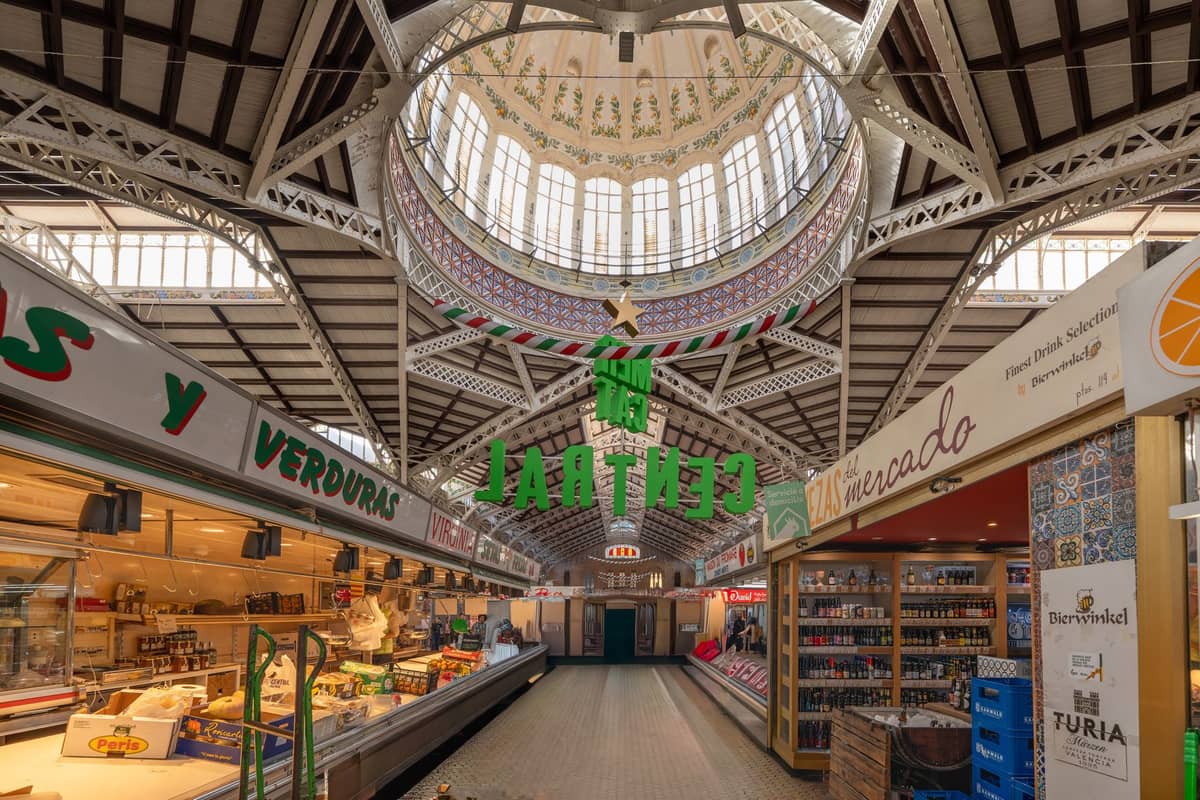
Opened in 1928 after roughly fourteen years of construction, the building was designed in the Valencian Art Nouveau style, a movement known locally as Modernisme. The architects Francesc Guàrdia Vial and Alexandre Soler March produced one of the largest covered markets in Europe, with a floor area of roughly 8,000 square metres. The scale is easier to appreciate from outside than from within, where the iron columns and glass ceilings draw your eye upward more than outward.
The market sits directly opposite La Lonja de la Seda, Valencia's 15th-century silk exchange and a UNESCO World Heritage Site. Together, the two buildings frame one of the most architecturally layered corners in the historic centre. If you arrive from the Lonja side, stop for a moment before crossing — the Mercado Central's full facade reads best from that distance.
💡 Local tip
Arrive before 09:00 on a weekday if you want to experience the market as locals use it, with vendors fully stocked, produce freshly arranged, and the aisles clear enough to actually navigate. By 11:00 on Saturdays, the central corridors can feel uncomfortably packed.
Inside the Market: What You'll Actually Find
Step through the main entrance and the sensory shift is immediate. The smell arrives first: citrus and cut herbs, then the briny edge of fresh fish from the dedicated seafood section, then something warmer from the dried fruit and nut stalls near the centre. The floor is laid with original mosaic tiles, worn smooth in the high-traffic lanes, and the iron columns rise to meet a clerestory of coloured glass that scatters the morning light in amber and green.
The stalls are arranged by category in a loose but logical pattern. Fruit and vegetables occupy much of the central floor, and Valencia's agricultural hinterland is represented in detail: local oranges and clementines in winter and spring, enormous beefsteak tomatoes in summer, persimmons in autumn. The seafood section stocks whatever came off the boats at the Grau fishing harbour that morning, including sea bream, sardines, squid, and shellfish. Butchers, charcuterie vendors, and olive sellers fill in the surrounding aisles.
There are also prepared food counters offering products to take away: fresh pasta, croquettes, house-made pastries, and — inevitably in Valencia — horchata-adjacent products and tiger nut preparations. A handful of small bars and counters inside the market serve coffee and a quick bite, useful if you want to eat before the surrounding restaurants open.
ℹ️ Good to know
The Mercado Central is a working market, not a food hall. Vendors are selling to local households and restaurant buyers, not primarily to tourists. Prices reflect that — which is a good thing.
Tickets & tours
Hand-picked options from our booking partner. Prices are indicative; availability and final rates are confirmed when you complete your booking.
Historic Valencia walking tour
From 27 €Instant confirmationFree cancellationValencia Food Tour with Tapas & Drinks with a Local
From 85 €Instant confirmationFree cancellationDiscover Valencia old town with tapas and wine in an 11th Century Historical Monument
From 80 €Instant confirmationFree cancellationValencia Silk Museum tickets and audio guide
From 7 €Instant confirmationFree cancellation
The Architecture in Detail: More Than a Backdrop
Visitors who treat the Mercado Central purely as a shopping stop miss half the reason to come. The building is a sustained work of decorative architecture, and it rewards slow attention. Look at the ironwork closely: the columns are not plain structural members but cast with foliate detail. The ceramic panel work on the exterior walls uses the vivid blues and ochres typical of Valencian tilework, and the roofline includes small towers capped with glazed ceramic in turquoise and gold.
The Modernisme movement that produced the Mercado Central was the same cultural moment that shaped Antoni Gaudí's work in Barcelona and much of the ornamental architecture of early 20th-century Spain. Valencia's version tends toward the restrained and municipal rather than the fantastical, but the Central Market is one of its finest surviving examples. For more context on how the building fits into Valencia's broader architectural story, the Art Nouveau architecture guide for Valencia is worth reading before or after your visit.
Photography inside the market is possible and the light conditions are genuinely good in the hours before noon, when daylight pours in through the upper glazing. The fish counters, with their ice beds and colour, make for strong close-up shots. The overhead views of the central dome are possible from the upper-level walkway if it is accessible on the day you visit — confirm this on arrival.
How the Market Changes Through the Day
The market opens at 07:30, and this first hour is when professional buyers, restaurant chefs, and committed locals do their shopping. The pace is quick, the conversation between vendors and regulars is dense and rapid, and the stalls are at their fullest. If you are comfortable navigating a purposeful crowd and want to see the market functioning at full pitch, this is the hour to come.
From around 09:30 to 11:00, the pace settles into something more manageable. Most vendors are still fully stocked, the light through the glazed ceiling is at its most photogenic, and you can stop to look without blocking someone's purchase. This window is the most comfortable for visitors who want to browse, ask questions, and shop without feeling rushed.
Saturdays between 10:00 and 13:00 can be genuinely difficult. Locals doing their weekend shop combine with tourists and the corridors narrow quickly. If you are visiting on a Saturday specifically to see the market in full social swing, that is a legitimate reason to go at that time. If you want to actually buy things comfortably, come on a Tuesday or Wednesday.
⚠️ What to skip
The market is closed on Sundays and public holidays. There are several public holidays in Valencia beyond the national Spanish calendar, including the Fallas period in March. Check the official site before planning around a specific date.
What to Buy and What to Skip
Fresh produce, seafood, olives, charcuterie, and local cheeses are the best purchases here. The fruit in particular reflects Valencia's position at the edge of one of Spain's most productive agricultural plains: the quality is high and the prices are reasonable. Olive varieties from the region are worth exploring at the specialist stalls, where vendors will usually let you taste before buying.
If you are visiting Valencia specifically to understand its food culture, the market is a good starting point — but pair it with reading about what to eat in Valencia so you arrive knowing what you are looking at. The tiger nut (xufa) products, for example, are easy to miss if you do not know what to look for.
Skip the souvenir items and packaged goods sold near the main entrance. These are aimed squarely at passing tourist traffic and are priced accordingly. The best value and quality are in the interior stalls, where vendors are competing for local trade.
Getting There and Practical Notes
The Mercado Central is in the heart of Valencia's old city and is walkable from most central accommodation. The address is Plaça Ciutat de Bruges, s/n, in the postal code 46001. Several city bus lines stop at or near Plaça del Mercat, immediately adjacent. The surrounding streets are dense with foot traffic during market hours, and cycling directly to the entrance can be awkward — the nearby bike lanes connect well, but plan to park before the plaza.
The market sits within easy walking distance of other major sites in the historic centre, including the Cathedral of Valencia and the Iglesia de San Nicolás. A morning that starts at the market and continues through this cluster of streets makes for a coherent few hours on foot.
Detailed accessibility information is not listed on the official market site. If you have specific requirements, contact the market administration directly before visiting. The main entrance floor is at street level, but the internal layout includes uneven mosaic tiling and some narrow passages between stalls.
The official hours are Monday to Saturday, 07:30 to 15:00, and the market is closed on Sundays and public holidays. Some stalls begin packing down before 14:30, particularly the seafood vendors when their stock runs out. If you want to see the full selection, do not arrive after 13:00.
An Honest Assessment: Is It Worth the Visit?
The Mercado Central appears on nearly every Valencia itinerary, and that popularity has consequences. In peak tourist season, particularly July and August, the market can feel less like a local institution and more like a managed attraction. The fundamentals, however, have not been hollowed out. Local families and restaurants still shop here in real numbers, and the building itself remains extraordinary.
Visitors who might want to skip it: anyone who has already visited La Boqueria in Barcelona and found it too crowded to enjoy should note that the Mercado Central is more functioning market than spectacle, but it shares some of the same dynamic on busy mornings. Travelers with no interest in food shopping and limited time in Valencia might find other parts of the historic centre more rewarding for their specific priorities.
For those building a broader visit, the market fits naturally into a walking tour of Valencia's old city or a morning structured around the historic centre before heading to other neighbourhoods in the afternoon.
Insider Tips
- Weekday mornings between 09:30 and 11:00 offer the best balance of full stalls, good light, and manageable crowds. Tuesday and Wednesday are the quietest days of the week.
- The fish vendors often run out of premium cuts and freshest stock by early afternoon. If seafood is your priority, arrive by 10:00 at the latest.
- The small bars inside the market serve coffee at counter prices. They are easy to miss but worth seeking out — particularly the ones tucked near the back, which are more likely to be filled with vendors on a break than with tourists.
- The facade photographs best from the La Lonja de la Seda side of the plaza, especially in the late morning when the light hits the ceramic tiles directly. Give yourself time before entering to look at the building from across the square.
- If a vendor does not have a price displayed, asking is expected and normal. Most vendors in the central aisles are accustomed to non-Spanish speakers and will manage.
Who Is Mercado Central For?
- Food lovers who want to shop local produce, seafood, and regional specialities at working-market prices
- Architecture and design enthusiasts interested in early 20th-century Valencian Modernisme
- Photographers looking for the combination of natural overhead light, colour, and human activity
- Early risers who want to build a morning itinerary around the historic centre
- Travelers who want to understand Valencia's food culture from the ground up, before sitting down to eat
Nearby Attractions
Other things to see while in Centro Histórico:
- Basílica de la Virgen de los Desamparados
The Real Basílica de Nuestra Señora de los Desamparados stands at the heart of Valencia's historic centre, housing the revered image of the city's patron saint. Built between 1652 and 1667, it is free to enter and open every day, making it one of the most accessible and emotionally resonant stops in the old city.
- Catedral de València
Rising above Plaza de la Reina in Valencia's historic centre, the Cathedral of Valencia is a remarkable layered monument built over seven centuries. From a Romanesque doorway to Gothic vaulting, a Baroque facade, and a relic claimed to be the Holy Grail, this is one of Spain's most architecturally complex and historically loaded churches.
- Centre Cultural La Nau
Housed in the University of Valencia's historic headquarters since the late 15th century, Centre Cultural La Nau is a historic landmark in the old town offering free exhibitions, concerts, and theatre. It rewards visitors who slow down and look closely.
- Centre Arqueològic de l'Almoina
Beneath a quiet plaza steps from Valencia Cathedral lies one of Spain's most compelling urban archaeology sites. The Centre Arqueològic de l'Almoina preserves around 2,500 square metres of Roman, Visigothic, and medieval remains, excavated over two decades and now visible through a striking modern structure.