Casa-Museo Benlliure: Inside a Valencian Painter's World
Tucked into a narrow street in the historic El Carme quarter, the Casa-Museo Benlliure preserves the home and studio of José Benlliure Gil exactly as the painter left it. With original furnishings, Italian treasures, and a rear garden studio, it offers an unusually intimate glimpse into 19th-century Valencian artistic life — at a price that makes it one of the most accessible museums in the city.
Quick Facts
- Location
- Calle Blanquerías 23, 46003 Valencia (El Carme, Ciutat Vella)
- Getting There
- Multiple bus lines serve the area, including lines 1, 5, 5B, 6, 11, 16, 26, 28, 29, 36, 80, 95 and N10. No metro stop directly adjacent — the museum is best reached on foot from the historic centre.
- Time Needed
- 45 minutes to 1.5 hours
- Cost
- €2 standard; €1 reduced (children 7–12, students with youth card, groups); free on Sundays and public holidays
- Best for
- Art history lovers, architecture admirers, anyone seeking a slow, quiet detour from Valencia's crowded landmarks
- Official website
- cultural.valencia.es/en/museu/benlliure-house-museum
What Is the Casa-Museo Benlliure?
The Casa-Museo José Benlliure is a municipal museum housed in the actual residence of the Valencian painter José Benlliure Gil, who bought the property on Calle Blanquerías in 1912 after spending years in Rome. Benlliure transformed the house over time, importing Italian furnishings, decorative objects, and artworks to create a home that doubled as an expression of his aesthetic sensibility. A separate studio pavilion was later built in the rear garden for both himself and his son, the painter Pepino Benlliure.
Unlike larger civic museums organized around chronology or genre, this is a house museum in the truest sense. The rooms feel lived-in rather than curated. Ceramics sit on shelves, painted portraits hang alongside personal photographs, and the garden studio still holds the tools of the trade. The cumulative effect is less like visiting an exhibition and more like stepping uninvited into someone's afternoon.
💡 Local tip
Entry is free every Sunday and on public holidays. If your schedule is flexible, Sunday morning — arriving close to 10:00 — offers the quietest experience in the building.
The Benlliure Family and Their Place in Valencian Art
José Benlliure Gil (1855–1937) belonged to one of the most remarkable artistic families in 19th-century Valencia. His brother Mariano Benlliure became one of Spain's most celebrated sculptors, responsible for monumental bronze works found across the country. José himself trained primarily in Rome and later worked in other European centres, becoming known for intimate genre scenes — domestic interiors, North African subjects, religious processions — painted with the luminous attention to light that characterized the Valencia school of the period.
The decision to settle permanently in this house on returning from Italy was both practical and symbolic. Benlliure wanted a space that reflected the visual culture he had absorbed abroad. The Italian furniture, the majolica ceramics, the small devotional paintings — all were brought back deliberately. The house, in other words, is not just where he lived. It is an argument about what a painter's life should look like.
For broader context on the artistic heritage embedded in Valencia's historic center, the Museo de Bellas Artes Valencia holds a large collection of Valencian painting from the same period, and makes for a natural companion visit on the same day.
Tickets & tours
Hand-picked options from our booking partner. Prices are indicative; availability and final rates are confirmed when you complete your booking.
Valencia Silk Museum tickets and audio guide
From 7 €Instant confirmationFree cancellationValencia English tour with entry to La Lonja, Catedral and San Nicolas
From 39 €Instant confirmationFree cancellationValencia top attractions MegaPass Classic with Oceanografic and Science Museum
From 79 €Instant confirmationValencia Spanish tour with entry to La Lonja, Catedral and San Nicolas
From 49 €Instant confirmationFree cancellation
A Room-by-Room Walkthrough
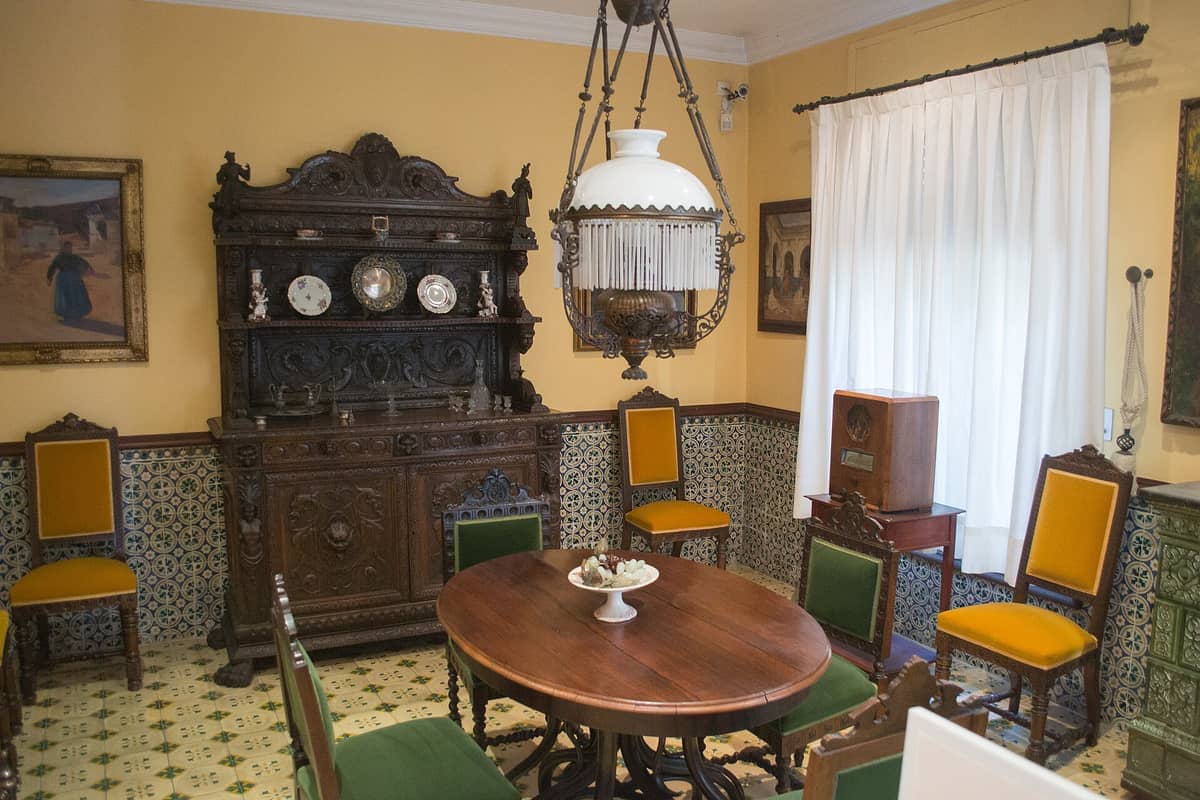
The ground floor sets the tone immediately. The entrance hall and reception rooms are furnished as Benlliure left them: carved wooden furniture, tiled floors with a warm ochre-and-white pattern underfoot, walls hung with paintings at every height. Natural light enters through a central courtyard, catching the glaze on ceramic pieces and giving the rooms a quality of light that feels almost staged for a painter's benefit.
Moving through the main floor, visitors pass through the dining room — where the Italian influence is most visible in the heavy furniture and decorative objects — into smaller private rooms that contain personal correspondence, drawings, and photographic material. These rooms reward slow looking. The scale is domestic rather than monumental, and the objects are small enough that you need to stop and bend toward them.
The rear garden and studio pavilion are the most distinctive part of the visit. The garden is modest but planted, and the pavilion — a purpose-built studio with north-facing light, as painters have always preferred — contains canvases, easels, and enough residual clutter to feel authentic. Standing in it, with the smell of old paint and wood in the air, is the closest the museum comes to a genuinely atmospheric moment.
ℹ️ Good to know
Opening hours: Tuesday to Saturday 10:00–14:00 and 15:00–19:00. Sundays and public holidays 10:00–14:00 only. Closed Mondays and on 1 January, 6 January, 1 May, and 25 December.
The Neighbourhood: El Carme as Context
Calle Blanquerías sits in the heart of El Carme, Valencia's oldest and most layered quarter. The street name itself — Blanquerías, from the old tanneries and leather-washing workshops that once occupied it — is a reminder that this was a working district before it became a cultural one. The neighbourhood's medieval street grid is largely intact, and walking to the museum from the Torres de Serranos or the old city walls takes less than five minutes.
The surrounding streets contain several of Valencia's most rewarding smaller attractions. The Centre del Carme Cultura Contemporània is a short walk away in the converted cloister of a former convent, and the two institutions make an interesting pairing: one devoted to a single artist's private world, the other to contemporary visual culture in an architecturally spectacular public space.
Early mornings on Calle Blanquerías are quiet enough to hear your own footsteps on the stone. By midday, especially on weekends, the lanes nearby fill with people moving between bars and boutiques. The museum itself never becomes crowded in the way that major sites do — it is simply too small and too specialized for that — but arriving in the first hour after opening tends to mean near-solitude.
Practical Details: Getting There, Accessibility, and What to Bring
The museum does not sit on a metro line, but several bus routes serve the surrounding area. Lines 1, 5, 5B, 6, 11, 16, 26, 28, 29, 36, 80, 95 and N10 pass through Ciutat Vella. For most visitors staying in the historic centre, the most practical approach is simply to walk — the museum is within comfortable distance of the Cathedral, the Mercado Central, and the Torres de Serranos.
If you are combining the visit with cycling through the old city, note that cycling routes in Valencia typically avoid the narrowest lanes of El Carme. Leave a bike locked at the edge of the quarter and proceed on foot.
Accessibility information from official sources is limited. The museum is listed on Valencia's accessible city portal, but specific details about wheelchair access, step-free routes, or tactile aids are not confirmed in published materials. Visitors with specific accessibility requirements should contact the museum directly before visiting.
There is no dress code and no bag check requirement. Photography policies inside the museum are not specified in official listings — if in doubt, ask at the entrance. The rooms are small and sometimes dimly lit, so do not expect sharp photographs without a camera that handles low light well.
Is It Worth Your Time? An Honest Assessment
The Casa-Museo Benlliure is not a landmark destination in the way that the Ciudad de las Artes y las Ciencias or the Cathedral are. The collection is modest in scale, and unless you have a particular interest in 19th-century Valencian painting, the individual works may not hold you for long. What the museum offers instead is texture: a sense of how a prosperous, well-travelled Valencian artist organized his life and visual world in the early 20th century.
At €2 for standard entry — or free on Sundays — the financial commitment is negligible. The time commitment is equally modest: 45 minutes is enough to see everything properly. The real question is whether intimate, slow-paced cultural history appeals to you more than spectacle. If it does, this is one of the more rewarding hours you can spend in the old city.
Travelers who want a broader overview of what Valencia's museums offer before committing their itinerary should consult a guide to the best museums in Valencia, which helps calibrate how this house museum fits relative to the city's larger institutions.
⚠️ What to skip
The museum is closed every Monday, and also on 1 January, 6 January, 1 May, and 25 December. Double-check the calendar before planning a visit around these dates.
Insider Tips
- Sunday entry is free, but the museum closes at 14:00 on Sundays and public holidays rather than 19:00 on weekdays — plan to arrive before noon to avoid a rushed visit.
- The rear studio pavilion is the most atmospheric space in the house. Spend time here rather than rushing through the front rooms, which can feel more like a standard period interior.
- Combining this visit with the Torres de Serranos (a few minutes' walk north) makes for a natural half-morning in El Carme without backtracking.
- The museum is very small and rarely crowded. If you are visiting Valencia during a busy period when larger museums have queues, this is a reliable quiet option.
- The collections include decorative arts and ceramics alongside paintings. If you are specifically interested in Valencian ceramics, look carefully at the objects in the reception rooms rather than focusing only on the canvases.
Who Is Casa-Museo Benlliure For?
- Art history enthusiasts with an interest in 19th-century Spanish and Valencian painting
- Travelers who prefer intimate, human-scale cultural experiences over large institutional museums
- Budget-conscious visitors looking for quality cultural content at minimal cost
- Anyone spending a slow morning exploring the lanes and architecture of El Carme
- Visitors curious about how wealthy Valencian artists lived and worked in the early 20th century
Nearby Attractions
Other things to see while in Barrio del Carmen:
- Centre del Carme Cultura Contemporània (CCCC)
The Centre del Carme Cultura Contemporània occupies a historic monastery complex in the heart of El Carme. Today it hosts rotating contemporary art exhibitions, all free to enter, inside one of Valencia's most atmospheric historic complexes.
- Iglesia de San Nicolás
Hidden in plain sight on Calle Caballeros, the Iglesia de San Nicolás is one of Valencia's oldest churches and its most visually overwhelming interior. A Gothic shell completely transformed by Renaissance frescoes, it rewards visitors who look up the moment they step through the door.
- IVAM – Institut Valencià d'Art Modern
The IVAM, or Institut Valencià d'Art Modern, is Valencia's flagship museum of modern and contemporary art, housed in a purpose-built concrete complex on the edge of the historic Barrio del Carmen. With a permanent collection built around sculptor Julio González and a rotating programme of international exhibitions, it delivers more than its reputation suggests for a regional institution.
- Museo de Prehistoria de Valencia
Housed inside the historic La Beneficència complex in Valencia's Barrio del Carmen, the Museu de Prehistòria de València traces human life in the region from the Paleolithic through the Visigothic period. Founded in 1927, it remains a respected provincial archaeology museum, and at €2 admission (free on weekends), it consistently overdelivers.