Museo de Bellas Artes de València: Valencia's Free Fine Art Museum
Housed in a 17th-century palace at the edge of the Turia garden, the Museo de Bellas Artes de València holds one of Spain's most important collections of painting and sculpture — from medieval altarpieces to Valencian masters including Joaquín Sorolla — and charges nothing for admission. It is unhurried, serious, and frequently overlooked by visitors who head straight to the City of Arts and Sciences.
Quick Facts
- Location
- Carrer de Sant Pius V, 9, 46010 València — northern edge of the Turia garden park
- Getting There
- Pont de Fusta (Metro Line 4); buses 1, 6, 7, 8, 9, 11, 16, 26, 28, 29, 36, 95
- Time Needed
- 1.5 to 3 hours depending on depth of interest
- Cost
- Free (permanent collection); check official site for temporary exhibition fees
- Best for
- Art lovers, Sorolla enthusiasts, families with older children, anyone seeking culture on a budget
- Official website
- museobellasartesvalencia.gva.es/en
What the Museo de Bellas Artes de València Actually Is
The Museo de Bellas Artes de València — officially the Museu de Belles Arts de València in Valencian — is the city's principal fine art museum and one of the most significant in Spain. Its permanent collection spans roughly five centuries, from Valencian Gothic panel painting of the 14th century through to 20th-century works, with particular strength in the Spanish Golden Age and the Valencian school of the late 19th and early 20th centuries. The name most visitors recognize is Joaquín Sorolla, Valencia's most celebrated painter, and the museum holds a substantial group of his works alongside pieces by El Greco, Velázquez, Ribera, and Ribalta.
The collection grew from holdings assembled by the Royal Academy of Fine Arts of San Carlos, founded in Valencia in 1768. When the religious orders were suppressed in Spain during the 1830s, artworks from dissolved monasteries and convents across the region were transferred to the Academy, dramatically expanding its holdings. The museum was formally separated from the Academy and established as an independent institution in 1913, and it has occupied its current building ever since.
ℹ️ Good to know
Admission to the permanent collection is free, Tuesday to Sunday, 10:00 to 20:00. The museum is closed on Mondays, 1 January, and 25 December. Temporary exhibitions may carry a separate fee — check the official site before your visit.
The Building: A 17th-Century Palace Repurposed
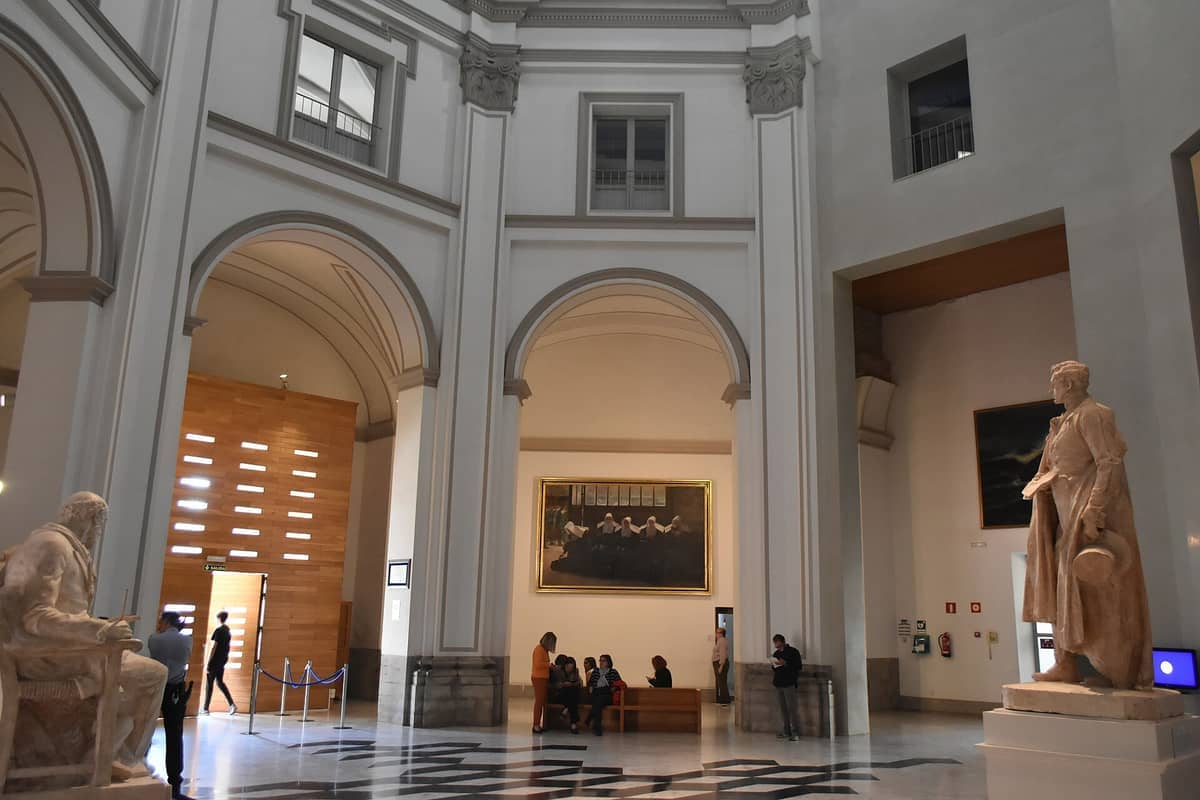
The museum occupies the former Colegio de San Pío V, a college built in the 17th century in a restrained Baroque style typical of Valencia's ecclesiastical architecture of that period. The facade along Carrer de Sant Pius V is long and austere, with a quality of stone that turns warm gold in afternoon light. The entrance courtyard — an arcaded cloister with two floors — gives the museum its spatial heart. Even before you reach the galleries, this courtyard is worth pausing in: the proportions are generous, the stone worn smooth by centuries of foot traffic, and the light on sunny mornings falls in long diagonal shafts across the arcade.
The building sits at the northern boundary of the Jardí del Túria, the linear park that runs along the old bed of the Turia River. This location matters for the visitor experience: arriving from the park side means walking through open green space before stepping into cool stone interiors, which makes the transition feel genuinely refreshing rather than abrupt. The surrounding area is quiet, residential, and far less trafficked than the historic centre.
The museum's position also makes it a natural pairing with a walk through the Jardí del Túria or with a visit to the nearby Torres de Serranos, the medieval gate towers located a short walk south.
Tickets & tours
Hand-picked options from our booking partner. Prices are indicative; availability and final rates are confirmed when you complete your booking.
Valencia Silk Museum tickets and audio guide
From 7 €Instant confirmationFree cancellationValencia English tour with entry to La Lonja, Catedral and San Nicolas
From 39 €Instant confirmationFree cancellationValencia top attractions MegaPass Classic with Oceanografic and Science Museum
From 79 €Instant confirmationValencia Spanish tour with entry to La Lonja, Catedral and San Nicolas
From 49 €Instant confirmationFree cancellation
The Collection: What to Prioritize
Medieval and Early Renaissance Rooms
The earliest rooms hold Gothic altarpiece panels painted primarily by Valencian artists between the 14th and 15th centuries. These are not well known internationally but they are historically important: Valencia was a dominant Mediterranean trading power during this period, and its painters absorbed influences from Flemish and Italian workshops at an early stage. The colors in these panels are remarkably well preserved — deep crimsons and gold leaf backgrounds that still read as luminous despite their age. If you have any interest in pre-Renaissance Spanish painting, these rooms deserve unhurried attention.
Spanish Golden Age
The 16th and 17th-century galleries hold works by Francisco Ribalta, whose dramatic use of chiaroscuro anticipates and parallels Caravaggio, and by his student José de Ribera, who worked primarily in Naples but remained one of the defining figures of Spanish Baroque painting. There are also works attributed to El Greco and Velázquez, though visitors should note that attribution questions in Golden Age Spanish painting are common and the museum's labeling is generally precise on this point. These are not the largest Golden Age collections in Spain, but the quality of individual works is high.
Sorolla and the Valencian Luminists
For many visitors, the Sorolla rooms are the reason to come. Joaquín Sorolla (1863–1923) was born in Valencia and trained partly here before becoming internationally famous, particularly in the United States and United Kingdom, for his sun-saturated beach scenes, garden paintings, and portraits. The museum's holdings include both finished canvases and studies, and they give a clear picture of his technical range — from the loose, almost Impressionist treatment of light on water to the more controlled brushwork of formal portraiture. If you find yourself wanting more after this visit, the dedicated Casa Museo Sorolla in Madrid holds his largest institutional collection.
Valencia produced several other painters working in a similar luminous, plein-air tradition around the same period. The museum covers these figures — Ignacio Pinazo, Francisco Domingo Marqués, and others — alongside Sorolla, making it the best single place to understand the Valencian school of the late 19th century. For broader context on art and architecture across the city, the best museums in Valencia guide covers the full landscape.
How the Visit Changes by Time of Day
The museum opens at 10:00, and the first hour is typically the quietest. Natural light enters the courtyard most dramatically before midday, which makes the early morning the best time to appreciate the architecture as well as the paintings. School groups tend to arrive between 10:30 and 12:30 on weekdays during term time — primarily on Tuesday and Wednesday mornings — which adds noise to the otherwise calm atmosphere of the galleries. If you are visiting with a preference for silence, arriving at 10:00 on the dot or after 14:00 tends to give the most tranquil experience.
On weekend afternoons, particularly Saturdays, attendance picks up but rarely reaches the levels that make a visit uncomfortable. This is not a museum that sells out or requires timed entry. The lack of queues and the free admission mean you can leave and re-enter freely, which is useful if you want to break the visit with a walk in the park.
Getting There and Finding the Entrance
The nearest metro stop is Pont de Fusta on Line 4 (the tram line), which runs along the northern edge of the Turia park. From the stop, the museum entrance is a four-minute walk east along Carrer de Sant Pius V. Multiple bus lines stop within a short walk, including The nearest metro stop is Pont de Fusta on Line 4 (the tram line), which runs along the northern edge of the Turia park. From the stop, the museum entrance is a four-minute walk east along Carrer de Sant Pius V. Multiple bus lines stop within a short walk, including lines 1, 5B, 6, 7, 8, 9, 11, 16, 26, 28, 29, 36, 95, and N3, which connect the museum to the historic centre and the main train station., which connect the museum to the historic centre and the main train station.
By foot from the old city, the walk takes around 12 to 15 minutes from Plaza de la Reina, heading north through the Torres de Serranos gate and then along the park. This is one of the more pleasant approaches to any museum in the city: you walk through the park, cross under the old medieval walls, and arrive at the building without touching a busy road.
💡 Local tip
The main entrance faces Carrer de Sant Pius V. There is also a garden-side entrance accessible from the Turia park. If you are arriving from the park, follow signs toward the building's south face — the garden entrance can feel less obvious the first time.
If you are combining this visit with cycling through the park — which is one of the most enjoyable ways to spend a morning in Valencia — the museum makes a logical midpoint stop. The cycling the Turia garden guide covers the full route.
Photography, Accessibility, and Practical Details
Photography for personal, non-commercial use is generally permitted in the permanent collection galleries. Flash is not allowed and tripods require prior authorization. The best light for photography of the paintings themselves comes from the diffused indoor lighting; the courtyard, however, photographs well in morning light before the sun rises high enough to create harsh shadows.
The building has been adapted with lifts and ground-level access to accommodate visitors with reduced mobility, though some areas of the historic structure present inherent limitations. Visitors with specific requirements are advised to contact the museum directly at +34 963 870 300 or at museobellasartesvalencia@gva.es before their visit.
The museum has a small bookshop near the main entrance with a focused selection of art history titles, catalogs, and postcards. There is no in-house café, so if you need refreshments, the Turia park has benches and the surrounding neighborhood has several cafes within a five-minute walk.
⚠️ What to skip
The museum is closed every Monday, as well as on 1 January and 25 December. If your Valencia trip falls on a Monday, plan your fine art fix for a different day or explore the IVAM (Institut Valencià d'Art Modern), which has different closing days.
Honest Assessment: Who This Museum Is and Is Not For
The Museo de Bellas Artes de València is not a museum that tries to be everything. It does not have an interactive children's wing, a rooftop restaurant, or a permanent blockbuster exhibition. What it has is a serious, well-curated collection of Spanish and Valencian painting housed in a building that rewards slow attention. Visitors who approach it expecting the scale of the Prado or the curatorial drama of a major contemporary institution will find it modest by comparison. That modesty is, for many people, exactly the point.
Travelers who prefer contemporary or conceptual art will likely find the permanent collection too conventional. For that audience, the IVAM — Valencia's museum of modern art — is a better fit. Similarly, visitors with very limited time in the city who are trying to cover major landmarks quickly may find that a 90-minute museum visit doesn't fit their schedule alongside the City of Arts and Sciences, the Mercado Central, and the beaches. But for anyone with a genuine interest in Spanish art history, the museum offers something rare: important works, free of charge, in a building with genuine character, in an unhurried atmosphere.
Combining the Visit with the Surrounding Area
The museum's location at the edge of the Turia park puts it within easy reach of several other worthwhile stops. The Torres de Serranos medieval gate towers are a 10-minute walk south, and entry is inexpensive. Walking north from the museum along the park toward the Jardines de Viveros — a formal garden adjacent to the museum's east side — takes less than five minutes and provides a pleasant open-air contrast to the indoor galleries.
For a full cultural morning, it is possible to visit the museum, walk through the park to the Torres de Serranos, and then continue into the Barrio del Carmen for lunch. This route covers a dense cross-section of the city's history — from the Golden Age paintings inside the museum to the Roman-era remains visible at the Centro Arqueológico de l'Almoina, all within a 2-kilometer radius.
Insider Tips
- The museum's Jardines de Viveros — the formal gardens immediately east of the building — are technically a separate city park but feel like an extension of the museum grounds. They are almost always quiet, well-maintained, and a good place to sit after a long gallery visit.
- If you are specifically interested in Sorolla, check the museum's temporary exhibition schedule before your trip. The permanent Sorolla holdings are strong, but the museum occasionally organizes focused loan exhibitions that bring together works from private collections not usually accessible to the public.
- The courtyard is worth entering even if you decide not to visit the galleries. It is open to the public during museum hours and gives a clear sense of the building's scale and atmosphere at no cost beyond the time it takes to walk through the entrance.
- The Pont de Fusta metro station on Line 4 is one of Valencia's most pleasant stations — open-air, above the park. If you have a transit card, the journey from the city centre takes around 10 minutes and the station exit drops you almost directly in front of the museum path.
- Weekday afternoons in the off-season (November through February, excluding holidays) offer the most uncrowded experience of the collection. The city's tourist volume drops noticeably, and the galleries can feel almost private during these hours.
Who Is Museo de Bellas Artes de València For?
- Art historians and serious collectors of Spanish painting who want to understand the Valencian school in depth
- Budget travelers and those doing Valencia on a budget, given free permanent collection admission
- Visitors with a half-day who want cultural depth without the crowds or price of larger institutions
- Families with older children (12+) who have some interest in art history or European painting
- Travelers who want to combine a gallery visit with a walk through the Turia park on the same outing
Nearby Attractions
Other things to see while in Jardín del Turia:
- Bioparc Valencia
Bioparc Valencia is a 10-hectare immersive zoo at the western tip of the Turia Garden, designed around the philosophy of 'zoo-immersion': no visible barriers between visitors and animals. Since opening in 2008, it has become one of Spain's most thoughtfully designed wildlife parks, with habitats spanning African savanna, equatorial forest, and Madagascar.
- Gulliver Park
Gulliver Park is a free outdoor playground built around a 70-metre fibreglass giant lying in Valencia's Turia Gardens. Open since 1992, it offers slides, ramps, and climbing structures that children can explore from head to toe. Entry is free, access is straightforward, and the scale of the sculpture makes it unlike any playground in Spain.
- Jardín Botánico de la Universitat de València
Founded in its current form in 1802, the Jardín Botánico de la Universitat de València is one of Spain's oldest working botanical gardens. Tucked along the edge of the Turia riverbed park, it offers a rare combination of scientific depth and quiet beauty at one of the city's most affordable admission prices.