Bioparc Valencia: An African Wilderness at the Edge of the Turia Garden
Bioparc Valencia is a 10-hectare immersive zoo at the western tip of the Turia Garden, designed around the philosophy of 'zoo-immersion': no visible barriers between visitors and animals. Since opening in 2008, it has become one of Spain's most thoughtfully designed wildlife parks, with habitats spanning African savanna, equatorial forest, and Madagascar.
Quick Facts
- Location
- Avenida Pío Baroja, 3, 46015 Valencia — western end of the Turia Garden, Parque de Cabecera
- Getting There
- City bus to Bioparc/Cabecera Park stop. On-site underground parking available (max €7 for up to 10 hours, open from 08:00, closing one hour after the park).
- Time Needed
- 3 to 5 hours for a complete visit
- Cost
- Adults €30.90 | Ages 4–12 and 65+ €24.20 | Under 4 free. Prices vary by date; book online
- Best for
- Families with children, wildlife enthusiasts, and anyone who finds traditional zoos depressing
- Official website
- bioparcvalencia.es
What Makes Bioparc Valencia Different from a Conventional Zoo
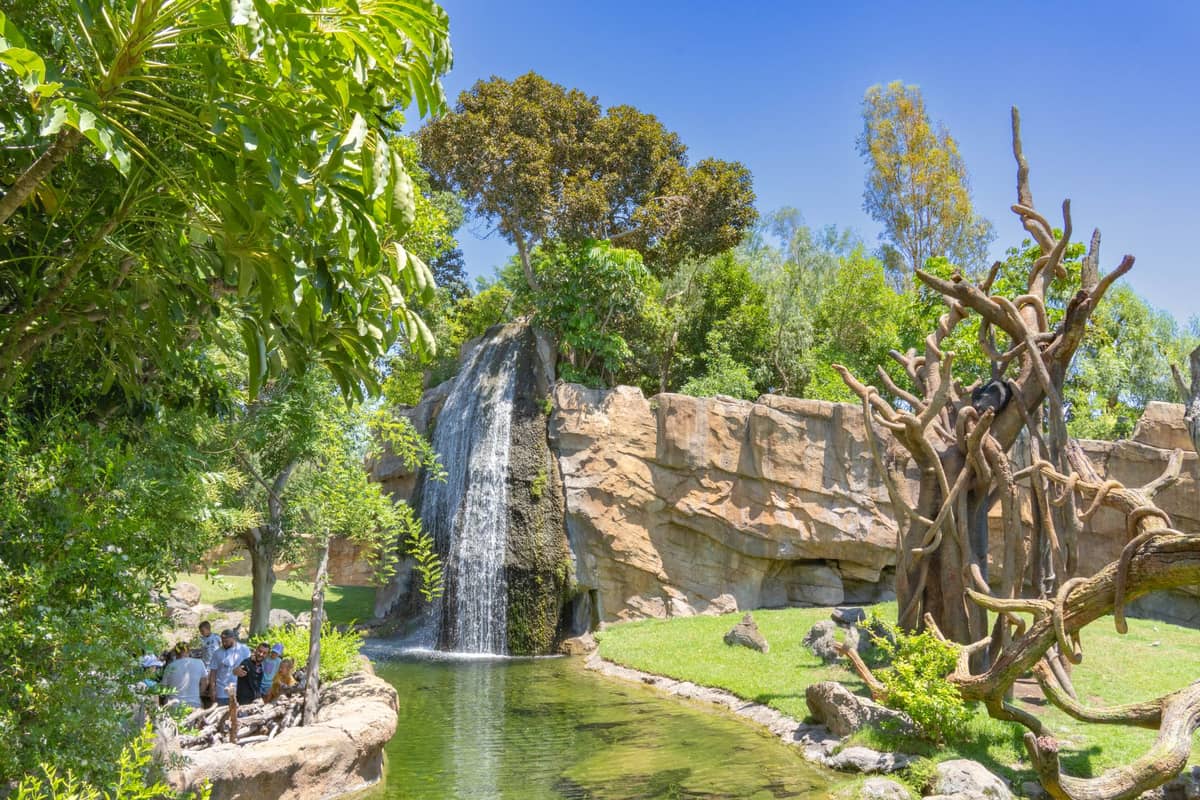
Bioparc Valencia opened on 27 February 2008, replacing Valencia's older Viveros Zoo, which had closed the previous year. The concept behind it was a deliberate departure from the caged enclosure model that defines most European zoos. The park operates on a principle it calls 'zoo-immersion': the design eliminates traditional bars and visible fences by using moats, landscaping, rock formations, and water features to separate visitors from animals. Standing at the edge of the gorilla habitat or watching a giraffe move against a painted-sky backdrop, most visitors find it genuinely difficult to identify where the enclosure ends.
The park covers roughly 10 hectares on the site of Parque de Cabecera, at the far western end of the Turia Garden. That location matters. Arriving on foot or by bike along the Turia riverbed, you transition from a green urban park into what is designed to feel like a fragment of sub-Saharan Africa. The transition is abrupt and intentional. Thick plantings, the sound of running water, and the calls of birds start the sensory shift well before you reach the entrance gate.
💡 Local tip
Book tickets online before you arrive. Entry prices vary by date and online booking typically avoids a queue at the gate — particularly useful on weekends and during school holiday periods.
The Habitats: What You Will Actually See
The park is organized around distinct African ecosystems. The savanna zone is the largest and most visually spectacular, with giraffes, zebras, and white rhinos sharing a wide open landscape. From the viewing platforms, the sight of a giraffe at close range — at eye level when you are standing on the raised walkway — is something children remember for years. Early morning is when the large mammals are most active; by midday in summer, many retreat to shaded areas.
The equatorial forest section is darker and noticeably cooler, shaded by dense canopy planting. This is where you will find the western lowland gorillas, one of the park's signature draws. The gorilla habitat is extensive and the group dynamics are visible over time — if you spend 15 or 20 minutes watching, rather than moving on immediately, you are far more likely to see meaningful behavior. Pygmy hippopotamuses are also housed in this zone, in a habitat that allows underwater viewing through glass panels.
The Madagascar area recreates the island's distinctive dry forests and is home to several lemur species. This is one of the more intimate zones in the park, where animals may come surprisingly close to the pathway. Note that the Madagascar area is not fully accessible to wheelchair users and visitors with significant mobility restrictions — the terrain is intentionally uneven to mimic a forest floor.
Beyond the main African zones, there is an amphibian and reptile exhibition and an educational amphitheater. The park connects naturally to the Turia Garden, so extending your visit into a walk along the former riverbed is easy and rewarding — particularly if you continue east toward the cycling and running sections of the park.
Tickets & tours
Hand-picked options from our booking partner. Prices are indicative; availability and final rates are confirmed when you complete your booking.
Entrance ticket to Bioparc Valencia
From 31 €Instant confirmationValencia Silk Museum tickets and audio guide
From 7 €Instant confirmationFree cancellationHistoric Valencia walking tour
From 27 €Instant confirmationFree cancellationNatural thermal springs and Girlfriend Waterfall tour from Valencia
From 89 €Instant confirmationFree cancellation
How the Experience Changes by Time of Day
Opening time, 10:00, is reliably the best slot (11:00 on December 25 and January 1). The light is soft, the temperature is manageable even in July and August, and the animals are at their most active. Large mammals graze, primates engage in social behavior, and the crowds have not yet built up. By 12:30 on a summer weekend, the main pathways through the savanna and gorilla zones become congested, and many animals have moved into shade.
Afternoon visits in spring and autumn carry their own advantages. From around 16:00, animal activity picks up again as the heat eases, and the late light in the savanna zone creates genuinely photogenic conditions. In winter, when the park closes at 18:00, the late afternoon slot is short but the park is noticeably quieter and the air has the kind of clarity that makes wide animal shots easier.
Midday in summer is the one window to actively avoid if you can help it. Temperatures in Valencia regularly exceed 32°C in July and August, there is limited shade on the main pathway spines, and the animals themselves are largely inactive. If you arrive at midday in high summer, expect to spend that central window in the indoor zones: the forest pavilion and the reptile exhibition are noticeably cooler.
⚠️ What to skip
In summer, bring water and sun protection. The open savanna viewing areas and raised walkways are fully exposed. The park sells food and drinks, but prices are predictably high for a captive attraction.
Getting to Bioparc Valencia
Bioparc sits at the western extreme of the Turia Garden, which means it is perfectly placed for visitors who want to combine a zoo visit with time in the park. Cycling the full length of the Turia riverbed from the city centre to Bioparc is a popular approach — the route is flat, car-free, and takes around 30 to 40 minutes from the historic centre by bike. The Turia Garden cycling route is well-signposted and accessible to riders of all abilities.
City buses serve the Bioparc/Cabecera Park stop directly. Check current EMT Valencia routes before your visit, as bus services and stop names are occasionally updated. The park also has its own underground parking facility, accessible to vehicles up to 2.20 m in height. Parking costs a maximum of €7 for visits of up to 10 hours, and the car park opens at 08:00 — and closes one hour after the park itself.
Practical Details: Accessibility, Photography, and What to Bring
Wheelchair users and visitors with reduced mobility can access most of the park, but not all of it. The Madagascar area and the Educational Exhibition of the Amphitheater are specifically listed by the park as not accessible. The immersive design philosophy that makes the park visually interesting also means that paths are not uniformly flat: some sections include deliberate slopes and uneven surfaces. If you or someone in your group has significant mobility requirements, contact the park in advance at info@bioparcvalencia.es or by phone at 960 660 526.
Photography here rewards patience more than equipment. A standard smartphone will produce good results from the raised gorilla and giraffe walkways because the viewing distances are close. The gorilla habitat in particular offers glass-panel viewing sections where wide-angle phone shots work well. A zoom lens helps in the open savanna areas where the animals range more freely. Early morning light entering the equatorial forest zone produces warm, filtered conditions that are difficult to replicate later in the day.
The park is open 365 days a year. On December 25 and January 1, opening is delayed until 11:00. Seasonal closing times vary: winter and autumn closings are typically at 18:00, while spring and summer extend to 20:00, depending on daylight hours. Always verify on the official calendar before planning around these times, as they are subject to change.
How Bioparc Fits Into a Wider Valencia Itinerary
Bioparc Valencia works best as a half-day or full-day attraction rather than a quick stop. Most visitors need three to five hours to see the park properly. Given its location at the western end of the Turia Garden, it pairs naturally with an afternoon walk or cycle east through the park toward the Gulliver Park and the Ciudad de las Artes y las Ciencias. Families can make a full day of the Turia corridor from west to east without covering the same ground twice.
If you are planning a trip specifically oriented around family-friendly attractions in Valencia, the combination of Bioparc with the L'Oceanogràfic — the largest aquarium in Europe, located in the Ciudad de las Artes y las Ciencias — covers marine and terrestrial wildlife in a single day. Budget accordingly: entry fees at both attractions add up quickly, and planning in advance with online tickets will save time and occasionally money.
For broader trip planning, the Valencia with kids guide covers the full range of family-oriented options across the city, with practical routing advice.
Who Should Think Twice Before Visiting
Bioparc Valencia is genuinely one of the better-designed zoological parks in Spain, but that does not mean it suits every visitor. Travelers with strong ethical objections to animals in captivity will not find the immersive design a sufficient answer to those concerns — the zoo-immersion concept improves animal welfare in measurable ways, but it is still a zoo. If that is your position, the Albufera Natural Park south of Valencia offers outstanding wildlife observation in a fully natural setting without enclosures.
Adults visiting without children, and with limited time in Valencia, may find the entry cost hard to justify against the city's other offerings. At close to €30 per adult ticket, Bioparc is one of the more expensive individual attractions in the city. The experience is rich, but so is a day in the historic center, which costs nothing to walk.
Visitors with serious heat sensitivity should also plan carefully. Valencia's summers are genuinely hot, and unlike an indoor museum, large sections of Bioparc are exposed. If you are visiting in July or August and are not comfortable in direct sun for extended periods, the park is significantly less enjoyable outside of the first two hours of opening.
Insider Tips
- Arrive at 10:00 on a weekday: the savanna walkway and gorilla habitat are almost empty for the first 90 minutes, and large animals are reliably active. This single timing decision changes the experience substantially.
- The underground car park opens at 08:00 — two hours before the park. If you are driving, arriving early means you can park, walk the adjacent Parque de Cabecera, and then enter the zoo at opening time without rushing.
- The gorilla habitat has both open-air and glass-panel viewing sections. The glass panels are in a slightly recessed corridor that many visitors walk past quickly. Spend time here: close-range gorilla observation is what Bioparc does better than almost any other zoo in Spain.
- The park restaurant and snack kiosks charge a premium, as expected at any enclosed attraction. Packing a water bottle and some snacks in a bag will save money and reduce the time spent in food queues, which build significantly by 13:00 on weekends.
- If you are cycling from the city centre along the Turia Garden to reach Bioparc, the route takes you past Gulliver Park — a free, giant-scale children's playground that makes a useful stop in either direction, especially if you are visiting with younger children who may need a break mid-journey.
Who Is Bioparc Valencia For?
- Families with children aged 3 to 12, for whom the giraffe and gorilla encounters are likely to be a trip highlight
- Wildlife photographers willing to arrive at opening time and invest patience at the primate and savanna enclosures
- Visitors spending three or more days in Valencia who want to balance the historic centre with something distinctly different
- Travelers combining Bioparc with a full Turia Garden walk or cycle, creating a complete half-day outdoor itinerary
- Anyone who has been disappointed by conventional zoo visits elsewhere and wants to see what a more thoughtfully designed alternative looks like
Nearby Attractions
Other things to see while in Jardín del Turia:
- Gulliver Park
Gulliver Park is a free outdoor playground built around a 70-metre fibreglass giant lying in Valencia's Turia Gardens. Open since 1992, it offers slides, ramps, and climbing structures that children can explore from head to toe. Entry is free, access is straightforward, and the scale of the sculpture makes it unlike any playground in Spain.
- Jardín Botánico de la Universitat de València
Founded in its current form in 1802, the Jardín Botánico de la Universitat de València is one of Spain's oldest working botanical gardens. Tucked along the edge of the Turia riverbed park, it offers a rare combination of scientific depth and quiet beauty at one of the city's most affordable admission prices.
- Museo de Bellas Artes de València
Housed in a 17th-century palace at the edge of the Turia garden, the Museo de Bellas Artes de València holds one of Spain's most important collections of painting and sculpture — from medieval altarpieces to Valencian masters including Joaquín Sorolla — and charges nothing for admission. It is unhurried, serious, and frequently overlooked by visitors who head straight to the City of Arts and Sciences.