Gulliver Park Valencia: The Giant You Can Climb
Gulliver Park is a free outdoor playground built around a 70-metre fibreglass giant lying in Valencia's Turia Gardens. Open since 1992, it offers slides, ramps, and climbing structures that children can explore from head to toe. Entry is free, access is straightforward, and the scale of the sculpture makes it unlike any playground in Spain.
Quick Facts
- Location
- Jardín del Turia, tramo XII, Valencia, Spain
- Getting There
- City bus to Turia Gardens, then walk to Tramo XII via Puente del Ángel Custodio or Puente del Reino
- Time Needed
- 30–60 minutes for the playground; 2+ hours if combining with a Turia Gardens walk
- Cost
- Free. No ticket or registration required.
- Best for
- Families with young children, first-time visitors to Valencia, cyclists exploring the Turia Gardens route
- Official website
- jardins.valencia.es
What Gulliver Park Actually Is
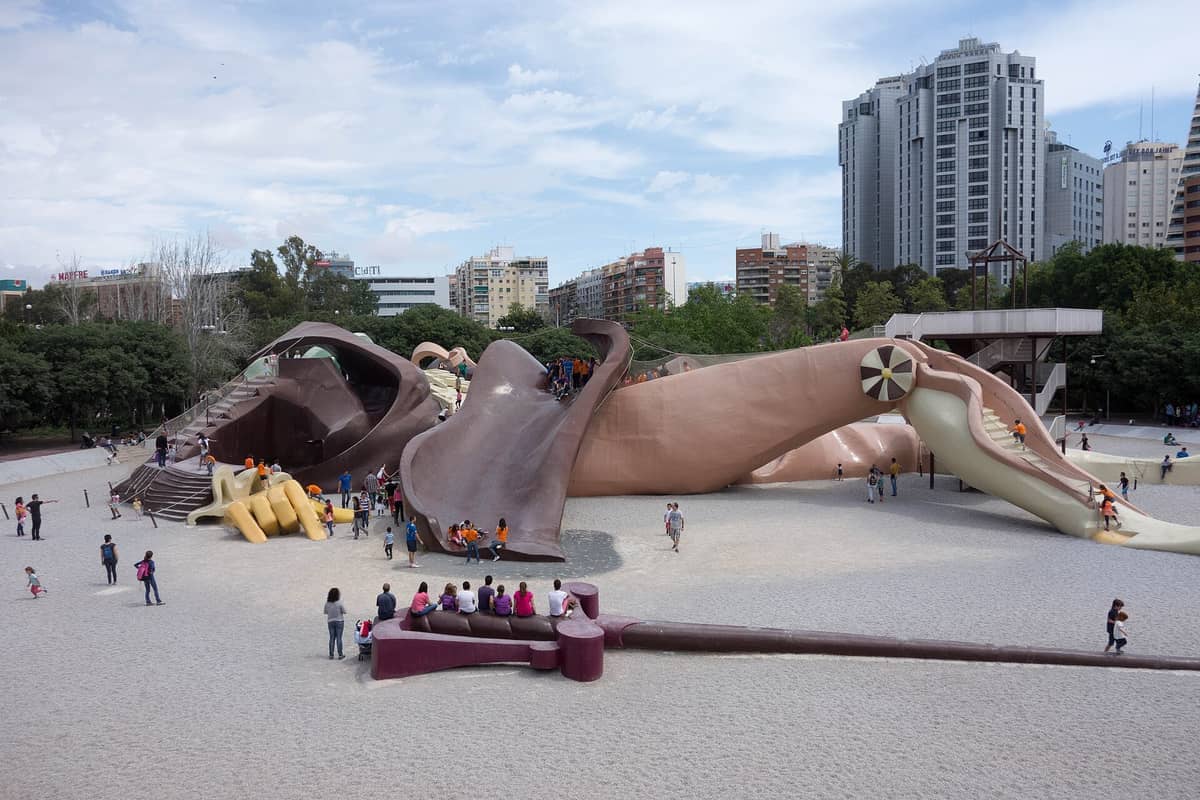
Parque Gulliver, or Gulliver Park, is a children's playground unlike anything else in Valencia. At its centre lies a fibreglass figure approximately 70 metres long, modelled on Lemuel Gulliver from Jonathan Swift's 18th-century novel, depicted as if washed ashore and pinned down by the Lilliputians. The sculpture is not a viewing object. Children climb on it, slide down the ropes attached to its limbs, scramble over its chest, and run across its outstretched arms. It is, in the most literal sense, a playable giant.
Built in 1992, the park occupies Tramo XII of the Jardín del Turia, the long linear park that replaced Valencia's old Turia riverbed after the catastrophic 1957 flood diverted the river south of the city. Gulliver is one of the most recognisable features of the Turia Gardens and sits close to the end nearest the City of Arts and Sciences, making it a natural stopping point on any walk or cycle through the park.
ℹ️ Good to know
The park is closed for maintenance on the first Tuesday of each month (moved to Wednesday if that Tuesday falls on a public holiday). It is also closed on 25 December and 1 January. Always check before visiting during holiday periods.
The Experience on the Ground
Approaching from the Puente del Ángel Custodio ramp, the scale of the figure registers slowly. From above the bridge railing it looks large but manageable. Once you descend and stand at ground level, the perspective shifts: the torso alone rises above head height, and the legs stretch so far they disappear into the distance. The fibreglass skin is painted in warm earth tones, worn smooth in places where thousands of small hands have found the same grip points over three decades.
The climbing surfaces are varied. There are rope ladders ascending the figure's sides, metal slides built into the legs at different angles, rope bridges across the body, and a series of lower platforms around the feet for younger children who are not yet ready for the steeper sections. The ground below is padded. On a weekday morning in spring, the park fills with families from the surrounding neighbourhoods and school groups from across the city. On weekend afternoons, the queue for the main slide can back up noticeably.
The surrounding garden is well shaded by mature trees, which makes a significant difference in summer. Adults waiting for children tend to settle on the low walls and benches at the edges. There is no café or kiosk inside the park itself, so if you are visiting with young children on a warm day, bring water.
💡 Local tip
In July and August, the park operates split hours: 10:00–13:30 in the morning and 17:30–21:00 in the evening. The afternoon session, once the day cools slightly, is more comfortable for children and less crowded than the morning slot.
Tickets & tours
Hand-picked options from our booking partner. Prices are indicative; availability and final rates are confirmed when you complete your booking.
Valencia Silk Museum tickets and audio guide
From 7 €Instant confirmationFree cancellationSaint Nicholas Church Entrance Tickets and Audioguide
From 11 €Instant confirmationHistoric Valencia walking tour
From 27 €Instant confirmationFree cancellationNatural thermal springs and Girlfriend Waterfall tour from Valencia
From 89 €Instant confirmationFree cancellation
Seasonal Hours and When to Visit
Gulliver Park adjusts its opening times by season, which is worth noting before you plan. In the shortest winter months (November through February) the park opens at 10:00 and closes at 17:30. Spring and autumn hours extend to 19:00 or 20:00. In summer (July and August), the midday heat closure means the park shuts between 13:30 and 17:30, reopening in the late afternoon. On Christmas Eve and New Year's Eve, it closes at 13:00.
The best overall visiting window for most travellers is a weekday morning in spring or early autumn, roughly between late March and early June or September to mid-October. Crowds are manageable, the temperature is pleasant for outdoor play, and the garden's trees are at their greenest. Summer visits are feasible but require planning around the heat closure and the higher number of families on school holidays.
The Turia Gardens are best explored as a full corridor. If you are planning a longer route, the guide to cycling through the Turia Garden explains how Gulliver sits within the broader park and how to combine it with other stops along the former riverbed.
Historical and Literary Context
Jonathan Swift published Gulliver's Travels in 1726. The novel's most famous episode features Gulliver waking on the island of Lilliput to find himself bound to the ground by ropes attached by a population no taller than his finger. The Valencia sculpture reproduces this image at scale: ropes cross the figure's chest and arms, stakes are driven into the ground around him, and the body is designed so children act out the role of the Lilliputians scrambling over their enormous captive.
The decision to place this park in the Turia Gardens around 1990 was part of a larger effort to activate the linear park that had been converted from the old river course through the 1980s. The Turia Gardens include sections designed by architect Ricardo Bofill near the Palau de la Música, and the individual tramos were developed over years with different recreational purposes. Tramo XII, toward the eastern end near the new arts complex, received the Gulliver installation as one of its defining features.
The same stretch of the Turia Gardens brings you close to some of Valencia's most significant contemporary architecture. The City of Arts and Sciences complex by Santiago Calatrava and Félix Candela sits just beyond the eastern end of the park and is visible from the Gulliver site on a clear day.
Getting There and Practical Logistics
Gulliver Park is located in Tramo XII of the Jardín del Turia, accessible via the ramps of either Puente del Ángel Custodio or Puente del Reino. The ramp access makes entry relatively easy for pushchairs and prams, though the playground itself involves slopes, steps, and climbing structures that require supervision for young children and are not fully accessible for visitors with significant mobility impairments.
Several city bus lines serve the surrounding streets; the exact routes and current stops are best confirmed through the EMT Valencia journey planner before your visit. If you are cycling, the Turia Gardens cycle path runs directly past the park. For orientation on public transport options across the city, the guide to getting around Valencia covers the metro, bus network, and bike hire options in useful detail.
There is no dedicated car park at the site. Street parking in the surrounding residential streets can be found, but the neighbourhood is dense and spaces fill quickly on weekends. Arriving by bike or public transport is the more reliable option. The Turia Gardens path itself is flat throughout, making the walk from the city centre manageable even with young children.
⚠️ What to skip
Wear closed shoes if children plan to climb. The rope sections and metal slide edges can be uncomfortable or mildly hazardous in open sandals, particularly after the structure has been in direct sun for several hours.
Photography and What to Bring
The scale of the sculpture creates good photography conditions, but the best angle is from slightly elevated ground, which the bridge ramps provide. Standing on the Puente del Ángel Custodio and looking down into the park gives a clear view of the entire figure with children on it, conveying the size relationship that makes the park distinctive. At ground level, detail shots of the rope ladders, the face, or the carved hands work well.
Morning light from the east catches the sculpture's painted surface more cleanly than the flat midday light. Late afternoon in summer, during the reopening session from 17:30, produces warm golden light and longer shadows across the body. Bring sunscreen and a hat for summer visits. The Turia Gardens offer shade, but the playground itself sits in a more open clearing.
Who Will Enjoy This, and Who Might Not
Gulliver Park is primarily designed for children between roughly 3 and 12 years old. For this age group, especially children who enjoy physical play and climbing, it delivers something genuinely unusual. As part of a longer day in Valencia that includes a walk or cycle through the Turia Gardens and a visit to the nearby L'Oceanogràfic or the Hemisfèric, it fits naturally into a family itinerary.
Adults visiting without children will find it an interesting five-minute curiosity, particularly if they know the source novel, but it is not an attraction that rewards extended time on its own. Travellers whose entire day is focused on Valencian history, art, or food should factor this realistically: the park is worth a look if you are already in the Turia Gardens corridor, but it does not need to be a primary destination for adults travelling solo or as a couple.
For a broader picture of what the Turia Gardens offer beyond Gulliver, the Jardín del Turia neighbourhood page covers the full length of the park and the various points worth visiting along the route.
Insider Tips
- The summer split-hour schedule (closing at 13:30, reopening at 17:30) catches many visitors off guard. If you arrive at 14:00 in August, the gates will be closed. Plan accordingly and use the midday break for lunch in the nearby Ruzafa neighbourhood.
- The first Tuesday of each month is a maintenance closure (moved to Wednesday if that Tuesday is a public holiday). If your trip falls on a Tuesday, check the municipal calendar at jardins.valencia.es before walking out specifically for Gulliver.
- For photographs that show the sculpture's scale clearly, position yourself on the Puente del Ángel Custodio ramp looking down into the park. Ground-level shots make the figure look smaller and lose the Lilliputian effect entirely.
- The park has no kiosk or drinking water point inside. A fountain and a small café are located a short walk north along the Turia Gardens path. Bring water, especially in warm weather.
- Weekday mornings between 10:00 and 11:30 are reliably the quietest period. School groups tend to arrive between 10:30 and 11:00, so arriving exactly at opening gives you roughly half an hour before the crowd peaks.
Who Is Gulliver Park For?
- Families with children aged 3–12 looking for an imaginative outdoor play space
- Visitors cycling or walking the full Turia Gardens route who want a natural stopping point
- First-time visitors to Valencia combining the park with the City of Arts and Sciences complex
- Budget-conscious travellers: completely free with no pre-booking required
- Parents who want to give children unstructured outdoor time while staying within a manageable urban area
Nearby Attractions
Other things to see while in Jardín del Turia:
- Bioparc Valencia
Bioparc Valencia is a 10-hectare immersive zoo at the western tip of the Turia Garden, designed around the philosophy of 'zoo-immersion': no visible barriers between visitors and animals. Since opening in 2008, it has become one of Spain's most thoughtfully designed wildlife parks, with habitats spanning African savanna, equatorial forest, and Madagascar.
- Jardín Botánico de la Universitat de València
Founded in its current form in 1802, the Jardín Botánico de la Universitat de València is one of Spain's oldest working botanical gardens. Tucked along the edge of the Turia riverbed park, it offers a rare combination of scientific depth and quiet beauty at one of the city's most affordable admission prices.
- Museo de Bellas Artes de València
Housed in a 17th-century palace at the edge of the Turia garden, the Museo de Bellas Artes de València holds one of Spain's most important collections of painting and sculpture — from medieval altarpieces to Valencian masters including Joaquín Sorolla — and charges nothing for admission. It is unhurried, serious, and frequently overlooked by visitors who head straight to the City of Arts and Sciences.