Museu de les Ciències Príncep Felip: Valencia's Science Museum Inside a Calatrava Masterpiece
The Museu de les Ciències Príncep Felip is one of Valencia's most architecturally striking attractions, housed inside Santiago Calatrava's soaring skeleton-like structure at the Ciudad de las Artes y las Ciencias. It combines hands-on science exhibits with one of the most photogenic interiors in Spain. Here is what the experience is actually like, and whether it belongs on your itinerary.
Quick Facts
- Location
- Av. del Professor López Piñero 7, Ciudad de las Artes y las Ciencias, Valencia
- Getting There
- City buses serving Ciudad de las Artes y las Ciencias; taxi from the historic centre takes around 10 minutes
- Time Needed
- 2 to 3 hours for the museum alone; allow half a day if exploring the full complex
- Cost
- Adults €9.00 | Reduced (children 4–12, over 60, disabled) €6.90 | Under 4 free. Combo tickets available.
- Best for
- Families with curious children, architecture enthusiasts, science and technology lovers
- Official website
- cac.es/en/museu-de-les-ciencies
What the Museu de les Ciències Príncep Felip Actually Is
The Museu de les Ciències Príncep Felip is a large interactive science and technology museum that opened in 2000 as part of the Ciudad de las Artes y las Ciencias complex in Valencia, Spain. It covers science, technology, the human body, and the environment across multiple floors, with most exhibits designed for active participation rather than passive observation. Children press buttons, pull levers, and peer through lenses. Adults tend to linger longer than they expect.
The museum sits within the broader Ciudad de las Artes y las Ciencias campus, which also includes the Hemisfèric IMAX theatre, the Oceanogràfic aquarium, and the Palau de les Arts opera house. The science museum is the most intellectually engaging of the indoor venues, and for visitors who want something more than architecture tourism, it delivers real content.
💡 Local tip
Opening hours vary by season. Low season (roughly January to June and mid-September to December): 10:00–19:00. High season (July and August): 10:00–21:00. Saturdays, public holidays, and eves of holidays often have extended hours to 19:00. Always confirm current times on the official website before visiting.
The Building: Calatrava's Whale Skeleton
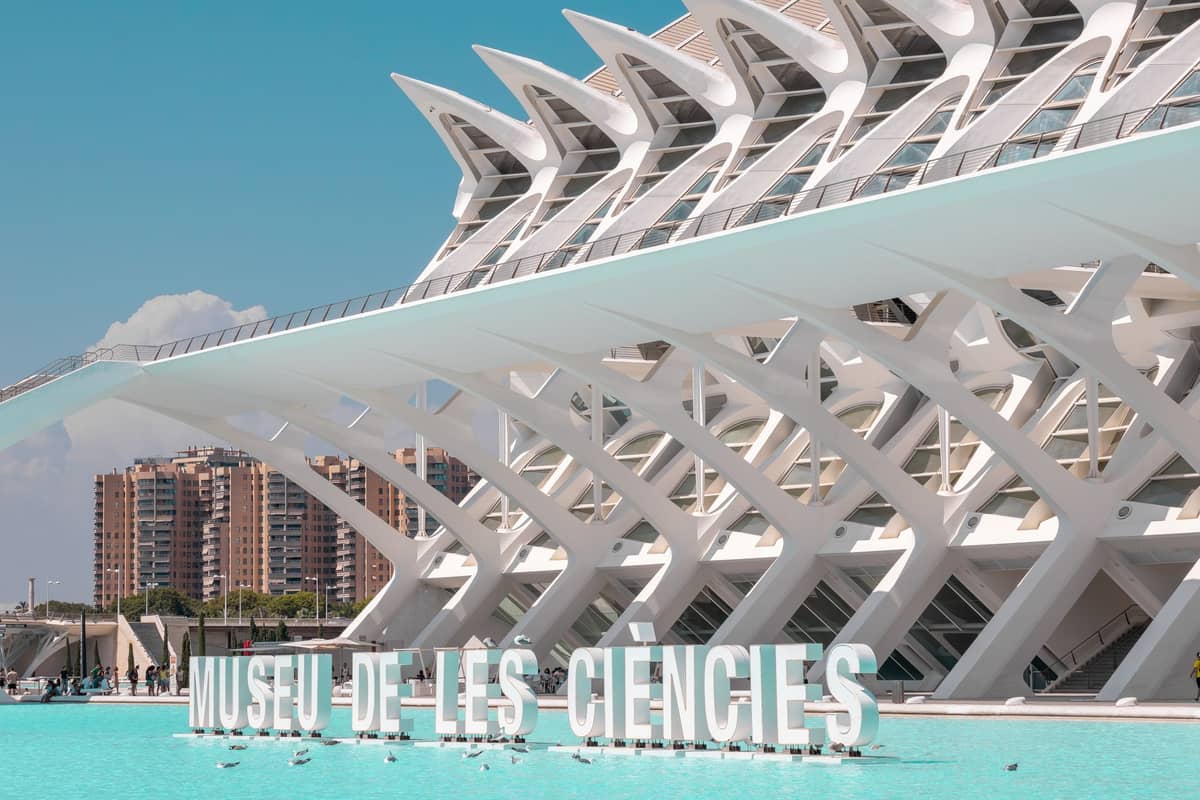
Designed by Valencia-born architect Santiago Calatrava, the museum building is consistently described as resembling the skeleton of a whale or a giant prehistoric creature. From the outside, the white ribbed canopy arches over the structure in a series of curving steel and concrete bones. It is a confrontational piece of architecture: enormous, impossible to photograph badly, and entirely unlike anything else in the city.
The interior is equally dramatic. Natural light floods through the latticed facade, creating patterns across the floors that shift through the morning and afternoon. The central atrium is tall enough that sound does not carry in the usual museum way; instead, there is a diffuse murmur rather than the sharp echo you might expect. The white surfaces reflect light generously, so even on overcast days the interior feels open and airy.
Photography inside the building is genuinely rewarding. The structural ribs create natural framing for wide-angle shots, and the geometry of the floors and balconies offers compositions that do not require post-processing tricks. Arrive close to opening time if you want interior shots without crowds in frame.
Tickets & tours
Hand-picked options from our booking partner. Prices are indicative; availability and final rates are confirmed when you complete your booking.
Valencia Silk Museum tickets and audio guide
From 7 €Instant confirmationFree cancellationSaint Nicholas Church Entrance Tickets and Audioguide
From 11 €Instant confirmationCosta Blanca in One Day: Guadalest, Altea and Algar Waterfalls
From 55 €Instant confirmationFree cancellationValencia English tour with entry to La Lonja, Catedral and San Nicolas
From 39 €Instant confirmationFree cancellation
What You Will See Inside: The Exhibits
The permanent collection spans physics, biology, the human body, mathematics, and environmental science. The exhibits are primarily interactive: visitors manipulate physical installations to observe principles of mechanics, optics, and acoustics in real time. This is not a museum of glass cases and explanatory plaques. The design philosophy is closer to an exploratory science centre than a traditional natural history institution.
The human body section tends to hold children's attention longest, with scaled models and interactive stations that explain anatomy in tactile terms. The physics exhibits work better for older children and adults who have enough context to understand what they are observing. Temporary exhibitions rotate and can significantly alter the character of a visit, so checking the current programme on the official site before you arrive is worthwhile.
The upper floors offer views down through the building's structural core and out across the surrounding water gardens of the complex. These vantage points are worth seeking out even if the specific exhibit floor is not your focus, as they give a sense of the building's full scale that is invisible from street level.
ℹ️ Good to know
The museum is entirely indoors and climate-controlled, which makes it one of the better options in Valencia during the intense heat of July and August, when outdoor exploration becomes genuinely uncomfortable by midday.
How the Experience Changes Through the Day
Mornings between 10:00 and 12:00 are the quietest period on weekdays. School groups arrive most frequently mid-morning during term time, which means the interactive stations can become congested between roughly 10:30 and 13:00 on school days. If you are visiting without children and want uninterrupted access to exhibits, arriving either right at opening or after 14:00 works better.
Weekends shift the demographic toward families with young children. The noise level rises noticeably, which suits the environment but changes the contemplative quality of the architecture. Saturday afternoons in summer, when closing time extends to 20:00, are a reasonable compromise: the early afternoon rush has thinned, and the low-angle light through the western facade is particularly good from around 17:00 onward.
On public holidays, the museum often runs extended hours, but visitor numbers also increase. If you are combining the museum with other parts of the Ciudad de las Artes y las Ciencias complex, note that the open-air water gardens and walkways around the complex are free to enter at any time and are at their most comfortable in the early morning or evening.
Practical Walkthrough: Getting There and Getting In
The museum is at Avenida Profesor López Piñero 7, at the southern end of the Hemisfèric and the main complex buildings. Several city bus lines serve the Ciudad de las Artes y las Ciencias directly; the journey from the historic centre by bus takes roughly 15 to 20 minutes. From the city centre by bicycle, the route follows the Jardí del Túria park path almost entirely, making it a flat and pleasant 25-minute ride with no significant road crossings.
Taxis from the historic centre are widely available and the fare is modest for the distance. There is a drop-off area adjacent to the complex entrance. If you are driving, parking is available in the surrounding area, though spaces fill quickly on Saturday mornings in summer.
Tickets can be purchased at the door or online through the official website. Online booking removes the risk of sold-out time slots during peak summer dates, which does occur for popular temporary exhibitions. Combo tickets covering multiple attractions in the complex (typically including the Oceanogràfic or the Hemisfèric) are available and represent reasonable value if you plan to spend a full day at the complex.
💡 Local tip
The reduced ticket price applies to children aged 4 to 12, visitors over 65, and people with disabilities who present valid documentation. Children under 4 enter free. If you qualify for the reduced rate, bring your documentation to the ticket desk.
The building is fully accessible with step-free routes and lifts between floors. Reduced-price tickets are available for visitors with disabilities upon presentation of supporting documentation. Pushchairs and wheelchairs move easily through the wide internal corridors.
Honest Assessment: Is It Worth Your Time?
For families with children between roughly 5 and 14, the Museu de les Ciències Príncep Felip is one of the stronger options in Valencia. The hands-on format keeps attention better than static collections, and the building itself provides a genuine sense of occasion. For a broader look at the city's museums, Valencia's best museums covers the full range if you want to compare options before committing.
For adults without children who have a strong interest in science, the exhibits are competent but not cutting-edge by international science centre standards. The building is the real spectacle here, and if your primary interest is architecture rather than the content, you will likely get as much from walking around the exterior of the complex as from paying admission. The exterior of the Calatrava buildings, the reflecting pools, and the views across the complex are all free.
Visitors who are primarily interested in Valencia's historic and cultural layers will likely find more lasting value at places like La Lonja de la Seda or the Museo de Bellas Artes. The science museum is definitively modern in its identity and does not connect to Valencia's historical depth.
The museum is not overhyped in the way that some major urban attractions are, but it is sometimes bundled into Valencia itineraries by default simply because it is part of a photogenic complex. Assess honestly whether interactive science exhibits align with what you actually want from your trip. If they do, this is one of the best-designed science museums in Spain.
Around the Complex: Extending Your Visit
The Ciudad de las Artes y las Ciencias complex rewards more than a single-attraction visit. The L'Oceanogràfic aquarium is the largest in Europe and is a full half-day attraction in its own right. The Hemisfèric IMAX and planetarium shows run on scheduled times throughout the day and are worth booking in advance in summer.
The open water gardens between the buildings are free to walk through at any time and are a popular spot for an evening stroll. The Umbracle walkway, a landscaped garden structure at the northern end of the complex, offers an elevated view across the site and good light for photography in the late afternoon. Cafes and restaurants operate within the complex, though prices are higher than the surrounding city and the quality is functional rather than exceptional.
Insider Tips
- Arriving at 10:00 on a weekday (outside Spanish school holidays) gives you roughly 90 minutes of relatively uncrowded access to the interactive exhibits before group visits arrive.
- The upper-floor balconies overlooking the central atrium are frequently overlooked by visitors focused on the ground-floor exhibits. The view from the top is the best way to understand the building's structural logic.
- If you are visiting in summer, the museum's air conditioning is genuinely powerful. Light layers are advisable even when it is 35°C outside.
- The reflecting pools surrounding the complex are at their most photogenic in the early morning, before wind disturbs the surface. If you are staying nearby, a 08:30 walk around the exterior before the museum opens is one of the best free experiences the complex offers.
- Combo tickets are sold at different price points depending on which attractions you combine. Run the numbers against individual admissions before buying: the science museum combined with the Oceanogràfic is typically the best-value pairing for a full day.
Who Is Museu de les Ciències Príncep Felip For?
- Families with children aged 5 to 14 who respond to hands-on, interactive learning formats
- Architecture enthusiasts who want to experience Calatrava's interiors as well as the exterior
- Visitors escaping Valencia's summer heat who want a full-day indoor programme
- Science and technology-focused travellers looking for engagement beyond historic sites
- First-time visitors to Valencia who want to understand the city's modern identity alongside its historic one
Nearby Attractions
Other things to see while in Ciudad de las Artes y las Ciencias:
- CaixaForum València
Opened in June 2022 inside Santiago Calatrava's landmark L'Àgora building, CaixaForum València is the cultural arm of the 'la Caixa' Foundation in the City of Arts and Sciences complex. It hosts rotating international exhibitions across art, science, and society, with accessible pricing and a location that rewards a longer visit to the surrounding complex.
- Hemisfèric
The Hemisfèric is the signature building of Santiago Calatrava's City of Arts and Sciences complex, housing one of Europe's most impressive IMAX cinemas and a full digital planetarium. With a concave screen of roughly 900 m² and seating for 306, it delivers a genuinely overwhelming visual experience. This guide covers what to expect inside, the best time to visit, and how to fit it into a day at the complex.
- L'Oceanogràfic
L'Oceanogràfic is Europe's largest aquarium, occupying 100,000 square metres in Valencia's Ciudad de las Artes y las Ciencias. With marine ecosystems ranging from the Mediterranean to the Antarctic, it offers a full half-day experience for visitors of almost any age or interest.
- L'Umbracle
Part elevated promenade, part open-air sculpture gallery, and part gateway to one of Valencia's most famous nightlife venues, L'Umbracle is a free attraction within the City of Arts and Sciences complex that rewards visitors at almost any hour. By day, it offers shade, contemporary art, and sweeping views of Santiago Calatrava's architectural ensemble. By night, it transforms into something else entirely.