CaixaForum València: World-Class Exhibitions Inside Calatrava's L'Àgora
Opened in June 2022 inside Santiago Calatrava's landmark L'Àgora building, CaixaForum València is the cultural arm of the 'la Caixa' Foundation in the City of Arts and Sciences complex. It hosts rotating international exhibitions across art, science, and society, with accessible pricing and a location that rewards a longer visit to the surrounding complex.
Quick Facts
- Location
- C/ Eduardo Primo Yúfera 1A, inside L'Àgora, Ciudad de las Artes y las Ciencias, València
- Getting There
- Metro L10 (Ciutat Arts i Ciències – Justícia stop); Bus lines 15, 19, 35, 92, 93, 94, 95
- Time Needed
- 1.5 to 2.5 hours, depending on exhibitions
- Cost
- €6 general admission; free for under-16s and CaixaBank customers; occasional free-entry days linked to specific promotions or events
- Best for
- Art lovers, families, architecture enthusiasts, rainy-day culture seekers
- Official website
- caixaforum.org/es/valencia
What Is CaixaForum València?
CaixaForum València is a contemporary cultural centre operated by the 'la Caixa' Foundation, one of Spain's most active patrons of arts and sciences. It opened on 22 June 2022 as the ninth CaixaForum in the country, occupying the ground floor of L'Àgora, the sweeping steel-and-glass structure designed by Valencia-born architect Santiago Calatrava at the southern end of the City of Arts and Sciences. Rather than maintaining a permanent collection, CaixaForum runs a rotating programme of temporary exhibitions covering fine art, photography, social history, and science, typically drawing from major international institutions and its own foundation archives.
The centre sits at the heart of one of Europe's most photographed urban complexes, yet it remains distinctly quieter than the headline attractions nearby. Visitors who come specifically for the exhibitions often find themselves almost alone with the works, a contrast to the packed terraces outside. That low footfall is not a sign of mediocrity. It reflects the reality that many day-trippers to the City of Arts and Sciences never make it inside any of the buildings at all.
💡 Local tip
Tickets can generally be purchased up until closing. Arriving around 18:30–19:00 suits visitors coming after a late lunch or a morning at the Oceanogràfic.
The Building: Santiago Calatrava's L'Àgora
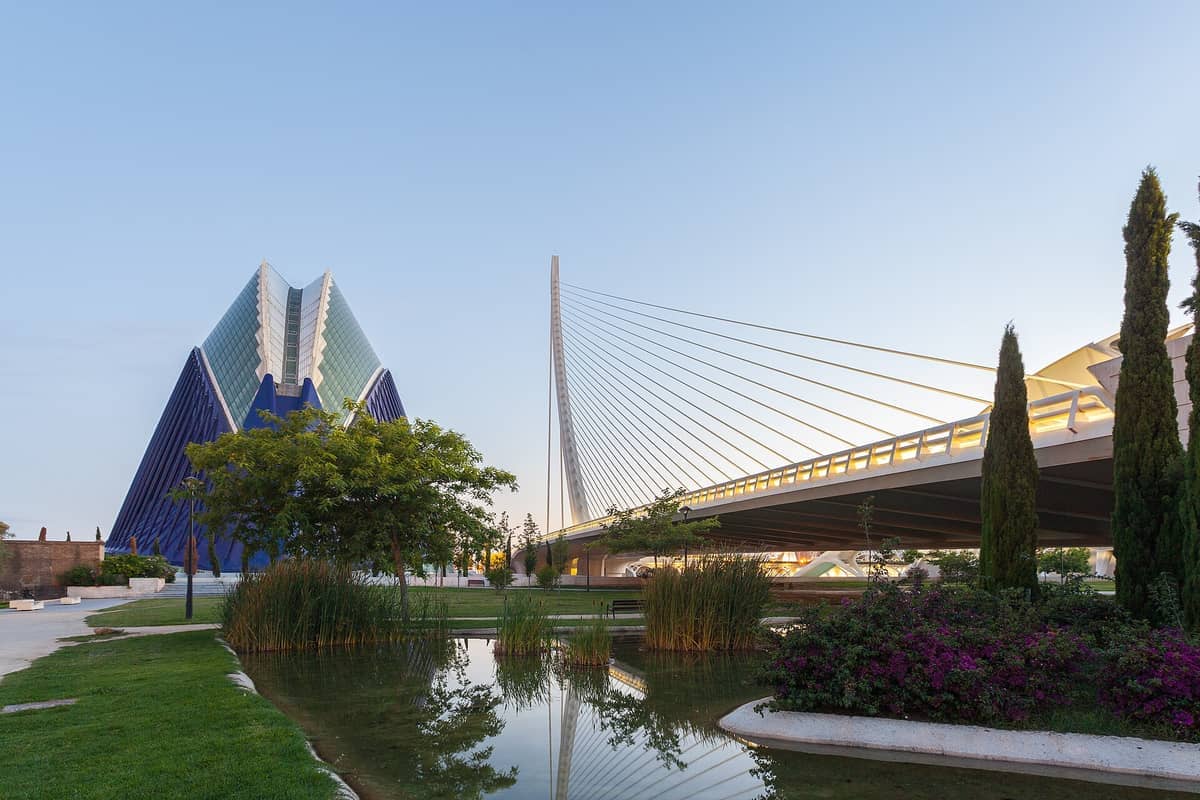
CaixaForum is not simply lodged in a generic shell. L'Àgora was conceived by Calatrava as a covered public plaza, an agora in the classical Greek sense: a sheltered space for gathering and exchange. The structure rises on two enormous inclined concrete arches, clad in white ceramic tile, with a retractable roof designed to regulate airflow and shade. From the exterior, the building reads as a vast metallic eye, elongated and sculptural, its reflection doubling in the shallow artificial lake that runs through the complex.
Calatrava's work defines the entire Ciudad de las Artes y las Ciencias, but L'Àgora is widely considered his most ambitious structure within the complex. Its engineering pedigree gives CaixaForum an entrance experience unlike any other exhibition space in Valencia: you approach across a pedestrian bridge, the white arches framing the sky above, before descending into a controlled interior atmosphere that immediately feels distinct from the noise and brightness outside.
Inside, the exhibition halls use the available floor area efficiently without feeling cramped. Ceiling heights vary, with lower corridors giving way to larger gallery rooms where ambitious large-format works or immersive installations can breathe properly. Lighting is calibrated for each show rather than standardised across the building, which means conditions genuinely adapt to the nature of whatever is on.
Tickets & tours
Hand-picked options from our booking partner. Prices are indicative; availability and final rates are confirmed when you complete your booking.
Valencia Silk Museum tickets and audio guide
From 7 €Instant confirmationFree cancellationHistoric Valencia walking tour
From 27 €Instant confirmationFree cancellationNatural thermal springs and Girlfriend Waterfall tour from Valencia
From 89 €Instant confirmationFree cancellationMontanejos guided hike with natural pools full-day tour from Valencia
From 45 €Instant confirmationFree cancellation
The Exhibition Programme: What to Expect
The foundation's programming model leans toward accessibility without becoming superficial. Past exhibitions across the CaixaForum network have included major retrospectives of painters like Hopper and Hockney, photography surveys tied to social and environmental themes, and science-facing shows aimed at families. Valencia's programme follows a similar logic: serious content, presented in a way that does not require specialist knowledge to engage with.
The typical structure involves two or three simultaneous exhibitions of varying scale. A primary show usually occupies the largest gallery and runs for two to three months. A smaller secondary exhibition runs concurrently, often with a different thematic register. Exhibition texts are generally provided in Spanish and Valencian, with English translations in major venues across the network, though the depth of English materials can vary by show.
Before visiting, check the current programme at the official CaixaForum site. If the current show is not compelling to you, it is worth noting that the building itself and the surrounding complex justify the trip anyway, particularly if you are already planning a visit to the L'Oceanogràfic or the Museu de les Ciències Príncep Felip.
ℹ️ Good to know
CaixaForum may offer free admission on selected public dates or during special open days; check the official programme for current conditions, as queues can form early when entry is free.
Visiting by Time of Day
CaixaForum València opens at 10:00 daily. Morning arrivals, particularly on weekdays, encounter the quietest conditions. The galleries have a particular quality in the first hour: the temperature inside is cool after the walk across the sun-exposed plaza, the sound of the exterior world drops away, and the light from the building's filtered fenestration creates a calm, diffused interior atmosphere. If you are a deliberate visitor who reads wall texts and spends time in front of individual works, mornings are worth prioritising.
Midday brings school groups and tour parties, mostly tied to the wider City of Arts and Sciences itinerary rather than to CaixaForum specifically. The corridors can narrow functionally when a group moves through together. Early afternoon, roughly 14:00 to 16:00, tends to quiet again as visitors break for lunch at the restaurants nearby. Late afternoon, from 17:00 onward, sees a secondary surge of visitors arriving after the main heat of a summer day has passed. In July and August, those late afternoon visitors often comment that the air-conditioned interior is one of its own attractions.
The building's exterior looks particularly striking at dusk, when the warm light catches the ceramic cladding and the reflective surface of the surrounding water changes tone. If you visit inside at 18:00 and exit near 19:30, the walk back through the complex in the fading light becomes a separate reward.
How to Get There and Practical Logistics
CaixaForum València sits inside the City of Arts and Sciences complex at C/ Eduardo Primo Yúfera 1A, in the southern part of the complex inside L'Àgora toward the Oceanogràfic end of the complex. Metro line L10 serves the area directly, and several bus lines connect the site to the city centre and the port district. Cycling is a practical option: the Jardí del Túria park runs parallel to the complex, and its flat, well-maintained path connects directly to the city centre in under 20 minutes by bike. Valenbisi public hire bikes are available nearby.
Parking is available within the complex but is expensive and fills quickly on weekends. Arriving by public transport or bicycle is genuinely more convenient. From the historic centre, a taxi or rideshare takes around 10 minutes outside peak hours.
The centre is wheelchair accessible. The entrance from the bridge leads directly into level gallery space without steps. Elevators serve any level changes inside the building. Group visits require advance booking via the dedicated group line (962 643 041) or email. Individual visitors with accessibility requirements can also contact the general information line (960 901 960) to arrange support.
⚠️ What to skip
CaixaForum is closed on 25 December and 1 January. It operates reduced hours (10:00–18:00) on 24 December, 31 December, and 5 January. Plan accordingly if visiting during the holiday period.
Photography, Atmosphere, and Honest Expectations
Photography policies inside the galleries depend on the individual exhibition and the licensing conditions agreed with lenders. In general, personal non-flash photography is permitted in the permanent architectural spaces, but specific shows may restrict image-making entirely. Ask at the front desk before you raise your camera. The exterior of L'Àgora, however, is photographable from every angle without restriction, and the building's geometry rewards attention: the compressed perspective looking along the lake from the south, the view of the arches from the western pedestrian bridge, and the underside of the roof structure from the entrance terrace all produce distinctive images.
Visitors who arrive hoping for a blockbuster permanent collection comparable to a national fine art museum will need to recalibrate. CaixaForum is not the Museu de Belles Arts or the IVAM. Its value is in access to major touring exhibitions and in the quality of its programming over time. Visiting once without checking what is on first is a gamble. Visiting with the current exhibition in mind, and treating the architectural surroundings as an equal draw, reliably rewards the trip.
The centre has a café and a shop. The shop stocks exhibition catalogues, design objects, and a selection of books tied to the programme. The café is functional rather than destination-worthy, but it serves as a sensible rest stop before or after a longer circuit of the complex. Prices are in line with similar urban cultural venues.
Who Should Skip This Attraction
If your primary interest is specifically Valencian art, history, or archaeology, you will find more directly relevant content at other institutions. The Museu de Belles Arts holds the city's finest permanent collection of Valencian painting. The IVAM focuses on avant-garde and local contemporary art. CaixaForum's programme is international and thematic, not rooted in the specific cultural heritage of the region.
Visitors on a single short day in Valencia who are prioritising the historic centre should also weigh their time carefully. The City of Arts and Sciences is a 20-minute journey from the old town, and CaixaForum is one of several paid attractions within the complex. If you have only four hours in the city, the time may be better spent in the centre among the Gothic architecture, the Mercado Central, and the Cathedral quarter.
Insider Tips
- Check the exhibition calendar on the official CaixaForum site before visiting rather than arriving speculatively. The quality gap between a major international retrospective and a smaller filler show is significant, and you want to time your visit to the former.
- CaixaBank customers enter free with proof of their card. If you are traveling with a group that includes a CaixaBank account holder, they can confirm the procedure at the front desk, which sometimes allows companion entry under specific conditions.
- Combine the visit with a walk through the Jardí del Túria from the city centre. The path delivers you directly to the complex and costs nothing. It also gives your eyes a full scan of L'Àgora from a distance before you arrive at the entrance.
- The southern end of the complex near L'Àgora is noticeably less crowded than the area around the Hemisfèric and the Palau de les Arts. Arriving from the Eduardo Primo Yúfera side rather than from the main northern entrance avoids the densest foot traffic.
- On free admission days, particularly 9 October, arrive at or before 10:00. The queues build quickly and the space inside, while well-managed, has a fixed capacity that can mean waits later in the day.
Who Is CaixaForum València For?
- Art and photography enthusiasts following touring international exhibitions
- Architecture lovers who want to experience Calatrava's L'Àgora from the inside
- Families with children under 16, who enter free and benefit from the programmatic variety
- Summer visitors looking for a genuinely cool, air-conditioned cultural afternoon
- Travelers combining a full day in the City of Arts and Sciences complex
Nearby Attractions
Other things to see while in Ciudad de las Artes y las Ciencias:
- Hemisfèric
The Hemisfèric is the signature building of Santiago Calatrava's City of Arts and Sciences complex, housing one of Europe's most impressive IMAX cinemas and a full digital planetarium. With a concave screen of roughly 900 m² and seating for 306, it delivers a genuinely overwhelming visual experience. This guide covers what to expect inside, the best time to visit, and how to fit it into a day at the complex.
- L'Oceanogràfic
L'Oceanogràfic is Europe's largest aquarium, occupying 100,000 square metres in Valencia's Ciudad de las Artes y las Ciencias. With marine ecosystems ranging from the Mediterranean to the Antarctic, it offers a full half-day experience for visitors of almost any age or interest.
- L'Umbracle
Part elevated promenade, part open-air sculpture gallery, and part gateway to one of Valencia's most famous nightlife venues, L'Umbracle is a free attraction within the City of Arts and Sciences complex that rewards visitors at almost any hour. By day, it offers shade, contemporary art, and sweeping views of Santiago Calatrava's architectural ensemble. By night, it transforms into something else entirely.
- Museu de les Ciències Príncep Felip
The Museu de les Ciències Príncep Felip is one of Valencia's most architecturally striking attractions, housed inside Santiago Calatrava's soaring skeleton-like structure at the Ciudad de las Artes y las Ciencias. It combines hands-on science exhibits with one of the most photogenic interiors in Spain. Here is what the experience is actually like, and whether it belongs on your itinerary.