Palau de les Arts Reina Sofía: Valencia's Architectural Opera House
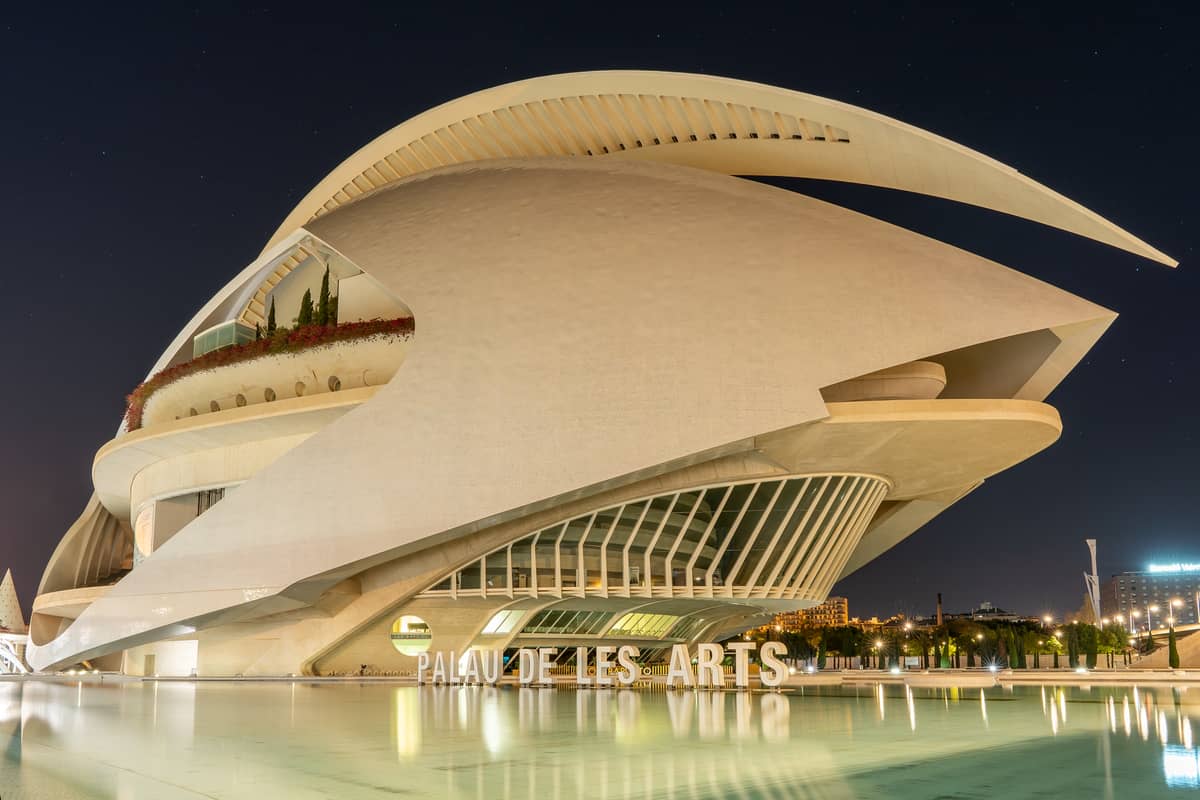
The Palau de les Arts Reina Sofía is Valencia's opera house and one of the most visually striking buildings in Europe. Designed by Santiago Calatrava and inaugurated in 2005, it anchors the City of Arts and Sciences complex with a shell-like form that dominates the skyline. Whether you come for a performance or simply to admire the architecture, it rewards close inspection.
Quick Facts
- Location
- Av. del Professor López Piñero, 1, 46013 València — within the Ciudad de las Artes y las Ciencias complex
- Getting There
- Multiple EMT Valencia bus lines serve the City of Arts and Sciences; check current routes at EMT València
- Time Needed
- 1.5–2.5 hours for a guided architectural visit; a full evening for a performance
- Cost
- Guided visits from around €14–€47.75 depending on type; performance tickets vary. Box office: Mon–Fri 11:00–18:00, Sat 11:00–14:00. Verify current prices at lesarts.com
- Best for
- Architecture lovers, opera and classical music fans, photography, cultural evenings
- Official website
- www.lesarts.com/en/home.html
What the Palau de les Arts Actually Is
The Palau de les Arts Reina Sofía is Valencia's principal opera house and performing arts centre, serving as the permanent home of the Orquestra de la Comunitat Valenciana. Its official Valencian name is Palau de les Arts Reina Sofía, though you will also see it referred to in Spanish as Palacio de las Artes Reina Sofía, or simply Les Arts. Queen Sofía inaugurated the building on 8 October 2005, and it has since become the most recognizable landmark of the wider City of Arts and Sciences complex.
The building hosts opera, classical concerts, theatre, and dance across multiple auditoriums. Beyond performances, the Palau opens its doors for guided architectural visits, allowing visitors who have no interest in opera to still experience the interior spaces, the engineering, and the panoramic views from its upper levels. Understanding this dual role — active arts venue plus architectural attraction — is essential for planning your visit, because the experience differs considerably depending on which you are there for.
The Architecture: Santiago Calatrava's Most Ambitious Form
Santiago Calatrava is a Valencian-born architect and engineer whose career spans bridges, train stations, and civic buildings across Europe and the Americas. The Palau de les Arts is widely considered among his most ambitious works in terms of sheer scale and formal complexity. The structure rises to approximately 75 metres and is encased in a double shell of ribbed white concrete and mosaic-clad surfaces that curve, taper, and overlap in ways that read differently from every angle.
Approach it from the south, along the Turia Garden riverbed, and the building appears almost organic — a crustacean or a helmeted figure depending on the light. Walk around to the northern facade and the geometry becomes more skeletal, the ribs of the outer shell separating clearly from the body beneath. The outer skin is finished in trencadís, the broken ceramic tile mosaic technique that Gaudí also used in Barcelona, though here it is applied at an industrial scale, covering thousands of square metres in white and pale grey fragments.
The building sits within the Ciudad de las Artes y las Ciencias, a complex that Calatrava masterplanned alongside the Hemisfèric, the Umbracle, and the Príncep Felip Science Museum, while the Oceanogràfic was designed separately by Félix Candela. Together these structures occupy the former course of the Turia River, redirected after catastrophic flooding in 1957. The transformation of that dry riverbed into a cultural corridor is one of the more remarkable urban planning stories in modern Spanish history.
💡 Local tip
Photography tip: The best exterior shot of the Palau de les Arts is from the reflecting pool on its western side, roughly one hour before sunset in summer, when the low light catches the trencadís mosaic and turns the white shell a warm amber. In winter, the same effect occurs earlier in the afternoon.
Tickets & tours
Hand-picked options from our booking partner. Prices are indicative; availability and final rates are confirmed when you complete your booking.
Palau de les Arts opera house self-guided visit with brouchure
From 14 €Instant confirmationPalau de les Arts Reina Sofia guided tour
From 18 €Instant confirmationPalau de Les Arts opera house entrance ticket and audio guided tour
From 14 €Instant confirmationSaint Nicholas Church Entrance Tickets and Audioguide
From 11 €Instant confirmation
The Guided Visit: What You Actually See Inside
Guided visits run Monday through Saturday from 10:30 to 14:30 and again from 15:30 to 18:30, with Sunday and holiday visits limited to the morning window of 10:30 to 14:30. These hours are subject to change when performances or rehearsals are scheduled, so checking the current calendar on the official website before you visit is genuinely necessary, not just a formality.
Inside, the scale becomes immediately apparent in ways the exterior photographs do not convey. The main opera hall, the Sala Principal, can seat around 1,470 people; the Teatre Martín i Soler is a separate venue, the Auditori is a large concert hall, and the Aula Magistral is used for educational and smaller-scale events. Guided visits typically move through the public foyers, the auditorium spaces when not in use, the backstage areas, and the upper terraces. The backstage infrastructure — the fly tower, the stage machinery, the wing spaces — is genuinely interesting even for visitors with no particular interest in opera production.
Prices for guided visits range from approximately €14 to €47.75 depending on visit type and availability. Given this is one of the higher-priced architectural visits in Valencia, it suits visitors with a genuine interest in either architecture or performing arts venues. If you are primarily drawn to the exterior, you can admire the building at no cost from the surrounding esplanade and reflecting pools.
ℹ️ Good to know
Box office hours: Monday to Friday 11:00–18:00, Saturday 11:00–14:00. On performance days the box office stays open until the show begins. On Saturdays, Sundays, and holidays with scheduled performances, it opens three hours before curtain. Contact the venue directly for accessibility arrangements.
Attending a Performance: What to Expect
The Les Arts season runs roughly from autumn through spring, with the main opera programme occupying October to June. The summer months see lighter programming, though outdoor events and festival performances sometimes fill the gap. The Orquestra de la Comunitat Valenciana performs regularly, and the venue has attracted internationally recognised conductors and soloists since its opening.
On performance evenings, the building transforms in ways that justify visiting on a night when nothing else is scheduled. The exterior shell is illuminated from below, making the white surfaces glow against the dark sky. Crowds arriving for the opera — dressed formally by Spanish urban standards, though strict black-tie is rare — gather in the glass foyers and on the terraces before curtain. The acoustic quality of the main auditorium has received generally strong reviews from performers and critics, which matters given the technical complexity of building a high-performance concert hall inside such an irregular outer form.
If attending an evening performance, consider pairing it with dinner beforehand in the nearby City of Arts and Sciences area or taking the short trip into the city centre. The area around the complex is not especially dense with restaurants, so planning ahead pays off. You can also check the best restaurants in Valencia for paella if you want to make a full evening of it before the curtain.
How the Experience Changes by Time of Day
Early morning, before 09:00, is the best time to photograph the building without people cluttering the foreground. The surrounding esplanade is almost empty, the pools are still, and the reflections are cleanest. Joggers from the Turia Garden path pass occasionally, but the complex is otherwise quiet. The building is oriented roughly east–west, so morning light falls directly on the northern facade.
Midday in summer brings the harshest conditions: the white concrete and mosaic reflect heat and glare intensely, and the esplanade offers almost no shade. Visitors doing a full tour of the City of Arts and Sciences in July or August should plan the Palau visit for the morning guided slot or late afternoon, and carry water. The Mediterranean climate means summers are genuinely hot, with temperatures regularly exceeding 30°C in July and August.
Late afternoon from October through April is close to ideal for exterior visits. The light angle is low enough to give the trencadís texture real depth, temperatures are comfortable, and the complex begins to fill with visitors finishing the day at the Oceanogràfic or the Science Museum. Performance evenings add another layer: from around 18:30 onward, the building takes on a different social character entirely.
Combining the Palau with the Rest of the Complex
The Palau de les Arts sits at the western end of the City of Arts and Sciences. A full visit to the complex would typically include the Hemisfèric, the Museu de les Ciències Príncep Felip, the L'Oceanogràfic, and the Umbracle garden terrace. Doing all of this in a single day is possible but exhausting; most visitors benefit from spending at least two half-days at the complex, or choosing two or three attractions rather than trying to cover everything at once.
The entire complex connects to the Jardí del Túria, Valencia's 9-kilometre linear park that runs through the city in the former riverbed. Walking or cycling from the historic centre to the City of Arts and Sciences along the Turia Garden takes roughly 30 to 40 minutes on foot and is one of the better ways to arrive, giving you a sense of the park's scale before the buildings appear at its eastern end.
⚠️ What to skip
Worth knowing: The Palau de les Arts guided visit is among the more expensive single-attraction experiences in Valencia. If your interest is mainly architectural rather than operatic, the exterior is fully accessible at no cost, and the views from the surrounding esplanade are substantial. The guided tour adds interior access and context but is a genuine financial commitment at its current price point.
Getting There and Practical Logistics
The building's address is Av. del Professor López Piñero, 1, 46013 València. The City of Arts and Sciences complex is served by multiple EMT Valencia city bus lines; the specific route numbers are subject to change, so using the EMT Valencia journey planner or Google Maps with real-time transit data is the most reliable approach. There is no metro station directly at the complex, though the surrounding road network is well served.
By bicycle, the complex is straightforward to reach via the Turia Garden cycling path, which is flat, well-maintained, and car-free. Valencia has an extensive public bike-share network and dedicated lanes. For a full breakdown of getting around the city, the getting around Valencia guide covers metro, bus, and cycling options in detail.
Taxis and ride-hailing drop-offs work well given the open esplanade — there is no complicated parking structure to navigate on foot. Drivers can approach via Av. del Professor López Piñero directly. On-site parking exists for those arriving by car, though availability on performance evenings can be limited.
Accessibility: The complex is generally flat and paved, making it manageable for wheelchair users in terms of exterior movement. For specific details about accessible seating in the auditoriums, lift access, or reserved spaces, contact the venue directly via the official website at lesarts.com, as these arrangements require advance coordination.
Insider Tips
- The exterior reflecting pools are cleaned and refilled periodically; if you arrive to find them drained, the building still photographs well but loses its most photogenic element. Check recent visitor photos online before making a special trip for photography.
- On weekday mornings outside of school holiday periods, guided visits tend to have smaller groups, which usually means more time with the guide in each space and fewer people in your photographs of the interior.
- The Umbracle, the planted terrace structure at the western end of the complex, offers an elevated view toward the Palau de les Arts that most visitors miss because they walk straight past it. The view from the top of the Umbracle ramp at dusk, with the Palau lit up ahead, is one of the better free viewpoints in Valencia.
- If you are attending a performance, note that the dress code is smart-casual to formal by most Valencian standards — jeans and trainers will not get you turned away, but most of the audience will be dressed up, and the building has a formality that makes smart attire feel appropriate.
- The trencadís mosaic on the outer shell is not perfectly white: up close, you can see the individual ceramic fragments vary in shade from cream to pale grey to near-white. This variation gives the surface a texture that flat photographs do not capture. Getting close to the base of the shell is worth doing.
Who Is Palau de les Arts Reina Sofía For?
- Architecture enthusiasts who want to understand Calatrava's engineering approach beyond the postcard image
- Opera and classical music fans visiting Valencia and wanting to see a performance in a world-class venue
- Photographers looking for a structurally complex subject that changes dramatically with light conditions throughout the day
- Travellers combining a full day at the City of Arts and Sciences complex with an evening performance
- Visitors interested in how Valencia reinvented a flood-damaged riverbed into a major cultural district
Nearby Attractions
Other things to see while in Ciudad de las Artes y las Ciencias:
- CaixaForum València
Opened in June 2022 inside Santiago Calatrava's landmark L'Àgora building, CaixaForum València is the cultural arm of the 'la Caixa' Foundation in the City of Arts and Sciences complex. It hosts rotating international exhibitions across art, science, and society, with accessible pricing and a location that rewards a longer visit to the surrounding complex.
- Hemisfèric
The Hemisfèric is the signature building of Santiago Calatrava's City of Arts and Sciences complex, housing one of Europe's most impressive IMAX cinemas and a full digital planetarium. With a concave screen of roughly 900 m² and seating for 306, it delivers a genuinely overwhelming visual experience. This guide covers what to expect inside, the best time to visit, and how to fit it into a day at the complex.
- L'Oceanogràfic
L'Oceanogràfic is Europe's largest aquarium, occupying 100,000 square metres in Valencia's Ciudad de las Artes y las Ciencias. With marine ecosystems ranging from the Mediterranean to the Antarctic, it offers a full half-day experience for visitors of almost any age or interest.
- L'Umbracle
Part elevated promenade, part open-air sculpture gallery, and part gateway to one of Valencia's most famous nightlife venues, L'Umbracle is a free attraction within the City of Arts and Sciences complex that rewards visitors at almost any hour. By day, it offers shade, contemporary art, and sweeping views of Santiago Calatrava's architectural ensemble. By night, it transforms into something else entirely.