Mercado de Ruzafa: Valencia's Neighborhood Market at Its Most Authentic
Tucked into the heart of Ruzafa on Plaza del Baró de Cortés, the Mercado de Ruzafa is a compact, covered municipal market with around 160 stalls serving the neighborhood since the early 1960s. Free to enter and open weekday mornings, it offers a ground-level look at how Valencians actually shop, eat, and talk to their neighbors.
Quick Facts
- Location
- Plaza del Baró de Cortés, s/n, 46006 València — in the Ruzafa neighborhood, opposite San Valero Church
- Getting There
- Walkable from Valencia's city center in 15–20 minutes; multiple EMT bus lines serve the Ruzafa area
- Time Needed
- 30–60 minutes for a relaxed visit; longer if you stop at a nearby café
- Cost
- Free entry; individual stall prices vary
- Best for
- Food lovers, slow travelers, people-watching, morning routines
- Official website
- mercatderussafa.com
What Kind of Market Is This, Exactly?
The Mercado de Ruzafa — officially the Mercado Municipal de Ruzafa, or in Valencian, the Mercat de Russafa — is not a tourist destination in the traditional sense. There are no spectacular iron facades here, no Instagram crowds jostling for the perfect shot. What you get instead is a working neighborhood market: around 160 stalls selling fresh fruit, vegetables, fish, meat, cheese, and olives to people who live within walking distance and have been coming here for decades.
The building is a low, flat-roofed covered structure on Plaza del Baró de Cortés, functional and unpretentious. Opened in the early 1960s after construction began in 1957, it predates the Ruzafa neighborhood's current reputation as Valencia's most design-conscious district. That contrast is part of what makes it interesting: the market has barely changed while everything around it has transformed.
ℹ️ Good to know
Opening hours: Monday to Saturday, 07:30–15:00. Closed Sundays and public holidays. Entry is free.
The Experience: What You See, Smell, and Hear
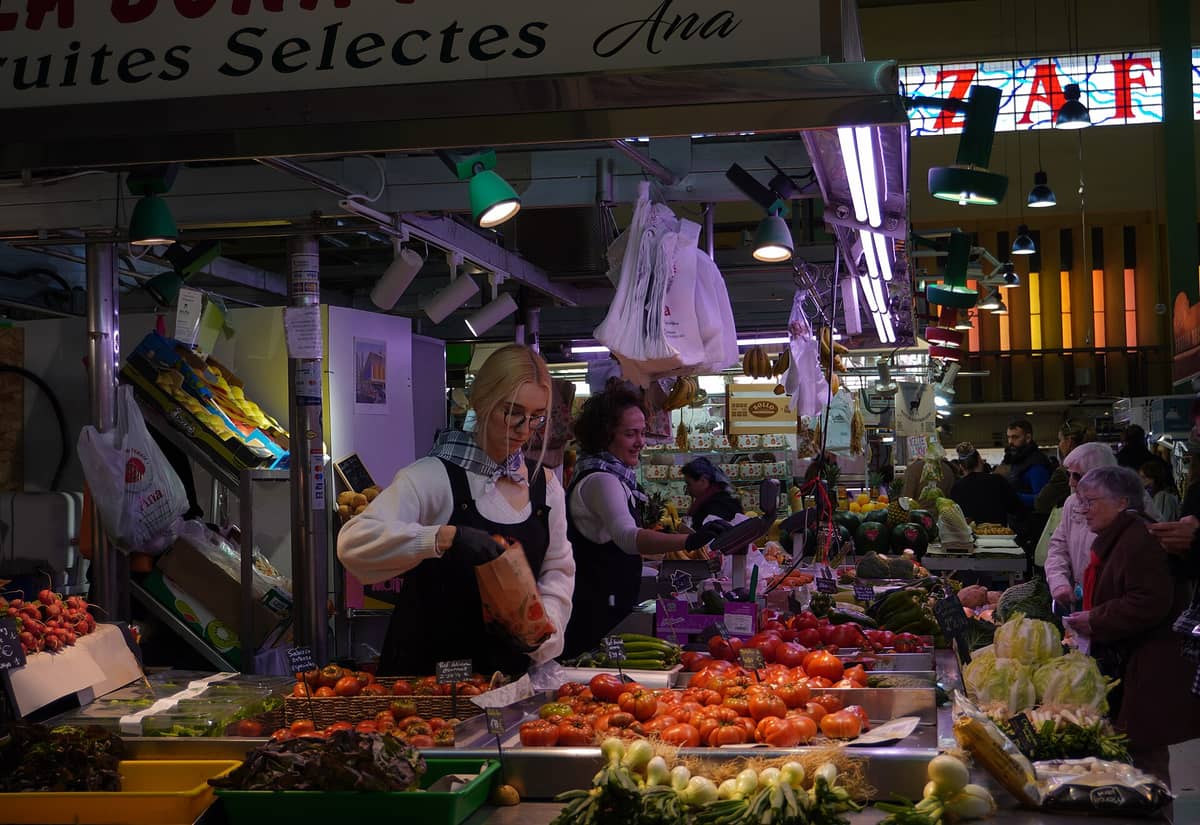
Step through the entrance from the square and the shift is immediate. Outside, Ruzafa hums with coffee shops and brunch spots. Inside, the temperature drops a few degrees, the light turns cool and diffuse, and the smell shifts to something more elemental: citrus peel, raw fish, damp stone, and the faint sweetness of cut flowers.
The stalls are arranged compactly, and the paths between them are narrow enough that you naturally slow down. Fish counters display whole sea bream and prawns on shaved ice. Produce stalls stack local tomatoes, fat green peppers, and garnet-red pomegranates by the kilo. A charcuterie vendor lays out jamón and cured sausages on paper. Everything has a price tag, and the vendors will hold up an example of whatever you're pointing at while you work out the vocabulary.
The ambient sound is a mix of Spanish and Valencian — short, practical exchanges between vendors and regulars, the thunk of a cleaver on a butcher's block, the scrape of a crate on tile. Nobody is performing for visitors here. That's a feature, not a bug.
Tickets & tours
Hand-picked options from our booking partner. Prices are indicative; availability and final rates are confirmed when you complete your booking.
Vegetable paella cooking class and Ruzafa market visit
From 45 €Instant confirmationFree cancellationValencian paella cooking class and Ruzafa market visit
From 55 €Instant confirmationFree cancellationSeafood paella cooking class and Ruzafa market visit
From 50 €Instant confirmationFree cancellationValencia Silk Museum tickets and audio guide
From 7 €Instant confirmationFree cancellation
When to Go: How the Market Changes by Hour
The market is busiest between 09:00 and 11:00, when locals do their serious shopping before the midday heat sets in. This is the best time to see it at full energy — stalls fully stocked, vendors mid-conversation with regulars, the square outside animated with people arriving and leaving with shopping bags. If you want to browse without feeling like you're in the way, aim for this window, but accept that it's genuinely busy.
Early risers who arrive at 07:30 or 08:00 will find a quieter, more atmospheric experience. Stock is at its freshest, the morning light angles in from the square, and conversations are unhurried. By 13:00, some stalls begin wrapping up and gaps appear in the displays. After 14:00, the market is winding down visibly — fine for a quick pass but not for serious shopping.
💡 Local tip
Saturday morning is the most energetic visit — but also the most crowded. A Tuesday or Wednesday at 08:30 gives you the full experience with none of the friction.
Ruzafa as Context: Why This Market Matters
The Mercado de Ruzafa sits at the geographic and social center of a neighborhood that has undergone significant change over the past two decades. Ruzafa was historically a working-class district, home to a large immigrant community and known for its affordable rents and tight-knit street life. That character has not entirely disappeared, but the neighborhood is now also Valencia's most recognized hub for independent restaurants, cafés, and creative businesses.
The market is a useful counterweight to that shift. It serves the people who were here before the wine bars arrived and continues to anchor the neighborhood's daily rhythms. Visiting it alongside the surrounding café culture gives you a more complete picture of Ruzafa than either element does alone.
If you want to compare it to Valencia's grand covered markets, the benchmark is Mercado Central — a cathedral-scale modernist market near the old town with hundreds of stalls and significant architectural drama. Mercado de Ruzafa is its quieter, smaller, and considerably less photographed counterpart. Neither is better; they serve different purposes and different audiences.
Practical Walkthrough: Getting There and Getting Around
The market is on Plaza del Baró de Cortés, a small square in the core of Ruzafa, directly opposite the Church of San Valero. On foot from Plaza del Ayuntamiento, it's about a 15-minute walk south — straightforward and flat. Several EMT bus lines serve the Ruzafa area; check current route maps on the EMT Valencia website, as specific line numbers and stops shift with network updates.
The building is ground-level with wide entrances from the plaza, making it accessible for pushchairs and those with limited mobility. The floor inside is flat tile. Detailed accessibility features such as dedicated ramps or adapted toilets are not specified in official sources — if these matter to your visit, contact the market directly at info@mercatderussafa.com or by phone at +34 963 744 025.
There is no need to bring anything specific. A reusable shopping bag is useful if you plan to buy. Vendors accept cash reliably; card acceptance varies by stall and should not be assumed.
⚠️ What to skip
The market closes on Sundays and public holidays. If you're visiting during a local festivo, check ahead — Valencia has a dense calendar of saints' days and regional celebrations that can mean surprise closures.
Photography: Honest Notes
The market interior is photogenic in a low-key way — the light is soft and even, the colors of the produce are strong, and the faces of the vendors are expressive. But this is a working market, not a photo set. Ask before pointing a camera at vendors or regulars. Most will agree; some will not. A quick 'puedo hacer una foto?' goes a long way.
Wide-angle shots work better than telephoto here — the space is compact enough that a longer lens makes things feel more intrusive than they are. The best light for the exterior plaza shots comes in the morning, when the sun hits the church facade across the square.
Who This Market Is Not For
If you're looking for a grand architectural experience, go to Mercado Central instead. If you want craft stalls, artisan products, or a weekend flea market atmosphere, this is not that. The Mercado de Ruzafa is a grocery market. It sells food to people who are going home to cook it. Visitors who arrive expecting a curated food hall or street food scene will find it underwhelming.
It is also not worth a special trip from across the city on its own. The value is in combining it with a wider exploration of the Ruzafa neighborhood — walking the surrounding streets, having breakfast at one of the cafés nearby, and using the market as a grounding point rather than the main event.
Insider Tips
- The fish stalls tend to be the most active and the most revealing — watching vendors break down a whole fish for a regular customer is worth the few minutes it takes. Arrive before 10:00 for the best selection.
- The plaza outside the market has benches and good morning light. Sit for a few minutes after your visit and watch the rhythm of arrivals and departures — it tells you a lot about how the neighborhood actually functions.
- Several bakeries and small cafés within a block of the market open early and serve coffee with a pastry for under two euros. This is where locals eat breakfast, not in the brunch spots a few streets over.
- If you buy produce, the vendors will often include extra items or round up generously if you're buying by the kilo. Don't negotiate aggressively — it's not that kind of market.
- Combine your visit with a walk through the surrounding Ruzafa streets on a weekday morning, before the lunch crowd arrives. The neighborhood reads very differently at 09:00 than it does at 13:00.
Who Is Mercado de Ruzafa For?
- Slow travelers who prioritize local life over sightseeing checklists
- Food-focused visitors planning to self-cater or simply curious about regional produce
- Photographers looking for genuine, unperformed street-level scenes
- Anyone spending a half-day in Ruzafa who wants to understand the neighborhood beyond its restaurant reputation
- Early risers who want somewhere purposeful to head before most of Valencia wakes up
Nearby Attractions
Other things to see while in Ruzafa:
- Mercat de Colón
Built between 1914 and 1916, Mercado de Colón is one of Valencia's finest examples of Valencian Modernisme architecture. Free to enter, it combines a landmark iron-and-tile building with a lively mix of food stalls, specialty cafés, and evening bars — making it as much a social hub as a sight.