Mercado de Colón: Valencia's Most Beautiful Market Building
Built between 1914 and 1916, Mercado de Colón is one of Valencia's finest examples of Valencian Modernisme architecture. Free to enter, it combines a landmark iron-and-tile building with a lively mix of food stalls, specialty cafés, and evening bars — making it as much a social hub as a sight.
Quick Facts
- Location
- Calle Jorge Juan 19, 46004 Valencia (Eixample district)
- Getting There
- Metro lines 3 and 5 (Colón stop); EMT buses 1, 3, 5, 8, 10, 13, 18, 22, 30, 32, 40
- Time Needed
- 30–60 minutes for the building; longer if eating or drinking
- Cost
- Free entry; food and drink priced at individual stall rates
- Best for
- Architecture lovers, coffee and brunch, evening drinks, rainy-day sightseeing
- Official website
- mercadocolon.es
What Is Mercado de Colón?
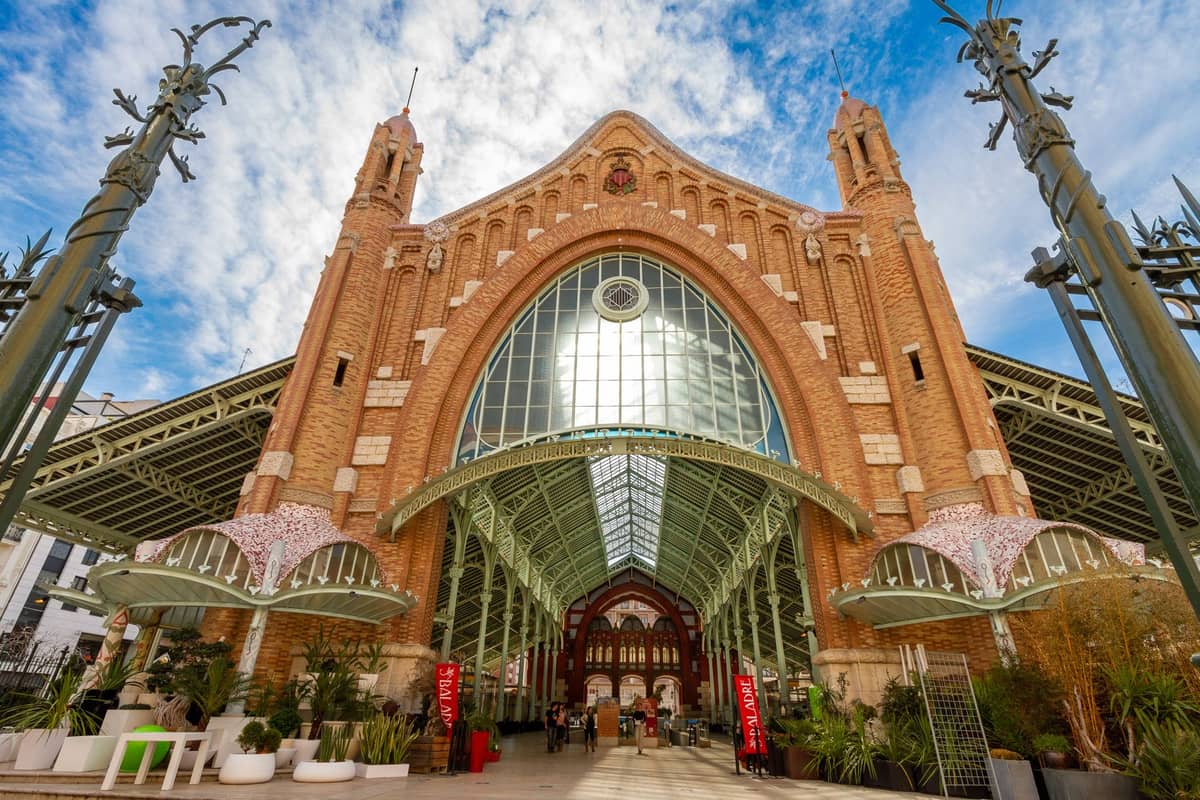
Mercado de Colón (officially Mercat de Colom in Valencian) stands on Calle Jorge Juan in Valencia's Eixample district, just a few blocks from the edge of Ruzafa. It is a covered market building completed in 1916, designed by architect Francisco Mora Berenguer in the ornate style known as Valencian Modernisme — a regional expression of the broader Art Nouveau movement that swept across Europe in the early twentieth century. The building occupies an entire city block between Calle Jorge Juan and Calle Cirilo Amorós, and its scale alone signals that this was conceived as a civic statement, not just a shopping hall.
Today it functions less like a traditional food market and more like an upscale social venue inside a protected architectural monument. The permanent tenants include specialty coffee bars, horchata stands, wine and cocktail stalls, a handful of gourmet food counters, and florists. The building itself is the attraction for many visitors; the commerce inside is a pleasant bonus.
ℹ️ Good to know
Entry to the building is completely free. Opening hours for the complex run Monday–Thursday and Sunday from 07:30 to 02:00, and Friday–Saturday from 07:30 to 03:00, though individual vendors set their own hours within that window.
The Architecture: What You're Actually Looking At
The facade is the first thing to stop you in your tracks. Two enormous arched portals, framed in wrought iron and filled with intricate ceramic tile decoration, face Calle Jorge Juan. The tilework uses the deep blues, greens, and yellows that are signatures of the Valencian ceramic tradition, and at mid-morning when the sun hits the south-facing front directly, the colours almost appear backlit. Overhead, the gabled roofline carries decorative cresting in cast iron, a detail that rewards a slow look upward. For more context on this architectural style across the city, the Art Nouveau architecture guide for Valencia covers the broader movement and its key buildings.
Step inside and the interior opens into a single high nave, covered by a continuous vaulted iron-and-glass roof. The structural ironwork is exposed and painted in deep green, giving the space the feel of a Victorian railway terminus rather than a market. Light falls from the glazed roof and from the large lateral windows, keeping the interior airy even on overcast days. The floor is laid with original patterned encaustic tiles in sections that have survived the building's various renovations.
After falling into decline and finally closing in 1985, the building was comprehensively restored and reopened in 2003. The restoration preserved the structural ironwork and ceramic decoration while modernising the internal fit-out for contemporary retail. It is a listed monument and a protected cultural asset, which places strict limits on how the interior can be altered — a fact that has kept the space more coherent than many restored markets of its era.
Tickets & tours
Hand-picked options from our booking partner. Prices are indicative; availability and final rates are confirmed when you complete your booking.
Valencia Silk Museum tickets and audio guide
From 7 €Instant confirmationFree cancellationSaint Nicholas Church Entrance Tickets and Audioguide
From 11 €Instant confirmationHistoric Valencia walking tour
From 27 €Instant confirmationFree cancellationNatural thermal springs and Girlfriend Waterfall tour from Valencia
From 89 €Instant confirmationFree cancellation
How the Atmosphere Changes Through the Day
Early morning, roughly 08:00 to 10:00, is when Mercado de Colón is at its quietest. A few locals pick up coffee and pastries on the way to work, conversations are brief and transactional, and the scale of the building is fully visible without crowds filling the sightlines. This is the best window for photography: the light through the roof glass is warm and directional, and you can stand at either end of the nave and frame the full length of the hall without strangers walking into the shot.
By mid-morning on weekends, the brunch crowd arrives and the noise level rises considerably. Tables outside on the pedestrianised section of Calle Jorge Juan fill quickly, and queues form at the more popular coffee counters. The smell of fresh orange juice, toasted bread, and roasted coffee drifts through the hall. It is convivial but can feel congested if you are trying to examine the architecture — the building works against you at this hour.
Evenings shift the demographic entirely. From around 19:00 onward, Mercado de Colón transitions into a drinks and aperitivo destination. Wine by the glass, craft beers, and vermut are the orders of choice, and the outdoor terrace tables attract a well-dressed local crowd. On Friday and Saturday nights the venue stays open until 03:00 and functions closer to a bar district than a market. If nightlife or a pre-dinner drink is your goal, this is the hour to arrive.
💡 Local tip
For architecture photography without people, aim for a weekday before 09:30 or after 21:00 when the food crowds have thinned but the lighting inside is still on.
What to Eat and Drink Here
The horchata counter is worth seeking out. Valencia is the home of authentic horchata de chufa — the chilled, slightly sweet drink made from tiger nuts — and a glass here, served with a long farton pastry for dipping, is one of the more grounded local experiences you can have in a tourist-friendly setting. The complete guide to horchata in Valencia explains where the tradition comes from and what to look for in quality.
Coffee standards at Mercado de Colón are reliably high. Several of the permanent counters source beans with some care and produce espresso drinks that hold up to comparison with dedicated specialty cafés. For breakfast, pan con tomate (bread rubbed with tomato, olive oil, and salt) and freshly squeezed orange juice are the default local order, and both are done well at multiple stalls.
Prices are noticeably higher than at neighbourhood cafés in Ruzafa or the old city. You are partly paying for the setting. A coffee and pastry might run 30 to 50 percent more than the same order three streets away. This is worth knowing in advance so it does not come as a surprise — but it is not extortionate by European market standards.
Getting There and Getting Around
The most direct metro access is via lines 3 and 5, which both stop at Colón station, a five-minute walk from the market. From the historic centre, the market is walkable in roughly 10 to 15 minutes along Gran Via Marqués del Turia or through the Eixample grid. Cyclists coming from the Turia park can lock up at the bike racks on Calle Cirilo Amorós on the building's north side.
If you are combining Mercado de Colón with a broader half-day in the area, the Ruzafa neighbourhood immediately to the south is worth the detour. Its Mercado de Ruzafa operates as a working local market with a very different atmosphere — rougher, cheaper, and more authentically neighbourhood-oriented. The contrast between the two markets, a ten-minute walk apart, illustrates how differently a city can use the same building typology.
Wheelchair access is available. The building has flat entrances from street level and wide internal passages throughout the main hall, making it one of the more accessible historic market buildings in the city. Individual vendor stalls may have their own counters at varying heights.
Honest Assessment: Is It Worth Your Time?
Mercado de Colón is genuinely worth a visit, but mainly for the building rather than the commerce. If you have already seen Mercado Central — the city's 1928 modernist food market near the old town — you may find Colón's interior less dramatic, though its iron-and-glass nave has a distinctive industrial elegance that Mercado Central's more ornate dome does not replicate.
Travellers who are primarily interested in shopping for fresh produce or local food products will be disappointed. This is not a market in the working sense — you cannot buy vegetables, fish, or cured meats to cook with. The vendors focus on ready-to-consume food and drinks for on-site consumption. If a functioning food market is what you want, Mercado de Ruzafa or Mercado Central are better choices.
For anyone interested in Valencian architecture specifically, Mercado de Colón fits naturally into a broader itinerary covering the city's modernist buildings. The Valencia architecture guide maps out how to see the key examples in a logical sequence without excessive backtracking.
⚠️ What to skip
Weekend brunch hours (10:00–13:00) are the peak congestion window. If crowds bother you or you want to photograph the interior properly, avoid this window. Weekday mornings or late evenings offer a completely different experience of the same space.
Insider Tips
- Stand at the far east end of the nave and look back toward the main portal: this is the angle that best shows the full length of the iron roof structure and the way the arched windows frame the light. It is also the least photographed angle of the building.
- The florist stall near the side entrance on Calle Cirilo Amorós has operated since the early years after the 2003 restoration and sells cut flowers at prices well below what you would pay in the tourist centre.
- On warm evenings, the outdoor tables on the pedestrianised stretch of Calle Jorge Juan fill faster than the interior. Arrive before 20:00 on a Friday or Saturday if you want a seat outside without a long wait.
- The ceramic tilework on the exterior portals includes heraldic and naturalistic motifs that most visitors walk past without examining closely. Give yourself five minutes at street level to work through the decorative programme — it repays attention.
- If you are visiting Valencia during a rainy spell, Mercado de Colón is one of the few genuinely interesting indoor attractions in the Eixample area that costs nothing to enter and has enough space to feel comfortable rather than cramped.
Who Is Mercat de Colón For?
- Architecture enthusiasts and those following a modernist Valencia itinerary
- Coffee and brunch seekers who want a distinctive setting over a standard café
- Evening aperitivo and pre-dinner drinks with a local crowd
- Travellers on a tight budget looking for a free cultural sight with practical refreshment options
- Families with pushchairs or wheelchair users who need a step-free, sheltered rest stop
Nearby Attractions
Other things to see while in Ruzafa:
- Mercado de Ruzafa
Tucked into the heart of Ruzafa on Plaza del Baró de Cortés, the Mercado de Ruzafa is a compact, covered municipal market with around 160 stalls serving the neighborhood since the early 1960s. Free to enter and open weekday mornings, it offers a ground-level look at how Valencians actually shop, eat, and talk to their neighbors.