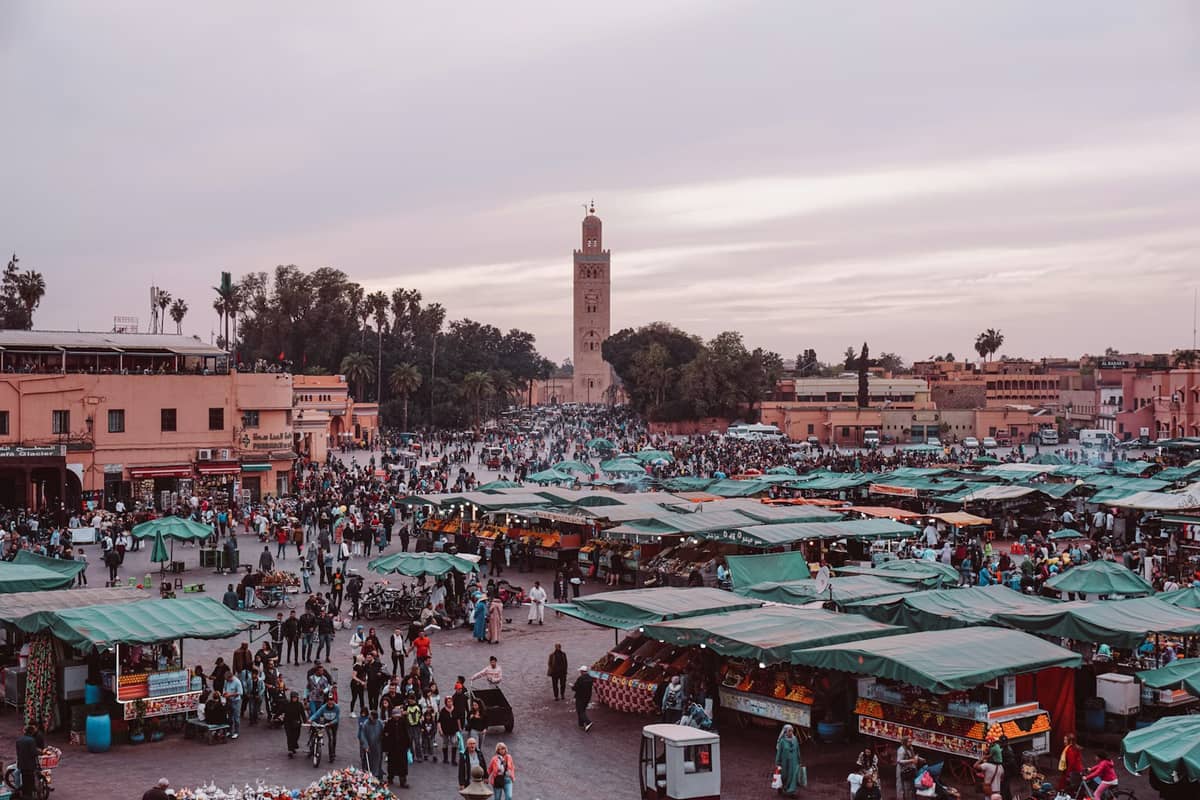
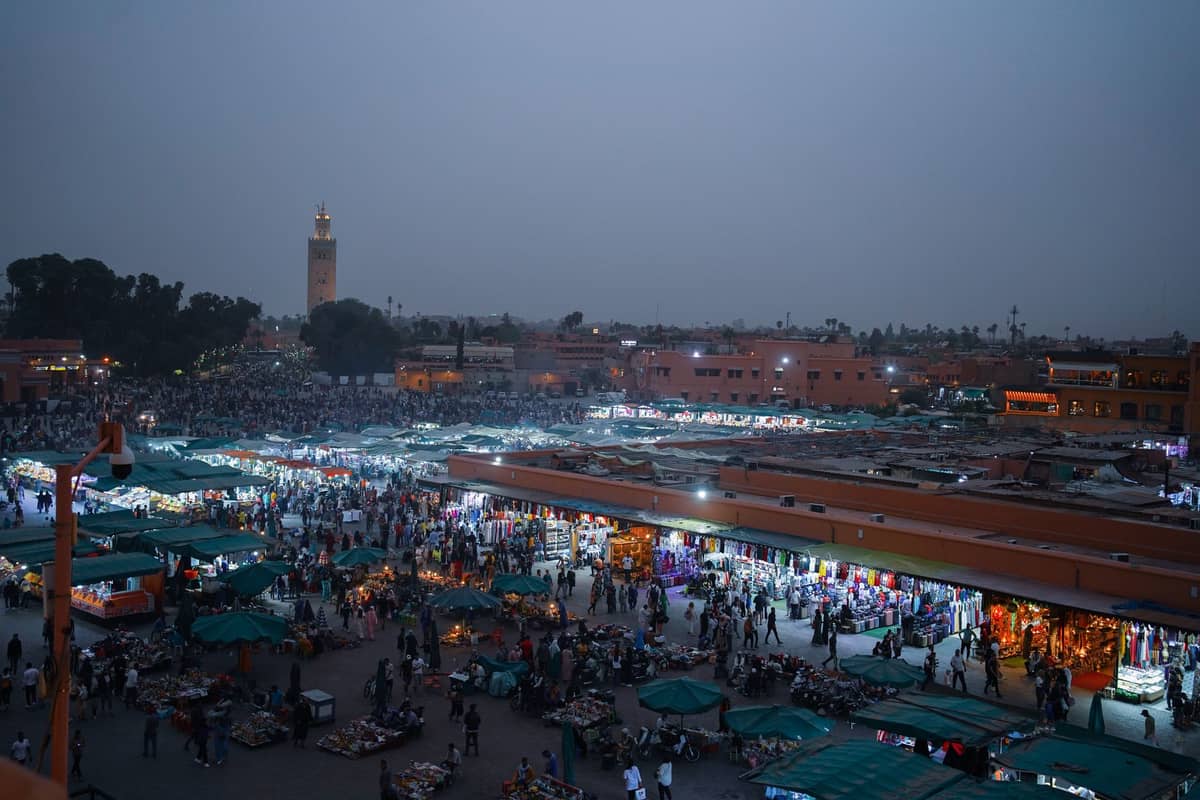
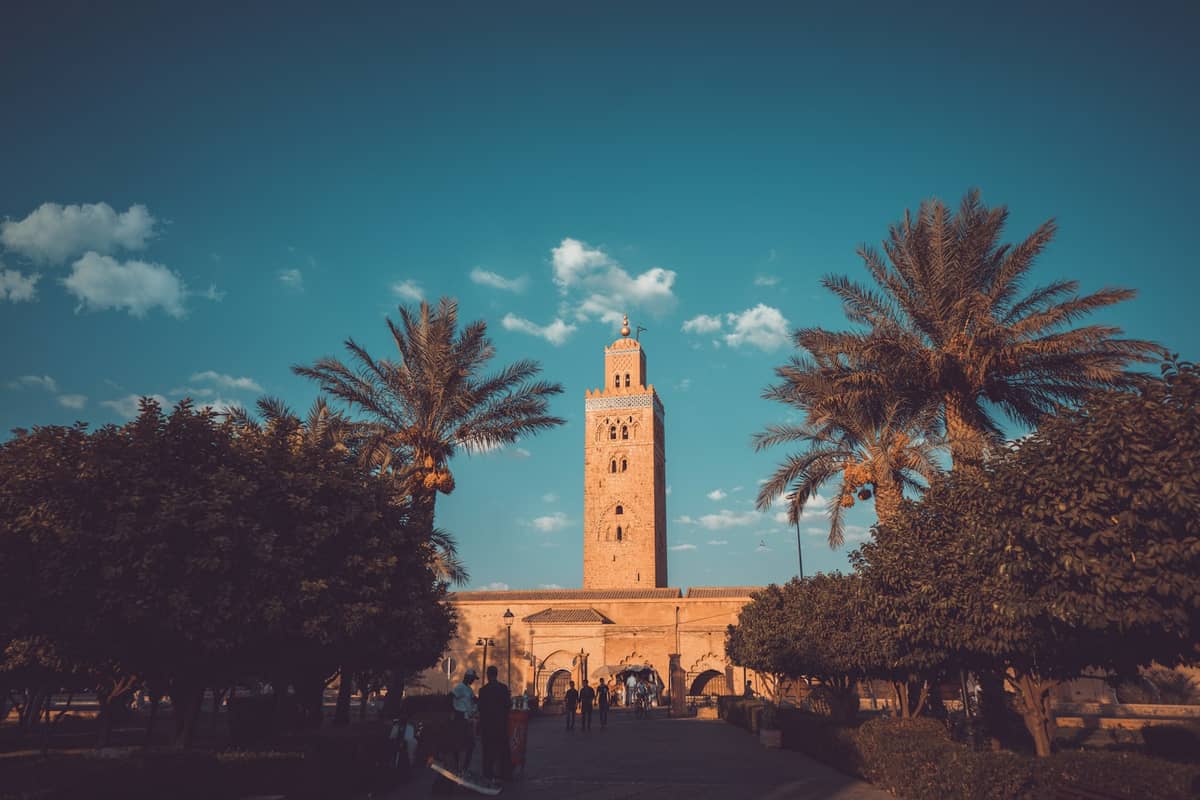
Jemaa el-Fna and the Koutoubia Mosque form the geographic and spiritual center of Marrakech's medina. This is where the city's ancient rhythms play out daily, from orange juice vendors and snake charmers to rooftop dinners with views of a 12th-century minaret. No other neighborhood in Marrakech delivers the same concentrated intensity.
Jemaa el-Fna is not just a square, it is the living core of Marrakech, a UNESCO-recognized space where the medina's daily theater has been performed for centuries. The Koutoubia Mosque rises just over 200 meters to the west, its nearly 70-meter minaret serving as the orientation landmark that anchors the entire old city. Together, they form the neighborhood that every visitor to Marrakech passes through, whether they plan to or not.
Orientation
Jemaa el-Fna sits at the western edge of the medina, where the ancient walled city meets the modern arteries running toward Gueliz and Hivernage. The square itself is large and open, roughly oval in shape, and functions as the primary transition point between the tangle of medina streets to the north and east and the broader avenues of the new town to the west. Avenue Mohammed V runs southwest from the square toward Gueliz, and it is along this artery that the Koutoubia Mosque stands, about 200 meters from the square's western edge.
Think of this area as Marrakech's central node. To the north of the square, the great medina souks begin almost immediately, pulling you into a labyrinth of covered markets for spices, leather, textiles, and metalwork. To the south and southeast lie the deeper, quieter residential quarters of the medina, leading eventually toward the Kasbah and Mellah neighborhoods. To the west, the Koutoubia gardens provide a rare open green buffer before the city transitions into the wide, car-filled boulevards of Gueliz.
This location means the neighborhood is uniquely accessible from every direction. Riads throughout the medina place themselves in walking distance of the square, usually between five and twenty minutes on foot through alleyways. The Koutoubia minaret is visible from much of the surrounding area, making it the single most reliable wayfinding landmark in all of Marrakech. When you are lost in the souks, you orient yourself by finding the minaret and walking toward it.
Character and Atmosphere
The area operates on a dramatic daily cycle that is unlike anywhere else in Morocco. In the early morning, Jemaa el-Fna is almost contemplative. A handful of juice stalls are already open, orange crates stacked high, and the square is occupied mostly by locals crossing it on their way elsewhere. The light at this hour is low and golden, the air still cool, and the minaret of the Koutoubia catches the early sun in a way that is genuinely arresting. This is the best time to photograph the square without the crowds.
By mid-morning, the performers begin to arrive. Henna artists set up their stations around the perimeter, and the first snake charmers position themselves with their baskets. The square starts filling with tourists and Moroccan visitors alike. By midday in summer the heat can be severe, pushing many people into the shade of the surrounding cafes and restaurants. The rooftop terraces that ring the square fill up with people escaping the direct sun while watching the action below.
The transformation at dusk is the neighborhood's defining moment. As the light fades and the call to prayer rolls out from the Koutoubia, the food stalls roll onto the square in formation. Smoke rises from dozens of grills simultaneously. Storytellers, musicians, acrobats, and Gnawa musicians claim their patches of ground and gather circles of onlookers. The noise level rises dramatically, layering Arabic, French, Tamazight, and every European language imaginable into a single continuous hum. By 9pm on any given evening, Jemaa el-Fna is one of the most densely concentrated human experiences on the African continent.
ℹ️ Good to know
The nighttime atmosphere on the square peaks between roughly 8pm and 11pm. If you visit only once, do it at dusk when the food stalls are setting up and the light is still warm enough to see the minaret clearly.
The Koutoubia side of the neighborhood has a noticeably different energy. The gardens flanking the mosque, known as the Lalla Hasna Gardens, are a calm counterpoint to the square's intensity. Marrakchi families walk here in the evenings, children chase each other between rose bushes, and the formal garden layout offers a space for sitting quietly. Non-Muslims cannot enter the mosque itself, but the exterior and its surrounding grounds are open and worth approaching on foot. The minaret, built in the 12th century during the Almohad dynasty, established the template that influenced the Hassan Tower in Rabat and the Giralda in Seville.
What to See and Do
The square itself is the primary attraction, and simply spending time on it across different times of day qualifies as a genuine experience rather than passive sightseeing. Jemaa el-Fna was designated a UNESCO Masterpiece of the Oral and Intangible Heritage of Humanity in 2001, recognizing its living cultural function rather than any built structure.
The Koutoubia Mosque rewards a slow approach. Walk toward it from the square along Rue El Koutoubia and take time to walk the full perimeter. The minaret's decorative stone carving changes on each of its four faces, a detail that most visitors rushing past on Avenue Mohammed V miss entirely. The gardens to the south of the mosque are well maintained and open to all.
From this neighborhood, the great landmarks of the wider medina are all within walking range. The Ben Youssef Madrasa is roughly 20 minutes north on foot through the souks. The Bahia Palace and the Saadian Tombs lie to the southeast, between 15 and 25 minutes on foot depending on your route. The Marrakech Museum sits within the souk district to the north.
Jemaa el-Fna square: free to enter, best experienced at dusk
Koutoubia Mosque exterior and Lalla Hasna Gardens: free, open daily
Rooftop cafe views across the square: available at multiple establishments on the square's perimeter
Souk entrance from the north side of the square: the main souk corridor begins here
Evening Gnawa and Berber music performances: informal, contribution-based
⚠️ What to skip
Non-Muslims are not permitted inside the Koutoubia Mosque. Attempting to enter will be politely but firmly stopped. Photography inside the grounds is generally acceptable; be respectful during the five daily prayer calls when worshippers are arriving and departing.
Eating and Drinking
The food scene around Jemaa el-Fna is one of the most concentrated in North Africa, ranging from very cheap street food to mid-range rooftop restaurants with views across the square. The evening food stalls on the square itself serve a wide range of Moroccan staples: harira soup, grilled merguez sausages, sheep's head for the adventurous, fresh-squeezed orange juice, and pastilla. Prices are fixed on boards but negotiation sometimes happens. The atmosphere of eating at a shared table while the square performs around you is something no sit-down restaurant can replicate.
The rooftop restaurants ringing the square's southern and eastern edges are a practical choice for dinner. They offer elevated views of the square's evening theater while serving tagines, couscous, and grilled meats at prices aimed squarely at the tourist market. Quality varies considerably. The rule of thumb is that places with aggressive touts outside tend to be lower quality, while establishments that require you to seek them out tend to be better. Portions are generally large and service can be slow.
For a break from the intensity, the cafes on the western edge of the square, closer to the Koutoubia side, tend to be slightly calmer. The area between the square and Gueliz along Avenue Mohammed V also has several well-regarded restaurants and coffee shops where the clientele is more mixed. If you want to explore the full range of the city's food culture, the Marrakech food guide covers options across all neighborhoods and price ranges.
Alcohol is served in some restaurants in the area, particularly those licensed for tourism, but Jemaa el-Fna and the immediate medina surroundings are not a bar district in any conventional sense. For Marrakech's nightlife, Hivernage and Gueliz serve that function. The square itself is best experienced sharp-eyed and at street level, not through the bottom of a glass.
💡 Local tip
The orange juice stalls on Jemaa el-Fna are iconic and cost only a few dirhams. They are freshly squeezed in front of you and perfectly safe. This is one of the great cheap pleasures of Marrakech.
Getting There and Around
Marrakech Menara Airport (IATA: RAK) is approximately 6 km southwest of the square, and the journey takes between 20 and 30 minutes depending on traffic. Bus 19, operated as the official airport shuttle, runs every 20 to 30 minutes directly to Jemaa el-Fna and is the most affordable option at around 30 MAD per person one way. Petit taxis are available outside the terminal and typically cost 70 to 100 MAD to the square, though you should confirm the fare before getting in. Pre-booked private transfers are available through a range of operators. For full details on all airport-to-city options, the Marrakech airport transfer guide covers everything you need.
Within the city, the Koutoubia area sits at a natural transit junction. Bus 16 from Gueliz has stops near the mosque along Avenue Mohammed V, making it straightforward to connect from the modern city to the medina. Lines 1, 3, and 8 serve additional stops in the immediate vicinity. City buses in Marrakech are cheap but can be crowded during peak hours.
Walking is the only practical way to navigate the medina itself. The streets inside the walls are narrow, irregular, and in many places inaccessible to vehicles. From the square, the main souk district is on foot only. Taxis drop and pick up passengers at or near Rue El Koutoubia and along Avenue Mohammed V, which is the closest vehicular access point to the square. Ride-hailing apps including Careem and inDrive operate in Marrakech, though their usefulness is limited once you are inside the medina walls. For a broader overview of navigating the city across all neighborhoods, the guide to getting around Marrakech is the most complete resource.
One practical note: car access to Jemaa el-Fna is restricted and varies by time of day. If you are arriving by taxi with luggage, the driver will typically stop on one of the adjacent streets and you will walk the final 100 to 200 meters to the square or your riad. Most riad staff will provide specific walking directions from the nearest drop-off point when you book.
Where to Stay
The streets radiating out from Jemaa el-Fna in every direction are lined with riads, many of which have been converted into guesthouses ranging from budget to boutique luxury. Staying here puts you within walking distance of virtually every major medina attraction and places you inside the city's historic atmosphere rather than looking at it from the outside. For anyone visiting Marrakech for the first time, the medina around the square is where most people should stay. The complete guide to staying in a riad in Marrakech explains what to expect from this type of accommodation and how to choose wisely.
There is a real range within the immediate neighborhood. The streets immediately adjacent to the square can be noisy late into the night, particularly on weekends, and the square's sound carries further than first-time visitors expect. If you are a light sleeper, look for a riad on a quiet derb (alleyway) a few streets removed from the square rather than one that opens directly onto its perimeter. The best riad locations for noise balance are typically found three to eight minutes' walk from the square in the residential side streets.
For travelers who prefer hotel-style facilities, large modern hotels, and proximity to international restaurants and nightlife, the neighborhoods of Hivernage and Gueliz are better suited and are easily connected to Jemaa el-Fna by taxi or bus. The Marrakech neighborhood accommodation guide provides a full comparison of all the city's main areas.
⚠️ What to skip
Touts around Jemaa el-Fna sometimes offer to 'help' arriving travelers find their riad for a fee. Your riad should provide clear walking directions from the taxi drop-off point. If approached, be polite but firm, and follow your pre-arranged directions rather than accepting unsolicited guidance.
Drawbacks
This neighborhood is not for everyone. The square is overwhelming at peak evening hours: loud, smoky from the food stalls, crowded, and relentlessly stimulating. For travelers who find sensory overload draining rather than energizing, the experience can tip from exhilarating to exhausting quickly. The henna artists and some performers are persistent in soliciting business, and a firm but polite 'la shukran' (no thank you) needs to be deployed regularly.
Petty theft, including pickpocketing, is a real risk in the densely crowded square during evening hours. Keep phones and wallets secure, avoid displaying expensive cameras in press-of-crowd situations, and be aware of distraction techniques. The Marrakech safety guide covers specific scams to be aware of and practical precautions for the medina.
The tourist infrastructure around the square has also become increasingly formulaic. Many rooftop restaurants near the square offer near-identical menus, similar decor, and similar price points. The authentic local dining experience requires walking further from the square rather than staying in its immediate orbit. Similarly, the souk streets closest to Jemaa el-Fna contain more souvenir shops targeting tourists than the deeper market streets, where the goods and atmosphere remain more oriented toward local trade.
TL;DR
Jemaa el-Fna is the undisputed center of Marrakech's medina and the most concentrated cultural experience the city offers, best experienced at dusk when the food stalls open and the square comes fully alive.
The Koutoubia Mosque, about 200 meters west, is the city's most important architectural landmark and provides a calmer, more contemplative counterpoint to the square's intensity. Non-Muslims cannot enter but the exterior and gardens are open to all.
Staying in a riad within this neighborhood gives first-time visitors immediate access to the medina's atmosphere, though light sleepers should choose accommodation a few streets removed from the square to avoid late-night noise.
Petty theft and tourist-oriented scams are genuine concerns on the square, particularly at peak evening hours. Standard precautions apply and awareness goes a long way.
This neighborhood suits first-time visitors to Marrakech, travelers who want to be immersed in the medina's historic fabric, and anyone whose primary interest is the city's food, markets, and traditional culture. It is less suited to those seeking quiet, modern hotel comforts, or who find crowd-heavy environments exhausting.
Three days is enough time to cover Marrakech's essential medina landmarks, the Jardin Majorelle complex, the souks, and at least one excellent meal in Gueliz. This itinerary is built around realistic walking distances, opening hours, and the things most guides get wrong — like Majorelle's timed-entry system and Bahia Palace's tiered ticket pricing.
Marrakech rewards visitors year-round, but the experience changes dramatically by season. This guide breaks down temperatures, crowd patterns, pricing shifts, and cultural events so you can choose the timing that fits your travel style.
Marrakech sits at the center of an extraordinary region. Within a few hours, you can be on an Atlantic beach, hiking in North Africa's highest mountains, exploring a UNESCO-listed ksar, or watching 110-meter waterfalls. This guide covers the best day trips from Marrakech, organized by theme, with practical notes on logistics.
From the airport shuttle to navigating the medina on foot, this guide covers every realistic way to get around Marrakech — with current prices, clear trade-offs, and the practical details most guides leave out.
Marrakech divides opinion more than almost any city in North Africa. This guide cuts through the hype and the horror stories to give you a clear, practical picture of what visiting Morocco's most famous city actually involves, from the medina's sensory overload to the Atlas Mountains on your doorstep.
Marrakech delivers a rare kind of luxury: palace hotels enclosed by ancient medina walls, Agafay desert camps under open skies, and hammam rituals refined over centuries. This guide covers the best high-end stays, spas, experiences, and practical logistics — with a clear look at what is worth the price and what is not.
Seven days in Marrakech gives you enough time to go deep into the medina, escape to the Atlas Mountains, and decompress in a hammam without rushing. This itinerary is structured by district and theme, with frank notes on what to skip, what to book in advance, and how to move around without getting fleeced.
The Agafay Desert sits less than an hour from Marrakech and offers a genuine desert experience without a two-day drive to the Sahara. This guide covers exactly what Agafay is, how to get there, what activities are worth paying for, how overnight camps differ by season, and the practical trade-offs you should know before booking.
Marrakech Menara Airport (RAK) sits just 6 km from the city centre, but knowing which transfer option to choose can save you time, money, and hassle. This guide covers every realistic option, from the 30 MAD public bus to pre-booked private transfers, with a realistic look at what to expect at each price point.
Marrakech is far more than medinas and souks. The city hosts one of Africa's most serious contemporary art ecosystems, anchored by MACAAL, the annual 1-54 Contemporary African Art Fair, and a growing network of galleries in Gueliz and the Medina. This guide covers every layer of that scene with practical details, seasonal timing, and a clear look at what's worth your time.
Marrakech has a stronger museum scene than many visitors expect. From fashion collections in Gueliz to centuries-old palace interiors in the Medina, these are the museums that reward a dedicated visit.
The Sahara is not a day trip from Marrakech. This guide covers the real routes, realistic prices, best seasons, and what to expect on a multi-day desert tour from Morocco's most visited city — so you can plan without surprises.
Ramadan transforms Marrakech in ways most travel guides get wrong. This guide covers the real daily rhythm, where to eat, how to behave respectfully, and why the evenings are worth staying for.
Marrakech is one of North Africa's great eating cities, where tagine-fuelled lunches, slow-cooked tanjia, and 5-dirham snail soup sit alongside rooftop restaurants charging ten times as much. This guide covers every dish worth trying, what it should cost, and exactly where in the medina to find the real thing.
Marrakech delivers a rare kind of romance: ancient medina alleys lit by lanterns, private riad courtyards with plunge pools, and hot air balloons drifting over desert plains at sunrise. This guide covers everything couples and honeymooners need to know, from choosing the right riad to booking a private hammam ritual, with current pricing and practical notes on timing.
From 10–40 MAD neighborhood hammams to 800–1,500 MAD palace rituals, Marrakech offers every tier of the traditional Moroccan bath experience. This guide covers real prices, practical etiquette, what actually happens inside, and how to choose the right hammam for your trip.
Hot air balloon rides over Marrakech offer some of the most dramatic morning views in North Africa, from the Atlas Mountains to the ochre plains of the Palmeraie. This guide covers prices, operators, seasonal timing, what the experience actually involves, and how to avoid common booking mistakes.
December is one of the most underrated months to visit Marrakech. Mild sunny days, manageable crowds, festive hotel programming, and lower prices outside the Christmas peak make it a smart choice for winter travel. Here is everything you need to plan it well.
Spring unlocks Marrakech at its most rewarding: temperatures sit between 22°C and 30°C, the souks and gardens are at their most photogenic, and the brutal summer heat hasn't arrived yet. This guide covers the month-by-month weather reality, what to do, what to watch out for, and how to plan a spring trip that actually delivers.
Marrakech holds some of the finest examples of Islamic architecture in North Africa. This guide covers the key monuments, what you can actually enter as a non-Muslim, current entry fees, the best times to visit, and how to get the most from each site.
Marrakech has two hotels that genuinely deserve the word 'legendary': La Mamounia and Royal Mansour. This guide breaks down what each actually costs by season, what you get for the money, and which alternatives are worth considering if your budget or travel style calls for something different.
Marrakech nightlife is more layered than most visitors expect. From atmospheric medina rooftops overlooking Jemaa el-Fna to sleek cocktail lounges in Gueliz and proper clubs in Hivernage, this guide covers where to go, what to spend, and how to navigate the scene without the usual tourist pitfalls.
Marrakech is one of Africa's most affordable city-break destinations, but it rewards those who know where to spend and where to save. This guide covers every budget category: transport, accommodation, food, attractions, and shopping, with clear cost breakdowns and the traps that drain wallets faster than they should.
Marrakech preserves some of the Islamic world's most extraordinary palatial architecture. This guide covers the Bahia Palace, El Badi Palace, the Saadian Tombs, and other historic monuments — with current ticket prices, opening hours, seasonal advice, and a clear take on what each site delivers.
Marrakech is generally safe for tourists, but the city has its share of scams, pushy touts, and transport traps that catch unprepared visitors off guard. This guide cuts through the noise with a practical breakdown of real risks, neighborhood-by-neighborhood advice, and exactly what to watch out for on the ground.
Marrakech is one of the most rewarding solo destinations in Africa, but it rewards preparation. This guide covers everything from airport transfers and neighborhood choices to safety realities, cultural customs, and the best ways to structure your time alone in Morocco's most iconic city.
The medina's souks are the commercial heart of Marrakech, a labyrinth of specialized markets selling everything from hand-tooled leather to raw saffron. This guide breaks down which souks to visit, when to go, how to haggle, and what to watch out for so you spend your time and money well.
The route from Marrakech to Casablanca is one of Morocco's most-traveled corridors, with frequent trains completing the journey in under three hours. This guide breaks down every transport option, compares fares, and tells you exactly what to expect before you board.
The coastal city of Essaouira sits about 175–190 km from Marrakech and is one of the most rewarding day trips or overnight escapes you can make from the city. This guide breaks down every transport option, with real prices, clear trade-offs, and practical tips for planning the journey.
The journey from Marrakech to Fes is one of Morocco's classic inter-city routes, connecting the country's two most celebrated imperial cities. This guide breaks down every transport option, with current prices, realistic journey times, and practical tips for making the trip smoothly.
The High Atlas Mountains sit less than 90 minutes from Marrakech, making them one of the most accessible mountain ranges for city-based trekkers anywhere in the world. This guide covers every level of trek, from easy valley walks to the summit of Mount Toubkal, with practical notes on costs, seasons, and how to avoid common mistakes.
The Marrakech medina is one of the most walkable historic city centers in North Africa, with landmark palaces, royal tombs, souks, and mosques all within 20 minutes of Jemaa el-Fna. This guide maps out a practical self-guided route with real entry prices, opening hours, timing advice, and warnings about common tourist mistakes.
Marrakech has a reputation for strict dress rules that is, frankly, exaggerated. This guide cuts through the confusion with season-by-season packing lists, candid notes on cultural norms, and specific guidance for mosques, hammams, and the souks. Know exactly what to bring before you pack.
Marrakech rewards curious families with sensory-rich souks, open-air squares, and day trips that children actually remember. This guide covers the best kid-friendly attractions, how to get around with young travellers, when to visit, and what to realistically expect from a medina with a stroller.
A riad is the definitive Marrakech accommodation experience: courtyard architecture, rooftop terraces, and medina immersion that no hotel chain can replicate. This guide covers how riads work, what they cost, where to find the best ones, and what first-timers consistently get wrong.
Marrakech rewards visitors with centuries of Islamic architecture, world-class gardens, hammams, mountain day trips, and one of the most theatrical main squares on the planet. This guide covers the best things to do in Marrakech, with real prices, seasonal advice, and a clear take on what is worth your time.
Marrakech serves one of the most distinctive food cultures in North Africa, from smoky food stalls on its famous main square to candlelit riad dining rooms. This guide covers every budget tier, the best neighborhoods for eating, what to order, and which tourist traps to skip.
Choosing where to stay in Marrakech shapes your entire trip. This guide breaks down every major area, from the labyrinthine medina to the palm-lined Palmeraie, with straightforward notes on who each neighborhood suits and what to expect at every price point.
Yves Saint Laurent first visited Marrakech in 1966 and the city never let him go. This guide covers everything you need to know about his legacy in the city: the cobalt-blue Jardin Majorelle, the Musée Yves Saint Laurent Marrakech, the Berber Museum, ticket prices, booking strategy, and how to visit without wasting a morning in the wrong queue.