Koutoubia Mosque: Marrakech's Defining Minaret
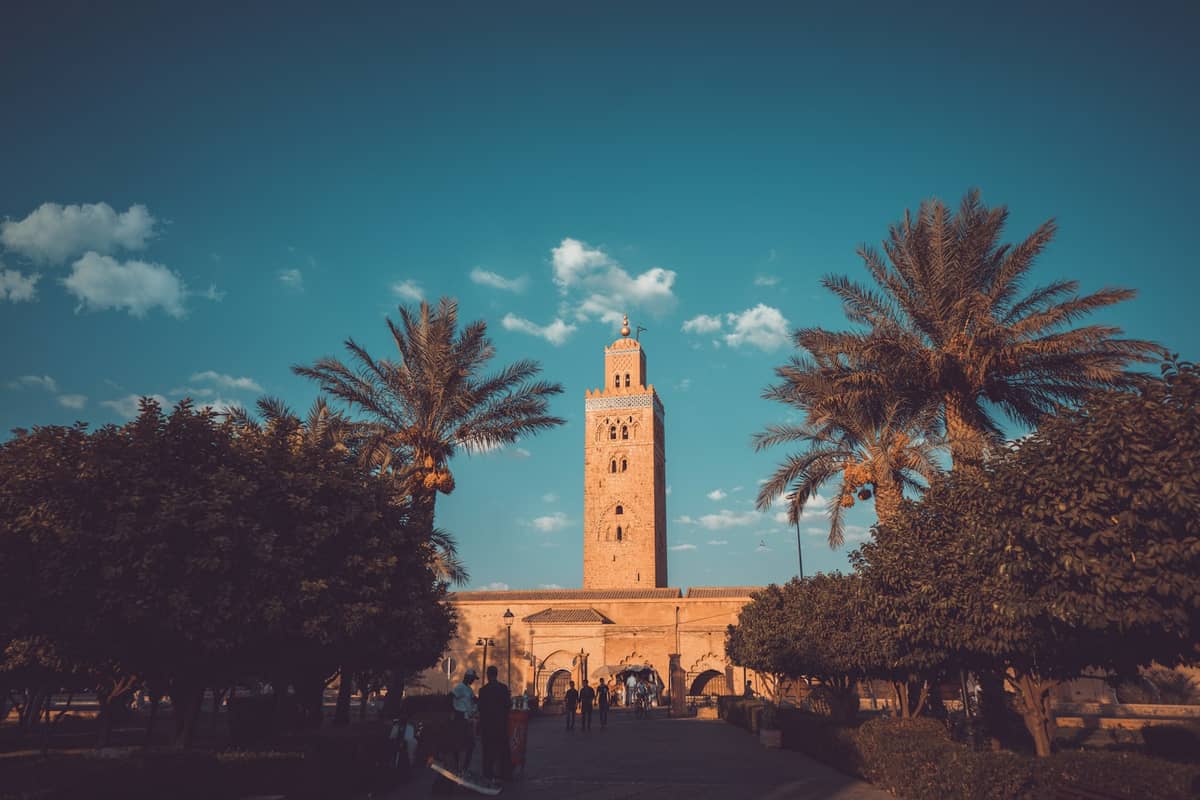
Rising about 69 metres above the medina (around 77 metres including its finial), the Koutoubia Mosque is the architectural anchor of Marrakech. Built by the Almohad dynasty in the 12th century, its minaret has shaped skylines and inspired imitations from Seville to Rabat. Non-Muslim visitors are welcome in the surrounding gardens and can observe the exterior freely, making it an essential stop near Jemaa el-Fna.
Quick Facts
- Location
- Avenue Mohammed V, near Jemaa el-Fna, Marrakech Medina
- Getting There
- 5–10-minute walk from Jemaa el-Fna; taxi from Gueliz approx. 15 min
- Time Needed
- 20–30 minutes for exterior and gardens
- Cost
- Free (exterior and gardens); interior reserved for Muslims
- Best for
- Architecture lovers, history seekers, photographers, early-morning walkers
- Official website
- koutoubiamosque.com
What the Koutoubia Mosque Actually Is
The Koutoubia Mosque is the largest mosque in Marrakech and, by most measures, the most architecturally significant structure in the entire city. Its minaret, standing approximately 69 metres tall to the top of the main shaft (around 77 metres including its finial), has served as a navigational landmark for travellers arriving from the Sahara for over eight centuries. The tower is so precisely proportioned, with a height-to-width ratio close to 5:1, that it became the direct model for Giralda in Seville and the Hassan Tower in Rabat. All three were commissioned during the Almohad dynasty's reign in the late 12th century.
The name translates roughly as 'Mosque of the Booksellers', a reference to the manuscript and book traders whose market once clustered at its base. That detail alone says something about the district's medieval character: this was not just a place of worship but the intellectual and commercial heart of a city that rivalled any in the medieval Mediterranean world.
The mosque sits at the western edge of Jemaa el-Fna, which means it is impossible to explore central Marrakech without passing it. That adjacency works in the visitor's favour: you do not need to make a special detour. You absorb it naturally, at different angles, across an entire day.
ℹ️ Good to know
Non-Muslim visitors may not enter the prayer halls. The interior is reserved for Muslims and open during the five daily prayer times. Everything described in this guide refers to the exterior, minaret views, and surrounding gardens, which are freely accessible by day and in the evening, including when the minaret is floodlit. Remain respectful around prayer times.
A Brief Architectural and Historical Context
Construction began under the Almohad caliph Abd al-Mumin around 1147, shortly after the dynasty captured Marrakech from the Almoravids. Accounts suggest the first structure was later found to be misaligned with the qibla (the direction of Mecca), which prompted demolition and reconstruction around 1157–1158. The minaret itself was completed around 1199 under Caliph Yaqub al-Mansur, the same ruler who commissioned the Hassan Tower in Rabat.
The minaret's decoration follows a deliberate hierarchy. Each of its four faces is ornamented differently, with the most elaborate stonework on the north face, which would have faced the city's main approach. The geometric lattice patterns, known as sebka, are carved in fired brick and sit above blind arches and decorative ceramic tile bands. At the very top, three gilded copper balls of diminishing size (the jamur) complete the tower, a detail that appears in mosque architecture across Morocco and Andalusia.
For a deeper understanding of how the Koutoubia fits into Marrakech's broader architectural legacy, the guide to Islamic architecture in Marrakech covers the full lineage of Almohad and Saadian building traditions across the city.
Tickets & tours
Live prices and dates from our booking partner. If you book, we may earn a commission at no extra cost to you.
Full day tour of Ouarzazate from Marrakech
From 51 €Instant confirmationFree cancellationEvening Quad Bike at Palmeraie Area with Tea Tasting from Marrakech
From 49 €Instant confirmationFree cancellationFull Day Economic Tour in Essaouira from Marrakech
From 29 €Instant confirmationFree cancellationFull Day Economic Tour of Ourika Valley from Marrakech
From 25 €Instant confirmationFree cancellation
How the Experience Changes by Time of Day
Early morning, roughly 7am to 9am, is the single best time to visit. The light from the east catches the minaret's carved stonework at a low angle that throws the sebka pattern into sharp relief. The gardens are quiet, the air still carries a trace of overnight cool, and the only sounds are sparrows in the orange trees and the distant murmur of the first street vendors setting up near the square. You can stand at the garden's northern corner and photograph the tower against a clear sky without a single tour group in frame.
By mid-morning the atmosphere shifts. Tour groups arrive from riads across the medina, guides speak in half a dozen languages, and the wide esplanade between the mosque and Avenue Mohammed V becomes a crossing point for horse-drawn caleches, cyclists, and families with children. The gardens remain pleasant but they are no longer contemplative.
Late afternoon, especially in the hour before maghrib (the sunset prayer), is the second-best time. The adhan, the call to prayer, projected from the Koutoubia's own minaret carries across the rooftops with unusual clarity at this hour. Locals sit on the garden benches. The light turns amber and the tower's reddish-pink fired brick glows against a darkening sky. If you time it correctly, you will hear the adhan from several mosques overlapping across the medina, a genuinely striking acoustic experience that no photograph can capture.
💡 Local tip
The Koutoubia's minaret is floodlit after dark. An evening pass through the gardens on your way back from Jemaa el-Fna takes less than ten minutes and produces an entirely different visual impression than the daytime visit.
The Gardens: What to Expect on the Ground
The gardens surrounding the mosque are more formal than wild. Low rose hedges, clipped into geometric patterns, run along the main paths. Orange and lemon trees provide occasional shade. In spring, the roses are in bloom and the scent is genuine, not perfumed by any nearby stall. The paths are wide and even, with benched rest points, which makes the whole circuit manageable for visitors with limited mobility.
The mosque's footprint, roughly 90 metres by 60 metres, means the exterior walls you walk alongside are substantial. The decoration on the outer walls is relatively restrained compared to the minaret, with simple stonework and wooden-shuttered windows set into thick white-rendered walls. What commands attention is always the tower rising above everything else.
There are vendors positioned at the garden entrance who sell postcards and small prints. Politely declining is easy and they are not aggressive. Bring water if visiting in summer: there is no cafe inside the garden perimeter, and summer temperatures in Marrakech regularly exceed 35°C.
Getting There and Practical Information
The Koutoubia Mosque is on Avenue Mohammed V, at the southwestern corner of Jemaa el-Fna square. From the square's main open area, the minaret is already visible. Walk toward it and you arrive at the gardens in under ten minutes. There is no risk of getting lost: the tower is the landmark by which the entire surrounding area orients itself.
From Gueliz, the modern district west of the medina, a petit taxi to the mosque takes around 15 minutes and should cost in the region of 30 to 50 MAD, though fares should be agreed or metered before departure. On foot from Gueliz along Avenue Mohammed V, the walk takes about 20–25 minutes and is straightforward, with a wide pavement and clearly visible tower as your guide.
The exterior and gardens are generally accessible at all hours, and admission is free. No ticket, no booking, no queue. Dress modestly when visiting: covered shoulders and avoiding very short garments is appropriate given the religious nature of the site. This is worth stating plainly, as some visitors arrive in beachwear having come directly from a hotel pool.
⚠️ What to skip
Photography of the exterior is unrestricted, but be respectful during prayer times: people are entering and exiting the mosque, and intrusive photography near the entrance is inappropriate. The gardens offer better compositions anyway.
Is It Worth Your Time?
The Koutoubia Mosque is worth visiting, but expectations need calibrating. You will not enter the building. You will see a large, beautifully proportioned mosque exterior and a garden that is pleasant rather than spectacular. If your benchmark is the Jardin Majorelle or the Ben Youssef Madrasa, the Koutoubia's gardens will feel understated by comparison.
What the Koutoubia offers that no other site in Marrakech can is proportion and permanence. The minaret has stood essentially unchanged for over 800 years. It is the structure against which all other architecture in the city is measured. For anyone interested in Islamic art, Almohad history, or the transfer of architectural ideas between Morocco and Spain, it is not replaceable. Pair it with a visit to the Ben Youssef Madrasa for a complete picture of Marrakech's medieval religious architecture.
Visitors who feel underwhelmed are typically those who walked past it briefly at noon in summer without context. Visitors who feel the visit was worthwhile are those who arrived early, sat with it for a while, and understood what they were looking at. The difference is not about the site: it is about preparation.
If you are planning a broader itinerary around Marrakech's historic core, the Marrakech walking tour guide integrates the Koutoubia into a logical half-day route through the medina that avoids backtracking.
Insider Tips
- The best photography position for the full minaret is from the northern garden path, roughly 80 metres from the base. Any closer and you lose the top in a standard smartphone frame. Any further and the garden trees interrupt the lower portion.
- During Ramadan, the area around the Koutoubia becomes particularly atmospheric after iftar (the evening meal breaking the fast). Locals gather in the gardens and on the esplanade in a way that does not happen at other times of year. Plan your evening walk accordingly.
- The two ruined structures visible in the gardens immediately north of the mosque are the remains of the original 1147 mosque’s foundations and pillars, left deliberately undemolished. They are easy to miss because they receive no interpretation signage, but they are historically significant: the visible foundation lines show the original misaligned qibla orientation.
- If you want to hear the full call to prayer from the Koutoubia without crowd noise, position yourself on the garden's western side around 15 minutes before sunset. The western aspect is quieter than the Avenue Mohammed V side and the acoustics carry more cleanly.
- The horse-drawn caleches that line up on Avenue Mohammed V adjacent to the mosque can be hired for a circuit of the city walls. Agreeing a price firmly before boarding is essential. Expect to negotiate from an opening ask.
Who Is Koutoubia Mosque For?
- Architecture and design enthusiasts who want to understand how Almohad geometry influenced buildings from Morocco to Spain
- Photographers looking for clean structural compositions, particularly in early morning or post-sunset floodlit conditions
- First-time visitors to Marrakech wanting a grounding landmark before exploring the medina
- Travellers interested in Islamic history who can use the Koutoubia as context for visiting the Ben Youssef Madrasa and Saadian Tombs on the same day
- Visitors who want a calm, free interlude between the intensity of the souks and Jemaa el-Fna
Nearby Attractions
Other things to see while in Jemaa el-Fna & Koutoubia:
- Jemaa el-Fna Square
Jemaa el-Fna is the geographic and cultural center of Marrakech's medina. A free, open-air public square inscribed on UNESCO's Intangible Cultural Heritage list, it shifts personalities completely from morning to midnight, drawing storytellers, musicians, food vendors, and crowds in equal measure.
Planning a trip? Discover personalized activities with the Nomado app.