Ben Youssef Madrasa: Marrakech's Most Breathtaking Piece of Islamic Architecture
Ben Youssef Madrasa is a 16th-century Saadian theological college in the heart of Marrakech's medina, and arguably the most ornately decorated interior in the entire city. Its central courtyard combines carved cedar, zellij tilework and sculpted stucco in a way that stops most visitors cold. This guide covers exactly what to expect, when to go, and how long to spend.
Quick Facts
- Location
- Rue Assouel, Ben Youssef district, Medina, Marrakech
- Getting There
- Taxi to medina edge, then ~10-min walk north from Jemaa el-Fna (approx. 1.1 km)
- Time Needed
- 45–90 minutes
- Cost
- 50 MAD (adults, foreign); 20 MAD (Moroccan nationals); 10 MAD (children under 12). Ask at the desk whether a same-day combined ticket with the nearby Marrakech Museum and Almoravid Koubba is available.
- Best for
- Architecture lovers, photographers, history enthusiasts, solo travelers
- Official website
- www.medersabenyoussef.ma/en
What Is Ben Youssef Madrasa?
Ben Youssef Madrasa is a 16th-century Islamic college in Marrakech's medina, originally constructed as a place where students came to study the Quran, Islamic law, and theology. Rebuilt under the Saadian dynasty, it was historically one of the largest theological colleges in all of North Africa, with estimates suggesting it housed around 800 students in small individual cells arranged over two storeys around a central courtyard. It closed as a functioning institution in 1960 and, after restoration, has operated as a cultural monument and museum since its reopening in 1982.
The madrasa sits about 1.1 kilometres from Jemaa el-Fna, in the northern quarter of the medina near the old Ben Youssef Mosque. The walk there takes you through progressively narrower lanes where motorbikes occasionally force pedestrians against doorways and the smell of fresh bread from neighborhood bakeries mingles with the dust of old plaster. There are no large signs pointing the way; you navigate by instinct and occasional handwritten arrows until a wooden entrance door appears in a plain whitewashed wall, giving almost nothing away about what lies beyond.
💡 Local tip
The entrance is easy to miss. Look for the door on Rue Assouel, just off Ben Youssef Square. If you reach the Ben Youssef Mosque, you have gone slightly too far — the madrasa entrance is a few metres before it.
The Architecture: What You Are Actually Looking At
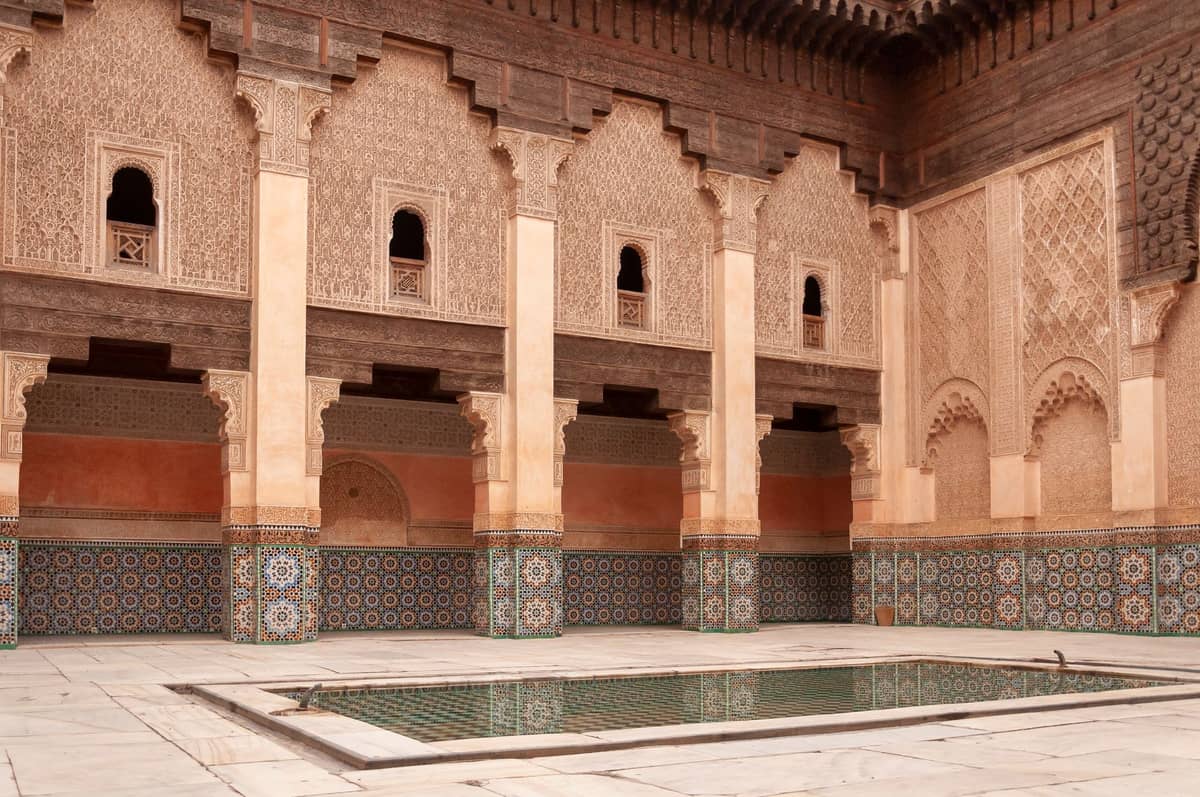
Stepping through the entrance corridor and into the central courtyard is one of the more genuinely arresting moments available in the medina. The space is rectangular, organized around a long marble pool that reflects the carved facades above. Every surface is layered: at the base, geometric zellij tilework in deep greens, blacks, and creams rises to about waist height. Above that, carved stucco panels carry intricate geometric and floral patterns, some incorporating Arabic calligraphy with Quranic verses. At the top, the upper registers are framed in carved cedar wood, darkened with age, which forms screens for the student cells above.
The three-tier vertical composition is deliberate. In classical Moroccan Islamic architecture, the progression from dense geometric tilework to lighter stucco to open cedar latticework symbolizes a movement from the earthly to the divine. You do not need to know this to be affected by it, but it does explain why the courtyard feels cohesive rather than merely ornate. The proportions are careful, and despite the extraordinary density of decoration, the space never feels claustrophobic. The marble pool down the centre amplifies whatever light is available and creates a reflected version of the carved facades, which rewards slower looking.
The prayer hall at the far end of the courtyard is worth entering. Its carved plaster mihrab, indicating the direction of Mecca, shows craftsmanship at close range that the wider courtyard views do not fully reveal. The cedar ceiling overhead is particularly fine. This is the quietest part of the complex and tends to draw fewer visitors than the courtyard itself.
Tickets & tours
Live prices and dates from our booking partner. If you book, we may earn a commission at no extra cost to you.
Full-day tour Marrakech to Kasbah Telouet and Kasbah Ait Ben Hadou
From 40 €Instant confirmationFree cancellationPrivate tour to Ouarzazate and Kasbah Ait Ben Haddou
From 229 €Instant confirmationFree cancellationPrivate day trip to the Ancient Kasbah of Ait Benhaddou
From 125 €Instant confirmationFree cancellationFull day tour of Ouarzazate from Marrakech
From 51 €Instant confirmationFree cancellation
The Student Cells: A Glimpse of an Older Life
A staircase at the corner of the courtyard leads to the upper level, where the student cells line the interior galleries. Each cell is barely large enough for a sleeping mat and a small shelf: the spareness is striking when set against the elaborate public spaces below. Students who lived here studied for years, often arriving from distant towns across Morocco and beyond. The contrast between the grandeur of the courtyard and the austerity of personal quarters is one of the more thought-provoking aspects of the visit.
The upper galleries also provide a different vantage point for looking down into the courtyard, which many photographers prefer to the ground-level view. The angle compresses the geometry of the zellij floor and marble pool into a single frame with the carved walls. Early morning light falls into the courtyard from the east, making the first hour after opening notably better for this particular shot.
💡 Local tip
For the best courtyard photography, arrive within the first 30 minutes of opening (09:00). By mid-morning, tour groups fill the space and the narrow galleries become congested. A wide-angle lens or a phone camera in portrait orientation works well for the full height of the carved facades.
How the Experience Changes by Time of Day
Opening time, around 09:00, brings a stillness that the madrasa rarely has later. The courtyard light is soft and directional, the marble pool surface undisturbed, and the only sounds are the faint echo of the city outside and the occasional murmur of an early guide explaining something in a low voice. This is by far the best time to visit for anyone interested in contemplation, photography, or simply appreciating the space without distraction.
By 10:30 or 11:00, tour groups begin arriving and the courtyard becomes noticeably noisier. The space absorbs a reasonable number of people, but the upper gallery walkways are genuinely narrow and passing other visitors requires patience. Between roughly 11:00 and 15:00, the madrasa is at its most crowded, particularly in peak tourist season (spring and autumn). The late afternoon window, from around 16:00 until closing at 19:00 (with last entry at 18:30), sees visitor numbers drop again. Afternoon light falls differently on the western facades, and the atmosphere is calmer.
During Ramadan, hours shift to 09:00–16:30. The experience can feel more contemplative during this period as overall tourist numbers in the medina are sometimes lower in the late afternoon.
⚠️ What to skip
Hours and ticket prices are subject to change. Verify current information at medersabenyoussef.ma before your visit, especially if traveling during Ramadan or public holidays.
Getting There and Practical Logistics
The madrasa is not accessible by car directly. The most practical approach is to take a petit taxi to the edge of the medina near the Ben Youssef area and walk the final section, or to walk the full distance from Jemaa el-Fna in roughly 15–20 minutes on foot. The route passes through the northern souks, which means navigating a section of the market before reaching the quieter residential lanes around the madrasa.
If you are planning a broader day in the medina, the madrasa combines naturally with the Marrakech Museum and the Almoravid Koubba directly nearby; ask at the entrance whether a combined ticket is available. The Koubba, just a short walk away, dates to the 12th century and offers a useful historical counterpoint to the madrasa's 16th-century Saadian work.
Tickets are purchased on-site only. The ticket window is just inside the entrance vestibule before you reach the courtyard. Online ticketing has reportedly been under maintenance; do not rely on advance booking. Payment is in Moroccan dirhams. There is no cloakroom for large bags, so travel light if possible. Photography is permitted throughout the complex, including in the prayer hall, though respectful behavior around other visitors is expected.
On the accessibility question: visitors with limited mobility should be aware that there are steps at the entrance, steep and narrow internal staircases, and uneven flooring in several areas. The ground-floor courtyard and prayer hall are comparatively more navigable, but the upper student cell galleries are not wheelchair accessible. There are no dedicated disability facilities reported on-site. If mobility is a concern, the ground-floor experience alone still captures the architectural highlights.
Cultural Context and What to Expect
The Ben Youssef Madrasa is frequently described as a highlight of Marrakech, and that reputation is largely deserved, particularly for the central courtyard. The decoration is genuinely exceptional, and the site provides one of the few opportunities in the medina to understand the depth of classical Moroccan architectural craft in a relatively controlled setting. For context on how this fits within the wider tradition of Islamic architecture across Morocco, the Marrakech Islamic architecture guide covers the broader historical lineage.
That said, it is worth calibrating expectations. The site is compact: the visit, even when taken slowly, rarely exceeds 90 minutes. The student cells are mostly empty, with minimal interpretive material to explain the daily lives of the people who lived in them. Visitors hoping for extensive museum-style context about Saadian history or Islamic education will find the experience primarily visual and spatial rather than educational in a conventional sense. This is not a criticism so much as practical information: come for the architecture, not for detailed historical interpretation.
If the madrasa is part of a broader day in the medina, the Saadian Tombs make a natural pairing, as both represent the highest-quality craftsmanship of the same dynastic period. The tombs are in the southern medina, so combining them requires some planning, but the visual echo between the two sites rewards the effort.
Visitors who are primarily interested in photography rather than history should note that the Jardin Majorelle and the Ben Youssef Madrasa represent quite different visual experiences: one is about saturated color in open air, the other about intricate surface and geometric shadow in an enclosed courtyard. Both reward careful attention, but at different times of day.
Who Should Consider Skipping It
Travelers with very limited time and a preference for open-air or outdoor experiences may find the madrasa less compelling than the souks, city walls, or gardens nearby. If ornate interior decoration does not appeal, this is not the attraction to prioritize. Families with young children should note the narrow stairs and potentially congested upper walkways, though the courtyard itself is open enough to be manageable. Anyone with significant mobility limitations should weigh the ground-floor-only experience against the full admission price.
For travelers working through a broader medina itinerary, the Marrakech walking tour guide provides a sequenced route that incorporates the madrasa alongside other northern medina sites in a logical order.
Insider Tips
- Arrive at 09:00 on the dot. The first 30 minutes offer an experience that is qualitatively different from the mid-morning crowds: the pool surface is still, the light is directional, and you can stand in the centre of the courtyard without negotiating around tour groups.
- Buy the combined ticket if it is offered and you plan to visit the Marrakech Museum or the Almoravid Koubba on the same day. The Koubba is directly outside and takes only 15–20 minutes, but its 12th-century Almoravid architecture is significant and rarely crowded.
- The prayer hall at the far end of the courtyard is skipped by a surprising number of visitors who simply photograph the courtyard and leave. Walk to the end and examine the mihrab up close — the stucco carving at eye level there is among the finest in the building.
- Dress in modest, lightweight layers. The courtyard is partially shaded but can feel warm in summer; the upper galleries catch the sun directly in the afternoon. Loose-fitting clothes that cover shoulders and knees are appropriate given the building's religious heritage.
- The walk back toward Jemaa el-Fna through the northern souks takes about 20 minutes and passes through the dyers' souk and several leather goods lanes that are less frequented by tourists than the central market arteries. Leave time to wander rather than retracing a direct route.
Who Is Ben Youssef Madrasa For?
- Architecture and design enthusiasts who want to understand the vocabulary of classical Moroccan craftsmanship
- Photographers seeking geometric interiors and the interplay of carved shadow and reflected light
- Solo travelers or couples who want a quieter, more contemplative counterpoint to the sensory overload of the main souks
- History-minded visitors tracing the Saadian dynasty's legacy across the medina
- Anyone doing a concentrated medina day who wants to anchor it around a single outstanding interior
Nearby Attractions
Other things to see while in Marrakech Medina:
- Dar El Bacha – Musée des Confluences
Built in 1910 for the powerful Pasha Thami El Glaoui, Dar El Bacha is one of the medina's grandest palatial complexes. Restored and reopened as the Musée des Confluences, it now presents Moroccan art and craftsmanship within some of the city's most extraordinary interior architecture.
- Koubba Ba'adiyn (Almoravid Qoubba)
Built around 1117, the Koubba Ba'adiyn is the sole intact Almoravid structure in Marrakech and one of the oldest Islamic monuments in the city. Small in footprint but immense in historical weight, it sits several metres below the current street level near Ben Youssef Square, offering a rare glimpse into the architectural vocabulary that defined Islamic North Africa before the Almohads arrived.
- Le Jardin Secret
Tucked inside a 19th-century palace complex on Rue Mouassine, Le Jardin Secret is one of the largest traditional riad gardens in the Marrakech medina. Opened to the public in 2016 after an extensive restoration, it offers two distinct garden styles, ornate Islamic architecture, and a rooftop tower with panoramic views of the medina roofscape and the Atlas Mountains beyond.
- Leather Tanneries
The Bab Debbagh tanneries sit at the northeastern edge of Marrakech's medina, where leather has been treated in open stone vats for centuries. This guide covers what you'll actually see, the best time to visit, how to handle informal guides, and who this walk is worth it for.
Planning a trip? Discover personalized activities with the Nomado app.