Le Jardin Secret: A Restored Palace Garden in the Medina
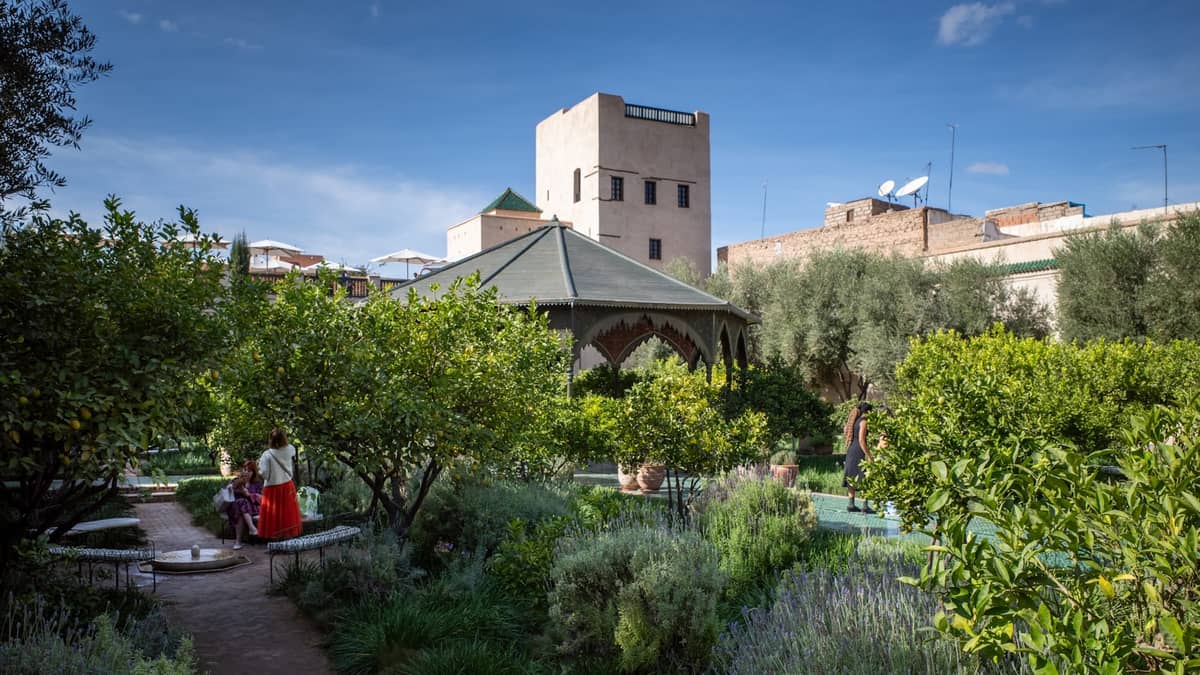
Tucked inside a 19th-century palace complex on Rue Mouassine, Le Jardin Secret is one of the largest traditional riad gardens in the Marrakech medina. Opened to the public in 2016 after an extensive restoration, it offers two distinct garden styles, ornate Islamic architecture, and a rooftop tower with panoramic views of the medina roofscape and the Atlas Mountains beyond.
Quick Facts
- Location
- Rue Mouassine 121, Marrakech medina
- Getting There
- Walk from Jemaa el-Fna, or take a petit taxi nearby and continue on foot through the Mouassine quarter
- Time Needed
- 1 to 1.5 hours for the full visit including the tower
- Cost
- Garden: 100 MAD (full price). Tower: +40 MAD. Reduced rates for under-24s and Moroccan nationals; children under 12 enter free. Tickets sold on site.
- Best for
- Architecture lovers, photography, couples, anyone needing a break from the souk crowds
- Official website
- www.lejardinsecretmarrakech.com/en
What Le Jardin Secret Actually Is
Le Jardin Secret is a restored 19th-century palace complex in the Mouassine quarter of the Marrakech medina. The property was opened to the public in 2016 following a meticulous restoration project, and it contains two distinct gardens: an exotic garden planted with specimens from around the world, and an Islamic garden laid out according to the classical Andalusian quadripartite design with a central water channel. There is also a tower you can climb separately for panoramic views across the medina rooftops.
The name translates simply as 'The Secret Garden', and it is accurate in a literal sense: from the narrow lane outside, nothing prepares you for the scale of what is inside. The entrance is a modest wooden doorway on Rue Mouassine. Once through it, the noise of the surrounding souks drops away almost immediately.
The site sits within the broader Mouassine quarter, one of the medina's quieter and more architecturally coherent neighbourhoods, and visiting Le Jardin Secret pairs naturally with exploring this area on foot.
💡 Local tip
Tickets are sold on site. Online booking is not yet available. Arrive at opening if you want to avoid the busiest small-group tour window from mid-morning onward.
The Two Gardens: What You're Looking At
The Islamic garden is the centrepiece. It follows the classical char bagh design, which divides the garden into four quadrants using water channels running from a central fountain. The planting here is restrained and intentional: clipped hedges, fragrant herbs, and shade trees selected for their traditional symbolic and medicinal roles in Moroccan garden culture. The sound of water running through the channels is constant and calibrated. This is not a wild space but a precisely engineered one, and understanding the geometry is part of the pleasure.
The exotic garden is a different proposition. It occupies an adjacent section of the complex and features plant species introduced to Morocco from elsewhere: cacti, subtropical specimens, and varieties that reflect the cross-cultural botanical exchanges of the 19th and early 20th centuries. The contrast between the two gardens is instructive rather than jarring. Together they cover a significant footprint for a structure embedded in the dense urban fabric of the medina.
For context on how this style of garden relates to wider Islamic architectural traditions in Marrakech, the Islamic architecture guide for Marrakech gives useful background on the principles that governed construction of these private palace complexes.
Tickets & tours
Live prices and dates from our booking partner. If you book, we may earn a commission at no extra cost to you.
Anima Gardens and Ourika Valley day trip from Marrakech
From 95 €Instant confirmationFree cancellationSpa Treatment Experience with Lunch at a Riad from Marrakech
From 99 €Instant confirmationFree cancellationFull-day Trip in Ouzoud Waterfalls from Marrakech
From 18 €Instant confirmationFree cancellationCamel ride in Marrakech Palm Grove
From 15 €Instant confirmationFree cancellation
The Panoramic Tower: Worth the Extra Cost?
The tower ticket costs an additional 40 MAD on top of garden entry. It is a separate purchase, and you do not need it to enjoy the garden itself. That said, the views from the top are useful for spatial orientation. Marrakech's medina is notoriously difficult to read at ground level. From the tower, you can see the minaret of the Koutoubia Mosque to the south and the patchwork of roof terraces and garden courtyards of the surrounding medina.
The climb involves stairs without a lift, which rules out the tower for visitors with limited mobility. Children under six are not permitted on the tower. Photography from the top is excellent in the late afternoon when the light comes from the west and hits the warm terracotta tones of the medina walls and rooftops directly.
ℹ️ Good to know
Tower access restriction: children under 6 years are not permitted. Visitors with reduced mobility should note the tower is stairs-only. The main garden level, however, is accessible, and wheelchair users and visually impaired visitors (plus one caregiver each) receive free and priority access.
How the Experience Changes by Time of Day
The garden opens at 09:30 daily. Arriving early is the most reliable way to have the Islamic garden more to yourself. The water channels catch the morning light and the air carries the smell of the herbs and damp stone before the heat builds. At this hour, the difference in temperature between the shaded garden interior and the sun-exposed lanes outside is pronounced, and it gives you a visceral understanding of why these enclosed garden spaces were engineered the way they were.
By 11:00, small guided groups begin to arrive and the garden fills with the murmur of multiple languages. The space handles this reasonably well because the two gardens and the palace interiors distribute visitors across different areas. Midday in summer pushes temperatures in the open exotic garden section well above 35°C. The Islamic garden, with its shade trees and water channels, remains noticeably cooler.
Late afternoon, roughly 90 minutes before closing, is the second quiet window. Tour groups have usually departed by then. The light in the Islamic garden becomes warmer and more atmospheric. If you are visiting primarily for photography, this is the better slot, especially for the tower views.
Practical Information: Getting There, Opening Hours, and Prices
The address is Rue Mouassine 121, in the Marrakech medina. From Jemaa el-Fna, the walk is roughly 15 to 20 minutes through the souk network. Navigation apps work reasonably well in the medina but the alley names are inconsistently signed, so having the address ready in Arabic script helps when asking locals.
Opening hours vary by season. From March through September the garden is open 09:30 to 19:30. In February and October the closing time is 18:30, and from November through January it is 18:00. During Ramadan hours shorten to 09:30 to 16:30. The garden is open every day of the year.
- Standard adult entry: 100 MAD
- Reduced entry (under 24, Moroccan nationals): 80 MAD and 50 MAD respectively
- Tower ticket (full price): 40 MAD additional; reduced tower: 30 MAD
- Groups of 15 or more: 80 MAD per person for garden entry
- Annual membership: 500 MAD
- Tickets sold on site only; cash (MAD or euro) or card. Online tickets are not yet available.
- Free and priority access: visitors with reduced mobility and one accompanying caregiver
If you are visiting Marrakech in spring, temperatures in the garden are at their most comfortable. The spring visit guide for Marrakech has more detail on planning around the city's seasonal patterns.
⚠️ What to skip
During Ramadan, closing time shifts to 16:30. If you are visiting Marrakech during Ramadan, factor this into your planning. The garden can also feel noticeably different in atmosphere during this period.
Historical Context: A Palace Restored
The site that houses Le Jardin Secret was originally a 19th-century palace complex, one of the larger private properties within the medina. Like many historic palace gardens in Marrakech, it deteriorated over much of the 20th century. The restoration project that preceded the 2016 public opening was extensive, involving the reconstruction of the palace pavilions, water systems, and planting schemes based on historical research.
The Islamic garden design follows conventions with deep roots in Moroccan and Andalusian garden culture. You can find the same quadripartite water channel logic, in more ruined form, at the El Badi Palace, whose 16th-century gardens were among the grandest ever built in Marrakech. Le Jardin Secret offers a version of that tradition in a fully restored and functional state.
The restoration has attracted both admiration and measured criticism. Some observers note that a fully restored and managed garden is a different experience from the weathered authenticity of sites like the Saadian Tombs nearby. This is a fair point. Le Jardin Secret is polished, well-maintained, and in some ways more museum than ruin. Whether that is a drawback depends entirely on what you are looking for.
Is It Worth Your Time?
Le Jardin Secret is not the only garden worth visiting in Marrakech. The Jardin Majorelle in Gueliz is larger and more internationally famous. The Menara Gardens offer a different scale and atmosphere. But Le Jardin Secret has a specific quality that neither of those provides: it is embedded in the living medina, reachable on foot through the souks, and it shows you how private palace life in this part of the city was actually organised.
At 100 MAD for garden entry, it costs roughly the same as a coffee and pastry at a tourist-facing café near Jemaa el-Fna. For visitors who care about architecture, garden design, or the history of the medina, it represents genuine value. For visitors mainly interested in a shaded rest stop, there are cheaper options.
The main limitation is scale. One hour is enough to see everything at a comfortable pace. It does not fill a half-day the way the Ben Youssef Madrasa or the Saadian Tombs might. Build it into a morning walk through the Mouassine quarter rather than treating it as a standalone destination, and the visit slots in naturally.
Travellers planning several days in the city can find useful itinerary structures in the 3-day Marrakech itinerary, which covers how to sequence the medina's main sites without backtracking.
Insider Tips
- The café inside the garden is a genuine respite rather than an afterthought. Coffee and mint tea are served in the shaded pavilion overlooking the Islamic garden. Prices are what you would expect for a tourist site, but the setting earns them.
- The best photography angle for the Islamic garden's central fountain is from the pavilion doorway at the western end, shooting east. The channel leads your eye through the frame and the far pavilion closes the composition. This works best in morning light.
- If you are also planning to visit the Ben Youssef Madrasa, the two sites are close enough to combine in a single morning. Start at Le Jardin Secret, then walk on to the madrasa for a progression from garden architecture to monumental religious architecture.
- The tower views include the minaret of the Koutoubia Mosque and are noticeably clearer in winter and early spring when dust levels are lower and Atlas snowfall is visible on the peaks to the southeast.
- Le Jardin Secret is genuinely quieter than the Jardin Majorelle year-round. If you have already visited Majorelle and want a less managed, more medina-integrated garden experience, this is the right alternative.
Who Is Le Jardin Secret For?
- Architecture and design enthusiasts who want to understand the logic of traditional Moroccan palace garden planning
- Photographers working in the medina who need a structured, low-crowd environment with strong geometric compositions
- Couples looking for a calm, shaded midday pause within walking distance of the main souk network
- Visitors on a longer trip who have already covered the major monuments and want to go deeper into the medina's residential architecture
- Families with older children who can manage a short walk through the souks and appreciate a focused, not-too-long cultural visit
Nearby Attractions
Other things to see while in Marrakech Medina:
- Ben Youssef Madrasa
Ben Youssef Madrasa is a 16th-century Saadian theological college in the heart of Marrakech's medina, and arguably the most ornately decorated interior in the entire city. Its central courtyard combines carved cedar, zellij tilework and sculpted stucco in a way that stops most visitors cold. This guide covers exactly what to expect, when to go, and how long to spend.
- Dar El Bacha – Musée des Confluences
Built in 1910 for the powerful Pasha Thami El Glaoui, Dar El Bacha is one of the medina's grandest palatial complexes. Restored and reopened as the Musée des Confluences, it now presents Moroccan art and craftsmanship within some of the city's most extraordinary interior architecture.
- Koubba Ba'adiyn (Almoravid Qoubba)
Built around 1117, the Koubba Ba'adiyn is the sole intact Almoravid structure in Marrakech and one of the oldest Islamic monuments in the city. Small in footprint but immense in historical weight, it sits several metres below the current street level near Ben Youssef Square, offering a rare glimpse into the architectural vocabulary that defined Islamic North Africa before the Almohads arrived.
- Leather Tanneries
The Bab Debbagh tanneries sit at the northeastern edge of Marrakech's medina, where leather has been treated in open stone vats for centuries. This guide covers what you'll actually see, the best time to visit, how to handle informal guides, and who this walk is worth it for.
Planning a trip? Discover personalized activities with the Nomado app.