Dar El Bacha – Musée des Confluences: Inside a Pasha's Palace Museum
Built in 1910 for the powerful Pasha Thami El Glaoui, Dar El Bacha is one of the medina's grandest palatial complexes. Restored and reopened as the Musée des Confluences, it now presents Moroccan art and craftsmanship within some of the city's most extraordinary interior architecture.
Quick Facts
- Location
- 65,69 Riad Laârous, route Dar El Bacha, Marrakech
- Getting There
- A short walk from Jemaa el-Fna; taxis drop at nearby medina access points
- Time Needed
- 1.5 to 2.5 hours
- Cost
- 60 MAD (foreigners); 25 MAD (Moroccan nationals); free Wed for pupils and students, free Fri for Moroccans, foreign residents, and students
- Best for
- Architecture lovers, history enthusiasts, photography, cultural immersion
- Official website
- darbacha.com
What Is Dar El Bacha?
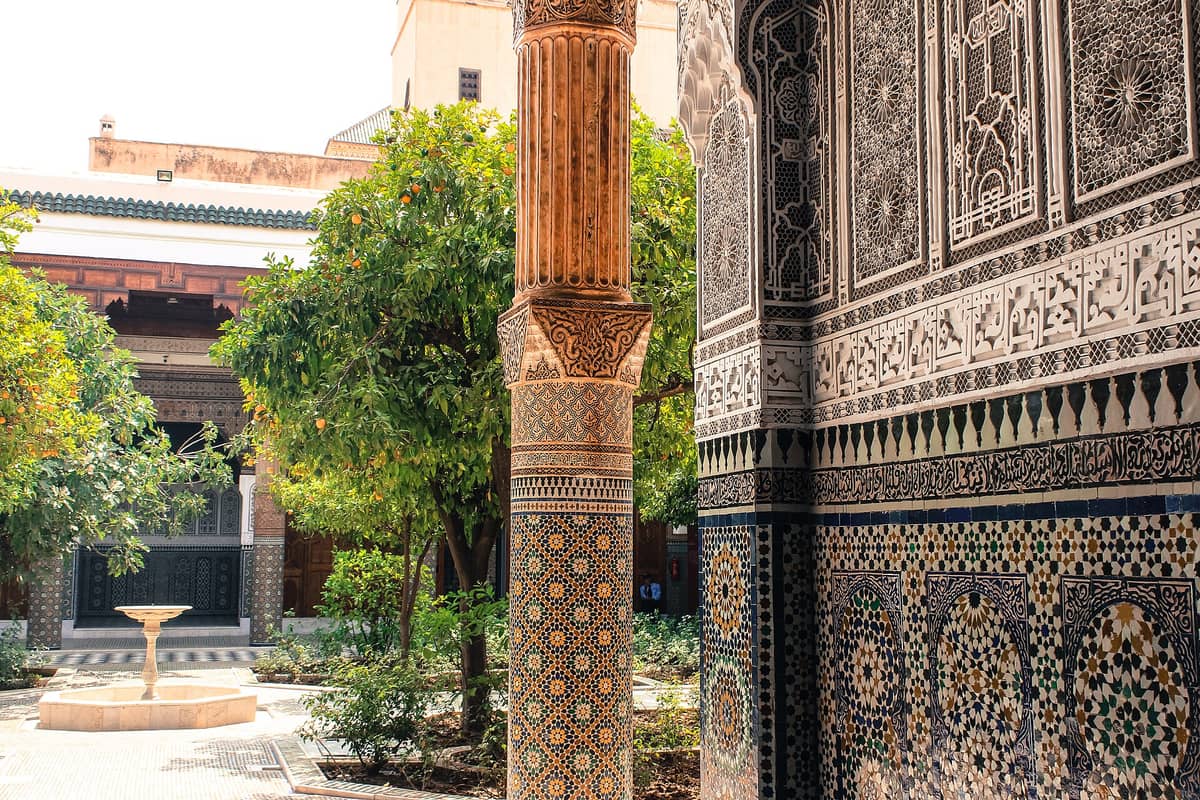
Dar El Bacha – Musée des Confluences is a palace museum occupying one of Marrakech's most historically loaded buildings. Constructed in 1910 as the private residence of Thami El Glaoui, the Pasha of Marrakech, the palace complex is an exercise in late Moroccan courtly excess: vast marble courtyards, carved cedar ceilings, zellij tilework rising to shoulder height, and stucco archways so dense with geometry they seem to generate their own atmosphere.
The Fondation Nationale des Musées restored the property and reopened it as a museum exploring cultural confluences in Morocco, meaning the layered influences that converge in Moroccan art and material culture. The result is a space where the building itself is as compelling as anything inside it.
ℹ️ Good to know
Opening hours: Tuesday to Sunday, 10:00–18:00. Closed Mondays. Admission is free on Fridays for Moroccan nationals, foreign residents, and students, and free on Wednesdays for pupils and students. Verify current hours at darbacha.com before visiting.
The Architecture: What You Actually See
The entrance sequence is understated by design. You pass through a relatively narrow doorway in the northern medina not far from the Mouassine quarter, and the palace opens up around you in stages. The main riad courtyard is the structural heart of the visit: a rectangular space paved in white marble, with a central fountain and symmetrical arcades running around all four sides. The proportions feel generous even by Moroccan palace standards.
The carved stucco work here reaches a level of elaboration that takes time to absorb. The traditional Moroccan craftsmen who executed this work, known as maalems, layered geometric and floral motifs across surfaces using techniques that have changed little in centuries. Above the zellij wainscoting, the stucco panels transition into painted cedar latticework near the ceiling, where light filters through in the afternoon to cast faint shadows across the tilework below. Arriving between 10:00 and noon, when natural light still enters the courtyard at a low angle, gives the tiling its best quality of illumination.
The palace complex extends through multiple reception rooms, galleries, and secondary courtyards. It is considerably larger than it appears from the street, and visitors who rush through the main courtyard in twenty minutes miss most of it. The surrounding rooms contain the museum's collection of decorative arts, ceramics, textiles, metalwork, and historical objects, all contextualized within Morocco's cultural exchange history. For a broader orientation to Moroccan Islamic architecture and its regional context, the Marrakech Islamic architecture guide provides useful background before your visit.
Tickets & tours
Live prices and dates from our booking partner. If you book, we may earn a commission at no extra cost to you.
Evening camel ride Agafay desert with a traditional dinner
From 95 €Instant confirmationFree cancellationAgafay desert private sunset quad bike tour from Marrakech
From 50 €Instant confirmationFree cancellationDesert Tour Morocco Merzouga 3 days and 2 nights from Marrakech
From 250 €Instant confirmationFree cancellationAgafay desert day trip From Marrakech
From 110 €Instant confirmationFree cancellation
The History Behind the Pasha's Palace
Thami El Glaoui was a complex and deeply controversial figure. As Pasha of Marrakech from 1912 until Moroccan independence in 1956, he aligned closely with French colonial authorities and wielded enormous power over southern Morocco. Dar El Bacha was not simply a private home; it was a seat of political power, a venue for diplomatic receptions, and at various points a gathering place for dignitaries who passed through Marrakech during the Protectorate years.
When El Glaoui died in 1956, just months after Morocco regained independence, the palace passed through various uses before its eventual restoration. The decision to frame it as a museum of cultural confluences rather than a strictly historical memorial is deliberate: it shifts the interpretive lens toward the broader story of Morocco's layered cultural inheritance.
💡 Local tip
If you want deeper context for Marrakech's palaces and the figures who built them, visit Bahia Palace and El Badi Palace on the same day. All three offer different angles on the city's palatial history without significant repetition.
How the Experience Changes Through the Day
Morning visits, particularly between 10:00 and 11:30, offer the calmest conditions. Midweek mornings see the fewest visitors, and the sound inside the main courtyard at that hour is mostly the low murmur of the fountain and distant medina noise filtering over the rooftops. The light quality in the marble courtyard is also strongest in the morning, before the sun climbs high enough to flatten the shadows on the carved surfaces.
By early afternoon, especially in warmer months, the courtyard becomes noticeably warmer and tour groups tend to cluster around the most photographed sections of the arcade. The inner galleries provide welcome shade. Late afternoon, from around 15:30 to closing, sees a second quieter window, and the lower-angle light returning to the courtyard gives photographers another good opportunity. There is no dramatic sunset spectacle here as the courtyard is enclosed, but the warm late-afternoon tone on the ochre stucco is genuinely beautiful.
Summer visits require some planning. Marrakech regularly exceeds 35°C in July and August, and while the thick palace walls and shaded courtyards offer real relief compared to the surrounding streets, the route through the medina to reach the palace involves exposed lanes. Wear light, breathable clothing that covers shoulders and knees out of respect for local norms, and carry water.
Getting There: Navigation Through the Northern Medina
Dar El Bacha sits in the northern section of the medina, in a neighborhood associated with the Mouassine quarter. From Jemaa el-Fna, the walking route takes roughly 15 to 20 minutes through the souks and the Mouassine district. The streets narrow considerably once you leave the main souk spine, and the lanes around Rue Fatima Zahra are not signposted with particular clarity. A map app is genuinely useful here. Most visitors find the walk itself worthwhile as the route passes through less-touristed sections of the medina.
Taxis cannot enter the pedestrian lanes of the medina, so they drop passengers at access points on the edges of the car-free zone, typically a short walk from the museum entrance depending on the specific drop-off. The walk from any drop-off point involves uneven paving, the occasional stepped threshold, and surfaces that become slippery when wet after rain. Sensible flat shoes are advisable.
There is no on-site parking. Visitors arriving by taxi, ride-hailing app, or hired vehicle should agree on a pickup location in advance, as the narrow streets make spontaneous pickups difficult.
⚠️ What to skip
Accessibility note: The palace and surrounding medina streets involve uneven surfaces, raised thresholds, and no confirmed step-free access. Visitors with significant mobility limitations should contact the museum directly before planning a visit.
The Collection and What the Museum Is Actually About
The Musée des Confluences presents objects and artworks framed around the idea of Morocco as a crossroads: a place where trans-Saharan trade routes, Andalusian migrations, Amazigh traditions, and Arab Islamic culture have intersected over centuries. The collection includes examples of Moroccan ceramics, embroidered textiles, woodwork, metalwork, jewelry, and historic objects, organized thematically rather than in strict chronological order. It is a different interpretive approach from a conventional history museum, and visitors who arrive expecting a linear narrative of Moroccan history may need to adjust expectations. For a broader view of how Marrakech museums compare, see the guide to the best museums in Marrakech.
The labeling is provided in Arabic and French, with limited English translation in parts of the museum. English-speaking visitors who want interpretive depth will benefit from hiring a licensed guide at the entrance or reading background material beforehand. The absence of comprehensive English labeling is the museum's most significant practical limitation for international visitors.
The museum also operates Bacha Coffee within the palace grounds, a specialty coffee house that is a destination in its own right. Even visitors with limited interest in the collection often come specifically for the café in the courtyard setting. It fills up quickly after 11:00, and a table during peak hours requires patience. If you're building a half-day cultural itinerary in this part of the medina, pairing Dar El Bacha with the nearby Ben Youssef Madrasa makes strong architectural sense, as both demonstrate the highest registers of Moroccan decorative craft.
Photography, Practical Preparation, and Who Should Reconsider
Photography is generally permitted in the public areas of the museum, including the courtyard. The main courtyard is the primary photographic subject: the symmetry of the arcade, the fountain, and the zellij walls give structured compositions that work well with a standard smartphone or camera. Avoid using flash indoors out of consideration for the artworks and other visitors. The best light on the main courtyard is in the morning; the secondary courtyards and interior galleries can be darker and benefit from wider aperture settings.
Visitors who find traditional decorative arts museums slow-moving may not engage deeply with the collection rooms. The building itself is the principal draw, and if ornate Islamic architecture and palace history are not particular interests, the 60 MAD entrance fee for foreigners and 25 MAD fee for Moroccan nationals might be better spent on more interactive sites. That said, the café alone justifies a short visit for many people, and the building's condition is exceptional compared to some of Marrakech's more deteriorated historic structures.
Visitors traveling with children should know that the museum is tranquil rather than interactive; there are no child-oriented exhibits or hands-on elements. For family-focused planning in Marrakech, the guide to Marrakech with kids has more suitable suggestions. Solo travelers and couples with an interest in architecture or craft traditions will find this one of the most rewarding stops in the medina.
Insider Tips
- Visit on a Wednesday morning if you're a student: admission is free, and midweek mornings are consistently the quietest time in the museum. The combination of no entry fee and minimal crowds is hard to beat.
- The café inside the palace, Bacha Coffee, is popular and tables in the courtyard go quickly after 11:00. If you want to sit in the main courtyard, arrive when the museum opens rather than saving the café for the end of your visit.
- The English-language interpretation is limited throughout the museum. Download or print a background article on Moroccan decorative arts before your visit; it transforms the collection rooms from a series of beautiful objects into a legible story.
- The walk to Dar El Bacha from Jemaa el-Fna passes through the Mouassine area. Build 20–30 extra minutes into the approach if you want to browse without rushing.
- The palace has multiple interior rooms and secondary courtyards beyond the main arcade. Many visitors spend all their time in the primary courtyard and miss the further galleries. Follow the museum's circulation path through to the back sections, which are quieter and show a different register of the building's scale.
Who Is Dar El Bacha – Musée des Confluences For?
- Architecture and design enthusiasts who want to see Moroccan palatial craftsmanship at its most accomplished
- Cultural history travelers interested in Morocco's layered identity and the Protectorate period
- Photographers seeking well-preserved geometric tilework and courtyard compositions in natural light
- Travelers building a half-day medina itinerary around the Mouassine quarter
- Anyone who wants a genuinely atmospheric café stop in a historic setting
Nearby Attractions
Other things to see while in Marrakech Medina:
- Ben Youssef Madrasa
Ben Youssef Madrasa is a 16th-century Saadian theological college in the heart of Marrakech's medina, and arguably the most ornately decorated interior in the entire city. Its central courtyard combines carved cedar, zellij tilework and sculpted stucco in a way that stops most visitors cold. This guide covers exactly what to expect, when to go, and how long to spend.
- Koubba Ba'adiyn (Almoravid Qoubba)
Built around 1117, the Koubba Ba'adiyn is the sole intact Almoravid structure in Marrakech and one of the oldest Islamic monuments in the city. Small in footprint but immense in historical weight, it sits several metres below the current street level near Ben Youssef Square, offering a rare glimpse into the architectural vocabulary that defined Islamic North Africa before the Almohads arrived.
- Le Jardin Secret
Tucked inside a 19th-century palace complex on Rue Mouassine, Le Jardin Secret is one of the largest traditional riad gardens in the Marrakech medina. Opened to the public in 2016 after an extensive restoration, it offers two distinct garden styles, ornate Islamic architecture, and a rooftop tower with panoramic views of the medina roofscape and the Atlas Mountains beyond.
- Leather Tanneries
The Bab Debbagh tanneries sit at the northeastern edge of Marrakech's medina, where leather has been treated in open stone vats for centuries. This guide covers what you'll actually see, the best time to visit, how to handle informal guides, and who this walk is worth it for.
Planning a trip? Discover personalized activities with the Nomado app.