Mouassine Quarter & Fountain: Marrakech's Most Atmospheric Medina Corner
The Mouassine Fountain is one of the finest surviving Saadian civic monuments in Marrakech's medina, set within a quarter of carved cedar doorways, old hammams, and shaded lanes. Free to visit at any hour, it rewards slow walkers who peel away from the main souk routes.
Quick Facts
- Location
- Rue Mouassine, Mouassine Quarter, Medina, Marrakech
- Getting There
- 10-15 min walk north from Jemaa el-Fna; no vehicle access inside the quarter
- Time Needed
- 30-60 min for the fountain and surrounding quarter; longer if you explore nearby souks
- Cost
- Free — the fountain is a public street monument with no admission fee
- Best for
- Architecture lovers, photography, slow medina walks, history enthusiasts
What the Mouassine Quarter Actually Is
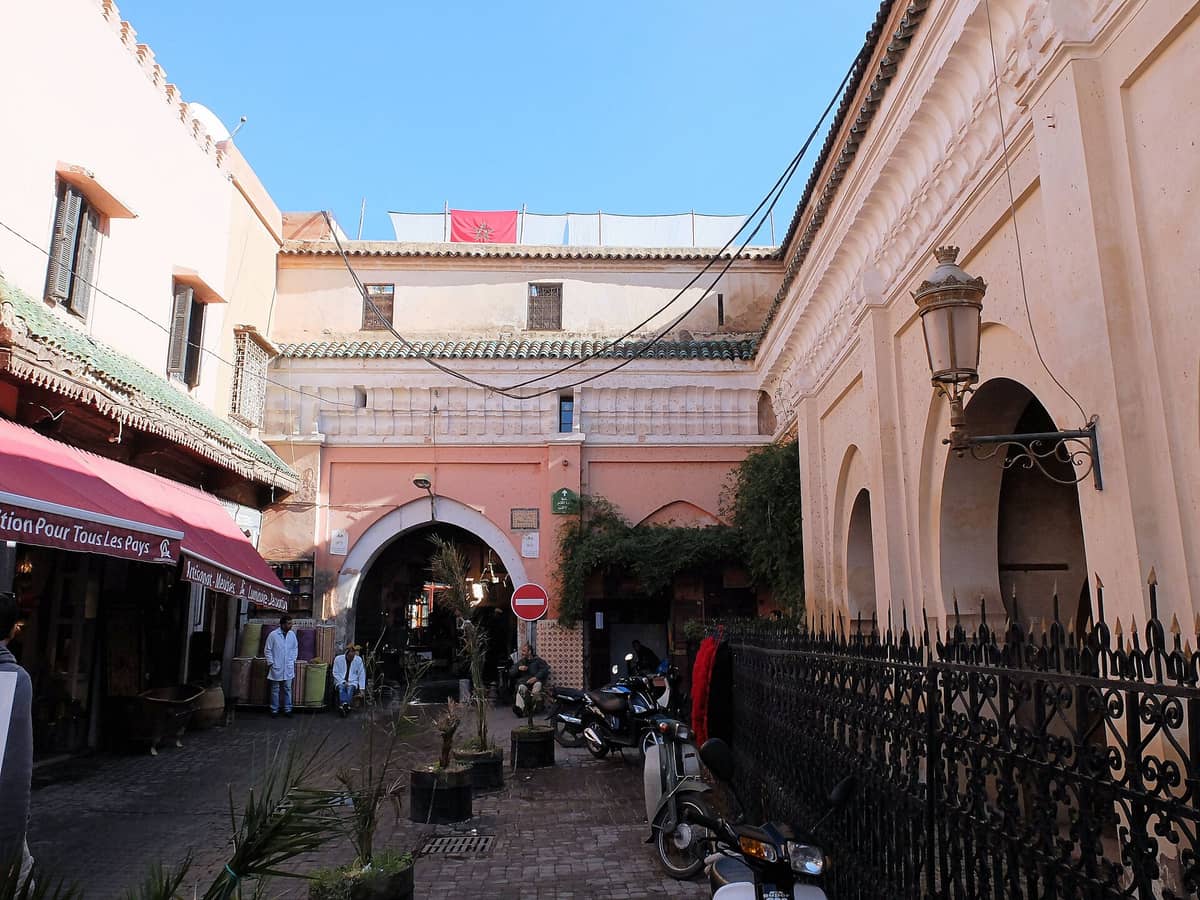
The Mouassine Quarter sits in the northern section of the Marrakech medina, a few minutes' walk from the main souk arteries but noticeably quieter once you turn off the main drag. It takes its name from the Mouassine Mosque, a major Saadian religious complex constructed in the 16th century under the Saadian dynasty, which ruled Morocco from 1549 to 1659. The complex was built as a coordinated piece of civic and religious architecture: a mosque, a madrasa for Quranic students, a hammam for ritual purification, and a large public fountain to serve the surrounding neighbourhood.
The fountain itself, known in Arabic as Saqayat al-Mouassine, is the most accessible and photographed element of the complex for visitors. It occupies a recessed alcove on Rue Mouassine, built into the exterior wall of the mosque. Three arched bays are carved with stucco and cedar-wood decoration in classic Saadian style: geometric latticework above, calligraphic friezes at mid-level, and a lower section with troughs that historically supplied water to both people and animals. The central, larger bay was reserved for human use; the flanking smaller bays were for animals. That functional hierarchy is still legible in the stonework today.
💡 Local tip
The fountain is on a pedestrian street with no barriers or ticket booth. Walk past it, stop, look up at the carved cedar canopy above the central arch, and then step back across the lane for the full composition. The best light on the carved surfaces falls in the morning, when the sun is low and angled.
The Walk In: Getting to Mouassine from Jemaa el-Fna
The most straightforward approach is to walk north from Jemaa el-Fna square along Rue Sidi Abdelaziz, then follow signs towards the souks before bearing left onto Rue Mouassine. The street runs roughly north-south through the quarter. This is a 10 to 15 minute walk on mostly flat, stone-paved lanes. Expect to share the first stretch with moped deliveries and handcart porters moving goods into the souks — move to the side when you hear a horn, they are not slowing down.
An alternative approach from the north is via Rue Laksour and through the Bab Laksour gateway, which drops you into the quarter from the Gueliz side. This works well if you are walking from the modern city and want to enter the medina directly into Mouassine rather than funnelling through the main souk crowds first.
No vehicles can reach the fountain. Petit taxis and rideshare drivers will drop you at the nearest medina gate, typically Bab Doukkala to the northwest or near Jemaa el-Fna to the south. The walking section is unavoidable. The lane surfaces are uneven cobblestone and compressed earth in places, with occasional steps at junctions. Visitors with significant mobility limitations should plan their route carefully and may want to assess conditions before committing to the deeper lanes.
Tickets & tours
Live prices and dates from our booking partner. If you book, we may earn a commission at no extra cost to you.
Full day tour of Ouarzazate from Marrakech
From 51 €Instant confirmationFree cancellationEvening Quad Bike at Palmeraie Area with Tea Tasting from Marrakech
From 49 €Instant confirmationFree cancellationFull Day Economic Tour in Essaouira from Marrakech
From 29 €Instant confirmationFree cancellationFull Day Economic Tour of Ourika Valley from Marrakech
From 25 €Instant confirmationFree cancellation
The Fountain Up Close: What to Look For
Saadian decorative stonework is at its most concentrated on this fountain. The carved plasterwork panels above the arches use a layered geometric technique called zellij-influenced strapwork, where patterns are incised rather than tiled, building up a relief surface that catches light differently depending on the time of day. The cedar wood canopy projecting over the central arch is particularly fine, its carved muqarnas (honeycomb-vaulted cells) showing the same workshop vocabulary as the Ben Youssef Madrasa, which was also constructed or heavily renovated in the Saadian period.
If you have already visited the Ben Youssef Madrasa, the visual language here will feel familiar. The difference is context: the madrasa is now a curated monument with an entrance fee and guided flow; the fountain remains embedded in daily life, with a neighbourhood grocer a few metres away and cats sleeping on the warm stone base in the afternoon. That ordinariness is part of its value.
Look also at the brass grille work covering the water basin openings, a later addition intended to prevent contamination. The troughs no longer flow with running water in the way they historically did, supplied by the city's ancient underground khettara irrigation channels. What you see is a dry but structurally complete piece of 16th-century public infrastructure, which makes it rare in a medina where many historic fountains have been partially demolished or absorbed into building facades.
Morning, Afternoon, and Evening: How the Quarter Changes
Early morning, before 9am, is when Mouassine is at its most local. Bread sellers carry flat rounds of khobz from the neighbourhood oven. The light is soft and raking across the carved surfaces of the fountain. At this hour, very few tourists are present. The sounds are domestic: a radio from an upper window, the clatter of a shutter being raised, the distant call to prayer echoing across the tiled rooftops.
By mid-morning the souk traffic builds. Rue Mouassine connects to the souk des teinturiers area and draws visitors browsing the carpet and textile shops that line its lower stretch. The lane gets genuinely narrow at the junction near the fountain, and large groups can create a bottleneck. If you are going specifically to photograph the fountain without people, aim for before 9am or after 6pm.
Late afternoon brings a different quality. The stone walls have absorbed heat all day and the air in the lane is noticeably warmer than the open streets. The low western light catches the upper tiers of carving and throws the geometric relief into sharp shadow. By dusk, the quarter takes on an amber quality from warm interior lighting spilling through open doorways. The mosque call to prayer at this hour is particularly resonant against the enclosed geometry of the lane.
ℹ️ Good to know
The Mouassine Quarter contains several design and craft boutiques that have opened in converted riads along Rue Mouassine. These are worth browsing if you want contemporary Moroccan craftsmanship rather than mass-produced souvenir goods. Quality is generally higher than in the main tourist souks near Jemaa el-Fna.
Cultural and Historical Context
The Mouassine complex was built during one of Marrakech's periods of greatest architectural ambition. The Saadian sultans, after consolidating power in the mid-16th century, invested heavily in monuments that would signal both religious legitimacy and civic order. The Mouassine Mosque was constructed for a community that had been relocated — the site was previously a Jewish neighbourhood, and the Saadian rulers displaced that community to the Mellah district southeast of the medina. The Mellah Jewish Quarter that exists today is a direct result of that same period of Saadian urban reorganisation.
That history matters for understanding how the medina was shaped. The Mouassine complex was not just a religious building; it was a statement of neighbourhood transformation, replacing one community's presence with a new institutional anchor. Visitors who know this layer of history read the architecture differently: the grandeur of the fountain was partly designed to consecrate new ownership of the space.
The Saadian dynasty's architectural legacy across Marrakech is substantial. Beyond Mouassine, it includes the Saadian Tombs near the Kasbah district, which were sealed for centuries and only rediscovered in 1917. Together, these sites give a coherent picture of a dynasty that built with serious intention and left material traces that have lasted five centuries.
Practical Notes for Visitors
Dress modestly when walking through the quarter. The Mouassine Mosque is an active place of worship and the surrounding streets are a residential neighbourhood. Shoulders covered and knees covered is appropriate. This matters more here than in the main tourist souk zones, where the commercial environment has created different norms.
Marrakech in summer, particularly July and August, is genuinely hot, with temperatures regularly exceeding 35°C. The narrow lanes of Mouassine provide more shade than open squares, but the heat is still significant by midday. Spring (March to May) and autumn (September to November) offer considerably more comfortable conditions for extended walking in the medina. For a broader view of when conditions suit different travel styles, the best time to visit Marrakech guide covers seasonal tradeoffs in detail.
Photography is unrestricted on the public street. The fountain is on an open lane with no staff or barriers. However, pointing a camera directly at local residents without acknowledgement is considered intrusive. The architecture itself offers more than enough subject matter without needing to photograph people who have not indicated they are comfortable with it.
⚠️ What to skip
The medina lanes around Mouassine do not follow a grid. First-time visitors frequently get turned around. Download an offline map before you enter — Google Maps and Maps.me both work with reasonable accuracy in this part of the medina. The fountain is a useful landmark to orient yourself once you find it.
Is It Worth Your Time?
If you are visiting Marrakech primarily for a fast overview of headline sites, the Mouassine Fountain may feel like a minor detour compared to the paid monuments. It lacks the dramatic spatial scale of the El Badi Palace or the concentrated decorative intensity of the Ben Youssef Madrasa. What it offers instead is authenticity of setting: a genuinely historic object still embedded in its original neighbourhood, not moved to a museum or roped off behind a fee structure.
Travellers who respond well to this kind of experience, where the point is layered context rather than a single visual payoff, will find the Mouassine Quarter one of the most rewarding parts of the medina. Those expecting a manicured heritage site with information panels and a café will be disappointed. The fountain is a working street corner that happens to be 500 years old.
People who dislike navigating narrow, uneven lanes without clear signage, or who find medina crowds stressful, may want to visit very early morning when conditions are calmer. The fountain itself is not a crowd magnet in the way that the main souks are, but the surrounding lanes can feel pressured during peak afternoon hours.
Insider Tips
- The best single photograph of the fountain is taken from directly across the lane, roughly 4 metres back, using the narrowness of the street as a natural frame. A wide-angle lens at 24mm works well. Arrive before 9am for clean light and empty foreground.
- The hammam attached to the Mouassine complex is one of the few traditional neighbourhood hammams in the medina still operating primarily for locals rather than tourists. It is not a spa experience. If you want a curated hammam visit, look elsewhere. If you want to see how the original civic function of a Saadian hammam still operates, this is a rare opportunity.
- Rue Mouassine feeds directly into the souk des teinturiers (dyers' souk) area to the north. Combining the fountain with a walk through the dyers' quarter makes a coherent half-day itinerary through the northern medina that most package tours miss entirely.
- Several of the riad guesthouses on the lanes immediately off Rue Mouassine have rooftop terraces with views over the mosque minaret. If you are staying in the area, ask your riad host about access to the roof around sunset — the elevated view of the quarter in amber light is considerably more dramatic than the street-level perspective.
- The carved cedar wood above the fountain's central arch is exposed to weather and shows its age in places. Look closely at the underside of the canopy rather than just the front face — the depth of the carving is better appreciated from slightly off-angle.
Who Is Mouassine Quarter & Fountain For?
- Architecture and craft enthusiasts who want to read decorative details rather than just photograph them
- Slow travellers building a medina walk around historic monuments that are still embedded in daily neighbourhood life
- Photographers looking for Saadian carved stonework in natural, unmanaged light
- History-focused visitors who want to understand the Saadian dynasty's urban legacy beyond the headline tombs
- Anyone staying in a riad in the Mouassine or Dar el-Bacha area for whom this is effectively a neighbourhood landmark
Nearby Attractions
Other things to see while in Marrakech Medina:
- Ben Youssef Madrasa
Ben Youssef Madrasa is a 16th-century Saadian theological college in the heart of Marrakech's medina, and arguably the most ornately decorated interior in the entire city. Its central courtyard combines carved cedar, zellij tilework and sculpted stucco in a way that stops most visitors cold. This guide covers exactly what to expect, when to go, and how long to spend.
- Dar El Bacha – Musée des Confluences
Built in 1910 for the powerful Pasha Thami El Glaoui, Dar El Bacha is one of the medina's grandest palatial complexes. Restored and reopened as the Musée des Confluences, it now presents Moroccan art and craftsmanship within some of the city's most extraordinary interior architecture.
- Koubba Ba'adiyn (Almoravid Qoubba)
Built around 1117, the Koubba Ba'adiyn is the sole intact Almoravid structure in Marrakech and one of the oldest Islamic monuments in the city. Small in footprint but immense in historical weight, it sits several metres below the current street level near Ben Youssef Square, offering a rare glimpse into the architectural vocabulary that defined Islamic North Africa before the Almohads arrived.
- Le Jardin Secret
Tucked inside a 19th-century palace complex on Rue Mouassine, Le Jardin Secret is one of the largest traditional riad gardens in the Marrakech medina. Opened to the public in 2016 after an extensive restoration, it offers two distinct garden styles, ornate Islamic architecture, and a rooftop tower with panoramic views of the medina roofscape and the Atlas Mountains beyond.
Planning a trip? Discover personalized activities with the Nomado app.