Saadian Tombs: Marrakech's Royal Necropolis Uncovered
Hidden behind the Kasbah Mosque and sealed for nearly 250 years, the Saadian Tombs are one of the most precisely crafted historic sites in Marrakech. This guide covers what to expect inside, the best time to visit, how to get there, and who will find it most rewarding.
Quick Facts
- Location
- Rue de la Kasbah, Medina, Marrakech 40000 — beside the Kasbah Mosque
- Getting There
- 15-minute walk south of Jemaa el-Fna, or take a petit taxi to the Kasbah Mosque area
- Time Needed
- 45 minutes to 1.5 hours
- Cost
- Around 100 MAD for foreign adults; reduced rates for children and Moroccan residents. Verify current prices at the ticket office.
- Best for
- History lovers, architecture enthusiasts, and travellers wanting depth beyond the souks
What the Saadian Tombs Actually Are
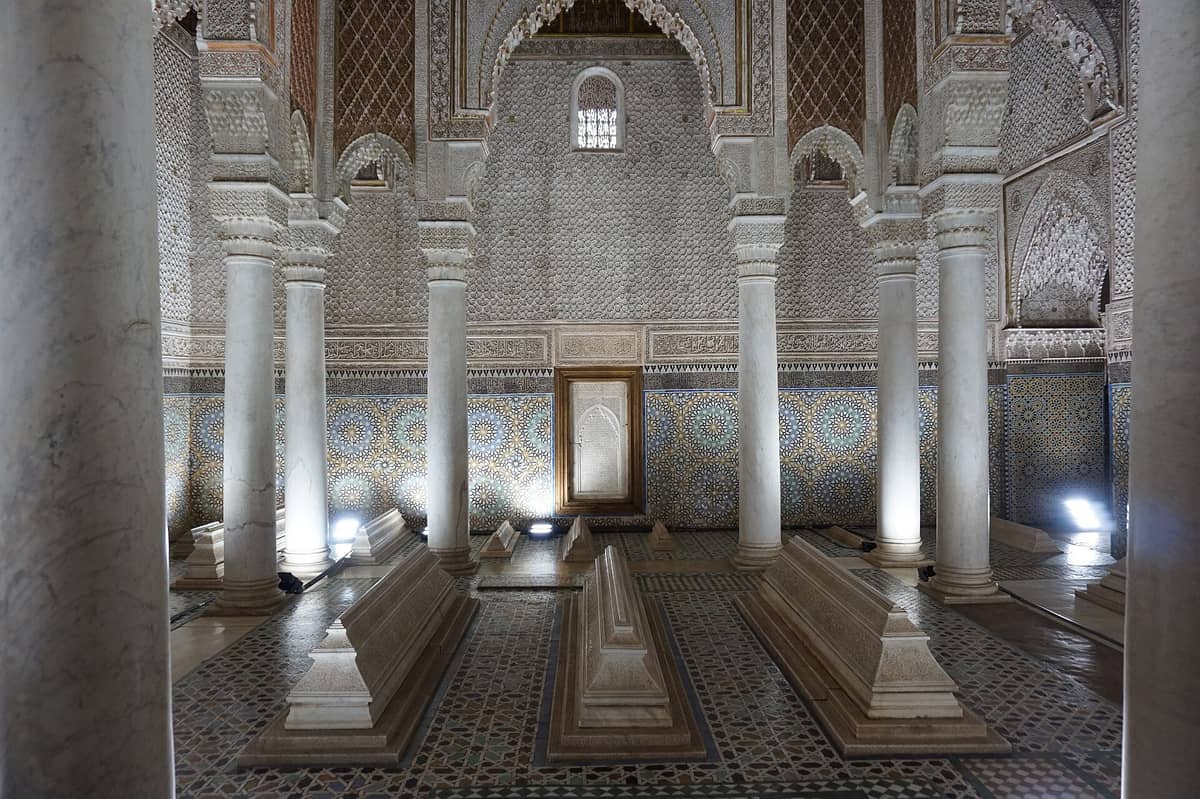
The Saadian Tombs are a royal necropolis built during the reign of the Saadian dynasty in the 16th and early 17th centuries. The complex contains over 60 tombs arranged across several chambers and an open courtyard, with the most celebrated structure being the Hall of Twelve Columns, built to house Sultan Ahmad al-Mansur (who died in 1603) and members of his immediate family. Al-Mansur was the dynasty's most powerful ruler, responsible for pushing Morocco's influence deep into sub-Saharan Africa and funding much of the decorative architecture that defines Marrakech's historic core.
The formal name in French, used on official Moroccan heritage signage, is Tombeaux Saadiens. In English, the site is consistently called the Saadian Tombs. Both refer to the same enclosed necropolis on Rue de la Kasbah, accessed through a narrow passage beside the Kasbah Mosque.
What makes this site unusual in Marrakech's roster of historic monuments is its backstory: when a later dynasty, the Alaouites, came to power in the late 17th century, they chose to seal parts of the tombs rather than destroy them outright. The site remained hidden from general view, accessible only through a small opening in the mosque wall, until French aerial surveys in 1917 led to its formal rediscovery and study. Restoration followed, and what visitors see today reflects both the original Saadian craftsmanship and careful 20th-century conservation work.
Inside the Complex: What You Will Find
The entrance corridor is deliberately narrow. You will pass through a small gatehouse, cross a short passage that runs along the mosque wall, and then step into a surprisingly spacious walled garden. The courtyard is planted with low hedges and seasonal flowers, and on quieter mornings the contrast between the confined entry and the open garden feels almost theatrical.
Three mausoleums stand around the courtyard. The largest and most elaborate is the Hall of Twelve Columns, on the left as you enter. The room takes its name from its twelve Italian Carrara marble columns, which support a ceiling of carved and painted cedarwood so dense in detail that visitors frequently stop and stand with their heads tilted back for several minutes. The zellige tilework on the lower walls and the stucco muqarnas above the arches are equally precise: this is Moroccan craftsmanship at a level comparable to anything in the Ben Youssef Madrasa.
The central chamber holds the tomb of Ahmad al-Mansur, along with those of his son and grandson. Surrounding tombs in the outer hall belonged to members of the Saadian court. A second, older mausoleum on the right side of the courtyard pre-dates al-Mansur's tomb and houses the remains of Sultan Muhammad al-Sheikh, who founded the dynasty's Moroccan capital. Beyond the mausoleums, the open garden contains roughly 100 additional graves marked with modest stone slabs or low tile surrounds. Visiting the Ben Youssef Madrasa on the same day makes for a strong architectural pairing, as the two sites showcase Saadian-era craft at its most ambitious.
💡 Local tip
Arrive at opening time (9:00) on a weekday if you want any chance of photographing the Hall of Twelve Columns without a crowd filling the frame. By 10:30 most mornings, tour groups from the major riads begin arriving and the chamber becomes difficult to navigate slowly. Standard hours are typically 09:00–17:00, with last entry around 16:30–16:45.
Tickets & tours
Live prices and dates from our booking partner. If you book, we may earn a commission at no extra cost to you.
Full day tour of Ouarzazate from Marrakech
From 51 €Instant confirmationFree cancellationEvening Quad Bike at Palmeraie Area with Tea Tasting from Marrakech
From 49 €Instant confirmationFree cancellationFull Day Economic Tour in Essaouira from Marrakech
From 29 €Instant confirmationFree cancellationFull Day Economic Tour of Ourika Valley from Marrakech
From 25 €Instant confirmationFree cancellation
How the Experience Changes by Time of Day
Early morning, between 9:00 and 10:00, the courtyard garden is calm and the light in the mausoleums is soft. The cedarwood ceiling in the Hall of Twelve Columns catches diffuse daylight through the arched doorways rather than harsh overhead sun, which makes the painted decoration far easier to read. The smell in the courtyard at this hour is faintly floral, especially if there has been overnight moisture, and the stone underfoot is cool.
By midday, particularly in summer when temperatures in Marrakech regularly exceed 35 degrees Celsius, the open courtyard becomes uncomfortable. The mausoleum interiors are naturally cooler due to the thick walls, but the narrow passages between sections trap heat once crowds build. Afternoon visits in July and August are hard going from a temperature standpoint, and the site's relatively small footprint means there is no shaded retreat to wait things out.
The late afternoon slot, from around 15:00 to last entry at approximately 16:30, works reasonably well in spring and autumn. The sun shifts and the courtyard garden is again pleasant. However, the final 30 minutes before closing can feel rushed, with staff beginning to move visitors toward the exit from around 16:30.
⚠️ What to skip
During Ramadan, opening hours are often reduced to roughly 10:00–16:00, with last entry around 15:30–15:45. If your visit coincides with Ramadan, verify the schedule locally or check the official site before making plans.
Getting There and Practical Logistics
The Saadian Tombs sit on Rue de la Kasbah in Marrakech's Kasbah district, directly beside the Kasbah Mosque. On foot from Jemaa el-Fna, the walk takes about 15 minutes heading south through the medina. The most direct route passes near Bab Agnaou, the carved gate at the southern edge of the medina, which is worth pausing at on the way. If you prefer a taxi, ask to be dropped at the Kasbah Mosque (Mosquée de la Kasbah) and follow the signage a short distance to the entrance passage.
The entrance to the tombs is not immediately obvious from the street. Look for a narrow archway along the mosque's outer wall, marked with a small sign. There is no large plaza or obvious courtyard approach: the gate is tucked between buildings and easy to walk past if you are not looking carefully.
Admission prices are tiered by nationality and age. At the time of research, foreign adult visitors pay around 100 MAD, with children aged 7–13 paying a reduced rate, and Moroccan citizens and residents paying around 30 MAD for adults and 10 MAD for children. Entry for disabled visitors is noted as free at the ticket office and Moroccan citizens enjoy free entry on Fridays and the first days of national and religious holidays. These prices are subject to change and should be confirmed on arrival or via the official site. Tickets are purchased at a small booth just inside the gateway.
The site falls within the Kasbah and Mellah district, one of the less-visited corners of the historic medina. Pairing a visit here with the nearby Bahia Palace or the El Badi Palace makes geographic sense, as all three are within a manageable walking distance in the southern medina.
Photography, Accessibility, and What to Bring
Photography is permitted throughout the site. A wide-angle lens or a smartphone with a good wide mode is useful in the Hall of Twelve Columns, because the chamber is relatively compact and the full ceiling is difficult to capture from a standard focal length. Tripods and monopods are impractical given the crowds and the narrow passageways. Morning light entering through the main doorway creates good natural illumination; flash tends to flatten the texture of the carved plasterwork.
The site has limited accessibility for visitors with reduced mobility. The pathways between sections are narrow and the stone surfaces are uneven in places, with low thresholds at some doorways. There is no lift, ramp, or adapted route through the complex. If mobility is a concern, the courtyard garden is more navigable than the interior mausoleum chambers, but the most architecturally significant space (the Hall of Twelve Columns) involves stepping up and maneuvering through a tight doorway.
Dress modestly, covering shoulders and knees, as you are entering a site immediately adjacent to an active mosque. Comfortable flat-soled shoes are important: the stone and tile floors can be slippery, particularly in cooler months. Bring water, especially in warmer seasons, as there are no refreshments available inside the complex.
Is It Worth Visiting?
The Saadian Tombs occupy a specific niche: they reward visitors who slow down and look carefully at craftsmanship, and they disappoint visitors expecting a sprawling, dramatic site. The entire complex takes 45 minutes to an hour to see thoroughly. The Hall of Twelve Columns is exceptional and ranks among the finest interior spaces in the medina. The outdoor garden with its low grave markers is quieter and more reflective. Together, the two moods of the site, ornate interior and serene exterior, create a visit that feels complete without being exhausting.
The site does attract significant visitor numbers and can feel crowded between roughly 10:30 and 14:00. Unlike larger attractions in Marrakech, there is no way to book timed entry in advance, and the space does not expand comfortably to absorb large groups. If you find crowd-heavy heritage sites frustrating, either arrive at opening or visit late in the afternoon. For context on how this fits into a broader Marrakech itinerary, the 3-day Marrakech itinerary positions the Saadian Tombs alongside the southern medina's other historic sites as a logical half-day combination.
Visitors who arrive expecting the visual extravagance of a full Moroccan palace complex may find the scale underwhelming. The Saadian Tombs are a necropolis, not a palace: the mood is contained and, in the garden, deliberately somber. That restraint is part of what makes it interesting. But travelers on a very tight schedule who must choose between this and the Ben Youssef Madrasa or the Bahia Palace should know that the Tombs offer less overall variety, compensated by a uniquely intense focus in one extraordinary room.
ℹ️ Good to know
The site is managed as a heritage monument by Moroccan authorities. No eating, smoking, or loud audio is permitted inside the complex. Guided tours are available from licensed guides at the entrance or through riads and tour operators in the medina.
Insider Tips
- The carved cedarwood ceiling in the Hall of Twelve Columns has a central octagonal lantern detail that most visitors miss because they focus on the eye-level tilework. Look directly upward at the center of the dome for the most intricate section.
- The passage running alongside the Kasbah Mosque wall to the entrance is also where unofficial guides often approach visitors. If you prefer to explore independently, a polite but firm refusal at the gate saves you from repeated offers inside the complex.
- Friday is free entry day for Moroccan citizens (including Moroccans residing abroad), which can make midday noticeably busier than a standard weekday. If your visit falls on a Friday, go at opening time.
- The outer garden containing the ordinary Saadian court graves is almost always less crowded than the mausoleum interiors. Spending time there after the interior chambers gives a quieter and more atmospheric end to the visit.
- Combining this stop with Bab Agnaou, the ornately carved gate just a few minutes walk away, adds meaningful architectural context for no extra cost or significant time.
Who Is Saadian Tombs For?
- History and architecture enthusiasts who appreciate Moroccan Islamic craft at a detailed level
- Photographers looking for exceptional interior detail work with natural light
- Travellers building a half-day itinerary through the southern medina, pairing with El Badi Palace or Bahia Palace
- Visitors who prefer a compact, focused site over a sprawling complex
- Repeat visitors to Marrakech who have already seen the major palaces and want deeper historical context
Nearby Attractions
Other things to see while in Kasbah & Mellah:
- Agdal Gardens
Stretching across roughly 340–500 hectares south of the medina, Agdal Gardens is among the oldest garden complexes in Marrakech, originally planted in the 12th century. Entry is free, but access is restricted to Fridays and Sundays — and can be suspended without notice when the King is in residence.
- Bab Agnaou
Bab Agnaou is the most elaborately decorated of Marrakech's historic city gates, a 12th-century Almohad masterpiece carved from blue-grey Gueliz stone at the entrance to the royal Kasbah quarter. It costs nothing to visit, stands open around the clock, and rewards anyone with even a passing interest in Islamic architecture.
- Bahia Palace
Built for a Grand Vizier and expanded by his son, Bahia Palace is a sprawling 19th-century complex of roughly 160 rooms arranged around shaded courtyards and orange-tree gardens. It offers one of the most detailed windows into late Moroccan imperial craftsmanship anywhere in the medina.
- Dar Si Saïd – Museum of Moroccan Arts
A 19th-century palace a short walk from Bahia Palace, Dar Si Saïd served after 2018 as Morocco's National Museum of Weaving and Carpets. Confirm opening status before visiting: the historic building has been closed for repairs since the September 2023 Al Haouz earthquake.
Planning a trip? Discover personalized activities with the Nomado app.