Bahia Palace: Inside Marrakech's Most Ornate 19th-Century Residence
Built for a Grand Vizier and expanded by his son, Bahia Palace is a sprawling 19th-century complex of roughly 160 rooms arranged around shaded courtyards and orange-tree gardens. It offers one of the most detailed windows into late Moroccan imperial craftsmanship anywhere in the medina.
Quick Facts
- Location
- Rue Riad Zitoun El Jdid, Marrakech Medina, Kasbah-Mellah district
- Getting There
- 10–15 min walk southeast of Jemaa el-Fna; taxis drop on the pedestrian lane leading to the main entrance
- Time Needed
- 45–90 minutes
- Cost
- 100 MAD foreign adults; 50 MAD foreign children 7–13; 30 MAD Moroccan or resident adults; 10 MAD Moroccan or resident children 7–13; free for children under 7, visitors with reduced mobility, and Moroccan nationals on Fridays and on the first day of national and religious holidays
- Best for
- Architecture lovers, history enthusiasts, photography, cultural sightseeing
- Official website
- e-services.minculture.gov.ma/en/tickets/palais-bahia
What Bahia Palace Actually Is
Bahia Palace (Palais Bahia in French, قصر الباهية in Arabic) is a late 19th-century royal residence in the southern medina of Marrakech, sitting roughly halfway between Jemaa el-Fna and the Saadian Tombs. The name translates roughly as 'palace of brilliance,' and the scale matches the ambition: approximately 150–160 rooms arranged across multiple courtyards, gardens, and reception halls, all on a single level with no staircases to navigate.
Construction began under Grand Vizier Si Moussa in the 1860s and was substantially expanded by his son Ba Ahmed ibn Moussa between 1894 and 1900. Ba Ahmed served as regent during the early reign of Sultan Abdelaziz and used the palace as a statement of personal power. The result is less a unified architectural vision than a sequence of expansions added over decades, which is partly why the floor plan feels deliberately labyrinthine.
Unlike the nearby El Badi Palace, which is a romantic ruin open to the sky, Bahia is largely intact and still contains most of its original decoration. That makes it a genuinely rare survivor among Marrakech's historic palace complexes.
The Craftsmanship: What You Are Actually Looking At
The ceilings are the first thing that stops most visitors cold. Cedar wood carved into geometric and floral patterns, then painted in ochre, green, and deep red, spans rooms that were built to impress foreign dignitaries and senior court officials. In the private apartments used by Ba Ahmed's wives and concubines, the plasterwork transitions from painted cedar to intricate stucco screens, filtering the courtyard light into geometric shadows on whitewashed walls.
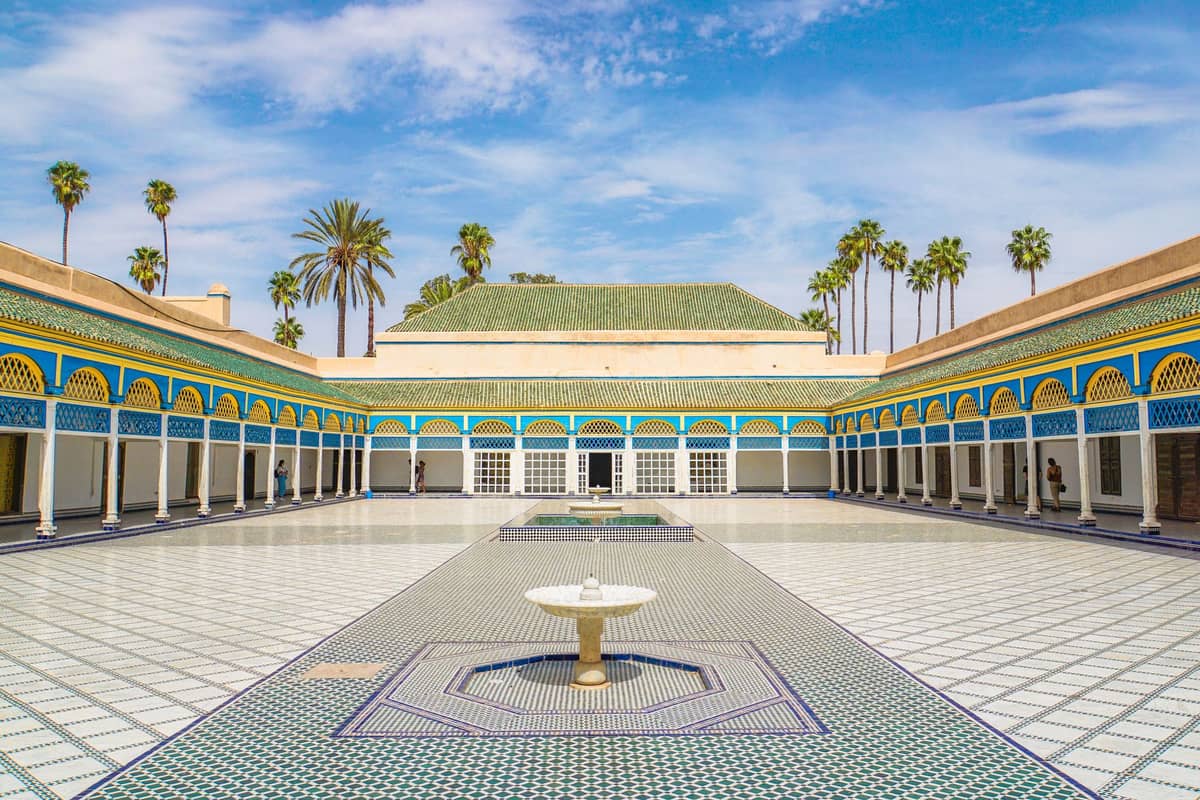
The floors throughout the main visitor circuit are covered in zellige tilework, the small hand-cut glazed ceramic tiles that are a signature of Moroccan palace interiors. Up close, the tiles have a slight irregularity that machine-cut versions lack: edges are not perfectly crisp, colours shift subtly within a single panel. Running your eye across a full courtyard floor, the effect is of something almost woven rather than built.
The Grand Riad courtyard is the compositional centrepiece: a large open garden planted with orange trees and palms, edged by a covered gallery with painted columns and tilework dados. Early morning, when sunlight enters at a low angle and the orange trees still carry overnight moisture, the courtyard has a stillness that the midday crowds erase entirely.
💡 Local tip
Photography tip: The carved cedar ceilings in the reception halls photograph best in overcast light or on shaded sides of the courtyard. Direct midday sun blows out the white plasterwork. Arrive before 10:00 for both better light and smaller crowds.
Tickets & tours
Live prices and dates from our booking partner. If you book, we may earn a commission at no extra cost to you.
How the Visit Flows: A Practical Walkthrough
The main entrance is on Rue Riad Zitoun El Jdid. After buying your ticket (the Ministry of Culture e-services portal sells tickets online, which can save queue time during peak season), you enter through a sequence of tiled antechambers before emerging into the first internal garden. The standard visitor route is loosely signposted and most people follow the same rough circuit, but the rooms branch in several directions and it is easy to double back through a different doorway.
Allow at least 45 minutes to walk the full circuit without rushing. Visitors who linger in the private apartments and the smaller subsidiary courtyards often spend closer to 90 minutes. The scale is large enough that groups with audio guides and solo wanderers rarely crowd the same room simultaneously, even on busy afternoons.
The palace is built on a single level, and the Ministry of Culture grants free entry to visitors with reduced mobility, though not all areas are fully accessible. The main paths are smooth tile and marble, though a few doorway thresholds are slightly raised. Visitors using wheelchairs should be aware of occasional uneven joins between floor surfaces, but the overall circuit is more accessible than most medina monuments.
⚠️ What to skip
Last entry is around 16:30, even though closing time is listed as 17:00. During Ramadan, hours shorten significantly (approximately 10:00–16:00, though exact times vary by year). Always confirm locally before visiting during Ramadan.
Best Time to Visit and Crowd Patterns
Bahia Palace is one of Marrakech's most-visited monuments, which means timing matters more than at lesser-known sites. Tour groups, often routed here as part of half-day medina circuits, typically arrive between 10:30 and 12:30. The palace empties noticeably after 14:30 on most days, when coaches move on to the next stop. Arriving at opening (09:00) or after 14:30 gives a meaningfully different experience: quieter galleries, slower movement through rooms, and the possibility of standing in a courtyard without another group crossing your field of view.
Seasonally, spring (March to May) and autumn (September to November) bring the most comfortable temperatures for walking the open courtyards. Summer afternoons can be genuinely punishing in the exposed Grand Riad garden, where stone and tile radiate heat. The covered galleries provide shade, but it is worth knowing that there is limited seating and no cafe inside the monument itself.
For broader context on seasonal planning, the best time to visit Marrakech guide covers temperature ranges and crowd patterns across the full year.
Getting There: Navigating the Southern Medina
Bahia Palace sits in the Kasbah-Mellah area of the medina, about 10 to 15 minutes on foot southeast of Jemaa el-Fna. The most direct walking route follows Rue Riad Zitoun El Jdid southward from the main square: the street narrows and broadens several times, passing spice sellers and small souks before the palace entrance appears on the left. It is not prominently signed from a distance, so look for the flow of other tourists and the ticket booth set back from the lane.
Taxis from anywhere in the medina or from Gueliz can drop passengers close to the entrance. Agree a price before getting in, or insist on the meter. Petit taxis cannot enter the pedestrian lanes of the medina itself, so the final 100 to 200 metres will always be on foot.
If you are combining the visit with the Saadian Tombs (roughly 10 minutes' walk southwest of Bahia), it makes sense to visit both in the same half-day and plan for a late morning arrival at Bahia to avoid peak overlap with coach tours.
Cultural and Historical Context
Ba Ahmed ibn Moussa, the driving force behind Bahia's expansion in the 1890s, was one of the most powerful figures in late 19th-century Morocco, effectively running the country as regent. The palace reflects both his political ambitions and his personal lifestyle: estimates of his household at the time run to hundreds of family members, servants, and staff, which explains why a 160-room complex still feels proportionate rather than excessive.
After Ba Ahmed's death in 1900, the palace was stripped of many portable valuables by court rivals, a common fate for the residences of powerful officials in the Makhzen system. What remained fixed in the walls, the carved cedar ceilings, the zellige floors, the stucco panels, survived intact. French colonial authorities later used parts of the complex as a residence for the Resident-General, which probably contributed to its preservation.
Bahia is one of several surviving examples of Moroccan palatial architecture in Marrakech. The Marrakech palaces guide covers the broader context of how these complexes compare and which ones reward the most time.
Strengths and Limitations
Bahia Palace delivers on its central promise: the carved ceilings, zellige floors, and courtyard proportions are genuinely extraordinary, and the scale of the complex makes it more immersive than a single grand room could be. For anyone with an interest in Moroccan architecture, decorative arts, or the political history of the late Makhzen period, it is hard to leave disappointed.
The limitations are real, though. Signage inside the palace is minimal: rooms are not labeled, historical context is sparse, and visitors without a guide or a downloaded audio tour will find themselves walking through magnificent spaces with little explanation of what they are seeing or who lived in each part of the complex. Bringing a guidebook, downloading an audio guide in advance, or hiring a licensed guide at the entrance significantly improves the experience.
Visitors primarily interested in authentic, uncrowded Marrakech experiences may also find the concentration of tour groups between 10:30 and 13:00 frustrating. The palace is not overhyped in terms of what it offers, but the visitor experience at peak hours is more theme-park than contemplative. Timing, as always in the medina, is most of the battle.
Travelers looking for a quieter alternative in the same part of the medina might also consider the Dar Si Said Museum. Dar Si Saïd has been closed for post-earthquake repairs; confirm it is open before pairing the two. When both are open, the pairing is efficient: a smaller palace nearby that draws far fewer visitors and houses a collection of traditional Moroccan crafts and woodwork.
Insider Tips
- Buy tickets through the Moroccan Ministry of Culture e-services portal (e-services.minculture.gov.ma) before arriving. During peak season this can save 15–20 minutes queuing at the booth.
- The private apartments section, toward the rear of the complex, sees far fewer visitors than the main Grand Riad courtyard. Spend more time there: the painted ceilings in these rooms are just as fine, and you will often have them to yourself.
- Moroccan nationals enter free on Fridays and on the first day of national and religious holidays, which can make Friday afternoons noticeably busier with local visitors. For foreign visitors who want quieter conditions, Friday morning before noon is still manageable.
- There is no cafe or water point inside the palace. Buy a bottle of water before entering, particularly in summer when the open courtyard sections can be very hot in the middle of the day.
- The walk between Bahia Palace and the Saadian Tombs takes about 10 minutes and passes through a quieter section of the southern medina. Do it without a guide if you want to explore rather than be escorted, but keep your bearings: the lanes south of Bahia are less tourist-oriented and less signed than those around Jemaa el-Fna.
Who Is Bahia Palace For?
- Architecture and decorative arts enthusiasts who want to understand the grammar of Moroccan palace design
- History-focused travelers interested in the late 19th-century Makhzen and colonial period
- Photographers seeking carved cedar ceilings, zellige tilework, and courtyard compositions
- Visitors on a first trip to Marrakech who want a single monument that captures the scale and craft of the medina's palatial tradition
- Travelers with limited mobility looking for a major historic site that is largely flat and accessible
Nearby Attractions
Other things to see while in Kasbah & Mellah:
- Agdal Gardens
Stretching across roughly 340–500 hectares south of the medina, Agdal Gardens is among the oldest garden complexes in Marrakech, originally planted in the 12th century. Entry is free, but access is restricted to Fridays and Sundays — and can be suspended without notice when the King is in residence.
- Bab Agnaou
Bab Agnaou is the most elaborately decorated of Marrakech's historic city gates, a 12th-century Almohad masterpiece carved from blue-grey Gueliz stone at the entrance to the royal Kasbah quarter. It costs nothing to visit, stands open around the clock, and rewards anyone with even a passing interest in Islamic architecture.
- Dar Si Saïd – Museum of Moroccan Arts
A 19th-century palace a short walk from Bahia Palace, Dar Si Saïd served after 2018 as Morocco's National Museum of Weaving and Carpets. Confirm opening status before visiting: the historic building has been closed for repairs since the September 2023 Al Haouz earthquake.
- El Badi Palace
El Badi Palace is a vast 16th-century Saadian ruin in Marrakech's Kasbah district. What remains, stripped bare by a later sultan, is still monumental: sunken gardens, colossal walls, and a silence that the original opulence only hints at. This guide covers what to see, when to go, and how to get there.
Planning a trip? Discover personalized activities with the Nomado app.