Bab Agnaou: The Carved Stone Gateway to Marrakech's Royal Kasbah
Bab Agnaou is the most elaborately decorated of Marrakech's historic city gates, a 12th-century Almohad masterpiece carved from blue-grey Gueliz stone at the entrance to the royal Kasbah quarter. It costs nothing to visit, stands open around the clock, and rewards anyone with even a passing interest in Islamic architecture.
Quick Facts
- Location
- Rue Oqba Ben Nafaa, Mechouar-Kasbah district, southern Marrakech fortifications
- Getting There
- 10-15 min walk south from Jemaa el-Fna; taxis drop at 'Bab Agnaou, Kasbah'
- Time Needed
- 15-30 minutes to view and photograph
- Cost
- Free — no ticket, no entry fee
- Best for
- Architecture lovers, history buffs, photographers
What Is Bab Agnaou?
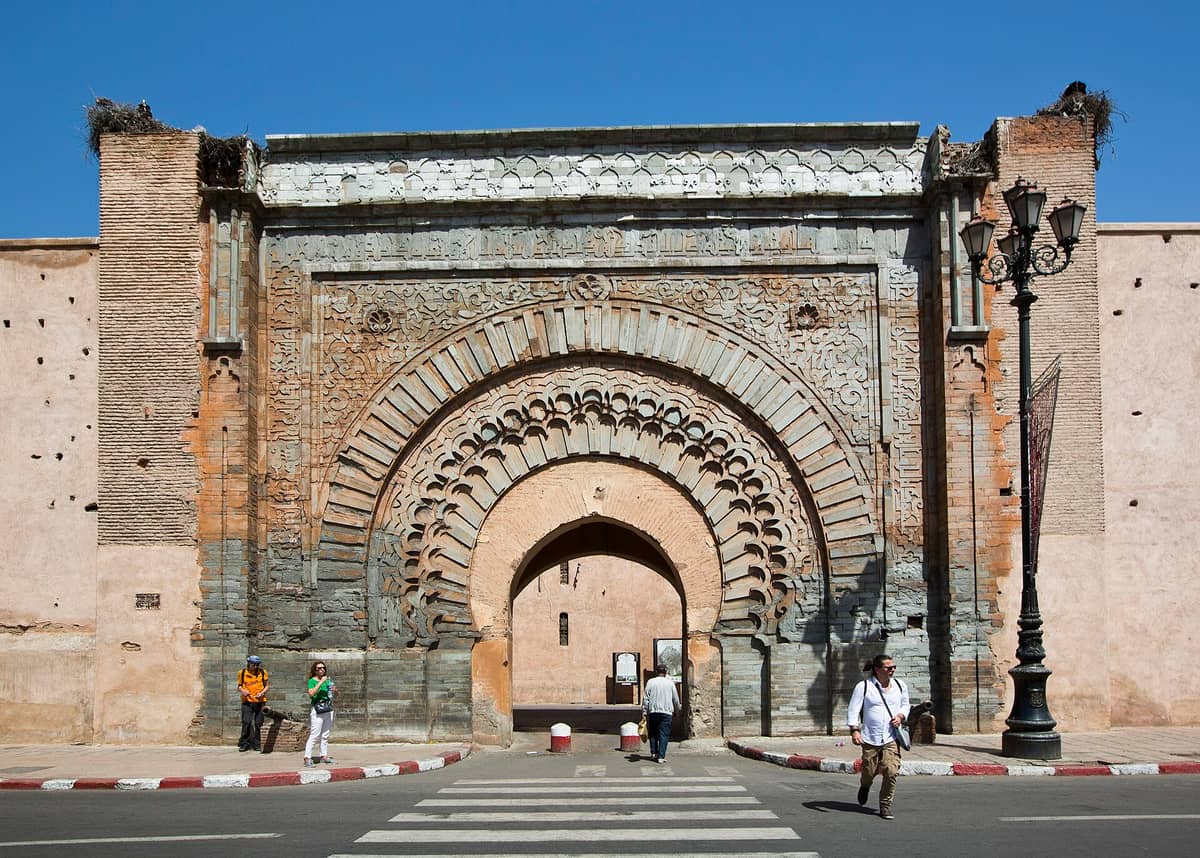
Bab Agnaou is a monumental stone gate built during the Almohad dynasty in the 12th century, designed as the principal ceremonial entrance to the royal Kasbah of Marrakech. Unlike most of the city's earthen ramparts, this gate was carved from pale blue-grey Gueliz stone and finished with dense geometric and floral relief work that covers nearly every surface of its façade. It is widely considered among the finest surviving examples of Almohad decorative stonework in Morocco, comparable to gates such as Bab er-Rouah and Bab Oudaia in Rabat.
The gate's name is a point of historical debate. One interpretation links 'Agnaou' to a Berber term for the Gnawa people of sub-Saharan origin. Another connects it to an ancient word meaning horned or black ram. Neither reading detracts from the gate's visual impact: from the moment you round the bend on Rue Oqba Ben Nafaa and the façade comes into full view, it is immediately clear why this gateway has been admired for nearly nine centuries.
💡 Local tip
Bab Agnaou sits directly on a public street and has no opening hours or admission fee. You can walk up to it at any time of day or night, though the best light for photography typically falls in the late afternoon when the sun strikes the carved stone from a low southwesterly angle.
The Architecture Up Close
The façade is structured around a large horseshoe arch framed by a rectangular alfiz border, a characteristic feature of Almohad religious and civic buildings. What distinguishes Bab Agnaou from more utilitarian gates is the density and quality of its carved ornamentation. Three concentric bands of interlacing geometric patterns, arabesque floral motifs, and Kufic calligraphic inscriptions ring the arch, each band slightly different in rhythm and scale. The outermost band appears as Quranic text rendered in a stylised script that reads as almost purely decorative to the untrained eye but carries precise textual meaning.
The stone itself is a pale blue-grey in shade, quarried from the hills near Gueliz. Over centuries of sun and wind, the carved surfaces have taken on a worn, sun-bleached quality, with the deepest recesses still holding traces of shadow and definition. Run your fingers along the lower panels if the crowds allow, and you can feel the alternating raised ridges and incised grooves that give the surface its textile-like appearance from a distance. The arch opening itself is large enough to have allowed mounted horsemen to pass through, and the passageway beyond is relatively short, leading directly into the Kasbah district.
The gate belongs to the same Almohad building campaign as the Koutoubia Mosque, reflecting the same Almohad patrons who transformed Marrakech into an imperial capital during the second half of the 12th century. Comparing the gate's carved stonework with the minaret of the Koutoubia, built by the same dynasty, reveals a consistent architectural vocabulary: geometric networks, calligraphic bands, and a preference for stone over the more common pisé (rammed earth) used elsewhere in the medina walls.
Tickets & tours
Live prices and dates from our booking partner. If you book, we may earn a commission at no extra cost to you.
Full day tour of Ouarzazate from Marrakech
From 51 €Instant confirmationFree cancellationEvening Quad Bike at Palmeraie Area with Tea Tasting from Marrakech
From 49 €Instant confirmationFree cancellationFull Day Economic Tour in Essaouira from Marrakech
From 29 €Instant confirmationFree cancellationFull Day Economic Tour of Ourika Valley from Marrakech
From 25 €Instant confirmationFree cancellation
The Setting and Surrounding Area
Bab Agnaou anchors the southern edge of the Kasbah quarter, one of Marrakech's most historically significant but least touristy neighborhoods. The gate stands at a T-junction on Rue Oqba Ben Nafaa, flanked by low ochre walls and a steady stream of motorbikes, residents on foot, and the occasional horse-drawn cart. This is not a sterile museum precinct: the gate is alive in the middle of a working street, surrounded by small shops, the smell of grilled meat from nearby stalls, and the ambient noise of one of the medina's quieter arteries.
Just inside the gate, the Kasbah quarter contains two of Marrakech's most significant historic sites within easy walking distance: the Saadian Tombs and the El Badi Palace. Most visitors combine all three into a single afternoon loop, starting at Bab Agnaou and working their way through the Kasbah. This is a logical and efficient route that avoids doubling back through the medina's tighter alleys.
The street immediately outside the gate is wide enough to photograph the full façade without distortion, which is rarer than it sounds in the medina. Stand roughly 15 to 20 metres back from the arch and you can frame the entire composition, including the flanking wall sections. Traffic passes continuously, so patience is required for a clean shot.
How the Experience Changes by Time of Day
Early morning, before 8am, the gate is almost deserted. The light at this hour is soft and even, without the harsh contrast that midday sun creates on the deeply carved surfaces. You will share the space with local residents heading to the mosque next door for Fajr prayer, bread sellers pushing carts, and the occasional stray cat warming itself on the stone threshold. This is the quietest, most atmospheric time to visit.
By mid-morning, tour groups begin arriving from the direction of Jemaa el-Fna, often pausing here briefly before continuing to the Saadian Tombs. The gate remains accessible but the pavement in front fills with people. From around 3pm onward, the afternoon sun swings to a favourable angle for photography, lighting the carved details from the side and creating strong shadows that emphasise the relief work. The late afternoon also brings a cooler temperature and slightly lower foot traffic as tour groups disperse.
At night, the gate is illuminated by streetlights that cast a warm yellow glow across the stone, turning the carved patterns into something more theatrical. There are no dedicated floodlights, so the effect is ambient rather than dramatic, but it is worth seeing if you are in the Kasbah area for dinner. The surrounding streets are calm but not deserted.
ℹ️ Good to know
Visiting between late autumn and early spring (November to March) brings more comfortable temperatures for extended outdoor sightseeing in this part of the medina. Summer afternoons can reach 35°C or above; early morning visits become even more important in those months.
Getting There and Practical Logistics
Bab Agnaou is located on Rue Oqba Ben Nafaa in the Kasbah district, which sits at the southern end of the Marrakech Medina. From Jemaa el-Fna, head south along Rue du Bab Agnaou (the street is named after the gate itself) and continue roughly 10 to 15 minutes on foot. The route is largely straightforward by medina standards, running along wider streets rather than the labyrinthine alleys further north.
Petit taxis can drop you directly at the gate; simply tell the driver 'Bab Agnaou, Kasbah' and confirm a metered fare before departing. The gate is also a useful landmark for reaching Les Bains de Marrakech, one of the medina's well-regarded hammams, located at 2 Derb Sedra just inside the Kasbah walls.
Accessibility at the gate itself is straightforward: there are no steps, no interior rooms, and no barriers. The gate is a passageway through a wall, and viewing the façade requires nothing more than standing on a public pavement. The surrounding streets have uneven paving and no dedicated pedestrian lanes, which is standard for the medina. Visitors using wheelchairs or pushchairs should be aware that the approach from Jemaa el-Fna involves some cobblestone and compressed earth surfaces, and may prefer to arrive by taxi directly to the gate.
⚠️ What to skip
Unofficial 'guides' sometimes approach tourists near Bab Agnaou offering to show them the Saadian Tombs or other nearby sites for a fee. The tombs have a separate official ticket office and are easy to find independently. Politely declining unsolicited guides is straightforward; the area is safe and well-traveled.
Photography Tips
The full façade is best captured with a moderate wide-angle focal length, approximately 24 to 35mm equivalent on a full-frame camera. The arch is tall enough that a standard 50mm lens requires you to step back significantly, and at that distance traffic becomes more difficult to avoid. Shoot in the afternoon when the sun lights the right side of the arch, creating a clear distinction between raised and recessed carving. In flat midday light, the intricate relief work loses much of its definition.
Detail shots of individual carved bands reward a longer focal length. The outermost Kufic inscription panel, the interlacing geometric rosette in the spandrel above the arch, and the scalloped inner arch profile each make strong individual compositions. If you have a polarising filter, it can reduce glare on the pale stone under direct sunlight.
For context on Marrakech's broader tradition of Islamic decorative architecture, a visit to the Ben Youssef Madrasa in the northern medina makes an excellent comparison point: the madrasa's interior stucco and zellij work draws on related design principles but represents a later Saadian period interpretation of similar geometric and calligraphic themes.
Is Bab Agnaou Worth Your Time?
As a standalone destination, Bab Agnaou is a 20-minute stop at most. The gate does not have an interior, a museum, or any interpretive material on site. If you are making a deliberate detour for architecture alone, the Ben Youssef Madrasa offers a more immersive and richly detailed experience. But Bab Agnaou's great strength is its location: it sits at the entrance to the Kasbah quarter and is a natural starting point for a half-day loop that includes the Saadian Tombs and El Badi Palace. In that context, the gate is not a detour at all — it is the front door.
Travellers who are not particularly interested in medieval Islamic architecture may find the gate easy to absorb in a few minutes and move on. That is perfectly valid. The gate does not demand extended contemplation, but the quality of its carving repays closer attention if you choose to give it. For anyone compiling a serious study of Almohad architecture in Morocco, Bab Agnaou is one of the clearest surviving examples of the dynasty's decorative stonework program and belongs on the itinerary.
For a broader understanding of Marrakech's architectural and historical layers, the guide to Islamic architecture in Marrakech provides useful context on how the city's gates, mosques, and madrasas relate to one another across different dynasties and centuries.
Insider Tips
- The gate is significantly less crowded immediately after the midday call to prayer, when tour groups have typically moved on to lunch and the surrounding streets briefly empty.
- If you want a photograph without motorbikes in the foreground, come on a Friday morning: traffic in this part of the Kasbah thins noticeably during Friday prayers at the adjacent mosque.
- The small café on the corner just south of the gate has outdoor seating with a direct sightline to the arch. It is a good place to sit with a mint tea and watch the light change on the carved surface without fighting for pavement space.
- Combine Bab Agnaou with the Saadian Tombs (a three-minute walk inside the Kasbah walls) and El Badi Palace (roughly ten minutes further on foot) to make the most of the walk. All three can be done in half a day without feeling rushed.
- The carved stone is at its most photogenic in the 90 minutes before sunset, when raking light picks out the relief work in sharp detail. This is also when the local neighbourhood comes alive with after-school foot traffic, adding human scale and movement to any wide shots.
Who Is Bab Agnaou For?
- Architecture and history enthusiasts who want to see Almohad stonework in its original context
- Photographers looking for a structurally complex façade with good afternoon light
- Travellers combining the Kasbah loop (Saadian Tombs, El Badi Palace) into a single afternoon
- Anyone interested in Islamic geometric and calligraphic design traditions
- First-time visitors to Marrakech who want to understand the city's imperial history beyond the souks
Nearby Attractions
Other things to see while in Kasbah & Mellah:
- Agdal Gardens
Stretching across roughly 340–500 hectares south of the medina, Agdal Gardens is among the oldest garden complexes in Marrakech, originally planted in the 12th century. Entry is free, but access is restricted to Fridays and Sundays — and can be suspended without notice when the King is in residence.
- Bahia Palace
Built for a Grand Vizier and expanded by his son, Bahia Palace is a sprawling 19th-century complex of roughly 160 rooms arranged around shaded courtyards and orange-tree gardens. It offers one of the most detailed windows into late Moroccan imperial craftsmanship anywhere in the medina.
- Dar Si Saïd – Museum of Moroccan Arts
A 19th-century palace a short walk from Bahia Palace, Dar Si Saïd served after 2018 as Morocco's National Museum of Weaving and Carpets. Confirm opening status before visiting: the historic building has been closed for repairs since the September 2023 Al Haouz earthquake.
- El Badi Palace
El Badi Palace is a vast 16th-century Saadian ruin in Marrakech's Kasbah district. What remains, stripped bare by a later sultan, is still monumental: sunken gardens, colossal walls, and a silence that the original opulence only hints at. This guide covers what to see, when to go, and how to get there.
Planning a trip? Discover personalized activities with the Nomado app.