El Badi Palace: Marrakech's Most Impressive Ruin
El Badi Palace is a vast 16th-century Saadian ruin in Marrakech's Kasbah district. What remains, stripped bare by a later sultan, is still monumental: sunken gardens, colossal walls, and a silence that the original opulence only hints at. This guide covers what to see, when to go, and how to get there.
Quick Facts
- Location
- Ksibat Nhass, Kasbah district, southern medina, Marrakech
- Getting There
- On foot (~15 min) from Jemaa el-Fna, or taxi to Place des Ferblantiers
- Time Needed
- 1 to 2 hours
- Cost
- 100 MAD foreign adults; 50 MAD foreign children 7–13; 30 MAD Moroccan or resident adults; 10 MAD Moroccan or resident children 7–13; free for children under 7, visitors with reduced mobility, and Moroccan nationals on Fridays and on the first day of national and religious holidays
- Best for
- History lovers, photographers, architecture enthusiasts, medina explorers
- Official website
- badipalace.com
What El Badi Palace Actually Is
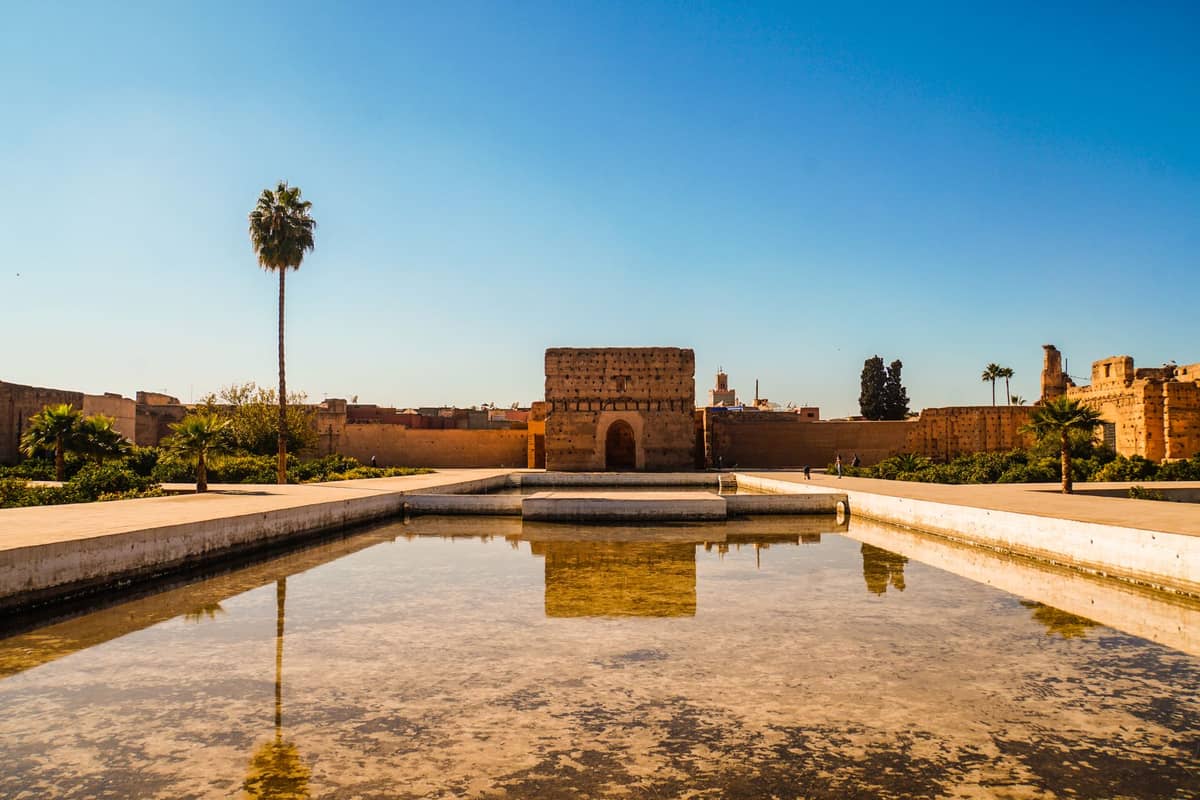
El Badi Palace, known in Arabic as Al-Qasr al-Badi, is a ruined royal palace in the Kasbah district of Marrakech, about 800 metres south of Jemaa el-Fna. What you walk into today is not a restored palace but a stripped skeleton: enormous pisé walls, a sunken rectangular garden, and the outlines of pavilions and reflecting pools that once made this one of the most celebrated buildings in the Islamic world.
That contrast between legend and reality is the whole point of the visit. El Badi means 'the incomparable' in Arabic, and by contemporary accounts it deserved the name. Ambassadors reported ceilings inlaid with gold, columns of Italian marble, and surfaces covered in onyx and precious stone. Then, between roughly 1696 and 1707, Alaouite Sultan Moulay Ismail ordered the palace systematically dismantled. The valuables were carted to Meknes to furnish his new capital. What he left behind were walls, arches, and foundations, which have remained largely as he left them.
Understanding that deliberate stripping is what makes the space legible. You are not looking at neglect or earthquake damage. You are looking at what a powerful ruler decided was not worth keeping.
💡 Local tip
El Badi Palace is currently open daily from 09:00 to 17:00 (last entry 16:30). During Ramadan, hours typically reduce to 10:00–16:00. Verify current hours with the official site before your visit, as times can shift seasonally.
A Brief History: The Saadian Palace and Its Undoing
Sultan Ahmad al-Mansur commissioned El Badi Palace following the Battle of the Three Kings in 1578, a decisive Portuguese defeat that strengthened Saadian Morocco and flooded its coffers with ransom money, captured goods, and trans-Saharan gold trade revenue. Construction ran from 1578 into the early 17th century. The palace was not just a residence but a symbol of the Saadian dynasty's new international standing, designed to receive foreign dignitaries in surroundings that would leave no doubt about Morocco's wealth.
At its peak, the complex comprised hundreds of rooms arranged around a central courtyard approximately 135 metres long and 110 metres wide. Four large pavilions anchored the corners, a sunken garden ran along the central axis, and two flanking basins reflected the sky. The Italian Carrara marble in the columns was reportedly traded weight-for-weight against Moroccan sugar, which gives some sense of the economic scale involved.
The Saadian dynasty also built the Saadian Tombs, located just a short walk from El Badi. Where the palace was stripped bare, the tombs were walled off and largely forgotten until rediscovered in 1917, leaving their tile work and carved stucco intact. Visiting both on the same afternoon gives you the full arc of Saadian ambition in one district.
Tickets & tours
Live prices and dates from our booking partner. If you book, we may earn a commission at no extra cost to you.
What You See Inside: The Layout and Its Landmarks
Entry brings you into the vast central courtyard almost immediately. The scale registers before anything else: the space is larger than most European palace forecourts, and the surrounding walls rise high enough to block the surrounding city entirely. In the middle of the courtyard, the sunken garden is planted with orange trees and divided by raised walkways. On hot days, the orange blossom scent in early spring is noticeable even from the perimeter paths.
The two large reflecting pools, one to each side of the central garden, still hold water at certain times of year. When the water level is high and the light is right in the mid-morning, the surrounding walls and nesting storks reflect cleanly in the surface. The storks are one of the more memorable details: dozens of white storks nest on the highest walls from around February to August, and their chatter, bill-clattering, and occasional squabbles overhead give the otherwise still space an unexpected layer of activity.
Around the courtyard perimeter, excavated basement chambers and underground passages are partially open and allow visitors to understand something of the palace's structural depth. A small pavilion on the south side now houses the original minbar (pulpit) from the Koutoubia Mosque, a carved cedarwood structure dating from the early 12th-century Almoravid period that was once housed in the mosque before being moved here for preservation.
For broader context on Marrakech's Islamic architectural heritage across different periods, the Islamic architecture guide covers how El Badi fits alongside the city's other major monuments, from the Koutoubia to the Ben Youssef Madrasa.
How the Experience Changes by Time of Day
Arriving at opening (09:00) is worth the effort. The courtyard faces east on one long axis, and in the first two hours of the day, the light enters low and rakes across the adobe walls in a warm orange tone. Shadows from the battlements cut sharp lines across the courtyard floor. There are very few other visitors at this hour, and the space has a genuine quietness that disappears by mid-morning.
By 11:00, tour groups begin to arrive. The courtyard handles crowds reasonably well because of its size, but the underground chambers and the minbar pavilion become congested. If you want to photograph the minbar without other visitors in frame, arrive at or just after opening.
Midday through early afternoon is the harshest time to visit, particularly in summer. The courtyard offers almost no shade, the walls radiate heat absorbed in the morning, and temperatures regularly exceed 35°C in July and August. If summer is your only option, wear a hat, carry water, and plan to leave by 12:00 at the latest. Spring and autumn mornings are the most comfortable overall.
⚠️ What to skip
There is virtually no shade in the main courtyard. In summer (June–August), the heat in the open space becomes intense by mid-morning. Bring water, wear sun protection, and consider visiting first thing after opening or late afternoon close to 16:00.
The late afternoon window, roughly 15:30 to 16:30 (the last entry slot), offers the next-best light after early morning. The sun moves around to the west and catches the top of the walls at an angle that intensifies the reddish-ochre of the pisé. Crowds thin again and the space regains some of its contemplative quality. The storks on the battlements tend to be most active in the late afternoon, particularly in spring.
Getting There and Practical Navigation
The most direct approach on foot from Jemaa el-Fna takes you south through the medina toward the Kasbah district. The route is not entirely straightforward the first time, but the Ksibat Nhass neighborhood and Place des Ferblantiers serve as useful landmarks. Allow 15 minutes of walking from Jemaa el-Fna and budget a little extra if you are navigating the alley network for the first time.
Taxis can drop you at Place des Ferblantiers (also called Place du Mellah on some maps), which is a small square a few minutes' walk from the palace entrance. This is a practical option in summer when walking through the medina in midday heat is unpleasant. Agree a price before getting in, or insist on the meter.
The palace sits in the southern medina's Kasbah-Mellah area, which is also home to the Mellah Jewish Quarter and the Bahia Palace. A half-day itinerary that combines all three is one of the most efficient ways to use your time in this part of the medina.
The entrance is on the north side of the palace complex, off a small street that can be easy to miss. Look for the ticket booth and the crenellated wall. There are usually vendors selling water and snacks just outside the entrance, which is worth noting given the lack of shade inside.
Photography: What Works and What Doesn't
El Badi is one of the more photogenic ruins in Morocco, but the results depend heavily on time of day and season. The early morning east-facing light is ideal for the main courtyard walls. The minbar pavilion is indoors and relatively dark, so a camera that handles low light well (or a phone with a good night mode) produces better results than flash, which flattens the carving detail.
For the reflecting pools, the most reliable reflections appear in late winter and spring when water levels are higher. In summer and early autumn, the pools may be shallow or partially dry. The stork nests on the high walls photograph best with a longer lens from the courtyard floor, particularly in the morning when the birds are most active.
Drone photography is not permitted at the site. The views from the top of the accessible rampart sections are wide enough for a standard wide-angle lens to capture the full courtyard in a single frame.
Who This Is and Isn't For
El Badi Palace rewards visitors who can work with absence. There is no restored interior, no multimedia guide to what the rooms looked like, and no museum-quality interpretive signage. What there is is scale, silence at the right hour, and the intellectual weight of knowing what was here and what was taken. Visitors who find ruins atmospheric and historically legible will leave satisfied. Visitors expecting the ornate tile work and carved plaster of Bahia Palace or the Ben Youssef Madrasa may find the space stark.
If detailed Saadian craftsmanship is what you are after, the Saadian Tombs a few minutes' walk away offer exactly that, and the two sites complement each other well as a pair.
Visitors with significant mobility limitations should know that the site involves uneven ground, gravel paths, low steps, and a large courtyard without smooth surfaces throughout. Entry is free for people with reduced mobility, but some areas of the ruins require steps or rough terrain to access fully.
For those planning a full day in the historic medina, the Marrakech walking tour guide maps out a logical sequence that includes El Badi alongside the Kasbah Mosque, the Saadian Tombs, and the Mellah in a single loop.
Insider Tips
- The minbar from the Koutoubia Mosque is displayed in a covered pavilion on the south side of the courtyard. Most visitors walk past it quickly; take your time here. It is a 12th-century Almoravid masterpiece and arguably the most significant object in the entire complex.
- If you visit on a Friday, Moroccan nationals including residents abroad (MREs) enter free; note that they also have free entry on the first day of national and religious holidays. The site can be noticeably busier with local families on Friday afternoons, which changes the atmosphere considerably from a typical weekday morning.
- The stork population is most active from February through July. The bill-clattering courtship displays happen in the early morning from February onward and are easy to observe from the northern end of the courtyard where the nests are most concentrated.
- The reflecting pools photograph better in late winter and spring (February to April) when they tend to hold more water. By late summer, the pools may be low or dry, which reduces the visual impact of the central courtyard.
- Combine El Badi with the Saadian Tombs on the same visit. The tombs are a five-minute walk south, and together the two sites take two to three hours without feeling rushed. The contrast between the stripped palace and the intact tomb decoration makes both more meaningful.
Who Is El Badi Palace For?
- History and architecture enthusiasts drawn to Saadian Morocco and the politics of royal destruction
- Photographers looking for dramatic scale, raking light, and wildlife (storks) in a heritage context
- Medina explorers pairing this with the Saadian Tombs and Mellah in a single southern medina loop
- Travelers who appreciate atmospheric ruins over restored interiors
- Travelers who want a major Kasbah monument at the same Ministry of Culture tariff as Bahia Palace
Nearby Attractions
Other things to see while in Kasbah & Mellah:
- Agdal Gardens
Stretching across roughly 340–500 hectares south of the medina, Agdal Gardens is among the oldest garden complexes in Marrakech, originally planted in the 12th century. Entry is free, but access is restricted to Fridays and Sundays — and can be suspended without notice when the King is in residence.
- Bab Agnaou
Bab Agnaou is the most elaborately decorated of Marrakech's historic city gates, a 12th-century Almohad masterpiece carved from blue-grey Gueliz stone at the entrance to the royal Kasbah quarter. It costs nothing to visit, stands open around the clock, and rewards anyone with even a passing interest in Islamic architecture.
- Bahia Palace
Built for a Grand Vizier and expanded by his son, Bahia Palace is a sprawling 19th-century complex of roughly 160 rooms arranged around shaded courtyards and orange-tree gardens. It offers one of the most detailed windows into late Moroccan imperial craftsmanship anywhere in the medina.
- Dar Si Saïd – Museum of Moroccan Arts
A 19th-century palace a short walk from Bahia Palace, Dar Si Saïd served after 2018 as Morocco's National Museum of Weaving and Carpets. Confirm opening status before visiting: the historic building has been closed for repairs since the September 2023 Al Haouz earthquake.
Planning a trip? Discover personalized activities with the Nomado app.