Agdal Gardens: Marrakech's Ancient Royal Orchards
Stretching across roughly 340–500 hectares south of the medina, Agdal Gardens is among the oldest garden complexes in Marrakech, originally planted in the 12th century. Entry is free, but access is restricted to Fridays and Sundays — and can be suspended without notice when the King is in residence.
Quick Facts
- Location
- Routes des Remparts, south of the medina, Kasbah-Mellah district, Marrakech
- Getting There
- Petit taxi from Jemaa el-Fna (10–15 min); on foot from the medina approx. 30 min heading south toward the Royal Palace
- Time Needed
- 1.5 to 3 hours, depending on how far you walk into the orchard
- Cost
- Free admission on public open days (Fridays and Sundays, generally between morning and late afternoon)
- Best for
- History enthusiasts, photographers, anyone seeking calm after the intensity of the souks
- Official website
- visitmarrakech.com/en/listing/jardin-de-lagdal
What the Agdal Gardens Actually Are
The Agdal Gardens, known locally as the Jardins de l'Agdal, are a royal garden and orchard complex that sprawls across several hundred hectares directly south of Marrakech's walled medina. They sit adjacent to the Royal Palace, which is precisely why access is not guaranteed: the gardens remain active royal property, and the gates close whenever the King is in residence or official ceremonies are taking place.
This is not the manicured, photogenic garden experience of the Jardin Majorelle or Le Jardin Secret. There are no curated flower beds, no museum attached, and no café inside the walls. What you get instead is something rarer: an immense, flat expanse of olive, orange, pomegranate, and fig orchards, threaded by ancient irrigation channels and punctuated by large, still reflecting pools. The scale takes a moment to absorb. You can walk for twenty minutes in a straight line and still be surrounded by trees.
⚠️ What to skip
Access is restricted to Fridays and Sundays only, with public hours limited to daytime and subject to change without notice due to royal activity. Always confirm locally on the morning of your visit before making the journey.
Nearly 900 Years of Royal Agriculture
The gardens were originally laid out during the 12th century under the Almohad dynasty, the same Berber empire responsible for the Koutoubia Mosque. The word 'agdal' comes from the Amazigh language and roughly translates as 'enclosed meadow' or 'walled pasture', pointing to the site's original agricultural purpose rather than ornamental intent.
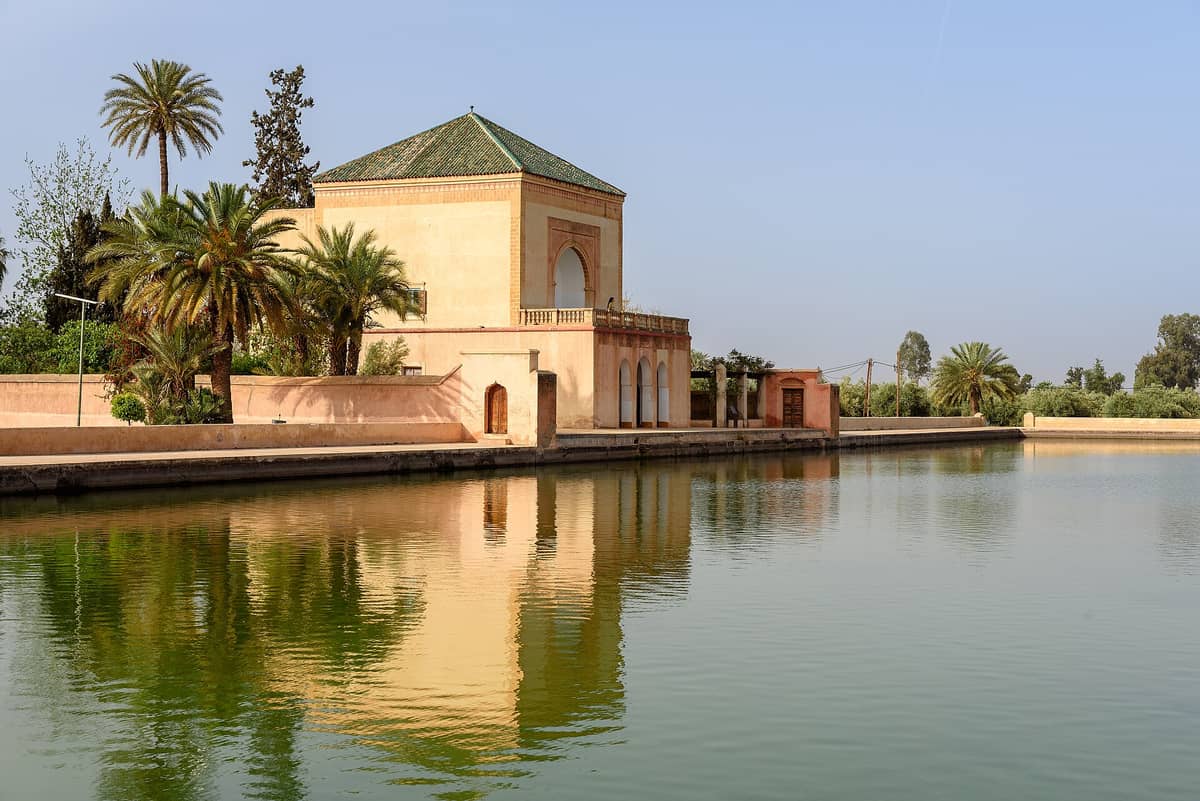
Unlike European palace gardens designed primarily for visual effect, the Agdal was conceived as a working orchard-reservoir system. An elaborate network of underground channels called khettaras fed water from the Atlas foothills into a series of large basins, the most prominent of which is the Sahraj el-Hana, a pool large enough that 19th-century sultans reputedly used it for rowing. The hydraulic engineering behind this system is, in many ways, the real attraction of the site, even if it takes some imagination to appreciate it while standing on a dusty path between olive rows.
The gardens were expanded and restored across multiple dynasties, including the Saadian period that also produced the Saadian Tombs and the grand ambitions behind El Badi Palace. UNESCO includes the Agdal within the Medina of Marrakesh World Heritage property, inscribed in 1985. The gardens are valued as a working example of Moroccan hydraulic orchard tradition rather than as a separate World Heritage listing.
Tickets & tours
Live prices and dates from our booking partner. If you book, we may earn a commission at no extra cost to you.
Anima Gardens and Ourika Valley day trip from Marrakech
From 95 €Instant confirmationFree cancellationSpa Treatment Experience with Lunch at a Riad from Marrakech
From 99 €Instant confirmationFree cancellationFull-day Trip in Ouzoud Waterfalls from Marrakech
From 18 €Instant confirmationFree cancellationCamel ride in Marrakech Palm Grove
From 15 €Instant confirmationFree cancellation
What a Visit Actually Looks and Feels Like
Arriving at the main entrance on a Friday or Sunday morning, you pass through an unremarkable gate in a section of the outer walls. There is no ticket booth and no queue. Within thirty seconds of entering, the noise of Marrakech's streets drops away almost completely. The first thing you notice is the smell: a faint sweetness from citrus blossoms in spring, or the drier, earthier scent of dust and warm bark in summer.
The landscape is predominantly flat and open. The dominant textures are rough tree bark, dry-packed earth, and the occasional stone lip of an irrigation channel. If you visit in late winter or early spring, orange and lemon trees will be in various stages of fruit and flower simultaneously. In summer, the heat between the rows is intense and shade pools under the canopy in narrow strips. The orchards are not densely planted in the way a forest feels; it is more like walking through a working farm that has been operating continuously for eight centuries.
The Sahraj el-Hana basin sits toward the interior. On calm mornings, the water surface reflects the sky and the surrounding trees with unusual clarity. A small pavilion stands at one edge. Local families sometimes picnic near the water on Friday afternoons, children running between the rows. There is a gentleness to those hours that contrasts sharply with the sensory pressure of the souks around a roughly thirty-minute walk north.
💡 Local tip
Morning visits (arriving close to 09:00) give you the gardens in cooler air and softer light before the midday heat sets in. In July and August, temperatures in the open orchard can exceed 38°C by early afternoon. Bring at least one litre of water — there are no vendors inside.
How the Experience Changes by Time and Season
Spring visits, roughly March through May, offer the most comfortable conditions. Daytime temperatures are typically in the low-to-mid 20s Celsius, the orchards may be in bloom, and the light is clear enough for good photography. The low, horizontal morning light filters through the olive canopy in a way that rewards patience with a camera.
Summer visits are feasible but demanding. The gardens offer almost no shade for long stretches of path, and the reflected heat from the pale ground is significant. If you visit in June through August, limit yourself to the first ninety minutes after opening. Autumn, September through November, brings more moderate temperatures and the satisfaction of seeing fruit on the trees.
Winter visits, particularly in December or January, have a particular spare quality. The light is softer, the trees are less full, and the gardens feel emptier. Marrakech in December is generally mild during the day but can be cool and overcast. The reflecting pools have a pewter quality on grey days that is worth seeing, if not warm.
Getting There and Practical Navigation
The most direct approach is by petit taxi from Jemaa el-Fna or anywhere in the medina. The ride takes roughly ten to fifteen minutes and should cost a modest fare by meter. Ask to be dropped at the Agdal entrance near the Routes des Remparts; drivers will know it. Walking from the medina is also straightforward: head south through the Kasbah area, past the outer walls of the Royal Palace compound, following the perimeter road. The walk itself passes sections of the city walls and gives useful context for the scale of the historic palace-garden complex.
The Kasbah-Mellah district immediately north of the gardens contains several other significant sites, including the Bahia Palace and the Mellah Jewish Quarter. Combining the Agdal with these on the same half-day is practical and avoids backtracking.
The terrain inside the gardens is largely unpaved: compacted earth paths, uneven ground near the irrigation channels, and some areas of loose gravel. Comfortable walking shoes are more important than any specific footwear style. Mobility aids may struggle on the more rural paths toward the interior, though the area close to the entrance is more even. There are no toilet facilities visible inside the public area, so plan accordingly before entering.
Photography and What to Focus On
The Agdal is one of the less-photographed major sites in Marrakech, partly because its visual appeal requires time and a wide-angle perspective. The classic shot is the Sahraj el-Hana pool in the morning, with the tree line reflected in still water. Get there early: by mid-morning, any breeze will break the surface reflection, and the light becomes flatter.
The irrigation channels and their stone edges make for strong compositional lines. The repetition of olive and fruit tree rows, receding toward the horizon in long parallel lines, rewards a longer focal length that compresses the depth. The pavilion at the pool edge is a useful anchor point for shots that need human scale. Do not expect the lush, saturated greens of more manicured gardens: the palette here is dusty grey-green, ochre, and rust, which suits film photography and desaturated edits particularly well.
Who Will Love This, and Who Will Not
The Agdal Gardens reward visitors who are comfortable with open, unstructured space and have genuine curiosity about agricultural history or Islamic garden design. It is a place for slow walking and looking, not for ticking off landmarks.
Travelers who find value in the grand scale of historic places, without needing interpretive panels or guided structure, will feel at home here. Those expecting the density and artistry of the Jardin Majorelle will be disappointed. The Agdal is more patient and more austere.
Visitors with limited mobility should be aware that the paths are uneven and the distances significant. Families with young children will find it works well on a cool morning: there is space to move, nothing delicate to accidentally disturb, and the pool is a natural focal point. However, in summer heat with restless children, the lack of shade, water sources, and facilities inside makes it a genuinely uncomfortable outing.
One practical caution: because the gardens are royal property, there is always a real possibility that you will arrive on a Friday or Sunday and find the gates closed. This happens without prior announcement. If the Agdal is the main reason for your morning, have a backup plan. The nearby Saadian Tombs or the Bahia Palace are both within a fifteen-minute walk and have predictable opening schedules.
Insider Tips
- Confirm access on the morning of your visit by asking at your riad or a local café near the Kasbah area. Locals and petit taxi drivers will often know whether the gardens are open that day before you travel.
- The reflecting pool (Sahraj el-Hana) is deep inside the gardens, not immediately visible from the entrance. Walk steadily inward for fifteen to twenty minutes rather than stopping short — the pool is the compositional and historical centrepiece of the site.
- Bring more water than you think you need. The open orchard on a warm day is significantly hotter than Marrakech's shaded medina streets, and there is nothing to buy inside.
- If you visit on a Friday, the rhythm of the day is shaped by Friday prayers at midday. Many local families enter the gardens in the afternoon after prayers, which changes the atmosphere considerably — quieter in the morning, more social by early afternoon.
- The outer perimeter road along the ramparts makes for a worthwhile walk in itself even if the gates happen to be closed. The scale of the enclosure walls gives a concrete sense of the garden's historic footprint.
Who Is Agdal Gardens For?
- History and architecture enthusiasts interested in Almohad and Islamic garden design
- Photographers seeking unhurried, uncrowded landscapes outside the usual Marrakech highlights
- Travelers who want a genuine contrast to the intensity of the souks and medina
- Families with young children, in cooler months when the open space and low visitor numbers work in your favour
- Anyone building a half-day itinerary in the Kasbah-Mellah district combining multiple nearby sites
Nearby Attractions
Other things to see while in Kasbah & Mellah:
- Bab Agnaou
Bab Agnaou is the most elaborately decorated of Marrakech's historic city gates, a 12th-century Almohad masterpiece carved from blue-grey Gueliz stone at the entrance to the royal Kasbah quarter. It costs nothing to visit, stands open around the clock, and rewards anyone with even a passing interest in Islamic architecture.
- Bahia Palace
Built for a Grand Vizier and expanded by his son, Bahia Palace is a sprawling 19th-century complex of roughly 160 rooms arranged around shaded courtyards and orange-tree gardens. It offers one of the most detailed windows into late Moroccan imperial craftsmanship anywhere in the medina.
- Dar Si Saïd – Museum of Moroccan Arts
A 19th-century palace a short walk from Bahia Palace, Dar Si Saïd served after 2018 as Morocco's National Museum of Weaving and Carpets. Confirm opening status before visiting: the historic building has been closed for repairs since the September 2023 Al Haouz earthquake.
- El Badi Palace
El Badi Palace is a vast 16th-century Saadian ruin in Marrakech's Kasbah district. What remains, stripped bare by a later sultan, is still monumental: sunken gardens, colossal walls, and a silence that the original opulence only hints at. This guide covers what to see, when to go, and how to get there.
Planning a trip? Discover personalized activities with the Nomado app.