Jardin Majorelle: The Blue Garden That Rewrote Marrakech's Story
Once a painter's private sanctuary, Jardin Majorelle is now one of Marrakech's most photographed gardens. Set on Rue Yves Saint Laurent in Marrakech's modern Gueliz area, it pairs electric-blue architecture with an extraordinary collection of cacti and subtropical plants — and a world-class museum of Berber culture at its centre.
Quick Facts
- Location
- Rue Yves Saint Laurent, Guéliz, Marrakech — about 3 km north of Jemaa el-Fna
- Getting There
- Petit taxi or local bus from central Marrakech; taxis drop off directly on Rue Yves Saint Laurent
- Time Needed
- 1.5 to 2.5 hours for garden + Berber Museum; allow extra if you visit the YSL Museum next door
- Cost
- Garden 170 MAD adults (international); Berber Museum supplement 60 MAD. Moroccan citizens and residents 75 MAD (garden); under-10s free. Students have reduced rates. Tickets are online-only with timed entry.
- Best for
- Architecture lovers, plant enthusiasts, fashion history fans, and anyone who appreciates deliberate, curated beauty
- Official website
- www.jardinmajorelle.com/en
What Jardin Majorelle Actually Is
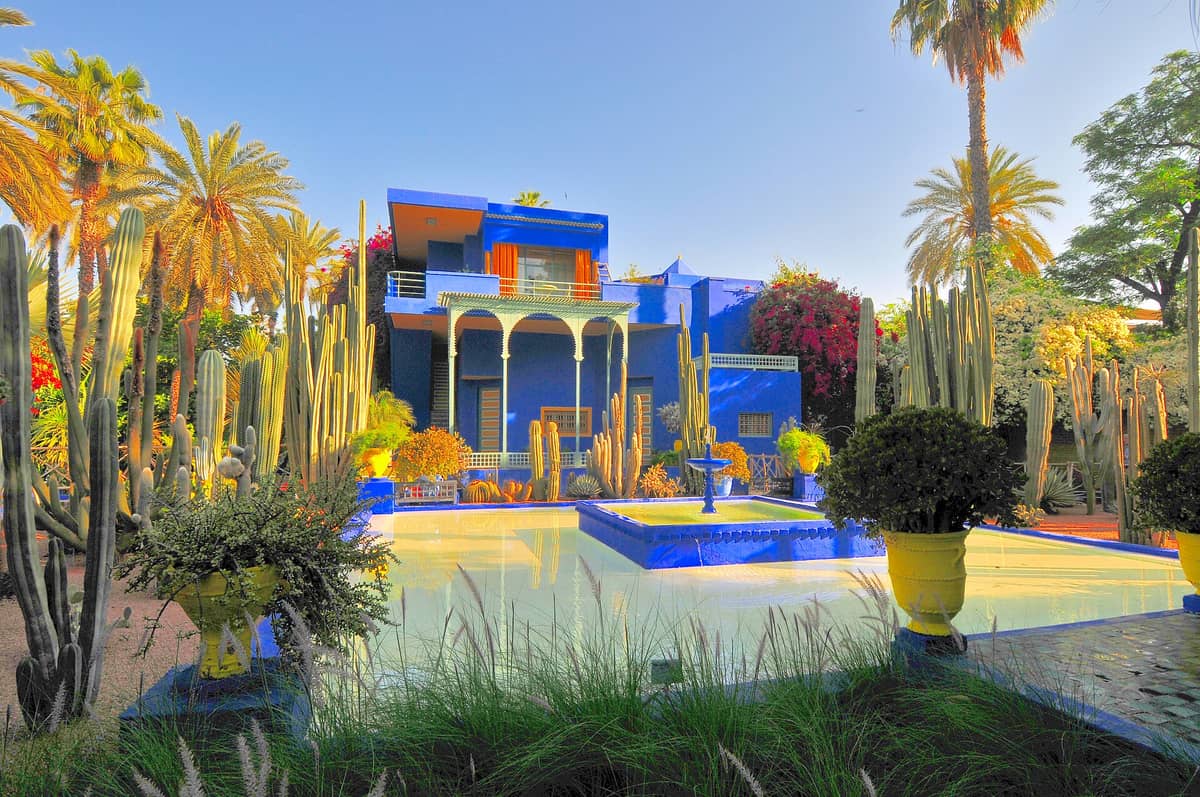
Jardin Majorelle is a 2.5-acre botanical garden in the Gueliz district of Marrakech, built around a vivid cobalt-blue villa that French painter Jacques Majorelle constructed as his studio in the 1920s. The particular shade of blue Majorelle used on his buildings — a deep, almost ultramarine tone now known internationally as Majorelle Blue — is the garden's visual signature, and it appears everywhere: on planters, pergolas, gates, and fountains, set against the ochre soil and the deep green of bamboo, palms, and towering cacti.
The garden fell into disrepair after Majorelle's death, and in 1980 it was purchased by fashion designer Yves Saint Laurent and his partner Pierre Bergé, who restored it and opened it to the public. When Saint Laurent died in 2008, his ashes were scattered in the rose garden of the adjacent Villa Oasis and a memorial pillar was placed within the garden. The site is now managed by the Fondation Jardin Majorelle and includes the Musée Pierre Bergé des Arts Berbères, a serious ethnographic collection, as well as a separate Yves Saint Laurent Museum on the adjacent property.
⚠️ What to skip
Tickets are sold exclusively online with timed entry via tickets.jardinmajorelle.com. There is no on-site ticket desk. Book before you arrive — popular time slots sell out several days in advance, especially on weekends and during spring and autumn.
The Visual Experience: What You Are Walking Into
The garden is small enough to cross in fifteen minutes, but almost nobody does. The plantings are extraordinarily dense: hundreds of plant species from several continents, with an entire section devoted to cacti and succulents that have grown to the scale of trees. In spring, bougainvillea spills over the blue walls in bursts of purple and pink that create an almost theatrical contrast.
The central pool reflects the blue pavilion and the overhanging palms. Terracotta pots — some as tall as your waist — are arranged along gravel paths that crunch underfoot. The sound of water is constant: channels and fountains run throughout the garden, and that trickling acoustic layer is part of why the place feels so calm despite the number of visitors. There are yellow pond lilies on the still-water sections and darting flashes of what appear to be large goldfish below the surface.
Photography here works unusually well. The high walls block the surrounding city entirely, which means clean compositions without visual noise. Morning light falls across the blue architecture in a way that saturates the colour rather than bleaching it. The most photographed angle — the cobalt blue pavilion reflected in the central pool — is also the most crowded. If you want it without people, arrive at opening time (8:00 a.m.) on a weekday.
Tickets & tours
Live prices and dates from our booking partner. If you book, we may earn a commission at no extra cost to you.
Full day tour of Ouarzazate from Marrakech
From 51 €Instant confirmationFree cancellationEvening Quad Bike at Palmeraie Area with Tea Tasting from Marrakech
From 49 €Instant confirmationFree cancellationFull Day Economic Tour in Essaouira from Marrakech
From 29 €Instant confirmationFree cancellationFull Day Economic Tour of Ourika Valley from Marrakech
From 25 €Instant confirmationFree cancellation
How the Experience Changes by Time of Day
Early morning, roughly 8:00 to 10:00 a.m., is the quietest window. The air is cooler, the light is directional and golden, and the paths are not yet crowded. The birds are active in this period — Marrakech's resident bulbuls and swifts are audible above the garden's walls. This is the time serious photographers arrive.
By late morning and midday, particularly between 10:30 a.m. and 2:00 p.m., visitor numbers are at their peak. The garden's enclosed walls mean the temperature inside can feel noticeably higher than the street, and in summer that heat becomes significant. There is limited shade on the main central axis around the pool.
Late afternoon, from around 4:00 p.m. onward, brings softer light and a second lull in visitor numbers as tour groups clear out. The last entry is at 6:00 p.m. and the garden closes at 6:30 p.m., so arriving at 4:30 p.m. gives you roughly two hours with noticeably fewer crowds. The blue deepens in late afternoon shadow in a way the midday sun does not produce.
💡 Local tip
In summer (June to August), temperatures inside the garden regularly exceed 35°C by midday. Wear light, breathable clothing, bring water, and consider the early morning slot. There is a café on-site but it is often crowded at peak hours.
The Musée Berbère: The Part Most Visitors Rush Past
The Berber Museum is housed in the original Majorelle studio building inside the garden. It requires a separate 60 MAD supplement on the official ticket (garden admission alone does not include it). The collection contains more than 600 objects: Berber jewellery, ceremonial textiles, musical instruments, leather goods, and carved wooden pieces, most of them sourced from across Morocco's rural regions by Yves Saint Laurent and Pierre Bergé over decades. The curation is thoughtful and the labelling is in French, Arabic, and English.
The building itself is striking inside: the same deep blue walls, tiled floors, and wooden beamed ceilings that Majorelle designed. It is air-conditioned, which makes it a practical refuge during a hot midday visit. If you have already visited the Ben Youssef Madrasa or the Dar Si Said Museum, the Berber Museum here adds a distinct contemporary-curatorial perspective that complements those older institutions.
Historical Context: Jacques Majorelle and What He Built
Jacques Majorelle was a French Orientalist painter who first came to Marrakech in 1919 and was so captivated by Morocco's light and landscape that he settled permanently. Over a period of roughly four decades, he transformed the garden from bare land into a botanical estate, importing plants from across South America, Asia, and Africa. He popularised the cobalt blue that now carries his name after applying it to every architectural surface he built. The villa, the pergolas, the planters, the fountains — all were painted in this particular shade as a kind of unified artistic statement about how colour and architecture could interact with plant life.
After Majorelle's death in 1962, the property deteriorated over nearly two decades. The rescue by Saint Laurent and Bergé in 1980 was not just preservation — it was an active restoration that introduced new plant species, rebuilt collapsed structures, and eventually opened the garden to the public. Saint Laurent credited Marrakech and this garden specifically with a creative influence on his work throughout his career.
For those interested in the fashion history angle, the Yves Saint Laurent Museum sits directly adjacent to the garden entrance on Rue Yves Saint Laurent. It has a separate ticket and covers his career in detail. The two attractions work well as a half-day together. For broader reading on how this history fits into Marrakech's modern cultural landscape, see the YSL Marrakech guide.
Getting There and Practical Logistics
The garden is on Rue Yves Saint Laurent in Gueliz, Marrakech's modern district, about 3 kilometres from Jemaa el-Fna. A petit taxi from the medina takes roughly 10–15 minutes and costs around 20 to 30 MAD, depending on traffic and negotiation. The ride-hailing apps Careem and inDrive are also available and give fixed prices, which removes the bargaining step. There is no dedicated on-site parking for private cars at the gate; those arriving by car typically park on nearby side streets.
The Gueliz district surrounds the garden with good cafés and restaurants for before or after your visit. The neighbourhood has a noticeably different character from the medina: wider streets, a more relaxed pace, French-influenced architecture from the colonial period. If you are staying in the area, the Gueliz neighbourhood guide has practical suggestions for the area.
Opening hours are daily 8:00 a.m. to 6:30 p.m., with last entry at 6:00 p.m. The garden operates year-round, though hours may shift during major public holidays or Ramadan — check the official site before visiting. Adult garden admission for international visitors is 170 MAD; the Berber Museum is an additional 60 MAD on the official ticket. Children under 10 enter free when accompanied by an adult. Persons with a disability card also enter free. Moroccan nationals and residents pay 75 MAD (garden) with ID.
ℹ️ Good to know
All tickets must be booked online in advance at the official website. Timed-entry slots are enforced via QR code scanning at the gate. If your slot is for 10:00 a.m., you enter at 10:00 a.m. — arriving early does not get you in sooner, and late arrivals may be turned away if the slot has passed, especially at peak times.
Is It Worth It?
At 170 MAD for the garden (230 MAD if you add the Berber Museum), Jardin Majorelle is among the pricier attractions in Marrakech, and it is small enough that some visitors feel it is over too quickly. That reaction is usually from people who skipped the museum or arrived at peak hours and found the garden uncomfortable with crowds. On an early-morning weekday visit, with proper time allocated to both, it is one of the most considered and photogenic hours you can spend in the city.
The garden does not reward rushing. It rewards slow movement, noticing the plant labels, sitting near the pool, and spending real time inside the museum. Visitors who treat it as a quick photo stop and then leave tend to feel it was not worth the price. Visitors who allocate two proper hours usually find it one of the highlights of their trip.
If you are building a wider Marrakech itinerary, the garden fits naturally into a Gueliz-centred day that might include the YSL Museum in the morning and lunch in Gueliz before heading back toward the medina in the afternoon. For a full trip framework, the 3-day Marrakech itinerary places the garden in useful context with the rest of the city's major sites.
Who Should Consider Skipping It
If you are visiting Marrakech primarily for the medina experience — the souks, the historic architecture, the food scene — and you are pressed for time, Jardin Majorelle requires a separate journey into Gueliz that can consume half a morning including travel. Travelers with limited mobility should note that the pathways include gravel surfaces and some uneven terrain. The official site states that the garden and museums are accessible to disabled visitors, but not every path is equally easy with a wheelchair. Those who find formal garden spaces frustrating will not be won over here; this is a curated, managed environment, not wild nature. And anyone who cannot book online in advance will simply not be able to enter, as there is no walk-in option.
Insider Tips
- The 8:00 a.m. opening slot sells out fastest. Book it at least several days in advance for weekends, or about a week ahead during spring and autumn peak season. The 4:30 p.m. slot is typically easier to secure and gives softer light.
- The Berber Museum is a separate 60 MAD supplement on the official ticket site, not included in garden admission. If you are already inside, it is worth the extra cost — budget at least 40 minutes; the jewellery and textile sections in particular repay slow looking.
- The garden's walls block all street noise and city views, which means your photos will look as if Marrakech does not exist around you. That clean visual isolation is part of what makes composition straightforward even for non-photographers.
- The on-site café is pleasant but slow when crowded. If you want coffee after your visit, walk two minutes to any of the cafés on Avenue Mohammed V in Gueliz — they are faster and cheaper.
- Gueliz itself is worth an hour of exploration before or after the garden. The neighbourhood has good patisseries, contemporary galleries, and a different architectural character to the medina. It is one of the least-touristed but most liveable parts of Marrakech.
Who Is Jardin Majorelle For?
- Architecture and design enthusiasts drawn to the interplay of colour, form, and planting
- Photographers who want clean, controlled compositions in warm morning light
- Fans of Yves Saint Laurent and the broader story of European creative figures in Marrakech
- Travelers who want to explore Moroccan Berber material culture through a serious museum collection
- Visitors who need a calm, enclosed break from the sensory intensity of the medina
Nearby Attractions
Other things to see while in Gueliz (Ville Nouvelle):
- MACMA – Musée d'Art et de Culture de Marrakech
Founded in 2016 by private collector Nabil El Mallouki, MACMA is one of Marrakech's most coherent art museums, presenting orientalist works, early photography and contemporary Moroccan painting in a quiet courtyard setting in Gueliz. It offers a genuine counterpoint to the city's more touristic attractions.
- Berber Museum (Musée Berbère)
Housed in the iconic Blue Villa inside Jardin Majorelle, the Pierre Bergé Museum of Berber Arts presents one of Morocco's most carefully curated collections of Amazigh jewelry, textiles, and ceremonial objects. Small in scale but dense in meaning, it rewards visitors who take time to look closely.
- Marrakech Railway Station
Marrakech Railway Station (Gare de Marrakech) is the southern terminus of Morocco's national rail network, sitting in the modern Gueliz district about 3.5 km from the medina. This guide covers everything travelers need: how to reach it, what to expect inside, which trains run where, and the practical details that make the difference between a smooth departure and a stressful one.
- Église des Saints-Martyrs
Catholic worship in Marrakech centres on a quiet parish in Gueliz, the city’s modern French-influenced district. The church most visitors actually find is Église des Saints-Martyrs; Notre-Dame de Lourdes is a separate landmark in Casablanca. The Gueliz parish offers a calm, architecturally modest space and a window into Morocco’s layered religious history.
Planning a trip? Discover personalized activities with the Nomado app.