Musée Yves Saint Laurent Marrakech: Fashion, Architecture, and a City's Unlikely Muse
Opened in October 2017, the musée Yves Saint Laurent Marrakech is a purpose-built fashion and design museum in the Gueliz district, adjacent to Jardin Majorelle. It traces the designer's career from the late 1950s onward through rotating couture exhibitions, permanent collections, and a research library, all housed inside one of Marrakech's most striking contemporary buildings.
Quick Facts
- Location
- Rue Yves Saint Laurent, Gueliz, Marrakech 40000, Morocco
- Getting There
- 10–15 min by petit taxi from Jemaa el-Fna; walkable from central Gueliz
- Time Needed
- 1.5 to 2.5 hours
- Cost
- Approx. 135 MAD (foreign visitors); free under 10. Buy online at tickets.jardinmajorelle.com. Prices subject to change.
- Best for
- Fashion enthusiasts, architecture lovers, anyone needing a quiet, air-conditioned reprieve from the medina
- Official website
- www.museeyslmarrakech.com
What the Musée YSL Marrakech Actually Is
The musée Yves Saint Laurent Marrakech is not a tourist attraction that trades on nostalgia or a designer's name alone. It is a serious fashion museum, purpose-built in the Gueliz district, and opened in October 2017, weeks after the equally dedicated musée YSL Paris. The two museums were conceived in parallel by the Pierre Bergé – Yves Saint Laurent Foundation, and the Marrakech site carries specific weight: this was the city that inspired Saint Laurent most deeply, and that influence runs through much of the permanent collection.
The museum sits directly adjacent to Jardin Majorelle, the garden that Saint Laurent and his partner Pierre Bergé purchased in 1980 and saved from planned demolition. Together, the two sites form a coherent half-day itinerary for anyone interested in how Marrakech shaped one of the twentieth century's defining couturiers. If you're planning a broader cultural day, the YSL Marrakech guide covers both sites in detail.
💡 Local tip
Buy tickets online at tickets.jardinmajorelle.com before you arrive. Time slots do fill up, particularly on busy mornings and weekend afternoons.
The Building: Architecture as a First Statement
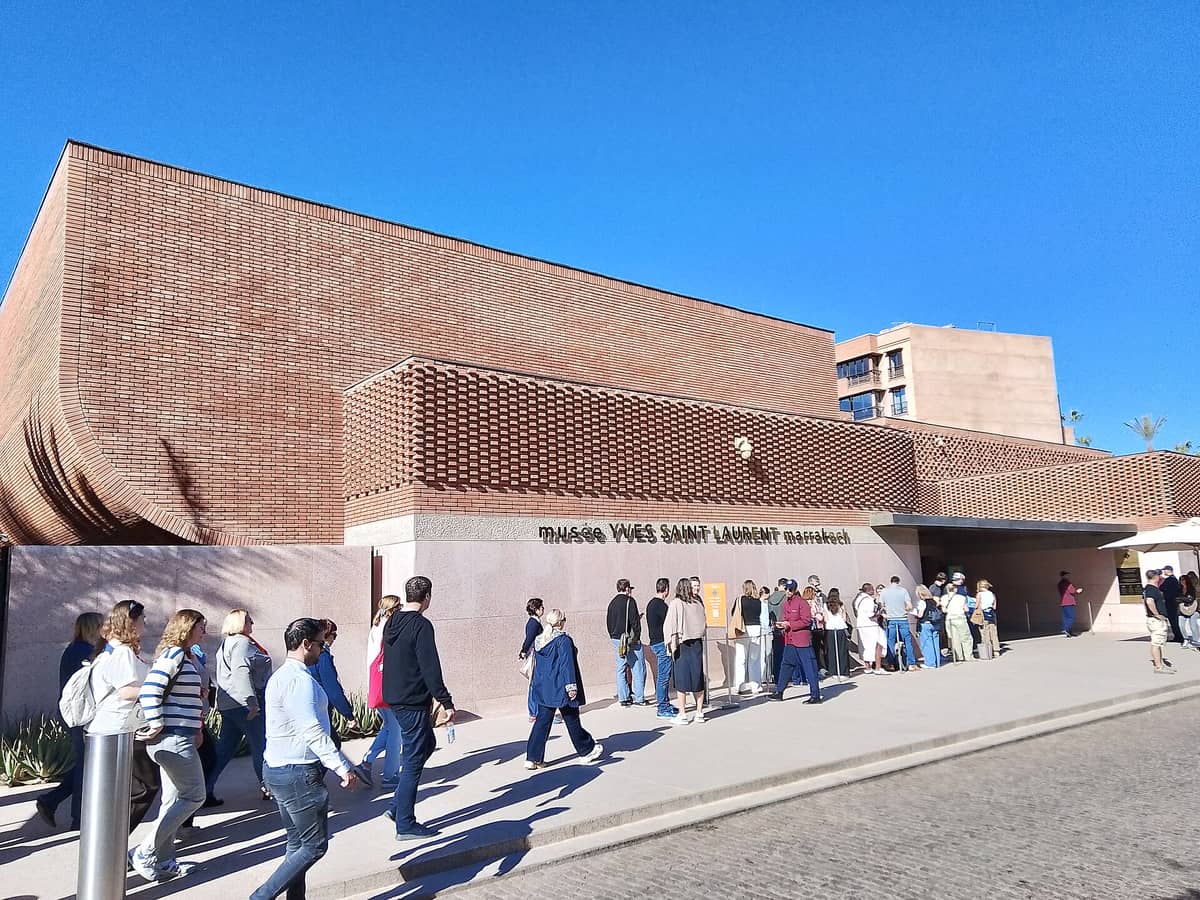
The first thing most visitors notice is the exterior. Designed by Parisian studio Studio KO, the building is clad in terracotta-coloured brickwork laid in an interlocking lattice pattern that references traditional Moroccan zellij tilework and mashrabiya screens without imitating either. The geometry is precise and modern; the material palette, warm sand and rust tones, anchors it firmly in its Marrakech context. It does not try to blend into the surrounding Gueliz streetscape so much as punctuate it.
Inside, the architecture shifts register. The entry hall is tall and spare, with controlled natural light filtering through narrow apertures. The transition from the warm outdoor light of a Marrakech afternoon into the cooler, dimmer interior takes a moment to adjust to, and it is clearly intentional: the building is managing your attention before the exhibitions do. Exhibition rooms use low, precisely calibrated lighting to protect fragile textiles, which makes photography difficult but preserves the integrity of pieces that in some cases are decades old.
Tickets & tours
Live prices and dates from our booking partner. If you book, we may earn a commission at no extra cost to you.
Full day tour of Ouarzazate from Marrakech
From 51 €Instant confirmationFree cancellationEvening Quad Bike at Palmeraie Area with Tea Tasting from Marrakech
From 49 €Instant confirmationFree cancellationFull Day Economic Tour in Essaouira from Marrakech
From 29 €Instant confirmationFree cancellationFull Day Economic Tour of Ourika Valley from Marrakech
From 25 €Instant confirmationFree cancellation
The Permanent Collection: Six Decades of Couture
The permanent galleries occupy the heart of the building and present rotating selections from the foundation's archive, which spans Saint Laurent's entire career from his earliest work at Dior in the late 1950s through the decades that defined his own house. Pieces are displayed on mannequins in dimly lit cases, with contextual information in French, Arabic, and English. The curation is deliberately restrained: you see fewer pieces than you might expect, but each one is given real space.
What the collection communicates clearly is the degree to which Moroccan colour, geometry, and textile tradition fed Saint Laurent's visual vocabulary. The deep cobalts and dusty golds of the kaftans he collected, the graphic geometry of Atlas Berber weaving, the sequined excess of the djellaba: these references appear repeatedly across decades of work. Visitors with no particular interest in fashion often find this cross-cultural dimension the most engaging aspect of the visit.
The museum also houses a research library and auditorium, used for public programming and lectures. If you want to go deeper into the cultural context, pair the visit with the nearby Berber Museum inside Jardin Majorelle, which maps the Amazigh textile and jewelry traditions that so clearly influenced Saint Laurent's palette.
How the Visit Changes by Time of Day
The museum opens at 10:00 and the first hour is consistently the quietest. Groups from riad hotels in the medina tend to arrive after 11:00, and the late morning through early afternoon (roughly 11:30 to 14:00) is when the entrance area and gift shop feel crowded, though the galleries themselves rarely reach the threshold where the experience degrades. The building's layout disperses visitors across multiple levels effectively.
Late afternoon visits, from around 15:30 onward, strike a balance: the early afternoon heat makes outdoor attractions uncomfortable, which means more people retreat indoors, but by 15:30 the post-lunch tour groups have largely moved on. Last entry is at 18:00; the museum closes at 18:30. The museum is closed on Wednesdays.
⚠️ What to skip
The museum is closed every Wednesday. This catches a significant number of visitors off guard. If your Marrakech itinerary is only two or three days and one of them falls on a Wednesday, plan Jardin Majorelle as a standalone visit and schedule the museum on another day.
Practical Walkthrough: Getting There and Getting In
The museum is located in Gueliz, Marrakech's modern ville nouvelle district, about 2.5 km northwest of Jemaa el-Fna. A petit taxi from the medina takes 10 to 15 minutes and costs roughly 20–30 MAD depending on traffic and negotiation. Uber does not operate in Marrakech; Careem and inDrive are available as app-based alternatives with fixed pricing, though availability should be confirmed before your trip as regulations in Morocco can change.
If you're staying in Gueliz, the museum is walkable from Avenue Mohammed V, Marrakech's main commercial spine. The walk is short on a flat, paved route. In summer, the midday heat on this stretch is serious, so take water and wear a hat.
Admission fees for foreign visitors are approximately 135 MAD for the museum alone (rates are subject to change; always verify at tickets.jardinmajorelle.com before visiting). A combined ticket covering the museum, Jardin Majorelle, and the Berber Museum is available at a higher price point and represents good value if you intend to visit all three. Children under 10 enter free. The museum is wheelchair accessible, with accessible parking and restrooms.
ℹ️ Good to know
Photography is permitted in parts of the museum but restricted in the couture galleries to protect the garments from light exposure. Staff enforce this consistently. Leave the tripod at the riad.
Who This Museum Is and Is Not For
The musée YSL Marrakech rewards patience and a degree of prior interest, whether in fashion, design, or the cultural exchange between France and Morocco. Visitors who arrive with context, even a basic awareness of Saint Laurent's career, will get considerably more from the visit than those who arrive cold. The museum's companion guide, available at the front desk, and the Marrakech museums guide provide useful background.
Visitors expecting an immersive or interactive experience may find the format austere. There are no reconstructed ateliers, no audio-visual spectacles, no touch screens. The museum is quiet, scholarly in tone, and deliberately so. Children under about 10 years old are unlikely to find much to hold their attention, though the architecture and the bookshop often surprise.
For travelers on a tight schedule who have to choose between this and Jardin Majorelle, the garden offers a more immediate sensory experience accessible to a wider range of visitors. The museum is the stronger choice for anyone with a genuine interest in design, fashion history, or the relationship between creative work and place.
The Gift Shop and On-Site Cafe
The bookshop at the exit is worth time. It carries a well-curated selection of fashion and design monographs, art books focused on North Africa and Morocco, and a small range of museum-edition objects. The quality is high and the selection is not replicated elsewhere in Marrakech. Prices are in line with European museum shops.
There is a cafe on-site that serves coffee, mint tea, and light snacks in a shaded courtyard setting. It is a reasonable place to decompress after the galleries before heading next door to Jardin Majorelle or making your way back toward the medina. For a broader overview of what to combine with this visit, the things to do in Marrakech guide includes this area's full range of options.
Insider Tips
- Book the first entry slot at 10:00 on a Tuesday or Thursday. These are consistently the quietest mornings, and you'll have the permanent galleries largely to yourself for the first 30 minutes.
- The combined ticket with Jardin Majorelle is worth purchasing if you plan to visit both on the same day, which most visitors do. Start with the museum when you're fresh and the light is cooler, then move into the garden.
- The research library inside the museum is open to students and researchers by appointment. If you have a serious academic interest in the archive, contact the foundation in advance rather than assuming walk-in access.
- The museum's exterior walls photograph best in the late afternoon when the sun catches the brick lattice and throws geometric shadows. Allow five minutes outside before entering, or after exiting around 16:00.
- If you're visiting during Ramadan, confirm hours on the official site the day before your visit. Reduced hours combined with adjusted city rhythms can affect taxi availability in the late afternoon.
Who Is Musée Yves Saint Laurent Marrakech For?
- Fashion and textile enthusiasts with an interest in couture history
- Architecture and design travelers curious about contemporary Moroccan building
- Visitors wanting a calm, air-conditioned cultural experience outside the medina
- Travelers combining a Gueliz half-day with Jardin Majorelle and the Berber Museum
- Anyone interested in the cross-cultural exchange between France and Morocco in the twentieth century
Nearby Attractions
Other things to see while in Gueliz (Ville Nouvelle):
- Jardin Majorelle
Once a painter's private sanctuary, Jardin Majorelle is now one of Marrakech's most photographed gardens. Set on Rue Yves Saint Laurent in Marrakech's modern Gueliz area, it pairs electric-blue architecture with an extraordinary collection of cacti and subtropical plants — and a world-class museum of Berber culture at its centre.
- MACMA – Musée d'Art et de Culture de Marrakech
Founded in 2016 by private collector Nabil El Mallouki, MACMA is one of Marrakech's most coherent art museums, presenting orientalist works, early photography and contemporary Moroccan painting in a quiet courtyard setting in Gueliz. It offers a genuine counterpoint to the city's more touristic attractions.
- Berber Museum (Musée Berbère)
Housed in the iconic Blue Villa inside Jardin Majorelle, the Pierre Bergé Museum of Berber Arts presents one of Morocco's most carefully curated collections of Amazigh jewelry, textiles, and ceremonial objects. Small in scale but dense in meaning, it rewards visitors who take time to look closely.
- Marrakech Railway Station
Marrakech Railway Station (Gare de Marrakech) is the southern terminus of Morocco's national rail network, sitting in the modern Gueliz district about 3.5 km from the medina. This guide covers everything travelers need: how to reach it, what to expect inside, which trains run where, and the practical details that make the difference between a smooth departure and a stressful one.
Planning a trip? Discover personalized activities with the Nomado app.