Église des Saints-Martyrs: Marrakech's Catholic Parish in Gueliz
Catholic worship in Marrakech centres on a quiet parish in Gueliz, the city’s modern French-influenced district. The church most visitors actually find is Église des Saints-Martyrs; Notre-Dame de Lourdes is a separate landmark in Casablanca. The Gueliz parish offers a calm, architecturally modest space and a window into Morocco’s layered religious history.
Quick Facts
- Location
- Église des Saints-Martyrs, Rue El Imam Ali, Gueliz, Marrakech (outside the medina walls)
- Getting There
- Petit taxi or city bus to Gueliz; ask for Église des Saints-Martyrs on Rue El Imam Ali. If a map shows Notre-Dame de Lourdes, confirm the pin is in Marrakech, not Casablanca
- Time Needed
- 20 to 45 minutes for a quiet visit; longer if attending a service
- Cost
- Free entry (typical for active parish churches); confirm on arrival as fees may apply for guided visits or special events
- Best for
- Architecture curiosity, interfaith reflection, quiet contrast to the medina's intensity
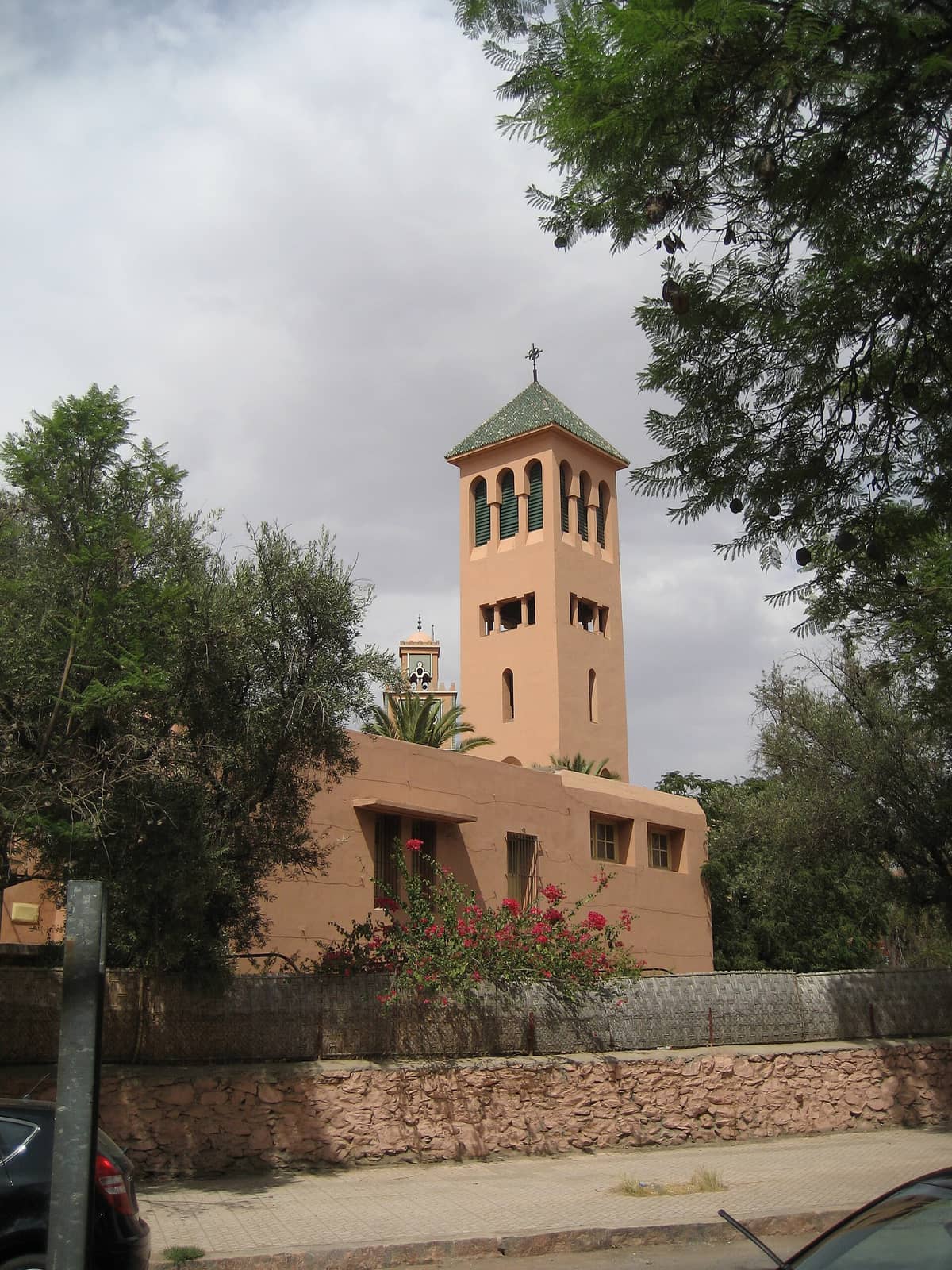
What Is Notre Dame de Lourdes Church in Marrakech?
Notre Dame de Lourdes listings for Marrakech usually point visitors to Gueliz, the city’s modern district. The Catholic parish church there is Église des Saints-Martyrs (Holy Martyrs Church) on Rue El Imam Ali, built in 1928 and consecrated in 1929; parish sources describe it as the only church in the region. Notre-Dame de Lourdes is a different, well-documented church in Casablanca. Morocco’s small Catholic community is a long-established minority in a country where Islam is the state religion.
A practical note before you go: Notre-Dame de Lourdes is a modernist 1950s church in Casablanca, not Marrakech. The Catholic parish in Gueliz is Église des Saints-Martyrs (Holy Martyrs Church), Rue El Imam Ali. What follows describes visiting that Gueliz parish; treat any map pin labelled Notre-Dame de Lourdes in Marrakech as a naming error unless it lands on Saints-Martyrs.
⚠️ What to skip
Ask for Église des Saints-Martyrs (or l'église catholique) in Gueliz, on Rue El Imam Ali. If a maps app returns Notre-Dame de Lourdes, check that the pin is in Marrakech, not Casablanca — that name belongs to a different church.
Gueliz: The District That Makes This Church Possible
To understand why a Catholic church exists in Marrakech at all, you need to understand Gueliz. This district was developed during the French Protectorate period (1912 to 1956) as a planned 'ville nouvelle' — a modern European-style town built alongside, but deliberately separate from, the historic medina. French colonial planners laid out wide boulevards, introduced municipal buildings, schools, cafés, and churches. The result is a district that still carries that architectural DNA: broad tree-lined avenues, art deco and mid-century facades, and a rhythm that feels distinctly different from the labyrinthine medina to the east.
Catholic churches like Notre Dame de Lourdes were built to serve the French and European settler population of that era. After Moroccan independence in 1956, most of that community left, but the parishes remained open, now serving a mix of African migrant workers, expatriates, Western tourists, and a small permanent Catholic community. Walking into this church today means stepping into a space that quietly holds that entire history.
Tickets & tours
Live prices and dates from our booking partner. If you book, we may earn a commission at no extra cost to you.
Full day tour of Ouarzazate from Marrakech
From 51 €Instant confirmationFree cancellationEvening Quad Bike at Palmeraie Area with Tea Tasting from Marrakech
From 49 €Instant confirmationFree cancellationFull Day Economic Tour in Essaouira from Marrakech
From 29 €Instant confirmationFree cancellationFull Day Economic Tour of Ourika Valley from Marrakech
From 25 €Instant confirmationFree cancellation
What to Expect When You Arrive
The church sits in a Gueliz streetscape where you might pass a patisserie, a pharmacy, and a café within the same block. From the outside, it presents a European ecclesiastical facade in a North African urban context, a combination that rewards a second look. The surrounding neighborhood moves at a different pace than the medina: cars, office workers at lunch, students. The contrast sharpens once you step inside.
Inside, the atmosphere is cool and quiet, particularly noticeable after Gueliz's midday heat. Stone or tiled floors, the faint smell of candle wax, filtered light through the windows: these are the sensory markers of a working parish, not a museum. The church is active, meaning it holds regular services, and the interior reflects ongoing use rather than preservation for tourism. Chairs or pews, devotional objects, and notice boards with schedules in French are typical of what you would find.
💡 Local tip
If you visit during a Sunday morning Mass, expect the church to be in active use by the congregation. Non-Catholic visitors are generally welcome to observe respectfully, but this is a place of worship first. Dress modestly, speak softly, and avoid photography during services.
Time of Day and When to Visit
The most peaceful time to visit is on a weekday morning, roughly between opening and midday. At this hour the church is likely to have only a handful of visitors or worshippers, and the light entering the windows is at its softest. Midday in Marrakech brings heat and the city's commercial rush, but inside the church the temperature stays comparatively mild. Afternoon visits are possible but the combination of heat outside and potentially louder street activity makes the morning window preferable.
Directory listings for Notre Dame of Lourdes churches in Morocco generally suggest daily opening from around 08:30 to 19:00, but these figures come from sources that primarily describe the Casablanca church. Hours in Marrakech may differ, and service schedules add another variable. The safest approach: arrive before 17:00 on a weekday and check the notice board at the entrance for the current schedule. Avoid arriving during the Saturday evening or Sunday morning Mass unless you intend to attend.
Historical and Cultural Context
Morocco has a small but historically continuous Christian presence, distinct from the much larger Muslim majority. The Catholic Church in Morocco operates under a special framework negotiated after independence, allowing parishes to function and serve the resident Christian community. In Marrakech, this community includes Sub-Saharan African migrants and residents, a significant portion of the congregation in many Moroccan urban parishes today. Visiting the church on a Sunday morning means encountering this community directly — which is itself an insight into contemporary Moroccan urban life that most visitors to Jemaa el-Fna or the souks never see.
The broader context of religious architecture in Marrakech is dominated by Islamic monuments: the Koutoubia Mosque, the Ben Youssef Madrasa, the mosques woven through every quarter of the medina. A Catholic church in this city is, architecturally and spiritually, a counterpoint. It does not compete with those spaces for grandeur, but it adds a layer of complexity to any reading of the city's character.
For travelers interested in Marrakech's full architectural and cultural range, the church fits into a broader itinerary that might include the Mellah Jewish Quarter and the Synagogue Slat Al-Azama — places that together reflect how multiple religious communities have coexisted in this city over centuries.
Practical Walkthrough: Getting There and What to Bring
Notre Dame de Lourdes Church is located in Gueliz, Marrakech's new town, which lies roughly 20 to 30 minutes on foot from the main medina gate at Bab Doukkala, or about 10 minutes by petit taxi from Jemaa el-Fna square. Petit taxis are the most practical option: flag one in the medina or on any main Gueliz boulevard, state the name of the church or the surrounding street, and confirm the fare before departing. City buses also serve Gueliz from multiple medina stops.
The Catholic parish in Gueliz is Église des Saints-Martyrs, on Rue El Imam Ali. If a mapping app shows Notre-Dame de Lourdes, confirm the pin is in Marrakech, not Casablanca, before you set out.
Dress modestly: covered shoulders and knees are appropriate for entering any house of worship in Morocco, regardless of religious tradition. A light scarf or layer is useful even in summer, both for this reason and because the interior can feel cool after the street heat. Entry is free. Photography inside is a matter of courtesy and discretion: avoid it during services and ask permission if others are present.
ℹ️ Good to know
Accessibility details for this specific church in Marrakech are not documented in available sources. Visitors with mobility requirements should contact the parish in advance or send someone ahead to check entrance conditions, as mid-century church buildings vary considerably in step heights and floor surfaces.
Is It Worth Your Time?
Notre Dame de Lourdes Church is not a major tourist attraction in the conventional sense. It lacks the visual spectacle of the Ben Youssef Madrasa or the garden drama of the Jardin Majorelle. There are no guided tours, no ticket desks, no gift shops. If you are working through a standard Marrakech highlights list on a short trip, this church will not be on it.
What it offers instead is specificity: a quiet, genuine glimpse into the minority religious life of a predominantly Muslim city, a piece of French Protectorate urban history, and a few minutes of genuine calm in a city that rarely stops moving. For travelers who read cities as layered documents rather than collections of photo opportunities, that is worth the small detour from the main Gueliz thoroughfare.
Travelers who want constant stimulation, who are short on time, or whose primary interest is Islamic architecture and medina culture will find their time better spent elsewhere. This is not a criticism of the church. It is an honest match of visitor expectations to what the place delivers.
Insider Tips
- Combine a visit with a broader Gueliz morning: the church pairs well with a walk along Avenue Mohammed V, a stop at a French-style patisserie, and a browse through the area's independent shops. The contrast between Gueliz's colonial-era urban planning and the medina is most visible when you do both in the same half-day.
- Sunday morning Mass typically draws the largest congregation, including many African residents of Marrakech. If you want to see the church in active community use rather than empty silence, this is the time — but treat it as an invitation to observe respectfully, not a tourist experience.
- The church notice board near the entrance usually lists current Mass times in French and sometimes other languages. This is the most reliable on-site source for current schedules, more accurate than any online listing.
- If you are traveling during Ramadan, note that Marrakech's non-Muslim religious sites often see less foot traffic than usual, and the atmosphere in Gueliz shifts noticeably. The church itself continues its regular schedule regardless of the Islamic calendar.
- Marrakech's heat makes interior spaces valuable in summer. Even if the church itself is not a primary draw, it provides a genuine cool respite between other Gueliz errands — and the quietness is a real counterpoint to the surrounding streets.
Who Is Église des Saints-Martyrs For?
- Architecture and urban history enthusiasts interested in the French Protectorate legacy in Morocco
- Travelers exploring interfaith Marrakech alongside the Mellah and its synagogue
- Catholic visitors wanting to attend Mass or a moment of devotion during their trip
- Anyone seeking genuine quiet and calm away from the medina's pace
- Slow travelers building a textured itinerary rather than a highlights checklist
Nearby Attractions
Other things to see while in Gueliz (Ville Nouvelle):
- Jardin Majorelle
Once a painter's private sanctuary, Jardin Majorelle is now one of Marrakech's most photographed gardens. Set on Rue Yves Saint Laurent in Marrakech's modern Gueliz area, it pairs electric-blue architecture with an extraordinary collection of cacti and subtropical plants — and a world-class museum of Berber culture at its centre.
- MACMA – Musée d'Art et de Culture de Marrakech
Founded in 2016 by private collector Nabil El Mallouki, MACMA is one of Marrakech's most coherent art museums, presenting orientalist works, early photography and contemporary Moroccan painting in a quiet courtyard setting in Gueliz. It offers a genuine counterpoint to the city's more touristic attractions.
- Berber Museum (Musée Berbère)
Housed in the iconic Blue Villa inside Jardin Majorelle, the Pierre Bergé Museum of Berber Arts presents one of Morocco's most carefully curated collections of Amazigh jewelry, textiles, and ceremonial objects. Small in scale but dense in meaning, it rewards visitors who take time to look closely.
- Marrakech Railway Station
Marrakech Railway Station (Gare de Marrakech) is the southern terminus of Morocco's national rail network, sitting in the modern Gueliz district about 3.5 km from the medina. This guide covers everything travelers need: how to reach it, what to expect inside, which trains run where, and the practical details that make the difference between a smooth departure and a stressful one.
Planning a trip? Discover personalized activities with the Nomado app.