Slat Al Azama Synagogue: A Living Piece of Marrakech's Jewish History
Tucked inside the Mellah, Marrakech's historic Jewish quarter, Slat Al Azama Synagogue is one of the few remaining active synagogues in Morocco. Originally founded in 1492, the current building dates from the early twentieth century and operates today as both a functioning place of worship and a small museum, offering a quiet, reflective counterpoint to the intensity of the surrounding medina.
Quick Facts
- Location
- Derb Saka, Mellah (Jewish Quarter), Marrakech Medina
- Getting There
- On foot from Bahia Palace (5 min) or Place des Ferblantiers (3 min); taxis drop at Mellah/Kasbah area
- Time Needed
- 30–60 minutes
- Cost
- 10 MAD (approx. €1) per person
- Best for
- History enthusiasts, Jewish heritage travelers, anyone curious about Moroccan cultural diversity
What Slat Al Azama Actually Is
The Slat Al Azama Synagogue, also known as the Lazama Synagogue, sits at the end of Derb Saka in the Mellah, the historic Jewish district of Marrakech. It is not a ruin, a reconstruction, or a tourist replica. It is an active synagogue, still used for worship by the small Jewish community that remains in Marrakech today. That distinction matters: the atmosphere inside reflects something genuinely in use, not merely preserved.
The Slat Al Azama Synagogue belongs to the Lazama congregation and forms one of the most tangible anchors of Jewish life still visible in the city. The synagogue was originally founded in 1492 by Jews expelled from Spain, while the current building dates from the early twentieth century. Alongside the prayer hall, there is a small museum section containing religious objects, historic photographs, and documentation of the Marrakech Jewish community, which once numbered in the thousands before mass emigration to Israel and France during the mid-twentieth century.
ℹ️ Good to know
Opening hours are often reported as Sunday to Thursday 09:00–18:30 and Saturday 09:00–16:00, with tourist visits typically not possible on Fridays. In practice access can be irregular — a caretaker may be away, hours can shift around Jewish holidays, and Saturday visiting can be shorter than listed. Confirm locally on the day rather than treating any published timetable as guaranteed.
The Experience: Entering the Synagogue
Finding the synagogue is part of the experience. Derb Saka is a narrow derb, meaning a residential alley, and the entrance is modest to the point of being easy to miss. There is no grand facade visible from the street. A small sign and, usually, a caretaker near the door are your primary markers. This understatement is not accidental: Mellah architecture historically turned inward, presenting plain exterior walls while reserving all detail for interior courtyards.
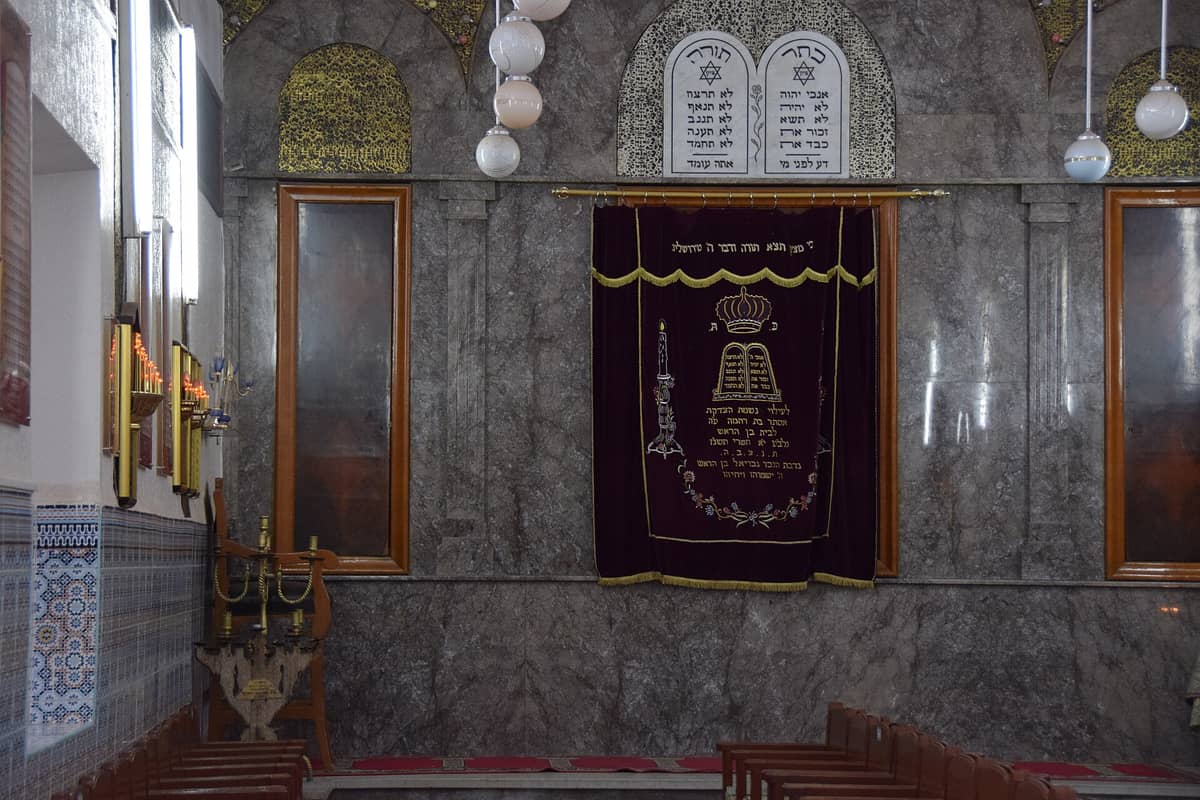
Once inside, the contrast is striking. The prayer hall opens onto a white-and-blue interior with a wooden gallery running along the upper level, traditionally reserved for women during services. The floor is tiled in a geometric pattern, the bimah (reading platform) sits centrally, and the ark containing Torah scrolls is set against the eastern wall. Light falls through the upper windows in a way that gives the room a calm, composed quality, especially in the morning hours before tour groups arrive.
Noise from the medina fades almost completely once you pass through the entrance. The courtyard garden, planted with citrus and seasonal flowers, acts as a decompression zone between the lane outside and the prayer hall. On weekday mornings, you may find it nearly empty, with only a caretaker present. That stillness is the experience: not spectacle, but quiet.
💡 Local tip
Morning visits on weekdays (before 11:00) tend to be the quietest. Organized tour groups typically arrive later in the morning. If you want the space to yourself, come early.
Tickets & tours
Live prices and dates from our booking partner. If you book, we may earn a commission at no extra cost to you.
Full day tour of Ouarzazate from Marrakech
From 51 €Instant confirmationFree cancellationEvening Quad Bike at Palmeraie Area with Tea Tasting from Marrakech
From 49 €Instant confirmationFree cancellationFull Day Economic Tour in Essaouira from Marrakech
From 29 €Instant confirmationFree cancellationFull Day Economic Tour of Ourika Valley from Marrakech
From 25 €Instant confirmationFree cancellation
Historical Context: The Mellah and Marrakech's Jewish Community
The Mellah of Marrakech was one of the earliest Jewish quarters in Morocco, established centuries before Slat Al Azama was built. At its peak, the Jewish population of Marrakech was a significant and integral part of the city's commercial, artisanal, and intellectual life. The area around the synagogue still shows traces of that history: the narrow lanes, the distinctive architecture with its overhanging upper floors and wrought-iron balconies, and the Jewish cemetery nearby, which remains one of the largest in Morocco.
The history of the synagogue places it at a particular historical moment. Morocco was under French protectorate control in the first half of the twentieth century, and North Africa was on the edge of the wider upheavals of World War Two. The Vichy regime had introduced antisemitic legislation affecting Moroccan Jews, though King Mohammed V's relationship with his Jewish subjects during this period remains a complex and debated aspect of Moroccan history. That the community maintained and renewed a synagogue during this period speaks to both the depth of their roots here and their determination to maintain communal life.
Post-independence emigration through the 1950s, 60s, and 70s dramatically reduced the Jewish population across Morocco. Today, only a small community remains in Marrakech, but its presence is real and the synagogue functions as a result. Visitors who want broader context on this history will find it useful to pair a visit here with time at the Mellah Jewish Quarter, where the urban texture of the community's former scale remains legible in the buildings and street layout.
Architecture and Interior Details Worth Noting
Moroccan synagogue architecture borrows from the same visual language as Moroccan domestic and religious architecture more broadly: zellij tilework, carved plasterwork, wooden lattice screens, and interior courtyards that draw natural light from above. Slat Al Azama is no exception. The building does not try to look like a European synagogue transplanted to North Africa. It is North African in its bones, adapted for Jewish ritual use.
Look at the upper gallery carefully. The carved wooden balustrade is the kind of craftsmanship you see in the region's finest riads and madrasas, applied here to a religious context. The colors, predominantly white and blue, give the interior a clean, airy quality. The overall scale is intimate rather than grand, reflecting the communal rather than monumental function of a synagogue used by a neighborhood congregation.
💡 Local tip
Photography is generally permitted in the courtyard and museum section. Be observant in the prayer hall: if a service is in progress or worshippers are present, lower your camera and behave as you would in any functioning place of worship. The caretaker will usually guide you.
Practical Walkthrough: Getting There and Around
The synagogue is in the southern section of the medina, in the Kasbah-Mellah area. The most natural approach is on foot from Bahia Palace, which is roughly a five-minute walk. From Place des Ferblantiers (the square of the tinsmiths, a useful landmark), the synagogue is about three minutes away through the alleys of the Mellah. Taxis can get you to the Mellah edge, but narrow lanes mean the last stretch is always on foot.
Admission is 10 MAD, around one euro, paid at the door. This fee goes toward the maintenance of the building. There is no online booking system; you simply arrive during opening hours. A caretaker is typically present and will orient you, sometimes in French or basic English. A tip for their time is appreciated but not required.
Accessibility is limited. The lane leading to the synagogue is paved with irregular stone surfaces typical of medina alleys, which can be difficult for wheelchairs or strollers. Inside, the ground floor courtyard and prayer hall are generally accessible, but upper gallery areas require stairs. If mobility is a concern, the ground floor alone is still worth the visit.
Dress modestly. This applies to the surrounding Mellah as much as the synagogue itself. Shoulders and knees covered is the standard expectation. For more general guidance on what to wear across Marrakech, the Marrakech dress code guide covers practical considerations for both medina and modern districts.
Is It Worth Your Time?
Yes, but with a calibration. If you arrive expecting a grand monument or an expansive museum, you will find the space smaller and simpler than anticipated. The interior is beautiful, but it takes about fifteen minutes to see thoroughly. What elevates the visit is the context: understanding what you are looking at and why it matters adds layers that a quick glance cannot capture.
The synagogue rewards visitors who come with some awareness of Moroccan Jewish history and are interested in how different communities shaped the same city. Those who are not interested in religious heritage and history will find the visit brief and may feel the detour is not justified if they are pressed for time. For that traveler, the El Badi Palace is a short walk away and offers a very different kind of scale and drama.
The visit is entirely appropriate for children old enough to appreciate quiet spaces and history. It is not suitable for very young children who need stimulation and movement, purely because there is little for them to engage with beyond the courtyard.
Insider Tips
- Combine this visit with the nearby Miara Jewish cemetery, which is only a few minutes' walk and adds significant depth to the Mellah history. The cemetery is one of the largest in Morocco and is itself worth a short visit.
- The caretaker often has detailed knowledge of the synagogue and its community. A small donation or tip encourages a more personal explanation, which is worth more than any printed guide available on-site.
- If you visit on a Saturday, hours may be shorter than on weekdays and the atmosphere can differ if Shabbat is being observed. Do not count on a standard tourist visit on Friday, and treat Saturday access as something to confirm on the day.
- The Mellah alleys immediately surrounding the synagogue still have a handful of Jewish-owned shops selling religious items and silverwork, a remnant of the quarter's traditional crafts. These are worth a look before or after your visit.
- Bring exact change of 10 MAD for the entry fee. The caretaker often cannot make change for larger notes, and the interaction is smoother if you arrive prepared.
Who Is Synagogue Slat Al Azama For?
- Travelers with an interest in Jewish heritage and the history of minority communities in the Islamic world
- Those exploring Marrakech's history beyond the usual sites and wanting a quieter, more reflective experience
- Architecture enthusiasts interested in how Moroccan craft traditions translate into Jewish religious spaces
- Visitors doing a dedicated Mellah walking tour who want to understand the full picture of the quarter
- History-focused travelers pairing this with Bahia Palace and El Badi Palace for a complete southern medina half-day
Nearby Attractions
Other things to see while in Kasbah & Mellah:
- Agdal Gardens
Stretching across roughly 340–500 hectares south of the medina, Agdal Gardens is among the oldest garden complexes in Marrakech, originally planted in the 12th century. Entry is free, but access is restricted to Fridays and Sundays — and can be suspended without notice when the King is in residence.
- Bab Agnaou
Bab Agnaou is the most elaborately decorated of Marrakech's historic city gates, a 12th-century Almohad masterpiece carved from blue-grey Gueliz stone at the entrance to the royal Kasbah quarter. It costs nothing to visit, stands open around the clock, and rewards anyone with even a passing interest in Islamic architecture.
- Bahia Palace
Built for a Grand Vizier and expanded by his son, Bahia Palace is a sprawling 19th-century complex of roughly 160 rooms arranged around shaded courtyards and orange-tree gardens. It offers one of the most detailed windows into late Moroccan imperial craftsmanship anywhere in the medina.
- Dar Si Saïd – Museum of Moroccan Arts
A 19th-century palace a short walk from Bahia Palace, Dar Si Saïd served after 2018 as Morocco's National Museum of Weaving and Carpets. Confirm opening status before visiting: the historic building has been closed for repairs since the September 2023 Al Haouz earthquake.
Planning a trip? Discover personalized activities with the Nomado app.