Jewish Cemetery of Marrakech (Miara): A Complete Visitor's Guide
The Miara Jewish Cemetery is one of the largest Jewish cemeteries in Morocco, tucked inside the Mellah district of Marrakech's medina. With burials spanning several centuries, it offers a rare and quietly affecting window into the long history of Jewish life in this city — a story that most visitors walk right past.
Quick Facts
- Location
- Avenue Taoulat El Miara, Mellah district, southeastern medina, Marrakech
- Getting There
- On foot from Jemaa el-Fna via Place des Ferblantiers (15–20 min walk), or by petit taxi to Taoulat El Miara
- Time Needed
- 30–60 minutes
- Cost
- No fixed admission fee; customary donation to caretaker (typically 10–20 MAD)
- Best for
- History enthusiasts, cultural travelers, those tracing Sephardic heritage
- Official website
- http://www.jmarrakech.org
What the Miara Jewish Cemetery Actually Is
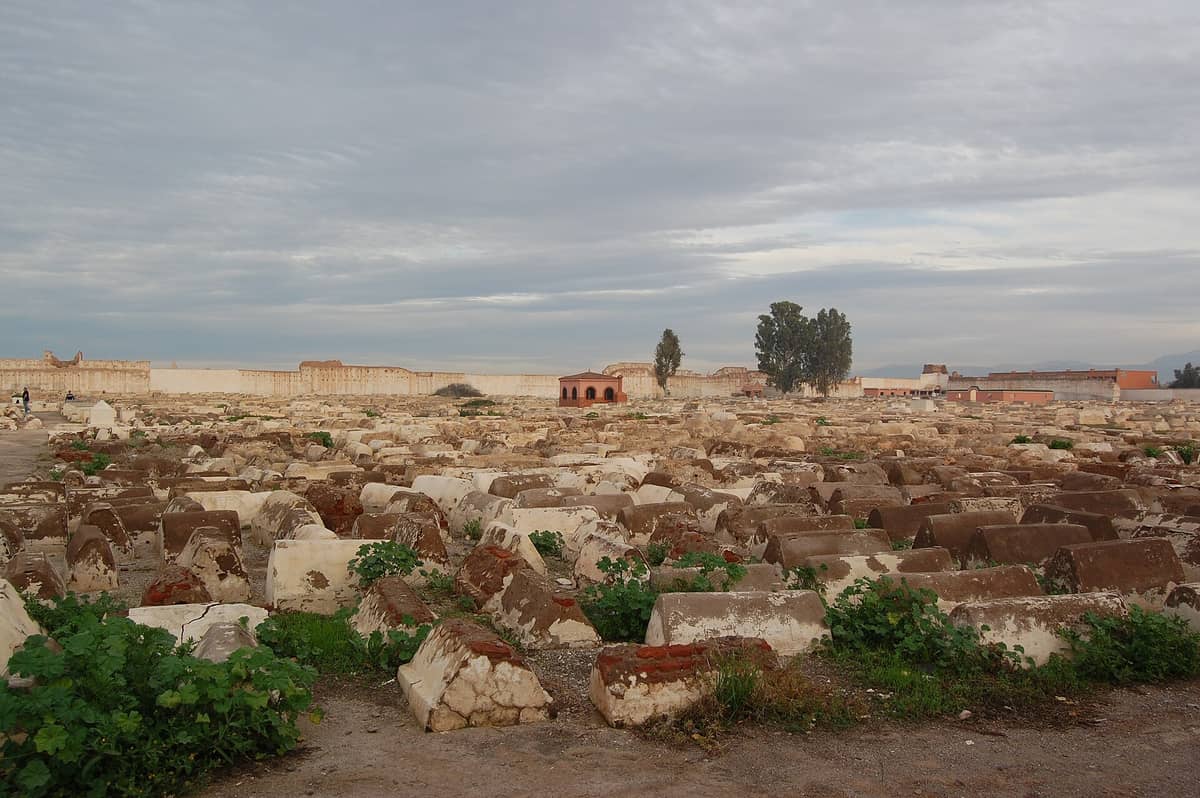
The Jewish Cemetery of Marrakech, formally known as the Miara Jewish Cemetery (Cimetière de Miaâra in French), is an active and historically significant burial ground at the southern edge of the Mellah, Marrakech's historic Jewish quarter. It is considered one of the largest Jewish cemeteries in Morocco, with thousands of whitewashed tombs arranged in dense, low rows across a walled enclosure. Unlike many heritage sites in Marrakech, this is not a museum or a reconstruction. It is a working cemetery where burials still take place, maintained by a caretaker who typically greets visitors at the entrance.
The cemetery's later history is closely tied to the Mellah, Marrakech's Jewish quarter, which the Saadian dynasty established in the mid-16th century. Jewish burial on this ground is often dated earlier still, and the site has been in use for centuries. The Miara cemetery holds the physical record of that presence: rabbis, merchants, scholars, and ordinary families whose names are inscribed in Hebrew on flat stone slabs, many worn smooth by decades of sun and rain.
ℹ️ Good to know
Opening hours vary by source and fluctuate around Jewish holidays. The most commonly cited hours are Sunday to Thursday 08:00–19:00 and Friday 08:30–18:00, with the cemetery typically closed on Saturdays. Always confirm on arrival or with your accommodation before making a special trip.
The Experience of Visiting: What You Will Actually See
Entering through the modest gate on Avenue Taoulat El Miara, the shift is immediate. The sounds of the Mellah lanes — motorcycle engines, the clatter of metalworkers near Place des Ferblantiers — drop away. Inside, the tombs are arranged in tight rows, their surfaces a brilliant white against the red-orange clay walls surrounding the compound. Many are completely plain; others bear carved Stars of David or Hebrew inscriptions. Some families have placed small stones on the tops of monuments, following the Jewish tradition of leaving a stone rather than flowers as a mark of visitation.
The scale is more significant than most visitors expect. This is not a small courtyard; it takes genuine time to walk the full perimeter and take in the density of graves. On a quiet weekday morning, you may have the space largely to yourself, accompanied only by the caretaker and the sound of birds. Midday visits in summer should be approached with caution: the cemetery has no shade to speak of, and the white surfaces intensify the heat considerably. Bring water and a hat if you visit between June and September.
Towards the back of the cemetery, a small whitewashed structure houses the tombs of several rabbis considered particularly revered within the community. These spots are often marked with candles left by visitors, and they tend to be the most visually striking part of the interior. The caretaker can point out the most significant graves if you ask, and while no fixed tour is offered, a small donation encourages patience and explanation.
Tickets & tours
Live prices and dates from our booking partner. If you book, we may earn a commission at no extra cost to you.
Full day tour of Ouarzazate from Marrakech
From 51 €Instant confirmationFree cancellationEvening Quad Bike at Palmeraie Area with Tea Tasting from Marrakech
From 49 €Instant confirmationFree cancellationFull Day Economic Tour in Essaouira from Marrakech
From 29 €Instant confirmationFree cancellationFull Day Economic Tour of Ourika Valley from Marrakech
From 25 €Instant confirmationFree cancellation
Historical Context: The Mellah and Marrakech's Jewish Community
To understand why the Miara cemetery exists and why it matters, it helps to understand the Mellah. Marrakech's Jewish quarter was established in the 16th century, making it one of the oldest Mellahs in Morocco. At its peak, the community living here numbered in the tens of thousands. The area was both a place of protection — Jews in Moroccan cities were often placed under the direct authority of the sultan — and of separation. Today the Mellah Jewish Quarter retains its distinctive architectural character: taller buildings than the surrounding medina, with overhanging balconies that allowed families to expand upward within the confined space of the walled district.
Much of Marrakech's Jewish population emigrated to Israel and France during the mid-20th century, and today only a very small Jewish community remains in the city. The Miara cemetery stands as one of the most tangible records of a community that once shaped the commercial and cultural life of the medina for centuries. The Hebrew inscriptions on the graves span from early modern to contemporary, with some dating back several hundred years.
Visitors interested in the broader Jewish heritage of Marrakech can also visit the nearby Synagogue Slat al-Azama, which has been restored and remains the most accessible surviving synagogue in the Mellah. Together, the cemetery and the synagogue form a coherent circuit for understanding the depth of Jewish history in the city.
Getting There and Practical Logistics
The cemetery is located in the southeastern section of the medina, a roughly 15 to 20-minute walk from Jemaa el-Fna. The most straightforward walking route takes you south through the medina lanes toward the Kasbah, passing through Place des Ferblantiers (the lantern-makers square) at the entrance to the Mellah. From Place des Ferblantiers, follow the edge of the Mellah south and look for Avenue Taoulat El Miara. The approach is not always clearly signposted, so downloading an offline map of the medina before you arrive is strongly recommended.
By petit taxi from Jemaa el-Fna, the journey takes under 10 minutes. Ask to be dropped at the Mellah or at Taoulat El Miara. The cemetery is also a natural addition to any visit to Bahia Palace, which is approximately a 3-minute walk from the cemetery entrance. Combining both in a single morning is entirely feasible.
💡 Local tip
Dress modestly when visiting the cemetery, covering shoulders and knees. This is both respectful to the religious nature of the site and consistent with general medina etiquette. There are no robes available to borrow here as at some mosques, so come prepared.
Photography: What Is and Is Not Appropriate
Photography is generally permitted in the cemetery, and the visual contrast of white tombs against the warm clay walls and open sky makes for striking images, particularly in the soft light of early morning or late afternoon. If you visit around golden hour, the shadows cast by the low tomb stones create an almost textural quality across the ground.
That said, this is an active place of burial and mourning. If a funeral or religious ceremony is in progress when you arrive, step back and wait, or return another time. The caretaker will usually make clear if photography is inappropriate at a given moment. Always ask before photographing any person inside the cemetery.
Is This Worth Your Time?
The Miara Jewish Cemetery is not a dramatic spectacle. It will not occupy more than an hour of your time, there are no exhibits, no audio guides, and no café nearby. What it offers is something harder to find in a city as heavily touristed as Marrakech: historical texture, undiluted by commercial packaging. For travelers who want to understand the full human history of this city — not just its souks and palaces — it belongs on the itinerary. It fits naturally into any exploration of the Kasbah-Mellah neighborhood, and the short distance to Bahia Palace and the Saadian Tombs means you can combine all three without backtracking.
Travelers seeking purely visual spectacle or fast-paced sightseeing may find the atmosphere too quiet and the visual language too unfamiliar to fully engage with. Those who prefer pre-interpreted heritage with information boards and guided tours will also find the cemetery's stripped-back presentation frustrating. But for anyone with even a passing interest in Moroccan Jewish history, Sephardic culture, or the often-overlooked layers of this city's past, the Miara cemetery is a place that tends to stay with you long after the souks fade from memory.
⚠️ What to skip
The cemetery is typically closed on Saturdays (Shabbat) and on major Jewish holidays. If your Marrakech itinerary is tight, do not plan this as your only option for a particular day without confirming it will be open. A local riad or guide can usually check ahead for you.
Insider Tips
- Visit on a weekday morning before 10:00. The caretaker is typically present and relaxed at this hour, and the low morning light gives the white tombs a warmth they lose by midday.
- A donation of around 10–20 MAD to the caretaker is both customary and genuinely appreciated — this is how the site is maintained. Bring small-denomination dirham notes rather than expecting change.
- Ask the caretaker to point out the tombs of revered rabbis near the back of the cemetery. These are often marked with candles and carry considerable significance for Moroccan Jews who visit from abroad.
- The Mellah lanes immediately outside the cemetery contain some of Marrakech's most photogenic and least-visited street architecture. Allow 20 minutes to walk the quarter before or after your visit rather than heading straight back to the main tourist circuit.
- If you are researching family genealogy with Moroccan Jewish roots, the cemetery records are documented in part through JewishGen's International Jewish Cemetery Project, which is worth consulting before your visit to identify specific grave locations.
Who Is Jewish Cemetery of Marrakech For?
- Travelers interested in the Jewish history of Morocco and North Africa
- History-focused visitors wanting to understand Marrakech beyond its Islamic monuments
- Those combining a circuit of the Kasbah-Mellah area including Bahia Palace and the Saadian Tombs
- Photographers looking for quiet, visually coherent subjects away from crowd-heavy sites
- Visitors of Sephardic or Moroccan Jewish heritage making a heritage journey
Nearby Attractions
Other things to see while in Kasbah & Mellah:
- Agdal Gardens
Stretching across roughly 340–500 hectares south of the medina, Agdal Gardens is among the oldest garden complexes in Marrakech, originally planted in the 12th century. Entry is free, but access is restricted to Fridays and Sundays — and can be suspended without notice when the King is in residence.
- Bab Agnaou
Bab Agnaou is the most elaborately decorated of Marrakech's historic city gates, a 12th-century Almohad masterpiece carved from blue-grey Gueliz stone at the entrance to the royal Kasbah quarter. It costs nothing to visit, stands open around the clock, and rewards anyone with even a passing interest in Islamic architecture.
- Bahia Palace
Built for a Grand Vizier and expanded by his son, Bahia Palace is a sprawling 19th-century complex of roughly 160 rooms arranged around shaded courtyards and orange-tree gardens. It offers one of the most detailed windows into late Moroccan imperial craftsmanship anywhere in the medina.
- Dar Si Saïd – Museum of Moroccan Arts
A 19th-century palace a short walk from Bahia Palace, Dar Si Saïd served after 2018 as Morocco's National Museum of Weaving and Carpets. Confirm opening status before visiting: the historic building has been closed for repairs since the September 2023 Al Haouz earthquake.
Planning a trip? Discover personalized activities with the Nomado app.