Mellah (Jewish Quarter): Marrakech's Forgotten City Within a City
Founded in 1558 under the Saadian dynasty, Marrakech's Mellah is one of the earliest formally designated Jewish quarters in Morocco. A freely accessible neighborhood of ornate wooden balconies, faded Hebrew inscriptions, and a working synagogue museum, it rewards slow exploration far more than a quick photo stop.
Quick Facts
- Location
- South-east of the medina, adjacent to Bahia Palace, Marrakech
- Getting There
- ~10-min walk from Jemaa el-Fna along Riad Zitoun; taxis drop at Place des Ferblantiers or Bab Mellah
- Time Needed
- 1.5–2.5 hours for the quarter plus synagogue museum
- Cost
- Quarter: free. Synagogue Salat Al Azama museum: approx. 10 MAD
- Best for
- History lovers, architecture explorers, slow walkers, photography
- Official website
- visitmarrakech.com/en/listing/le-mellah
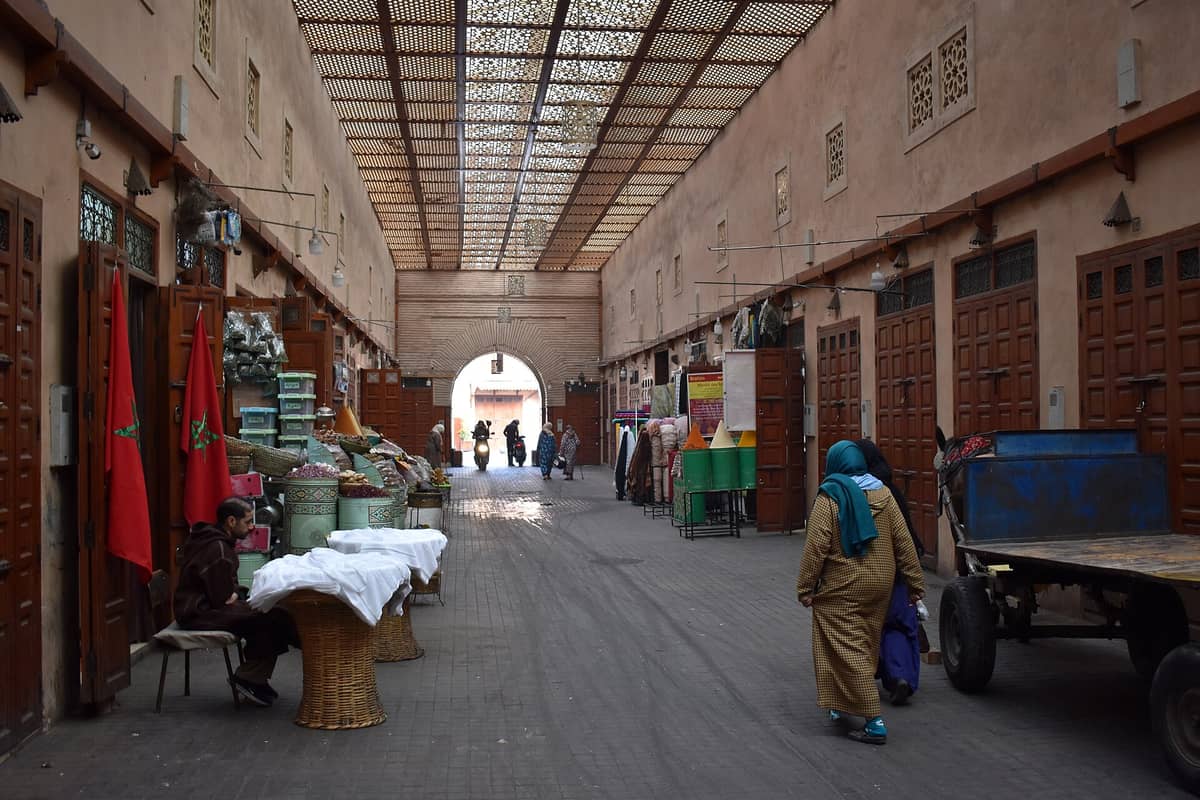
What the Mellah Actually Is
The Mellah (Jewish Quarter) of Marrakech is not a museum or a roped-off heritage precinct. It is a functioning residential neighborhood, compact and densely layered, where the evidence of a 500-year-old Jewish community sits alongside halal butcher shops, mobile phone repair stalls, and kids kicking footballs in narrow lanes. That combination is precisely what makes it worth your time.
Established in 1558 by the Saadian sultan Abdallah al-Ghalib, it was one of the first Jewish quarters in Morocco. The word 'mellah' derives from the Arabic for salt, and several competing theories explain the connection: some historians link it to the practice of salting the severed heads of rebels before display, a task reportedly assigned to Jewish residents; others associate it with a salty marsh the area was built on. Neither story is cheerful, but both point to the ambiguous, sometimes precarious position of the Jewish community within the city's social fabric over the centuries.
At its peak, the Mellah housed up to around 40,000 Jewish residents who played a central role in Marrakech's economy as goldsmiths, jewelers, money changers, and cloth merchants. Following Moroccan independence in 1956 and the establishment of Israel, most emigrated. Today the quarter is almost entirely Muslim, but the architecture, the synagogue, and the Jewish cemetery nearby preserve the memory of the community that built it. To understand these layers more fully, the Synagogue Slat Al Azama and the Jewish Cemetery are both within walking distance and add significant depth to a Mellah visit.
How to Enter and Orient Yourself
The most natural entry point from the broader medina is Place des Ferblantiers, a square named for the tin and copper craftsmen who once dominated it. It sits directly south of Bahia Palace and marks the northwestern gateway into the Mellah. You will hear metalwork before you see it: the rhythmic tapping of hammers on lanterns and decorative panels is the quarter's unofficial soundtrack at this edge.
From Jemaa el-Fna, follow Rue Riad Zitoun el-Kedim southward. The walk takes roughly ten minutes on foot and passes through progressively quieter territory as the souk density drops away. You pass olive vendors and fabric sellers before the street opens onto Place des Ferblantiers. Taxis will drop you at Bab Mellah or the square itself if you prefer to arrive directly.
💡 Local tip
The Mellah quarter itself is free to enter and open at all hours. There is no ticket booth, no entry gate, and no guided queue. Simply walk in. The Synagogue Salat Al Azama museum inside the quarter charges approximately 10 MAD and is open Sunday to Thursday 09:00–18:30, Saturday 09:00–16:00, and closed Friday.
Once inside, the grid is looser than the northern souks but still labyrinthine enough to disorient. The main commercial artery runs roughly northeast to southwest. Do not fight the narrow side streets. Ducking into them is where the Mellah's most distinctive architecture reveals itself.
Tickets & tours
Live prices and dates from our booking partner. If you book, we may earn a commission at no extra cost to you.
Full day tour of Ouarzazate from Marrakech
From 51 €Instant confirmationFree cancellationEvening Quad Bike at Palmeraie Area with Tea Tasting from Marrakech
From 49 €Instant confirmationFree cancellationFull Day Economic Tour in Essaouira from Marrakech
From 29 €Instant confirmationFree cancellationFull Day Economic Tour of Ourika Valley from Marrakech
From 25 €Instant confirmationFree cancellation
What to Look at: Architecture and Street Details
The signature feature of Mellah domestic architecture is the wooden balcony. Unlike the inward-facing courtyard houses of the Islamic medina, many Mellah homes were built with facades that face the street and decorated wooden balconies projecting over the lane. This outward orientation reflected different social and domestic norms. Today, many of these balconies are warped and unpainted, their carved screens faded to grey. A 2014 restoration program has addressed some structures, but the work is ongoing and uneven: a freshly rendered facade might stand next to a collapsing archway.
Look down as well as up. Doorways occasionally preserve Hebrew inscriptions in the stonework, faint but legible if you slow down enough. Small Stars of David appear in ironwork on a handful of older doors. These details are not marked or interpreted; finding them is a matter of moving slowly and looking carefully.
The Mellah sits close to two of Marrakech's most significant palatial sites. Bahia Palace is effectively adjacent, sharing a wall with the quarter's northwest edge. The ruined El Badi Palace is a short walk further south. Many visitors combine all three in a single half-day circuit, which makes geographic and thematic sense.
The Synagogue Salat Al Azama and Jewish Mellah Museum
The Synagogue Salat Al Azama is the Mellah's anchor attraction and the most concentrated point of historical interpretation in the quarter. The building itself is modest from the outside, tucked into a residential block with no grand entrance. Inside, the prayer hall has been restored to a state that conveys its original character: whitewashed walls, a wooden ark, hanging lamps, and tiled floors. The attached museum displays Torah scrolls, ritual objects, photographs of the Jewish community in its mid-20th-century prime, and documents tracing the community's history from the Saadian period through emigration.
The admission charge of approximately 10 MAD is nominal. Allow 30 to 45 minutes here. Staff are generally present and willing to provide basic orientation, though formal guided tours are not guaranteed. Photography rules inside should be confirmed on arrival.
⚠️ What to skip
The synagogue is closed on Fridays. If this is your only free morning in Marrakech, plan accordingly. The quarter itself remains accessible, but the synagogue museum is the main interpretive resource, and missing it significantly reduces the visit's depth.
The Mellah by Time of Day
Morning visits, between 08:00 and 10:30, offer the clearest light for photography and the most readable architecture. The low angle of the sun catches the carved wooden balconies and picks out surface texture on old plasterwork. The lanes are quieter, residents are going about ordinary routines, and the atmosphere has an unhurried quality that evaporates once tour groups arrive.
By midday in summer, the narrow alleys trap heat noticeably. Temperatures inside stone lanes can feel significantly higher than the ambient air. Bring water and plan shade stops. In cooler months from October through March, a midday visit is entirely comfortable, and the Place des Ferblantiers terrace cafes offer good spots for a break.
Late afternoon, roughly 16:00 to 18:00, brings different energy: shop activity picks up, children return from school, and the golden light warms the ochre walls to a richer tone. The main commercial lanes become genuinely lively. This is the better time if you want to photograph street life rather than architecture.
Practical Walkthrough and What to Expect
A practical circuit might run as follows: enter from Place des Ferblantiers, walk the main commercial lane southeast toward the synagogue, visit Salat Al Azama, continue through the residential side streets back toward Bab Mellah, then exit and walk five minutes to El Badi Palace. This loop covers the essential territory in about 90 minutes, or longer if you pause at the synagogue museum and explore side alleys.
The streets are entirely pedestrian but uneven, with loose paving, raised thresholds, and occasional puddles from household water use. Wheelchairs and pushchairs will find it genuinely difficult; this is not a retrofitted tourist zone but a working neighborhood with all that implies. Comfortable flat shoes are recommended. There is no formal cloakroom or storage facility.
Visitors interested in the broader context of Marrakech's historic neighborhoods and religious architecture should also consider the nearby Saadian Tombs, which date to the same Saadian dynasty that founded the Mellah and lie within a ten-minute walk. For a fuller picture of the medina's layered history, the Islamic architecture guide provides useful context for the styles you will encounter throughout the quarter.
ℹ️ Good to know
The Mellah is a living residential neighborhood. Treat it accordingly. Do not photograph individuals without permission, keep voices low near residential doorways, and dress modestly as you would throughout the medina.
Who Should Skip This
If your interest in Marrakech runs primarily toward the concentrated spectacle of the major souks and Jemaa el-Fna, the Mellah may feel anticlimactic. It is quieter, more worn, and less polished than the tourist-facing parts of the medina. There are no vendors chasing your attention, no snake charmers, no dramatic vistas. The reward here is subtle: layered history, unusual architecture, and a part of the city that most day-trippers never reach.
Visitors with significant mobility challenges will also find the terrain genuinely difficult, particularly in wet weather when the uneven paving becomes slippery. There is no accessible route through the narrow residential lanes.
Insider Tips
- Enter via Place des Ferblantiers rather than hunting for Bab Mellah from the main medina roads. The square is easy to find, well-served by taxis, and immediately adjacent to both Bahia Palace and the Mellah entrance, making it the natural hub for a combined visit.
- The synagogue museum's modest admission fee (approx. 10 MAD) is the best-value interpretation of Jewish Moroccan history in Marrakech. Do not skip it to save the dirham equivalent of one coffee.
- Look for Hebrew inscriptions and small Stars of David worked into doorway stonework and ironwork grilles on side streets east of the main lane. They are not signposted and require slow, deliberate looking. Most visitors walk straight past them.
- The 2014 restoration program has progressed unevenly. Some blocks look freshly rendered; others show serious structural deterioration. The contrast itself tells you something truthful about the pace of heritage preservation in a working neighborhood with competing pressures.
- Combine the Mellah with Bahia Palace and El Badi Palace in a single morning. The three sites share the same corner of the medina, the combined walk is under two kilometers, and the layered Saadian and post-Saadian history connects them into a coherent narrative rather than three disconnected stops.
Who Is Mellah (Jewish Quarter) For?
- History and heritage travelers who want context beyond the main tourist circuit
- Architecture enthusiasts interested in the distinctive Mellah balcony style and its contrast with Islamic medina houses
- Photographers seeking authentic street scenes and textured surfaces away from the more performative parts of the medina
- Travelers researching Moroccan Jewish history and the Sephardic diaspora
- Anyone building a half-day circuit of the southern medina combining Bahia Palace, El Badi Palace, and the Saadian Tombs
Nearby Attractions
Other things to see while in Kasbah & Mellah:
- Agdal Gardens
Stretching across roughly 340–500 hectares south of the medina, Agdal Gardens is among the oldest garden complexes in Marrakech, originally planted in the 12th century. Entry is free, but access is restricted to Fridays and Sundays — and can be suspended without notice when the King is in residence.
- Bab Agnaou
Bab Agnaou is the most elaborately decorated of Marrakech's historic city gates, a 12th-century Almohad masterpiece carved from blue-grey Gueliz stone at the entrance to the royal Kasbah quarter. It costs nothing to visit, stands open around the clock, and rewards anyone with even a passing interest in Islamic architecture.
- Bahia Palace
Built for a Grand Vizier and expanded by his son, Bahia Palace is a sprawling 19th-century complex of roughly 160 rooms arranged around shaded courtyards and orange-tree gardens. It offers one of the most detailed windows into late Moroccan imperial craftsmanship anywhere in the medina.
- Dar Si Saïd – Museum of Moroccan Arts
A 19th-century palace a short walk from Bahia Palace, Dar Si Saïd served after 2018 as Morocco's National Museum of Weaving and Carpets. Confirm opening status before visiting: the historic building has been closed for repairs since the September 2023 Al Haouz earthquake.
Planning a trip? Discover personalized activities with the Nomado app.