Dar Si Saïd – Museum of Moroccan Arts: A Traveler's Complete Guide
A 19th-century palace a short walk from Bahia Palace, Dar Si Saïd served after 2018 as Morocco's National Museum of Weaving and Carpets. Confirm opening status before visiting: the historic building has been closed for repairs since the September 2023 Al Haouz earthquake.
Quick Facts
- Location
- Riad Zitoun Jdid, Bahia district, Marrakech Medina
- Getting There
- 10-min walk from Jemaa el-Fna via Rue Riad Zitoun Jdid; taxis can drop near Bahia Palace
- Time Needed
- 1 to 1.5 hours
- Cost
- 30 MAD adults, 15 MAD under-18s; free Fridays for Moroccan nationals and foreign residents (verify before visiting)
- Best for
- Craft lovers, architecture fans, travelers wanting calm away from the souks
- Official website
- darsisaid.com
What Is Dar Si Saïd?
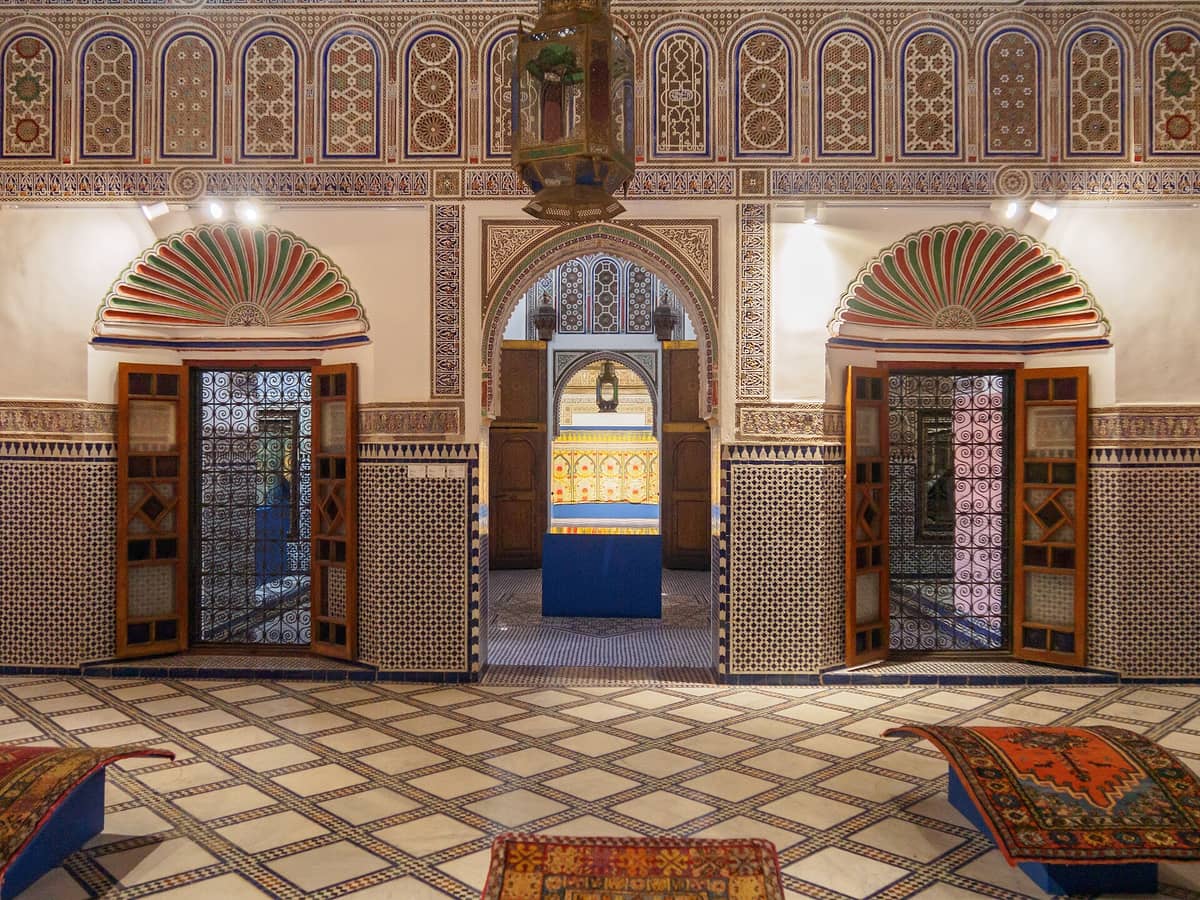
Dar Si Saïd is a palatial 19th-century residence in Marrakech's medina that served, after restorations completed in 2018, as the National Museum of Weaving and Carpets. It was built for Si Saïd, a brother of the powerful vizier Ba Ahmed, who also commissioned the nearby Bahia Palace. The two buildings share architectural DNA, both constructed in the closing decades of the 1800s, both lavishly decorated with hand-carved cedar, geometric mosaic tilework, and painted stucco. Where Bahia overwhelms with scale, Dar Si Saïd rewards with detail.
The museum's collection spans carved wooden doors from across the Moroccan south, Berber jewelry, embroidered textiles, glazed ceramics from Fes and Safi, and agricultural tools that document pre-industrial rural life. Taken together, these objects form a portrait of Moroccan material culture that no souk visit can replicate. The building itself is as much the attraction as anything displayed inside it.
⚠️ What to skip
The museum has been closed for repairs since the September 2023 Al Haouz earthquake damaged the historic palace. Confirm current status at darsisaid.com or by asking at your riad before making a special trip. When it has been open, published hours were typically 10:00–18:00, but hours and closure days can change.
The Building: Architecture as the First Exhibit
You enter through a discreet doorway on a narrow lane off Riad Zitoun Jdid, and the contrast with the street outside is immediate. The outer walls give nothing away, as is typical of traditional Moroccan domestic architecture, where all beauty faces inward. The entry corridor opens into a central courtyard organized around a marble fountain, with the geometry of the zellij floor reflecting upward onto the lower register of carved plasterwork. The proportions are domestic rather than ceremonial, which makes the craftsmanship feel more personal than in a grand palace.
The upper level contains the most celebrated interior space: a reception room whose carved and painted cedar ceiling is among the finest examples of this craft in Marrakech. The interlocking geometric motifs, finished with pigments in ochre, deep blue, and red, were worked by artisans whose training connected directly to centuries of practice. Light enters through carved stucco screens, softening in the late morning into something that makes photography difficult but the experience absorbing.
Visitors interested in the architectural tradition connecting this building to others in the medina should read more in the guide to Islamic architecture in Marrakech. The Ben Youssef Madrasa in the northern medina uses the same materials and grammar, though on a more monumental scale.
Tickets & tours
Live prices and dates from our booking partner. If you book, we may earn a commission at no extra cost to you.
Full day tour of Ouarzazate from Marrakech
From 51 €Instant confirmationFree cancellationEvening Quad Bike at Palmeraie Area with Tea Tasting from Marrakech
From 49 €Instant confirmationFree cancellationFull Day Economic Tour in Essaouira from Marrakech
From 29 €Instant confirmationFree cancellationFull Day Economic Tour of Ourika Valley from Marrakech
From 25 €Instant confirmationFree cancellation
The Collection: What You Will Actually See
The ground-floor rooms are organized loosely by craft category rather than strict chronology. Look for the collection of palanquins, the ceremonial litters once used to transport brides in the Atlas and High Souss regions. They are lacquered in red, hung with silk fringe, and decorated with naive painted motifs. Their scale is surprising, and their survival is fortunate: most objects of this type were used and worn away rather than preserved.
The woodwork gallery is the strongest part of the collection. The museum holds doors, screens, and carved panels from Marrakech, the Draa Valley, and the Saharan south, spanning several centuries. The oldest pieces show a spare, almost severe geometric vocabulary. Later pieces become more elaborate, with calligraphic registers running above arabesques. Comparing them side by side gives a clearer sense of how the craft evolved than any book description can.
Jewelry cases display silver Berber adornment from the Souss, the Anti-Atlas, and nomadic southern traditions: fibulas, heavy necklaces set with coral and amber, and engraved bracelets. These are not decorative objects in the Western sense. They were worn as portable wealth and as protective talismans, and understanding that function changes how you read their forms. Some labels provide context; others do not, and the quality of explanation varies noticeably across rooms.
💡 Local tip
Bring a small flashlight or use your phone torch in the woodwork galleries. Some display cases are lit unevenly, and the incised details on older carved panels are easy to miss in the ambient light.
When to Visit and What to Expect at Different Times
Mid-morning, between around 10:00 and 11:30, is typically the quietest window. Tour groups, when they come, tend to arrive after visiting Bahia Palace, so you have a reasonable chance of having the carved rooms largely to yourself if you arrive as the museum opens. The courtyard catches direct light at this hour, and the fountain basin reflects white marble and blue mosaic in a way that changes entirely by midday when the sun is overhead.
By early afternoon the museum can feel noticeably warmer, as the thick riad walls absorb heat through the morning. In summer, July and August in particular, temperatures inside the upper rooms rise significantly. Visiting in the first hour after opening is practical rather than just scenic advice during this period. In spring and autumn, afternoon visits are comfortable and the softening light through the stucco screens is at its most photogenic.
If you are planning to visit in the cooler months, the December travel guide for Marrakech covers what conditions to expect and how museum visits fit into a winter itinerary.
Getting There: Navigating the Medina to Riad Zitoun Jdid
From Jemaa el-Fna, take the main artery heading south: Rue Riad Zitoun Jdid. Walk past cafes and small shops for roughly 5–10 minutes. The lane narrows near the turn-off toward Bahia Palace. Dar Si Saïd is signposted, though the signs are not always visible at the first junction. Local shopkeepers will point you correctly if you ask for the museum by name.
Petit taxis can drop you near the entrance to Riad Zitoun Jdid from the Kasbah side, which cuts the walk to about three minutes. Give drivers the landmark reference of Bahia Palace rather than the street name. If you are driving yourself, park outside the medina walls near the Koutoubia Mosque and walk in; the lanes around the museum are too narrow for private cars.
While in the neighborhood, the Bahia Palace is a three-minute walk away and makes a natural pairing with Dar Si Saïd on the same half-day. The Saadian Tombs are another ten minutes south, past Bab Agnaou.
Accessibility and Practical Considerations
The lanes leading to Dar Si Saïd are uneven and unpaved in places, with occasional steps at thresholds. The medina streets themselves present the main challenge for wheelchair users or visitors with limited mobility, rather than the museum interior specifically. No detailed official information about internal ramps or lifts is provided on the museum's website. Visitors who need specific accessibility arrangements should contact the museum directly before planning their visit.
The admission price of around 30 MAD for adults and 10–15 MAD for children makes this one of the more affordable cultural visits in Marrakech. Students, teachers, and ICOM cardholders often qualify for reduced or free entry; bring relevant documentation. Fridays are reported to offer free entry for Moroccan nationals and foreign residents legally residing in Morocco. All prices should be verified at the entrance on the day, as museum tariffs can change.
For a broader overview of Marrakech's museum landscape and how Dar Si Saïd compares with other cultural institutions in the city, see the guide to the best museums in Marrakech.
Worth Your Time or Not?
Dar Si Saïd is not the most polished museum experience in Marrakech. Label quality is uneven, some rooms feel under-maintained relative to the grandeur of the architecture, and the exhibition design has not kept pace with contemporary curatorial standards. If you come expecting the immaculate presentation of, say, the Yves Saint Laurent Museum a few kilometers away in Gueliz, you will find it falls short.
What it offers instead is authenticity and quietness. The building has not been aggressively restored into a showpiece. The collection is genuinely substantial. And the combination of the 19th-century interior with objects made by craftspeople working in the same tradition gives the visit a coherence that is rare. For travelers who care about Moroccan craft heritage, and who have already seen the more publicized sites, this is a place where an hour passes quickly and productively. The Marrakech arts and culture guide provides further context on where Dar Si Saïd fits within the city's wider cultural offer.
Travelers who dislike slow-paced cultural visits, who struggle with dim lighting, or who prefer outdoor experiences will not find enough here to justify the entry. First-time visitors to Marrakech with limited time will likely get more visual impact from Bahia Palace's scale or the Ben Youssef Madrasa's setting. Dar Si Saïd rewards a second or third visit to the medina, when the souks have already been covered.
Insider Tips
- When the museum is open, visit within the first thirty minutes of opening. The courtyard light is at its best before the sun climbs overhead, and you will likely have the carved upper reception room to yourself.
- The palanquin collection on the ground floor is rarely mentioned in guidebooks but is one of the most singular objects in any Marrakech museum. Allocate time here rather than rushing toward the wood gallery.
- Bring cash in dirhams. There is no indication that card payment is accepted at the ticket desk, and the nearest reliable ATM is outside the medina on Avenue Houmane el-Fetouaki.
- If Dar Si Saïd has reopened, combine it with Bahia Palace on the same morning: buy your Bahia ticket first, as it draws larger crowds, then cross to Dar Si Saïd when the tour groups move on. Confirm the museum is open before you plan the pairing. The whole circuit takes under three hours.
- If you are traveling during summer, wear light layers. The thick walls keep the ground floor cool but the upper rooms trap heat by mid-morning in July and August.
Who Is Dar Si Saïd – Museum of Moroccan Arts For?
- Travelers with an existing interest in North African craft traditions and material culture
- Architecture enthusiasts who want to see a 19th-century Moroccan interior in a quieter context than Bahia Palace
- Repeat visitors to Marrakech looking for depth beyond the major circuit
- Photographers seeking interior light, carved geometry, and space without crowds
- Anyone pairing a half-day in the Kasbah-Mellah district with Bahia Palace and the Saadian Tombs
Nearby Attractions
Other things to see while in Kasbah & Mellah:
- Agdal Gardens
Stretching across roughly 340–500 hectares south of the medina, Agdal Gardens is among the oldest garden complexes in Marrakech, originally planted in the 12th century. Entry is free, but access is restricted to Fridays and Sundays — and can be suspended without notice when the King is in residence.
- Bab Agnaou
Bab Agnaou is the most elaborately decorated of Marrakech's historic city gates, a 12th-century Almohad masterpiece carved from blue-grey Gueliz stone at the entrance to the royal Kasbah quarter. It costs nothing to visit, stands open around the clock, and rewards anyone with even a passing interest in Islamic architecture.
- Bahia Palace
Built for a Grand Vizier and expanded by his son, Bahia Palace is a sprawling 19th-century complex of roughly 160 rooms arranged around shaded courtyards and orange-tree gardens. It offers one of the most detailed windows into late Moroccan imperial craftsmanship anywhere in the medina.
- El Badi Palace
El Badi Palace is a vast 16th-century Saadian ruin in Marrakech's Kasbah district. What remains, stripped bare by a later sultan, is still monumental: sunken gardens, colossal walls, and a silence that the original opulence only hints at. This guide covers what to see, when to go, and how to get there.
Planning a trip? Discover personalized activities with the Nomado app.