Marrakech's Contemporary Art Scene: Galleries, Museums & the 1-54 Fair
Marrakech is far more than medinas and souks. The city hosts one of Africa's most serious contemporary art ecosystems, anchored by MACAAL, the annual 1-54 Contemporary African Art Fair, and a growing network of galleries in Gueliz and the Medina. This guide covers every layer of that scene with practical details, seasonal timing, and a clear look at what's worth your time.
Tickets & tours
Live prices and dates from our booking partner. If you book, we may earn a commission at no extra cost to you.
TL;DR
- MACAAL (Museum of African Contemporary Art Al Maaden) is Marrakech's anchor contemporary art institution, open Wednesday to Sunday, 10:00–18:00, with tickets at 120 MAD for adults.
- The 1-54 Contemporary African Art Fair runs for just a few days each year (typically late January to early February) at La Mamounia and the DaDa space in the Medina — plan well ahead if this is your reason for visiting.
- Contemporary art activity peaks in January and February; visiting outside those months means relying on permanent institutions and independent galleries, which are still substantial.
- The art scene clusters in two areas: Gueliz (galleries, private spaces) and the Medina (MACAAL is south of the walls in Al Maaden; 1-54 venues are within or adjacent to the historic core).
- Marrakech's contemporary art is museum- and gallery-grade work by African and diasporic artists — not craft-market souvenirs. Adjust expectations accordingly.
Why Marrakech Has Become a Serious Contemporary Art Hub
The assumption that Marrakech's cultural appeal stops at historic architecture and traditional craft is outdated. Over the past decade, the city has developed a credible contemporary art infrastructure, driven by private patronage, international fair culture, and a generation of Moroccan and African artists gaining global visibility. The result is a scene that now attracts collectors, curators, and artists from across Africa, Europe, and beyond — particularly in the first two months of the year.
Geography matters here. Marrakech sits at a cultural crossroads between sub-Saharan Africa, the Arab world, and Europe, and that position shapes what gets shown and who shows up. Institutions like MACAAL explicitly frame their programming around pan-African and diasporic contemporary art, not Moroccan work in isolation. The MACMA (Musée d'Art et de Culture de Marrakech) and the Maison de la Photographie round out the institutional picture, while independent galleries and project spaces continue to multiply in Gueliz.
ℹ️ Good to know
Most of Marrakech's serious contemporary art infrastructure has been built since 2010. If you visited the city before that and only saw tourist-facing craft galleries, the landscape has changed considerably. Institutions now operate to international museum standards, with curated programming, educational outreach, and multilingual interpretation.
MACAAL: The Anchor Institution
MACAAL, the Museum of African Contemporary Art Al Maaden, is the most important contemporary art institution in Marrakech and one of the most significant dedicated to African art anywhere on the continent. It sits in Al Maaden, in the Sidi Youssef Ben Ali district south of the medina walls, which means a short taxi or ride from the historic centre rather than a walking distance visit. That slightly inconvenient location is worth noting before you plan your day.
- Opening hours Wednesday to Sunday, 10:00–18:00. Closed Monday and Tuesday. During Ramadan, hours reduce to 10:00–15:30 — confirm current hours before visiting if your trip overlaps with the holy month.
- Admission Adults: 120 MAD. African residents and nationals with proof: 60 MAD. Groups of 10 or more: 110 MAD per person. Free for children under 12 and students with valid ID.
- Guided tours Must be booked in advance at the museum reception or by email at mediation@macaal.org. Drop-in guided visits are not reliably available.
- Getting there Al Maaden, 40000 Marrakech. A petit taxi from Jemaa el-Fna takes around 15–20 minutes depending on traffic. Ride-hailing apps (Careem, inDrive) work well for this route.
The collection and programming at MACAAL span painting, sculpture, photography, video art, and installation, with a deliberate focus on artists from across the African continent and its diaspora. The building itself is worth the visit: a purpose-built museum space that takes contemporary architecture seriously, which is still rare in Marrakech. Plan at least 90 minutes for the permanent collection and any current temporary exhibition.
💡 Local tip
If you want a guided tour at MACAAL, email mediation@macaal.org at least a few days before your visit. Walk-in guided availability is inconsistent, and the museum's interpretation benefits significantly from expert context on the artists and their work.
The 1-54 Contemporary African Art Fair
The 1-54 Contemporary African Art Fair is the most high-profile art event on Marrakech's calendar. Founded in London and now running editions in New York and Marrakech, the fair focuses exclusively on contemporary African and diasporic art. The Marrakech edition is distinct from the others: smaller, more intimate, and unusually well-integrated with the city's social and cultural geography. Galleries from across Africa and internationally show work in a setting that feels genuinely embedded in place rather than parachuted in.
Recent editions have split across two main venues: La Mamounia, the historic palace hotel, and DaDa, a multidisciplinary art space in the Medina. The split works well in practice — La Mamounia brings a glamorous, high-end setting, while DaDa grounds the fair in the living city. The 2025 edition ran from 30 January to 2 February, with press and VIP previews on 30–31 January and public days on 1–2 February (11:00–19:00 Saturday, 11:00–18:00 Sunday). The 2026 edition ran from 5–8 February at La Mamounia, with DaDa again part of the wider programme. Confirm dates and venues for future editions on the official 1-54 website before booking travel around it.
⚠️ What to skip
The 1-54 Marrakech fair is open to the public for just two days per edition. If you are visiting specifically for the fair, verify the exact schedule on the official 1-54 website well in advance and book accommodation early — La Mamounia fills up fast during fair week, and good riads in the Medina follow shortly after.
What makes the Marrakech edition worth the effort is the programming that surrounds the main fair days. Gallery talks, curator-led tours, panel discussions, and satellite events at independent spaces run throughout the week, creating a broader art moment in the city that extends well beyond the fair floors themselves. If you can time your visit to arrive a day early and stay a day after the public days, you will catch a noticeably more layered experience.
Galleries and Independent Spaces Beyond the Main Institutions
Gueliz, Marrakech's modern district outside the old walls, is where most of the city's commercial gallery activity concentrates. The neighbourhood's wide streets and European-influenced architecture make it a natural fit for contemporary art spaces that need the kind of neutral, well-lit interiors that riads rarely provide.
Within and around the Medina, a smaller cluster of project spaces and concept galleries has developed alongside the traditional craft-oriented souks. These spaces tend to be less commercially driven and more experimental. The Marrakech Medina context gives them a particular character: art shown in spaces where the architecture is itself historic creates juxtapositions that you simply cannot replicate in a white-cube gallery setting. Expect unannounced openings, irregular hours, and occasional pop-up shows — the informal end of the scene operates on its own schedule.
- DaDa (Medina) Multidisciplinary art space that co-hosts the 1-54 fair and runs its own programming year-round. One of the most active contemporary art venues in the city.
- MACMA (Musée d'Art et de Culture de Marrakech) Housed in a historic riad, MACMA bridges traditional craft and contemporary practice. Its building is as interesting as the collection.
- Maison de la Photographie Focused on historic photography of Morocco, this is not strictly contemporary — but it provides essential visual context for understanding how the country and city have been represented over time.
- Sidi Ghanem Design District An industrial zone repurposed for design studios, concept stores, and a handful of gallery spaces. Best visited by taxi; more design-focused than fine art, but increasingly relevant to the creative scene.
The Sidi Ghanem design district deserves a separate mention for visitors interested in the overlap between contemporary art and design. Located in the Sidi Ghanem industrial design district on the northern fringe of the city, it clusters studios, workshops, and showrooms that have transformed an old manufacturing zone into a creative quarter. It is not a traditional gallery destination, but the concentration of makers and designers gives it genuine creative energy.
Seasonal Strategy: When to Visit for Art
Contemporary art programming in Marrakech follows a clear seasonal rhythm. January and February are by far the most active months: the 1-54 fair anchors the calendar, and its gravitational pull brings satellite exhibitions, artist residencies, and collector gatherings that lift the whole scene. If your primary interest is the breadth and intensity of the art offer, a visit timed around the fair period is unambiguous advice.
Outside the fair window, MACAAL and the independent gallery circuit operate year-round with rotating exhibitions. Spring (March to May) offers the most comfortable weather for gallery-hopping across different neighbourhoods, and the city is less crowded than during peak European holiday seasons. Spring in Marrakech also coincides with the tail end of some institutional programming cycles, so new exhibitions often open in March.
Summer (June to August) is genuinely difficult for outdoor movement, with daytime temperatures regularly above 35°C. Gallery visits work in summer precisely because they are air-conditioned indoor activities — but factor in the heat when planning routes between spaces across the city. The best time to visit Marrakech depends heavily on what you are optimising for, and for art specifically, winter or spring wins clearly.
✨ Pro tip
MACAAL reduces its hours to 10:00–15:30 during Ramadan. If your trip overlaps with the holy month, schedule your visit in the morning. The reduced hours also affect staffing for guided tours, so book further in advance than usual.
Practical Tips for Navigating the Art Scene
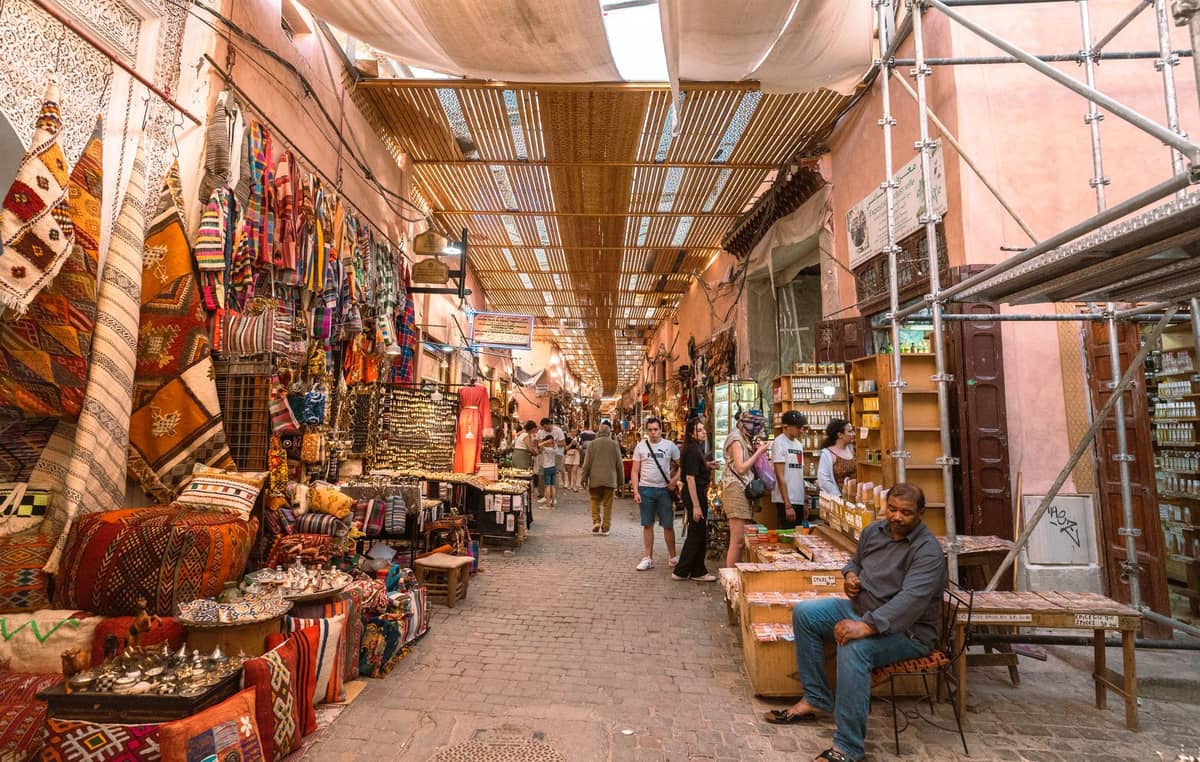
Getting between art venues requires some planning. MACAAL is south of the medina in Al Maaden, Gueliz galleries are west of the old walls, and Medina spaces are within the walled city where vehicles cannot go beyond the main access points. The distances between these clusters mean you will cover 3–5 km of mixed terrain in a single art day — manageable, but not walkable in a single straight line. Petit taxis are cheap and reliable for cross-city jumps; negotiate or insist on the meter before you get in.
Currency matters for admission. MACAAL charges in MAD (120 MAD is currently around 12 USD or about 11 EUR, though exchange rates vary). Some independent galleries are free entry. ATMs in Gueliz are plentiful and reliable; in the Medina, carry cash before you head deep into the historic core. Morocco's currency is the dirham (MAD) and it is not freely convertible, so plan your cash accordingly.
- Check MACAAL's current hours online before visiting — Ramadan adjustments and occasional private events can affect public access without much advance notice.
- For the 1-54 fair, register or buy tickets online in advance if available; last-minute queuing on public days is real during popular editions.
- Gallery hours in Marrakech, especially in the Medina, are often more flexible than posted times suggest. Calling ahead or arriving around midday (when staff are reliably present) reduces wasted trips.
- Dress modestly when visiting art spaces in the Medina — the galleries are contemporary but the surrounding streets follow traditional social norms. This is basic respect, not a formal requirement.
- French is the working language of the gallery circuit; English is widely spoken at MACAAL and during the 1-54 fair. Arabic and Darija are useful for taxi directions to less-known spaces.
For visitors with broader cultural interests, pairing the art scene with Marrakech's architectural heritage makes for a coherent few days. The best museums in Marrakech guide covers the full spectrum from historic to contemporary. And if you are building a longer itinerary around culture and design, the full things-to-do guide maps the city's wider offer.
FAQ
Is MACAAL worth visiting if I'm not a contemporary art specialist?
Yes, provided you go in with realistic expectations. MACAAL is a genuine museum with curated exhibitions of contemporary African art — the kind of work you would see in a European or American institution. You do not need specialist knowledge to engage with it, but if you expect traditional Moroccan craft or decorative art, you will be surprised. The building and setting are impressive regardless of your art knowledge level.
How do I get tickets for the 1-54 Contemporary African Art Fair in Marrakech?
Tickets are typically available through the official 1-54 website (1-54.com) in the weeks before the fair. The fair runs for just two public days, so buying in advance is strongly recommended. VIP and press previews require separate accreditation. Check the official site for the current edition's ticketing arrangements, as these vary slightly year to year.
Are Marrakech's contemporary art galleries free to enter?
It varies. MACAAL charges admission (120 MAD for adults, with concessions available). Many independent galleries in Gueliz and the Medina are free to enter, though some charge for specific events or guided experiences. The 1-54 fair charges admission for public days. Budget around 120–150 MAD for a day that includes MACAAL plus one or two other ticketed spaces.
When is the best time of year to visit Marrakech for contemporary art?
Late January to early February, timed around the 1-54 Contemporary African Art Fair, is the peak period for art activity across the city. Spring (March to May) is the next best window: comfortable temperatures, MACAAL at full hours, and gallery programming in full swing without the summer heat. Summer is workable for indoor gallery visits but challenging logistically. December is quieter on the art calendar but the city is at its most comfortable temperature-wise.
Is the contemporary art scene in Marrakech only for tourists?
No. The scene is genuinely shaped by local collectors, Moroccan artists, and pan-African curatorial networks. MACAAL in particular has strong educational programming aimed at Moroccan schools and communities, with reduced admission for African residents. The 1-54 fair draws a significant professional art world audience alongside tourism. That said, the fair-period crowd does skew international — if you want to see the scene as it operates locally, visit outside the fair window when the audience is more domestic.
Tickets & tours
Live prices and dates from our booking partner. If you book, we may earn a commission at no extra cost to you.
Planning a trip? Discover personalized activities with the Nomado app.