Jemaa el-Fna Square: What to Expect at Marrakech's Most Iconic Space
Jemaa el-Fna is the geographic and cultural center of Marrakech's medina. A free, open-air public square inscribed on UNESCO's Intangible Cultural Heritage list, it shifts personalities completely from morning to midnight, drawing storytellers, musicians, food vendors, and crowds in equal measure.
Quick Facts
- Location
- Centre of the medina, Marrakech, Morocco
- Getting There
- On foot from medina souks; taxi from Menara Airport (~70–100 MAD, 15–20 min); ALSA Bus 19 from airport (~30 MAD)
- Time Needed
- 1 hour minimum; 3–4 hours to absorb the evening atmosphere properly
- Cost
- Free to enter; budget extra for food stalls, juice, or tips for performers
- Best for
- First-time visitors, food lovers, photographers, night owls, culture seekers
- Official website
- www.placejemaaelfna.com/en
What Is Jemaa el-Fna?
Jemaa el-Fna is a large open square at the southwestern edge of Marrakech's medina, a few minutes' walk from the Koutoubia Mosque. During the day it functions as a transit hub and casual gathering point; at dusk it transforms into one of the most theatrically alive public spaces in the world. Dating back at least to the fourteenth century, the square has been in continuous social use for centuries, and in 2001 UNESCO originally proclaimed it a Cultural Space of Intangible Heritage, formally inscribing it in 2008 on the Representative List of the Intangible Cultural Heritage of Humanity — one of the first urban spaces in the world to receive this designation.
The name is sometimes translated loosely as 'Assembly of the Dead' or 'Mosque at the End of the World,' though scholars debate the exact etymology. What is not debatable is the square's function: it has long served as Marrakech's main public stage, where oral culture, trade, performance, and daily life converge in a way that has no real equivalent in North Africa.
ℹ️ Good to know
Jemaa el-Fna is free to enter and, as a public square, accessible at all hours of the day and night. There are no tickets, no gates, and no queues to get in. The square itself costs nothing — but bring small denomination dirhams (5–10 MAD notes) if you want to tip performers or photograph them.
Morning: When the Square Belongs to Locals
In the early morning, Jemaa el-Fna is quieter than most visitors expect. The paving stones are being hosed down, vendors are setting up juice carts, and orange-sellers arrange their pyramids with practiced precision. The smell is citrus and damp stone rather than smoke and spice. At this hour the square reads as a working public space: delivery motorbikes weave through, schoolchildren cut across it, and older men sit on low stools outside cafés nursing mint tea.
By mid-morning, the first snake charmers and henna artists claim their patches. The light is good for photography before 10am — soft and directional — and the square is sparse enough that you can actually frame a shot without a crowd of other tourists in it. If you want to photograph performers, establish clear consent before raising a camera. A tip of around 10–20 MAD per photo is standard practice, and declining to pay after taking a shot will often generate an uncomfortable confrontation.
Tickets & tours
Live prices and dates from our booking partner. If you book, we may earn a commission at no extra cost to you.
Marrakech City Guided Tour with Jemaa El-Fna Square and Lunch
From 49 €Instant confirmationFree cancellationFull day tour of Ouarzazate from Marrakech
From 51 €Instant confirmationFree cancellationEvening Quad Bike at Palmeraie Area with Tea Tasting from Marrakech
From 49 €Instant confirmationFree cancellationFull Day Economic Tour in Essaouira from Marrakech
From 29 €Instant confirmationFree cancellation
Afternoon: The Hazy Middle Hours
From roughly noon to 4pm, Jemaa el-Fna enters its least interesting phase. Summer heat (daytime highs in July and August often around or exceeding 35°C) empties much of the central space. The activity contracts toward the perimeter cafés, and the mood is drowsy. This is the time most tourists wander through without quite understanding what the fuss is about, because they are seeing the square at its flattest.
Use the afternoon instead to explore the souks that radiate north from the square, or visit nearby monuments like the Ben Youssef Madrasa and the Marrakech Museum. Return to Jemaa el-Fna around 5pm, when the atmosphere begins to shift noticeably.
💡 Local tip
In summer, the rooftop terraces of cafés overlooking the square — particularly on the eastern and northern edges — offer shade, cold drinks, and an elevated perspective on the scene below. Arrive at one of these terraces around 5:30pm to watch the square come alive from above before descending into it.
Dusk and Evening: The Square at Full Intensity
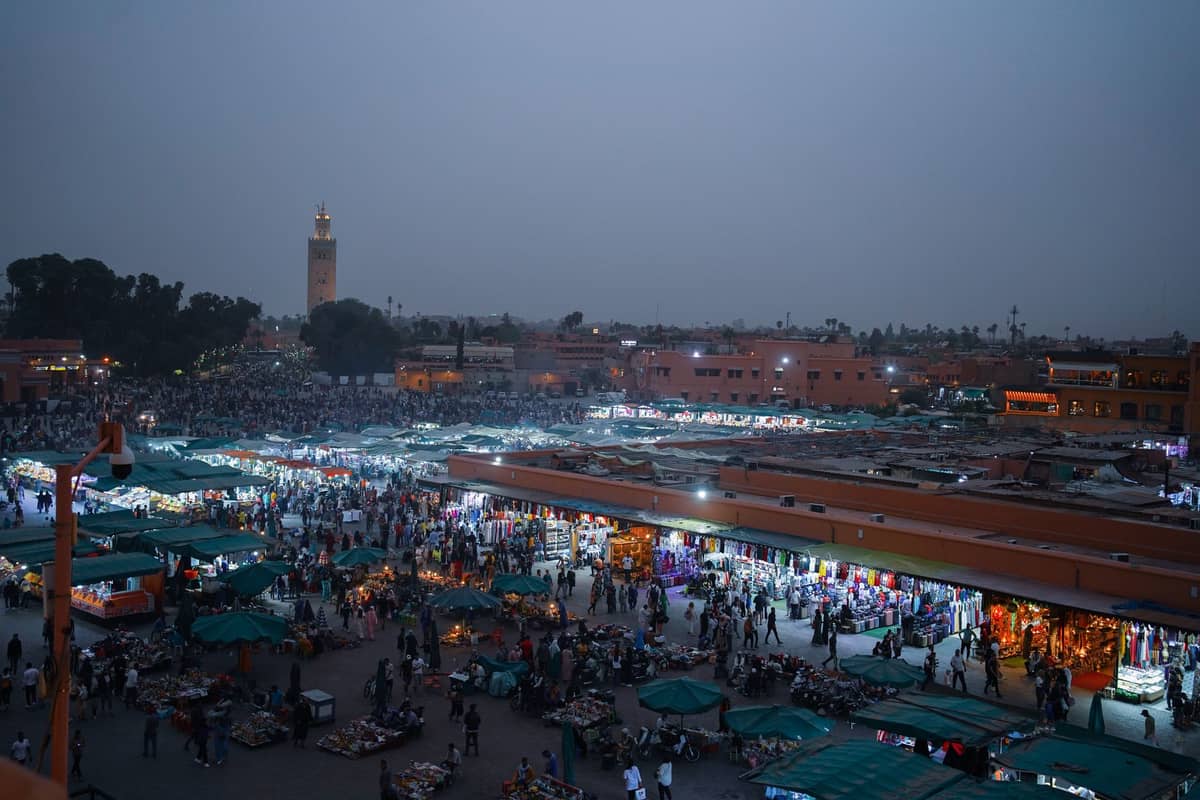
The transformation that begins around sunset is genuinely striking. Within about thirty minutes, the open expanse fills with food stalls, their gas lanterns hissing to life, smoke rising from dozens of grills simultaneously. The smell shifts: charcoal, lamb fat, cumin, harissa, and somewhere underneath it all, the sweet rot of the orange juice drains. Gnawa musicians set up in loose circles, playing krakeb (iron castanets) and guembri bass lutes. Water sellers in elaborate red costumes with broad-brimmed hats ring brass cups at passersby.
The storytellers — halaqas — gather the most intense audiences. These are oral performers continuing a centuries-old tradition of public narration, speaking in Darija (Moroccan Arabic) to tight circles of listeners who laugh, gasp, and toss coins into the ring. As a visitor who does not speak Darija you will not follow the narrative, but the energy of the audience is communicative on its own terms.
The food stall area runs down the center of the square. Each stall has a numbered sign and a young man outside it delivering a theatrical pitch to passing tourists, sometimes funny, sometimes exhausting. The stalls serve broadly similar menus: harira soup, merguez sausages, brochettes, kefta, snail broth (considered a local specialty), and sheep's head for the adventurous. Prices are fixed per stall and usually posted, but some stalls charge different amounts depending on who sits down — agree on pricing before ordering if you are concerned.
⚠️ What to skip
Stall numbers 1–30 nearest the main entrance tend to have the most aggressive touts. Walking confidently without making eye contact reduces (but does not eliminate) the pressure. If you sit down, you have committed to ordering. Leaving without ordering after a prolonged interaction is considered rude.
Late Night: After the Tourists Leave
After 10pm, the tourist numbers thin but the square does not empty. Moroccan families come out in force — this is a culture where evening is social time, and children are kept up late as a matter of course. The food stalls run until past midnight. A subset of the musicians and performers continue through the small hours, particularly on weekends. By 1am the atmosphere is looser and more local than at any other point in the evening.
Walking the perimeter at this hour, past the juice stands where vendors blend fresh oranges into cups for around 4 MAD, is as close as most visitors will get to experiencing the square the way residents do. The stakes feel lower, the pitching more relaxed, and the city's actual social life becomes more visible.
Historical and Cultural Context
The square sits at the heart of Marrakech's medina, the walled historic city founded in the 11th century by the Almoravid dynasty. For most of that history, Jemaa el-Fna served as the city's primary public gathering space: a marketplace, a site of public announcements, and a venue for the oral traditions that UNESCO later recognized as irreplaceable intangible heritage. The storytelling, acrobatics, and musical performances that take place here are not staged for tourists — they predate tourism to Morocco by several centuries, though they have inevitably adapted to a partially tourist audience in recent decades. For deeper context on Marrakech's Islamic architectural heritage that surrounds the square, the guide to Marrakech's Islamic architecture provides useful background.
The square's UNESCO inscription was explicitly for its intangible heritage rather than its physical form. The designation acknowledges the halaqas (storytellers), the gnawa musicians, the Amazigh acrobats from the High Atlas, and the water sellers as living cultural practitioners — not as performers of a recreation. This distinction matters. What you are watching has genuine cultural roots, even if the economy around it is now substantially tourist-driven.
Practical Information for Visitors
Jemaa el-Fna is free and open at all hours. Getting there from most medina accommodations is simply a matter of following the flow of foot traffic — nearly every lane in the medina eventually connects to the square. From Marrakech Menara Airport (IATA: RAK), about 6km southwest, ALSA Bus 19 runs every 20–30 minutes directly to the square for around 30 MAD. A petit taxi costs approximately 70–100 MAD and takes 15–20 minutes in normal traffic. Ride-hailing apps including Careem and inDrive operate in Marrakech and offer app-fixed prices in a similar range — verify availability in the app before travel, as this may change. For a full breakdown of airport options, see the Marrakech airport transfer guide.
The square is partially accessible for wheelchair users — the main open area is flat paving — but the surrounding lanes and the food stall area at night are crowded and uneven. For clothing, the medina is a conservative environment: shoulders and knees covered is appropriate regardless of season, and this reduces unwanted attention. For full guidance on what to pack and wear, the Marrakech clothing guide covers seasonal and cultural considerations in detail.
Photography in the square is technically unrestricted as a public space, but photographing individual performers, snake charmers, or henna artists without paying a tip will reliably cause conflict. Budget 10–20 MAD per interaction. Shooting from the rooftop cafés above the square is a practical way to photograph the panorama without direct negotiation.
Weather and Seasonal Considerations
Marrakech's climate is semi-arid, and the square experience varies significantly by season. Spring (March to May) and autumn (September to November) offer the most comfortable temperatures for lingering outdoors — daytime highs in the low-to-mid 20s°C in spring and similar in autumn, cooling to pleasant evenings. Summer evenings are warm but the heat of the day can be punishing, especially in July and August when temperatures regularly exceed 35°C. Winter evenings (December to February) can be surprisingly cold — evening temperatures drop into single figures in January, and the square feels different, less populated, more local. December is actually a worthwhile time to visit for those who prefer atmosphere over warmth; the guide to Marrakech in December explains what to expect.
Rain in Marrakech is concentrated in the cooler months (November to February) and occasional showers can empty the square rapidly. There is no covered shelter within the square itself. The rooftop cafés provide some cover. Visiting during Ramadan changes the experience substantially — the square comes alive after iftar (the fast-breaking meal at sunset) with an intensity that exceeds even normal evenings, but some food stalls close during daylight hours and the social atmosphere is somewhat different.
Insider Tips
- Position yourself on a rooftop café terrace facing the square at 5:30pm and order one drink. Watch the food stalls materialize below you in real time over about 45 minutes. This overhead perspective is something ground-level visitors completely miss.
- The orange juice stalls around the perimeter charge around 4–5 MAD per cup — some of the cheapest and most reliably fresh juice anywhere in Marrakech. Avoid stalls that quote you a price significantly higher before you sit down.
- If a performer approaches you unsolicited and places something in your hands (a snake, a monkey, a hat), you are about to be charged for it whether you want to or not. Return it immediately and firmly rather than engaging.
- Come back to the square at two very different times: once around 9am for the quiet, locals-only morning atmosphere, and once around 8pm for the full evening intensity. The contrast tells you more about the place than a single visit ever could.
- The halaqas (oral storytellers) typically gather in the northeastern section of the square after dark. Even without understanding Darija, standing at the outer edge of the circle for ten minutes and watching the audience react is worth doing — it is a form of performance that has almost no equivalent elsewhere in the world.
Who Is Jemaa el-Fna Square For?
- First-time visitors to Marrakech who need a geographic and cultural anchor point for the medina
- Food travelers who want to sample Moroccan street food (harira, merguez, snail broth) without restaurant formality
- Night owls and people interested in street performance, oral culture, and Gnawa music
- Photographers willing to engage with subjects directly and pay for portrait access
- Travelers interested in UNESCO Intangible Cultural Heritage and what living tradition actually looks like
Nearby Attractions
Other things to see while in Jemaa el-Fna & Koutoubia:
- Koutoubia Mosque
Rising about 69 metres above the medina (around 77 metres including its finial), the Koutoubia Mosque is the architectural anchor of Marrakech. Built by the Almohad dynasty in the 12th century, its minaret has shaped skylines and inspired imitations from Seville to Rabat. Non-Muslim visitors are welcome in the surrounding gardens and can observe the exterior freely, making it an essential stop near Jemaa el-Fna.
Planning a trip? Discover personalized activities with the Nomado app.