Marrakech Souks: How to Navigate the Medina's Ancient Markets
The Marrakech Souks are a sprawling network of traditional markets occupying the historic medina north of Jemaa el-Fna. Organized by craft and trade since medieval times, they offer everything from hand-tooled leather to raw saffron — free to enter, endlessly complex, and unlike most shopping experiences travellers encounter at home.
Quick Facts
- Location
- Medina of Marrakech, north of Jemaa el-Fna
- Getting There
- Taxi or bus to Jemaa el-Fna, then walk north into Souk Semmarine
- Time Needed
- 2–4 hours minimum; a full day for serious shoppers
- Cost
- Free to enter; tannery terraces charge a small viewing fee in MAD
- Best for
- Craft shopping, cultural immersion, photography, sensory exploration
What the Marrakech Souks Actually Are
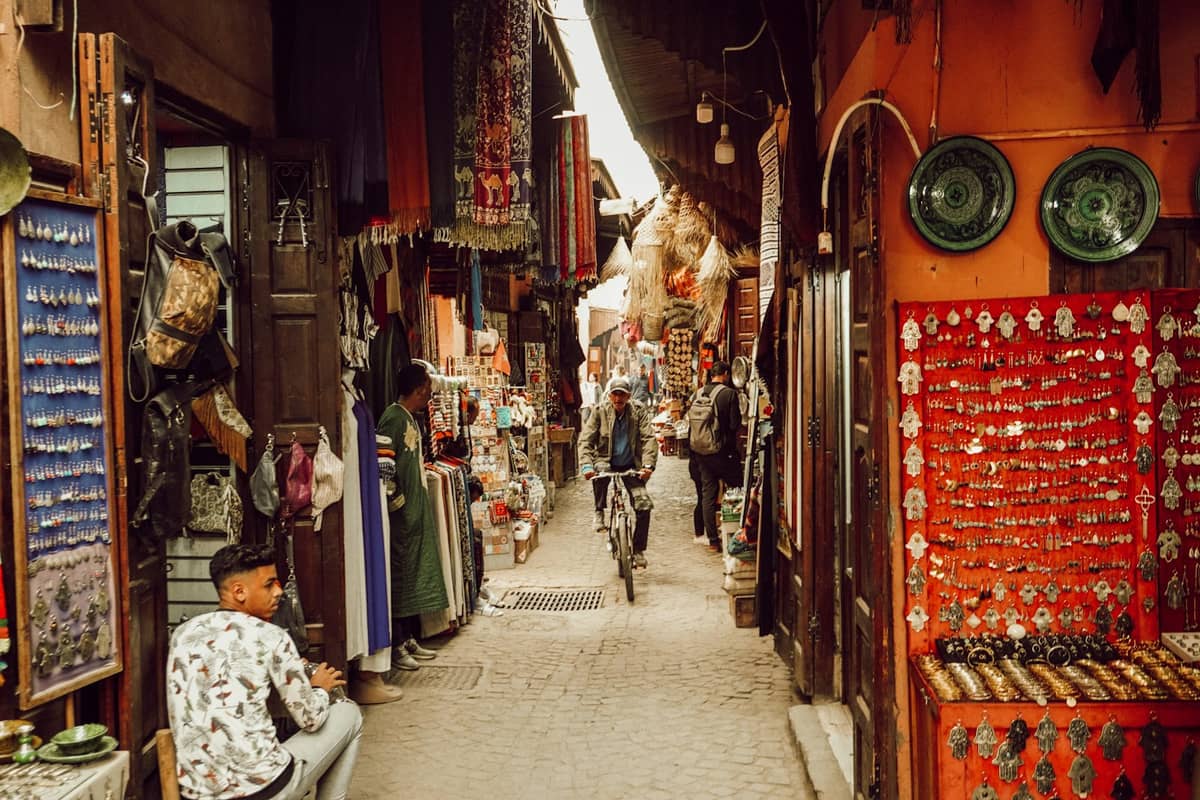
The Marrakech Souks are not a single market. They are a dense, interlocking city within a city: hundreds of alleyways, workshops, and stalls organized by trade, spreading across a substantial portion of the historic medina directly north of Jemaa el-Fna. The entry point most visitors use is Souk Semmarine, a wide covered lane lined with textiles and tourist goods that funnels you into a tighter web of specialized quarters the further in you go.
The organization reflects centuries-old guild structures. Dyers congregate near the Souk des Teinturiers, metalworkers hammer out lanterns and trays in Souk Haddadine, carpenters and woodcarvers fill Souk Chouari with the smell of cedar shavings. Leather workers, spice vendors, hat makers, and carpet sellers each have their own section. This is not a theme park recreation of a traditional market — it is a traditional market, still functioning as it has since Marrakech's founding in the 11th century, now layered with a tourist economy on top.
To understand what you are walking into, it helps to read a dedicated shopping guide to the Marrakech souks before you go. Arriving with at least a rough map of the different souk zones will save you from spending your first hour in the most tourist-facing stalls near the entrance.
💡 Local tip
Enter from the northern end of Jemaa el-Fna rather than the eastern side. The path through Souk Semmarine is better lit, easier to navigate initially, and gives you a clear orientation axis for the whole market network.
How the Souks Change by Time of Day
Arriving early, around 09:00–10:00, gives you the market at its most functional and least theatrical. Shopkeepers are setting up, arranging displays, stacking goods. The light at this hour is soft and raking, filtering through latticed reed roofing to cast geometric shadows across the lane floors. The smell is layered differently in the morning: bread from a nearby bakery, fresh mint carried in from the market gardens, the faint chemical tang of tanning pits carried on cooler air.
By late morning, the souks are fully operational and foot traffic builds steadily. This is when the haggling is most energetic and when you are most likely to be approached by unofficial 'guides' offering to show you around. Midday is the most challenging time: narrow lanes channel the afternoon heat, mopeds threading through crowds make it loud and slightly claustrophobic, and the pressure-selling is at its peak. Visitors who dislike crowds or intense sales interactions will find midday the hardest.
Late afternoon, roughly 16:00 onwards, is where the souks find a different rhythm. The tourist wave has partly thinned, locals are shopping for household goods, and the quality of light improves dramatically for photography. By 18:00–19:00 in summer, many stalls remain open as temperatures drop, and the covered sections fill with the amber light of bare bulbs strung overhead. This is arguably the most atmospheric time to be here, though you need to know your exit route since the alleys can feel disorienting in low light.
⚠️ What to skip
On Fridays, many shops close partially between late morning and mid-afternoon for prayers and reopen around 15:00. Plan accordingly if Friday is your only available day.
Tickets & tours
Live prices and dates from our booking partner. If you book, we may earn a commission at no extra cost to you.
Guided visit of souks and medina in Marrakech
From 31 €Instant confirmationFree cancellationMarrakech Souks and shopping guided tour
From 40 €Instant confirmationFree cancellation3-Hour monuments & souks walking tour in Marrakech
From 25 €Instant confirmationFree cancellationFull day tour of Ouarzazate from Marrakech
From 51 €Instant confirmationFree cancellation
The Major Souk Zones: A Practical Guide
Souk Semmarine is the main artery and the most commercial: clothing, pashminas, babouche slippers in every color, lanterns. Quality here varies enormously and prices for tourists start high. Think of it as the ground floor of the souk system, worth passing through but not where you want to spend most of your time or money.
Souk el-Attarin, the spice and perfume market, sits deeper in the network. The stalls here stock piles of cumin, ras el hanout, dried rose petals, argan products, and amber resin. The vendors are knowledgeable and the goods are genuinely excellent, though many of the 'argan oil' products sold to tourists near the entrance contain very little actual argan. Go further in for better quality and more honest pricing.
The Souk des Teinturiers — the dyers' quarter — is in a different category entirely. Skeins of freshly dyed wool hang from poles above a narrow lane, dripping color in reds, yellows, and blues. It is one of the most visually striking scenes in the medina and consistently worth seeking out, though it is a working quarter, not a display.
The leather tanneries lie just northeast of the main souk network. Tannery terraces look over the dye pits where hides are softened and colored in stone vats. The smell is significant — the pits use pigeon dung as part of the tanning process — and shops on the terraces typically hand visitors sprigs of mint. The leather goods sold here include bags, belts, and jackets at prices that, after bargaining, are often genuinely competitive.
Read more about visiting the leather tanneries before you go, since access through the terrace shops involves a degree of social obligation to look at their products.
Bargaining: What Actually Works
Bargaining in the souks is not optional and not aggressive — it is a social transaction with its own etiquette. Vendors quote a starting price that can be two to four times what they are willing to accept for tourist-facing goods. Walking away slowly but genuinely is the single most effective tactic; in most cases, a revised price follows before you have taken five steps.
The key distinction is between goods sold to tourists and goods sold to locals. Spices, basic food items, and household hardware are priced more consistently because locals buy them too. Carpets, leather, and silver jewelry are the categories where price flexibility is greatest and where the most time is invested in the sales process. If you sit down for tea in a carpet shop, you are inside a multi-act transaction that can last an hour. There is nothing wrong with doing this — the carpets are often beautiful and the tea is free — but understand what you are entering.
ℹ️ Good to know
Agreeing on a price and then backing out is considered very poor form. Only begin a negotiation if you are genuinely considering buying. Saying 'I need to think about it' and returning later is entirely acceptable and sometimes results in a lower price.
Historical and Cultural Context
Marrakech was founded in 1070 CE by the Almoravid dynasty as a trading and military base for their expanding empire. The souks grew organically around this function: merchants, craftspeople, and guilds established quarters that clustered by trade, a pattern formalized over subsequent centuries under the Almohad, Marinid, Saadian, and Alaouite dynasties. The spatial organization you walk through today — metalworkers in one lane, dyers in another, spice sellers in a third — is not a preservation project or a tourism reconstruction. It is a living urban structure that has persisted for nearly a thousand years.
The medina of Marrakech was designated a UNESCO World Heritage Site in 1985, recognizing the outstanding universal value of its urban fabric, including the souk network. The Ben Youssef Madrasa — one of North Africa's largest historic Quranic schools — lies within walking distance of the northern souks and adds significant architectural context to any visit.
Craft production in the souks remains active rather than purely decorative. You can watch weavers at looms, carpenters routing geometric patterns into cedarwood, and tinsmiths punching star patterns into metal sheets. These are not demonstrations staged for tourists; workshops here supply both the local market and export orders. The quality of production varies, and the cheapest goods near souk entrances are often mass-produced imports rather than local craft.
Practical Intelligence: Getting There, Getting Around, and Staying Oriented
The souks are entirely pedestrian. Taxis, including petits taxis and private transfers, drop off at Jemaa el-Fna. From there, the souk entrance via Souk Semmarine is a short, signposted walk north from the square. ALSA Bus 19 connects Marrakech Menara Airport (RAK) to Jemaa el-Fna roughly every 20–30 minutes, making it a practical and low-cost option for arriving directly at the starting point.
Navigation inside the souks is genuinely difficult, and getting lost is essentially guaranteed on a first visit. This is not necessarily a problem — many of the best discoveries happen while disoriented — but having an offline map downloaded to your phone (Google Maps works reasonably well for the main lanes) removes the anxiety. The key landmark to reorient yourself is always Jemaa el-Fna to the south; following the busier, more open lanes generally leads back toward the square.
Mopeds use the same lanes as pedestrians, often without warning. Stay aware and step to the side when you hear a horn. Dress codes in the medina lean modest; shoulders and knees covered is appropriate, and this is particularly relevant near mosques and working quarters. For more detail, the guide to what to wear in Marrakech covers this clearly.
Photography of goods, workshops, and architecture is generally uncontroversial. Photographing people — particularly women, older residents, or people at prayer — requires sensitivity and ideally permission. Many shopkeepers will ask you to buy something if you photograph their stall at length. This is reasonable; a purchase or a small tip is a fair exchange.
💡 Local tip
Bring cash in Moroccan dirhams. While a small number of larger shops now accept cards, the overwhelming majority of souk transactions are cash-only. ATMs are available near Jemaa el-Fna before you enter.
Who Should Skip the Souks
Visitors who find high-pressure sales environments genuinely distressing may find the central souk experience more draining than enjoyable, especially mid-day. The peripheral quarters — the dyers' lane, the metalworkers' section, the woodworking area — carry far less sales pressure and are worth visiting even if the carpet shops and jewelry stalls feel overwhelming. Wheelchair users and those with significant mobility limitations will find the uneven, narrow alleys difficult to navigate; the terrain is historic stone and compressed earth, with no accommodations for accessibility.
If your primary goal is shopping for luxury or designer goods, the souks are not the right venue; the modern Gueliz district has contemporary retail. If you want a quick cultural tick-box experience with minimal engagement, an hour at the souk entrance and a lap around the spice market will technically cover it, but it will not give you any real sense of what makes this place significant.
Insider Tips
- The best quality argan oil and spices are not at the stalls nearest Jemaa el-Fna. Walk at least five minutes deeper into Souk el-Attarin before buying; prices drop and authenticity improves the further from the tourist entry point you get.
- If you want to watch craft production without any sales interaction, time your visit to the woodworking quarter (Souk Chouari) before 10:00. Carpenters are focused on work at this hour and largely ignore passing visitors.
- The tanneries are most photogenic and least odorous in morning light, roughly 09:00–11:00, when fresh hides are being worked and the sun has not yet heated the vats. Afternoon visits are smellier and more crowded.
- Locals buy household goods including tagines, bread, and produce in the souks too, particularly in the northern sections further from Jemaa el-Fna. Following local shopping traffic leads you to genuinely useful goods at locally appropriate prices.
- The covered sections of Souk Semmarine and Souk el-Kebir are roofed in slatted wood that filters the sun into dramatic bars of light between roughly 10:00 and 14:00. This is the best window for overhead architectural photography.
Who Is Marrakech Souks For?
- Shoppers looking for handcrafted leather, ceramics, textiles, and metalwork at negotiated prices
- Photographers drawn to craft production, light effects, and concentrated visual detail
- Cultural travelers wanting direct contact with a functioning medieval trade system
- Travelers with a full day in Marrakech who want a single immersive destination rather than an itinerary of separate sites
- Anyone interested in the relationship between Islamic urban design and commercial life
Nearby Attractions
Other things to see while in Marrakech Medina:
- Ben Youssef Madrasa
Ben Youssef Madrasa is a 16th-century Saadian theological college in the heart of Marrakech's medina, and arguably the most ornately decorated interior in the entire city. Its central courtyard combines carved cedar, zellij tilework and sculpted stucco in a way that stops most visitors cold. This guide covers exactly what to expect, when to go, and how long to spend.
- Dar El Bacha – Musée des Confluences
Built in 1910 for the powerful Pasha Thami El Glaoui, Dar El Bacha is one of the medina's grandest palatial complexes. Restored and reopened as the Musée des Confluences, it now presents Moroccan art and craftsmanship within some of the city's most extraordinary interior architecture.
- Koubba Ba'adiyn (Almoravid Qoubba)
Built around 1117, the Koubba Ba'adiyn is the sole intact Almoravid structure in Marrakech and one of the oldest Islamic monuments in the city. Small in footprint but immense in historical weight, it sits several metres below the current street level near Ben Youssef Square, offering a rare glimpse into the architectural vocabulary that defined Islamic North Africa before the Almohads arrived.
- Le Jardin Secret
Tucked inside a 19th-century palace complex on Rue Mouassine, Le Jardin Secret is one of the largest traditional riad gardens in the Marrakech medina. Opened to the public in 2016 after an extensive restoration, it offers two distinct garden styles, ornate Islamic architecture, and a rooftop tower with panoramic views of the medina roofscape and the Atlas Mountains beyond.
Planning a trip? Discover personalized activities with the Nomado app.