Koubba Ba'adiyn (Almoravid Qoubba): Marrakech's Last Almoravid Survivor
Built around 1117, the Koubba Ba'adiyn is the sole intact Almoravid structure in Marrakech and one of the oldest Islamic monuments in the city. Small in footprint but immense in historical weight, it sits several metres below the current street level near Ben Youssef Square, offering a rare glimpse into the architectural vocabulary that defined Islamic North Africa before the Almohads arrived.
Quick Facts
- Location
- Place Ben Youssef, Medina, Marrakech
- Getting There
- On foot from Jemaa el-Fna (15–20 min north through the medina); no metro in Marrakech
- Time Needed
- 30–45 minutes on its own; 2–3 hours combined with Ben Youssef Madrasa and Marrakech Museum
- Cost
- 100 MAD foreign adults / 50 MAD foreign children 7–13 / 30 MAD Moroccan or resident adults / 10 MAD Moroccan or resident children 7–13 / Free for Moroccan nationals on Fridays and on the first day of national and religious holidays. Free for visitors with reduced mobility. Verify before visiting.
- Best for
- History enthusiasts, architecture lovers, medina walkers
- Official website
- almoravidkoubba.com
What Is the Koubba Ba'adiyn?
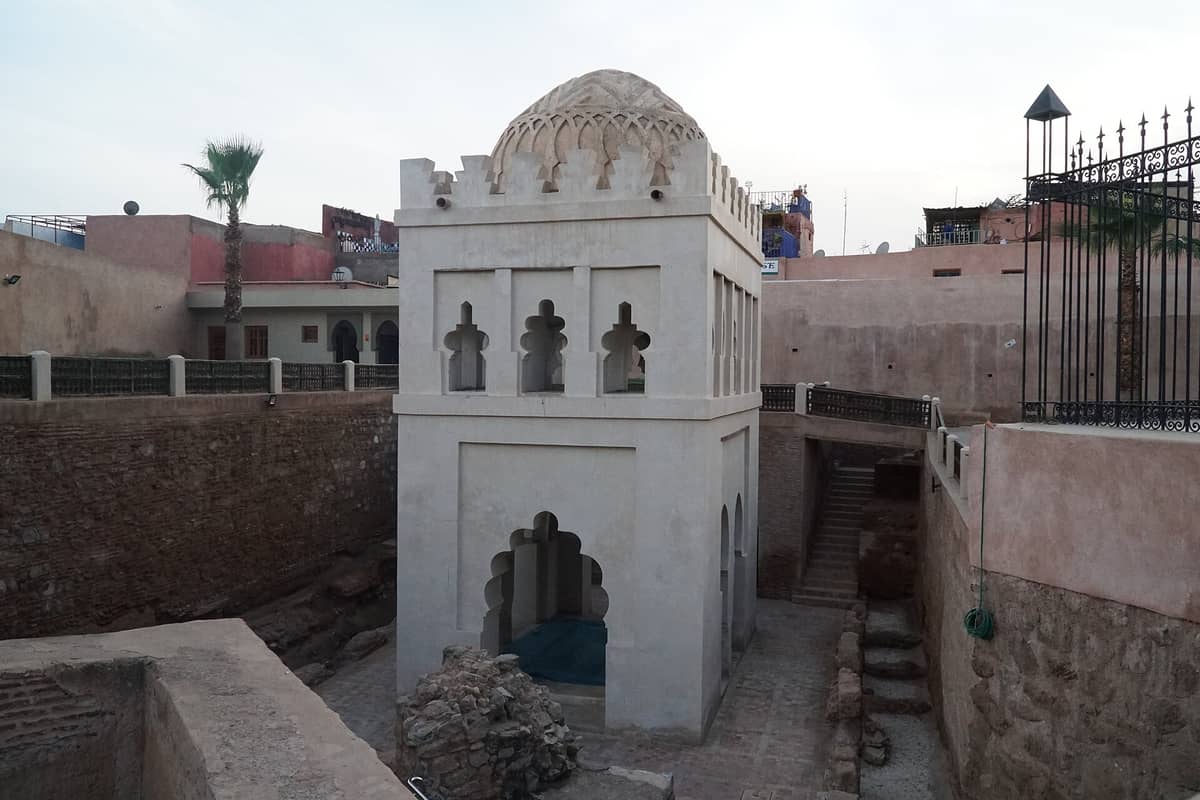
The Koubba Ba'adiyn, also written as Qoubba al-Baadiyn or the Almoravid Qoubba, is the only structure in Marrakech that dates from the city's founding dynasty. Every other Almoravid building in the city was demolished by the Almohads when they captured Marrakech in 1147. This small domed pavilion, measuring roughly 8 by 6 metres at its base and rising to about 10 metres, survived that destruction largely because it served a practical function: it was built to house ablution facilities for worshippers of the original Ben Youssef Mosque next door.
Historians date its construction to approximately 1117, during the reign of the Almoravid sultan Ali ibn Yusuf. That makes it not just Marrakech's oldest intact monument, but one of the oldest surviving examples of Moroccan Islamic architecture anywhere. The Almohads who razed the city around it either overlooked the Koubba or chose to preserve it; either way, its survival is historically improbable and architecturally precious.
ℹ️ Good to know
The Koubba sits several metres below present street level. You descend to it, which immediately gives you a sense of how much Marrakech has been built up over the centuries. Wear shoes with grip, as the steps can be worn smooth.
The Architecture Up Close
From the street, the Koubba barely announces itself. You pass through a low entrance, pay at a small ticket booth, and descend a short flight of steps into a sunken courtyard. Then the dome appears in full, and the scale shift is immediate. The exterior shell is a double-shell dome, a technical innovation that allows the interior and exterior profiles to differ. From outside, the dome sits on a rectangular base decorated with carved stone friezes, zigzag crenellations, and interlaced arched blind arcades, all rendered in pale ochre limestone that has softened with age.
The interior of the dome is where the craftsmanship becomes extraordinary. An eight-pointed star, a geometric motif that would go on to define Moroccan and Andalusian decorative art for the following five centuries, is cut into the dome's apex. Below it, successive zones of carved stucco shift between floral arabesques, Kufic calligraphy, and geometric lacework. The transitions between these registers are crisp despite almost 900 years of exposure. The precision of the carving, done without power tools, is the kind of detail that makes you stand still and look for longer than you expected.
Architecturally, the Koubba represents a bridge between the Umayyad aesthetic inherited from Al-Andalus (notably the horseshoe arches and interlaced motifs borrowed from the Great Mosque of Córdoba) and the distinctly Moroccan decorative language that would crystallise under later dynasties. The Almohads, the Merinids, and eventually the Saadians all built upon the visual vocabulary pioneered here. That lineage is easier to read once you have seen the Koubba in person.
For broader context on how this building fits into Marrakech's architectural story, the guide to Islamic architecture in Marrakech traces the stylistic evolution from this structure through to the city's later monuments.
Tickets & tours
Live prices and dates from our booking partner. If you book, we may earn a commission at no extra cost to you.
Full day tour of Ouarzazate from Marrakech
From 51 €Instant confirmationFree cancellationEvening Quad Bike at Palmeraie Area with Tea Tasting from Marrakech
From 49 €Instant confirmationFree cancellationFull Day Economic Tour in Essaouira from Marrakech
From 29 €Instant confirmationFree cancellationFull Day Economic Tour of Ourika Valley from Marrakech
From 25 €Instant confirmationFree cancellation
How the Visit Changes by Time of Day
The Koubba is officially open daily from 9:00 AM to 5:00 PM, though hours should be verified before your visit. The Ben Youssef quarter of the medina is active early with locals heading to work and school, but the Koubba itself draws fewer tourists before midday. The light at this hour is cool and indirect, which suits the pale limestone well and reduces glare in photographs.
Between noon and 2:00 PM, tour groups from organised itineraries tend to arrive, often combining the Koubba with the adjacent Ben Youssef Madrasa in a single block booking. The courtyard is small enough that even a group of fifteen people fills it considerably, so the experience during this window is less contemplative. If you are visiting independently, the post-lunch period around 2:30 to 4:00 PM tends to be relatively calm again, as groups move on and the afternoon heat keeps some visitors indoors.
In winter months (roughly December to February), afternoon light falls more directly into the sunken courtyard, illuminating the carved stone in warm tones. Summer afternoons can be very hot given the lack of shade; if you are visiting June through August, the morning slot is strongly preferable.
Getting There and Navigating Ben Youssef
The Koubba is located just off Place Ben Youssef at 75 Derb Souk Cheria in the northern medina, a few metres from the entrance to the Ben Youssef Madrasa. From Jemaa el-Fna, the walk north through the main souk arteries takes roughly 15 to 20 minutes on foot, passing through the spice and textile souks along the way. There is no metro in Marrakech, so you will either walk, take a petit taxi to the edge of the medina, or arrange transport through your riad.
Most visitors reach the Ben Youssef quarter as part of a longer medina walk. The Marrakech walking tour guide covers a route that connects the Koubba with the major monuments of the northern medina, including the Marrakech Museum and the Mouassine quarter.
💡 Local tip
The Koubba, the Ben Youssef Madrasa, and the Marrakech Museum share the same square and can be visited in a single 2–3 hour block. Buy individual tickets at each entrance; any combination ticket offers should be confirmed on-site as they are not always available.
The streets immediately around Place Ben Youssef are narrow and often clogged with motorbikes in the mid-morning. Walk close to the walls and move single-file in narrow passages. Signage to the Koubba exists but is inconsistent; looking for the Marrakech Museum (Musée de Marrakech) is sometimes easier, as they share the same square and the museum is better marked.
Practical Details and Accessibility
Admission as of the most recently published pricing is 100 MAD for foreign adults, 50 MAD for foreign children aged 7–13, 30 MAD for Moroccan or resident adults, and 10 MAD for Moroccan or resident children aged 7–13. Moroccan nationals enter free on Fridays and on the first day of national and religious holidays. Visitors with reduced mobility are listed as receiving free entry on the official ticketing page, though the site itself is noted as only partially accessible due to the below-street-level descent via stairs. All prices and hours should be verified at the official website or on arrival, as they are subject to change.
There is no cloakroom or luggage storage at the site, and the courtyard is compact, so large backpacks become awkward. The ticket area is shaded, but the courtyard itself is open to the sky. In the midday summer sun, that 30-minute visit can feel significantly longer. A small bottle of water is worth having.
If the Koubba is part of a broader museum circuit, the guide to Marrakech's best museums gives a useful overview of which sites to prioritise based on your interests and available time.
Photography and What to Realistically Expect
The Koubba is a photographer's subject that requires patience. The courtyard is small, which means wide-angle shots of the full dome are difficult without distortion. The best framing is from the base of the dome looking upward, capturing the star-shaped oculus and the carved stucco rings descending from it. A phone camera handles this reasonably well in morning light. In the afternoon, direct sun from the south can blow out the pale limestone; slightly overcast days actually produce better detail in the stonework.
The Koubba is a monument of major historical significance, but it is not a large or visually dramatic space. Visitors expecting the scale of the Ben Youssef Madrasa next door will find it modest. What it offers is intimacy and precision: you are standing very close to one of the oldest pieces of carved stonework in Morocco, and nothing is behind glass. That proximity is rare. For anyone with an interest in Islamic art, Moroccan history, or pre-Almohad architecture, the Koubba rewards attention. Visitors who prefer visual spectacle or expansive ruins may find the 100 MAD ticket harder to justify.
For context on the broader medina area and what else is worth your time nearby, the medina neighbourhood guide covers the full range of historic sites and how to connect them efficiently.
Cultural and Historical Context
The Almoravid dynasty (roughly 1040s to 1147) was a Sanhaja Berber confederation that rose from the western Sahara and went on to control a territory stretching from Senegal to the Iberian Peninsula. Marrakech was their capital, founded around 1070. At their peak, the Almoravids ruled one of the largest empires in the medieval world and presided over an extraordinary exchange between sub-Saharan African, North African, and Andalusian cultures.
When the Almohads, a rival Berber movement from the High Atlas, overthrew the Almoravids, they demolished almost all Almoravid construction in Marrakech, apparently for both political and theological reasons. The Koubba Ba'adiyn is what remains. Walking around it, you are looking at the only physical trace of a dynasty that once governed from the Sahara to Toledo.
The Saadian Tombs, the Bahia Palace, and the Ben Youssef Madrasa represent later dynasties' contributions to the city's architectural heritage. A visit to the Ben Youssef Madrasa directly next door shows how dramatically Moroccan Islamic decoration evolved in the four centuries between the Almoravid and Merinid eras.
Insider Tips
- Visit between 9:00 and 10:30 AM on a weekday if you want the courtyard to yourself. Tour groups typically arrive from 11:00 AM onward.
- Look at the exterior crenellations from the descent stairs before entering the main structure. The stepped merlons on the roofline are one of the earliest surviving examples of this decorative feature in Moroccan architecture.
- The dome's interior is best photographed from directly below the oculus. Crouch low, point straight up, and shoot. This single frame captures the full geometric composition of the ceiling.
- Combine your visit with the Marrakech Museum on the same square. The museum's courtyard is open to non-paying visitors in parts, and the riad-style architecture provides a pleasant contrast to the Koubba's more austere exterior.
- On Fridays, Moroccan nationals enter free, which can make the site noticeably more local in character, a different atmosphere from the usual tourist-heavy morning visits.
Who Is Koubba Ba'adiyn (Almoravid Qoubba) For?
- History and archaeology enthusiasts who want Marrakech's oldest surviving structure
- Architecture lovers tracing the roots of Moroccan Islamic ornamental tradition
- Photographers looking for intricate geometric stonework with minimal crowds in the early morning
- Medina walkers building a half-day northern medina circuit combining the Koubba, Madrasa, and Marrakech Museum
- Travellers on a second or third visit to Marrakech who have already covered the main sights
Nearby Attractions
Other things to see while in Marrakech Medina:
- Ben Youssef Madrasa
Ben Youssef Madrasa is a 16th-century Saadian theological college in the heart of Marrakech's medina, and arguably the most ornately decorated interior in the entire city. Its central courtyard combines carved cedar, zellij tilework and sculpted stucco in a way that stops most visitors cold. This guide covers exactly what to expect, when to go, and how long to spend.
- Dar El Bacha – Musée des Confluences
Built in 1910 for the powerful Pasha Thami El Glaoui, Dar El Bacha is one of the medina's grandest palatial complexes. Restored and reopened as the Musée des Confluences, it now presents Moroccan art and craftsmanship within some of the city's most extraordinary interior architecture.
- Le Jardin Secret
Tucked inside a 19th-century palace complex on Rue Mouassine, Le Jardin Secret is one of the largest traditional riad gardens in the Marrakech medina. Opened to the public in 2016 after an extensive restoration, it offers two distinct garden styles, ornate Islamic architecture, and a rooftop tower with panoramic views of the medina roofscape and the Atlas Mountains beyond.
- Leather Tanneries
The Bab Debbagh tanneries sit at the northeastern edge of Marrakech's medina, where leather has been treated in open stone vats for centuries. This guide covers what you'll actually see, the best time to visit, how to handle informal guides, and who this walk is worth it for.
Planning a trip? Discover personalized activities with the Nomado app.