Bab Debbagh Tanneries: Inside Marrakech's Ancient Leather Quarter
The Bab Debbagh tanneries sit at the northeastern edge of Marrakech's medina, where leather has been treated in open stone vats for centuries. This guide covers what you'll actually see, the best time to visit, how to handle informal guides, and who this walk is worth it for.
Quick Facts
- Location
- Bab Debbagh quarter, northeastern medina, Marrakech
- Getting There
- 15-20 min walk from Jemaa el-Fna, or petit taxi to Bab Debbagh (~10-20 MAD)
- Time Needed
- 45 minutes to 1.5 hours
- Cost
- Free entry; expect informal guide requests (approx. 20-50 MAD)
- Best for
- Photography, craft history, medina deep-dives
What the Bab Debbagh Tanneries Actually Are
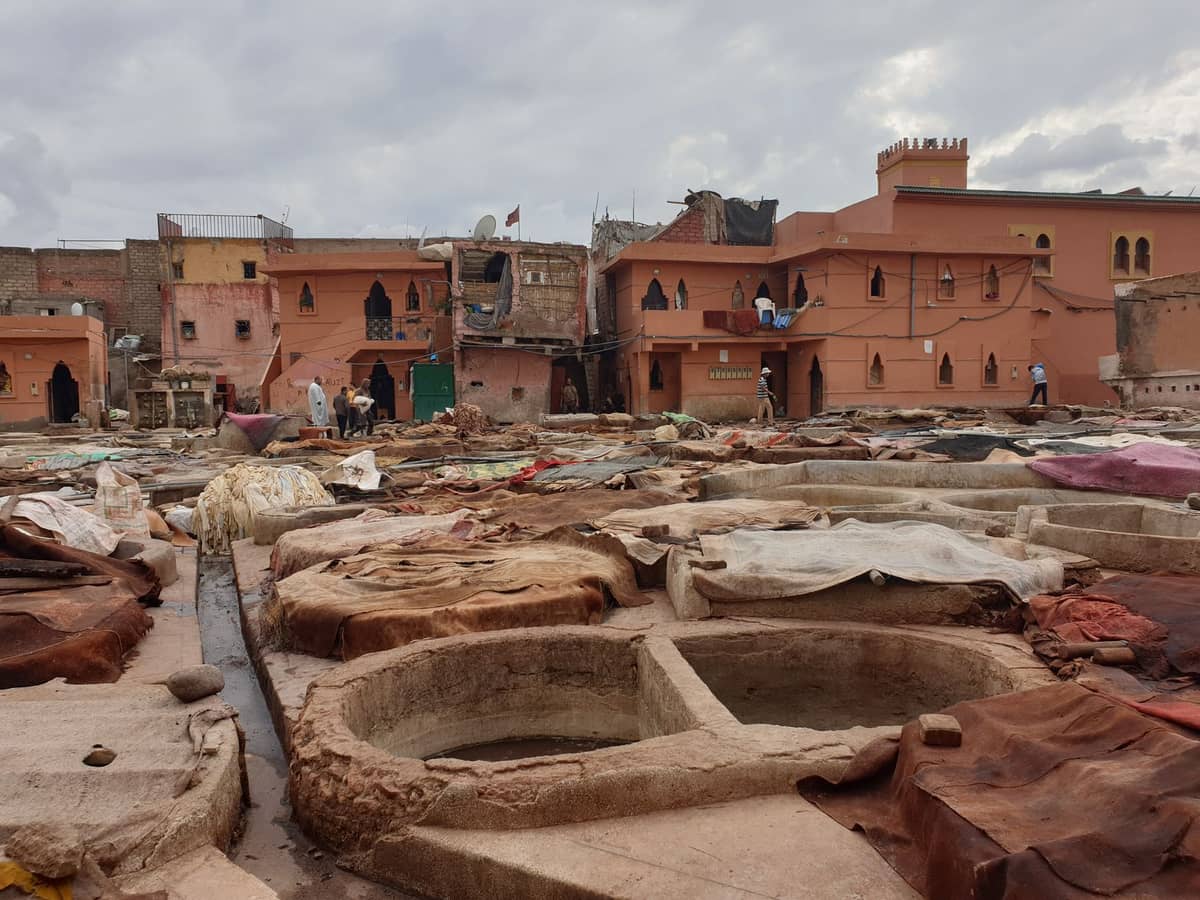
The Bab Debbagh tanneries are not a museum, a ticketed attraction, or a curated experience. They are a working craft quarter at the northeastern edge of Marrakech's medina, named for the ancient city gate whose Arabic name, Bab ad-Debbagh, literally translates as "Gate of the Tanners." The leather trade here predates most of the monuments tourists come to Marrakech to photograph.
What you find is a cluster of open-air stone vats filled with dyes and tanning solutions, surrounded by skins at various stages of curing. Workers wade through the pits and stretch hides across rooftop terraces to dry in the sun. The smell hits well before the view does: a sharp, ammonia-heavy scent from the pigeon droppings and quicklime used to strip fur from hides, layered beneath earthier odors of bark tannin and natural dyes. Some terraced leather shops above the pits offer sprigs of fresh mint to visitors, which helps.
ℹ️ Good to know
There is no official ticket booth. The tanneries are free to visit, but you will almost certainly be approached by informal fixers offering to take you to a rooftop viewpoint. You are not obligated to tip or pay, though a small amount (20-50 MAD) is reasonable if someone shows you the best vantage point.
The History Behind the Craft
Leather tanning in Marrakech's medina dates back to the medieval period, and the positioning of the quarter near the Oued Issil river was deliberate: running water was essential for soaking hides, and placing the industry at the city's edge kept the most pungent phases of production away from residential neighborhoods. The gate of Bab Debbagh itself is one of the historic openings in Marrakech's city walls, its name a direct acknowledgment of the trade that defined this corner of the city for generations.
The techniques used today would be broadly recognizable to a craftsman from several centuries ago. Hides are first soaked in lime pits to remove hair, then moved through a series of tanning vats containing bark, mimosa, or other plant-based agents, before being dyed in the chromatic pits that give the tanneries their visual appeal: terracotta reds, saffron yellows, deep greens. It is a process almost entirely done by hand and by eye. For context on how this craft fits into Marrakech's broader artisan economy, the medina souks that channel finished leather goods toward buyers are less than a 30-minute walk away.
Tickets & tours
Live prices and dates from our booking partner. If you book, we may earn a commission at no extra cost to you.
Full day tour of Ouarzazate from Marrakech
From 51 €Instant confirmationFree cancellationEvening Quad Bike at Palmeraie Area with Tea Tasting from Marrakech
From 49 €Instant confirmationFree cancellationFull Day Economic Tour in Essaouira from Marrakech
From 29 €Instant confirmationFree cancellationFull Day Economic Tour of Ourika Valley from Marrakech
From 25 €Instant confirmationFree cancellation
The Visit: What You See and How It Changes Through the Day
Morning is unambiguously the best time to visit. Between 8:00 and 11:00, workers are active in the pits, the light is angled enough to illuminate the color contrast between vats, and the heat has not yet intensified the smell to its afternoon peak. The view from rooftop terraces above the leather shops is the standard vantage point: you look down at dozens of circular stone vats arranged in an irregular grid, the workers' movements purposeful and unhurried.
By midday in summer, activity slows noticeably. The heat becomes significant, the smell compounds, and the visual spectacle diminishes as fewer workers are in the pits. If you visit in the cooler months of November through March, midday is less of a problem, but morning still offers the best light for photographs. Late afternoon visits before 17:00 can catch the final stretching of hides onto rooftops, which makes for a different but equally compelling image.
The general indicative hours for the quarter are daily from around 09:00 to 17:00-18:00, though there is no fixed closing mechanism since this is a working neighborhood rather than a managed site. Activity drops on Fridays during midday prayer. Verify conditions locally before planning a tightly timed visit.
💡 Local tip
The rooftop terraces of leather shops around the tanneries offer the best elevated views. You can access them without buying anything. If a shopkeeper shows you up, browsing their stock politely for a few minutes is a fair acknowledgment of their time.
Getting There: The Walk and the Taxi
From Jemaa el-Fna, the tanneries are roughly 15 to 20 minutes on foot through the medina. The route takes you through the northeastern souk corridors, past the dyers' quarter (Souk des Teinturiers) and the potters' section, and gradually the alleyways narrow and the foot traffic thins. This walk is itself one of the rewards of visiting: the transition from tourist-facing retail to working craft district happens over about ten minutes of walking.
Petit taxis can reach Bab Debbagh gate in around 8 to 10 minutes from the medina center. Ask specifically for "Bab Debbagh" or "Place Moukef." Metered fares within the medina periphery are typically in the range of 10 to 20 MAD, though fares are time-sensitive and subject to change. From Bab Debbagh gate, follow the signs and the smell toward the tanning quarter. The route is about a 3 to 5 minute walk from the gate itself.
⚠️ What to skip
You will likely be approached near Bab Debbagh by men offering to guide you to the tanneries. Some are helpful; others lead you through leather shops under pressure. You can navigate to the vats independently using a map app. If you accept help, agree on a price beforehand rather than paying whatever is requested afterward.
Photography, Practicalities, and What to Wear
The tanneries photograph well from rooftop level, particularly in morning light when the dye colors are saturated and workers are present in the pits. A wide-angle lens captures the full grid of vats; a longer focal length lets you isolate individual workers or the texture of stacked hides on surrounding walls. The color palette on a sunny morning, all yellows and browns and deep reds set against white plaster walls, is striking.
Wear shoes you do not mind getting dirty. The alleys around the vats are often wet and slippery, and the ground-level paths between pits are irregular. Closed-toe shoes are strongly advisable. On the question of dress more generally, the tanneries sit within a working-class residential and commercial part of the medina where modest clothing is appropriate. Covering shoulders and knees is a reasonable baseline. For broader guidance on what to wear in Marrakech's medina, the Marrakech dress guide covers this in detail.
The tanneries are not wheelchair accessible. The approach alleys are narrow and uneven, and there are no formal accessible paths or infrastructure in this part of the medina. Visitors with mobility limitations will find the approach very difficult.
Is It Worth the Detour?
The Bab Debbagh tanneries are not a polished tourist attraction, and that is precisely what makes them interesting. You are watching a centuries-old industrial process in real time, in the middle of a living city. The experience is raw in multiple senses: the smell, the physicality of the labor, the absence of any interpretive signage. Visitors who want context alongside the view might consider pairing the tanneries with the Dar Si Said Museum, which houses a significant collection of Moroccan crafts and provides the cultural framing that the tanneries themselves lack.
Travelers who have been to the more famous tanneries in Fes sometimes find the Marrakech equivalent underwhelming in scale. That comparison is fair: the Bab Debbagh quarter is smaller and less photographically dramatic than its counterpart in Fes. But it is also less aggressively touristed, which means the visit feels more like an encounter with a working place and less like a managed viewpoint. Whether that trade-off works for you depends on what you are after.
If you are building an itinerary around the medina's craft quarters, the tanneries fit naturally alongside the Souk des Teinturiers (the dyers' souk), which is on the walking route between Jemaa el-Fna and Bab Debbagh. The two together give a more complete picture of traditional textile and leather production in Marrakech.
Combining the Tanneries with the Surrounding Medina
The northeastern medina around Bab Debbagh is one of the least tourist-facing parts of the old city. The alleys here carry local traffic: motorbikes loaded with hides, handcarts, workers heading between workshops. This is worth keeping in mind both as a positive (the atmosphere is unperformed) and as a practical note (navigation requires attention). The medina walking tour guide includes routing options that pass through this quarter as part of a longer loop.
From the tanneries, the walk back toward the central medina passes the potters' district and several neighborhood mosques. If you continue west rather than doubling back, you eventually reach the Ben Youssef area, where one of the most significant surviving examples of Moroccan madrasa architecture awaits. It makes for a logical half-day circuit through the medina's northern craft districts.
For travelers interested in how Marrakech's traditional crafts fit into a wider cultural picture, the Ben Youssef Madrasa is around 15 minutes on foot from the tanneries and represents the medina's architectural high point.
Insider Tips
- Visit on a weekday morning between 8:30 and 10:30 for maximum activity in the pits and the best natural light for photography. Friday midday sees reduced activity due to prayer.
- The mint sprigs offered by some leather shops near the viewing terraces are genuinely useful for managing the smell. Accept them if offered; they are often given as part of the visit, though a small tip may be expected.
- If you want to buy leather goods, prices at the shops adjacent to the tanneries are not automatically better than in the central souks. The proximity to production does not translate into a discount. Compare before committing.
- A map app works well for navigation to the tanneries from Jemaa el-Fna. Search for 'Bab Debbagh Marrakech' and follow the route independently if you prefer to avoid informal guides.
- The smell is significantly stronger on hot days and in summer. If you are sensitive to strong odors, a winter or spring visit is noticeably more comfortable.
Who Is Leather Tanneries For?
- Photography travelers who want color, texture, and unscripted human activity in a single frame
- Travelers interested in traditional crafts and pre-industrial production processes
- Medina explorers building a full-day circuit through the northern craft districts
- Repeat visitors to Marrakech looking beyond the standard itinerary
- Travelers who want to understand how the leather goods in the souks are actually made
Nearby Attractions
Other things to see while in Marrakech Medina:
- Ben Youssef Madrasa
Ben Youssef Madrasa is a 16th-century Saadian theological college in the heart of Marrakech's medina, and arguably the most ornately decorated interior in the entire city. Its central courtyard combines carved cedar, zellij tilework and sculpted stucco in a way that stops most visitors cold. This guide covers exactly what to expect, when to go, and how long to spend.
- Dar El Bacha – Musée des Confluences
Built in 1910 for the powerful Pasha Thami El Glaoui, Dar El Bacha is one of the medina's grandest palatial complexes. Restored and reopened as the Musée des Confluences, it now presents Moroccan art and craftsmanship within some of the city's most extraordinary interior architecture.
- Koubba Ba'adiyn (Almoravid Qoubba)
Built around 1117, the Koubba Ba'adiyn is the sole intact Almoravid structure in Marrakech and one of the oldest Islamic monuments in the city. Small in footprint but immense in historical weight, it sits several metres below the current street level near Ben Youssef Square, offering a rare glimpse into the architectural vocabulary that defined Islamic North Africa before the Almohads arrived.
- Le Jardin Secret
Tucked inside a 19th-century palace complex on Rue Mouassine, Le Jardin Secret is one of the largest traditional riad gardens in the Marrakech medina. Opened to the public in 2016 after an extensive restoration, it offers two distinct garden styles, ornate Islamic architecture, and a rooftop tower with panoramic views of the medina roofscape and the Atlas Mountains beyond.
Planning a trip? Discover personalized activities with the Nomado app.