Marrakech Museum (Dar Menebhi Palace): Art, Architecture, and a Palace Worth Your Time
The Marrakech Museum occupies one of the medina's most accomplished late 19th-century palaces, Dar Menebhi. Inside, rotating exhibitions of Moroccan art and a permanent collection of coins, ceramics, and textiles fill rooms decorated with carved cedar, zellige tile, and stucco that rival the objects on display. It sits steps from the Ben Youssef Madrasa and makes a natural anchor for a morning in the northern medina.
Quick Facts
- Location
- Place Ben Youssef, Médina, Marrakech 40000
- Getting There
- Walk from Jemaa el-Fna (15–20 min) or take a petit taxi to Place Ben Youssef
- Time Needed
- 1 to 1.5 hours
- Cost
- Adults approx. 70 MAD; children under 12 approx. 20 MAD
- Best for
- Architecture enthusiasts, art lovers, and anyone needing a cool, quiet retreat from the souks
- Official website
- marrakechmuseum.com
What Is the Marrakech Museum?
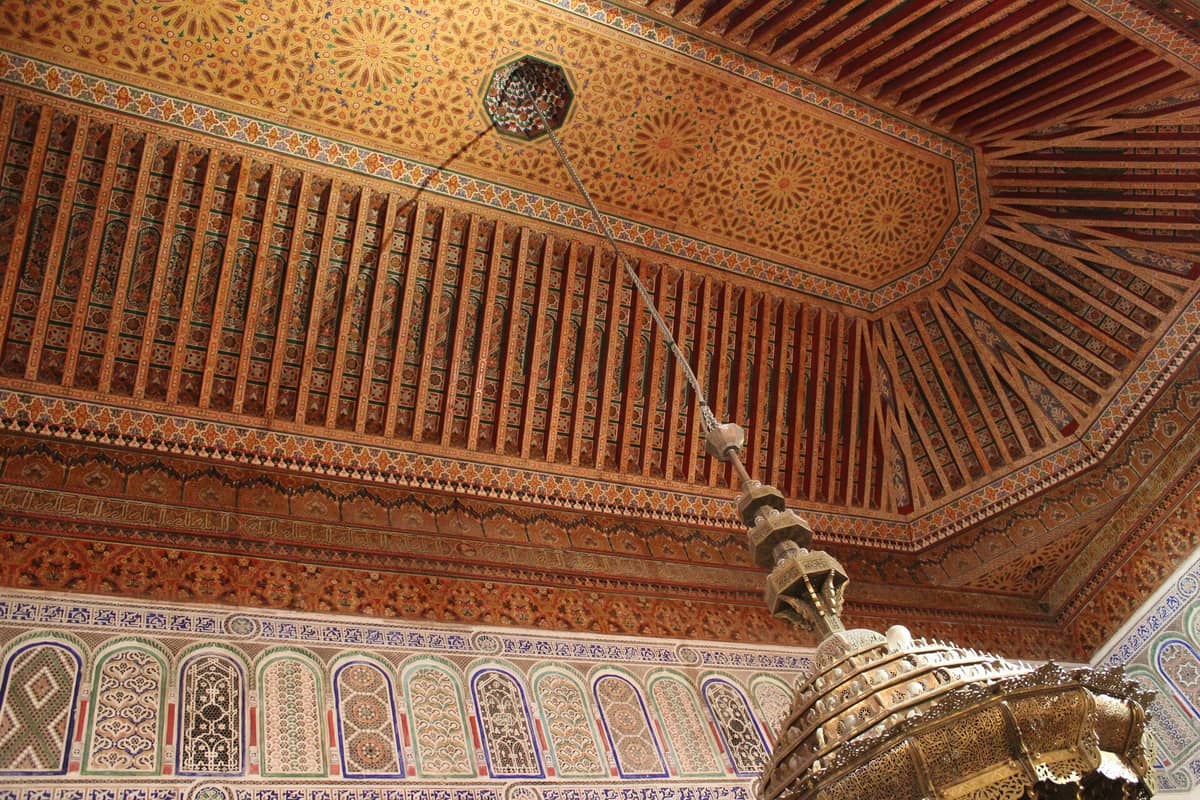
The Marrakech Museum, known in French as the Musée de Marrakech, is a museum of Moroccan art and heritage installed inside Dar Menebhi Palace, a grand private residence constructed at the end of the 19th century. The palace itself is as much the exhibit as anything hanging on its walls: a large open courtyard lit by a glass lantern overhead, walls sheathed in geometric zellige tilework from floor to shoulder height, and upper surfaces layered in carved stucco and painted cedar wood. Visitors who arrive expecting a conventional museum often leave talking mostly about the building.
The museum sits in the northern medina, near the Ben Youssef Madrasa, which was once the largest Islamic school in North Africa. The pairing of these two sites on a single morning is the most efficient way to cover this part of the medina without feeling rushed.
💡 Local tip
Ask at the door whether a combined ticket with nearby sites is available. Bundling options change, so do not assume a discount with the Ben Youssef Madrasa until you confirm it on the day.
The Palace: Architecture Before the Art
Dar Menebhi was built as a private residence for a Moroccan minister during the Alaouite dynasty period, and it shows the full repertoire of traditional Moroccan palatial craft. The name 'dar' simply means house or home in Arabic, but the scale here is closer to a compound. From the street entrance, a right-angled corridor shields the interior from view, a standard medina privacy principle, and then opens onto the main courtyard.
The courtyard is the spatial heart of the building. A large ornamental fountain sits at its center, and a glass ceiling fitted during the museum conversion floods the space with controlled light throughout the day. The zellige work, hand-cut terracotta tiles assembled in star and polygon patterns, covers the lower walls in deep greens, blues, and ochres. Above, plaster panels carved in floral and geometric relief frame doorways and gallery openings. The cedar ceilings in the surrounding rooms are painted in the muqarnas-influenced patterns common to high-status Moroccan interiors of the period.
Visitors with an eye for Moroccan architectural craft will find the palace fabric itself instructive. The zellige patterns are not decorative improvisation — they follow mathematical principles that artisans learn through years of apprenticeship. Running your eye along the transition between the tile dado and the carved stucco panel above it shows how different craft traditions were expected to harmonize within the same wall surface.
Tickets & tours
Live prices and dates from our booking partner. If you book, we may earn a commission at no extra cost to you.
Full day tour of Ouarzazate from Marrakech
From 51 €Instant confirmationFree cancellationEvening Quad Bike at Palmeraie Area with Tea Tasting from Marrakech
From 49 €Instant confirmationFree cancellationFull Day Economic Tour in Essaouira from Marrakech
From 29 €Instant confirmationFree cancellationFull Day Economic Tour of Ourika Valley from Marrakech
From 25 €Instant confirmationFree cancellation
The Collections: What You Actually See
The permanent collection is organized across the palace's ground-floor rooms and the rooms bordering the main courtyard. It includes coins from various Moroccan dynastic periods, ceramics from Fes and Safi, traditional textiles, jewelry, and household objects from across the country. The range of objects is broad rather than deep: this is a generalist collection of Moroccan decorative arts rather than a specialist repository for any single medium.
Temporary exhibitions are mounted in designated gallery spaces and vary significantly in quality and subject matter. On some visits, contemporary Moroccan painters or photographers occupy these rooms with work that sits in interesting tension with the historic building. On other visits, the temporary content feels thin. If the temporary show is a significant part of your motivation, check the museum's official website or social media before going.
The museum also contains a small library and a bookshop near the entrance stocking titles on Moroccan art and architecture. Labeling throughout the museum is primarily in French and Arabic, with limited English-language information. If you read neither, consider pairing the visit with context gathered beforehand — the Marrakech Islamic architecture guide provides useful background on the craft traditions you will encounter inside.
When to Visit and How It Changes Through the Day
The museum opens daily at 09:00 and closes at 18:00, and the first hour is reliably the quietest. The main courtyard, which is the most photographed space in the building, catches soft morning light through the glass ceiling before the sun climbs high enough to flatten the shadows on the zellige. School groups and organized tour parties typically arrive mid-morning, between 10:00 and 11:30, which coincides with the peak noise and crowding inside the smaller rooms.
The early afternoon lull, roughly 13:00 to 14:30, can offer another quiet window as visitors break for lunch. By mid-afternoon the museum fills again with day visitors working through the medina circuit. Last admission is around 17:00. On hot days between June and September, the interior of the palace stays noticeably cooler than the surrounding medina streets, which gives the museum a practical appeal beyond its cultural content — it is a legitimate place to recover from the heat for an hour.
ℹ️ Good to know
During Ramadan, hours shift to approximately 10:00–16:00. The atmosphere inside changes considerably during this period, with fewer tour groups and a quieter medina overall. Check the official site for current Ramadan adjustments before your visit.
Getting There: Navigation Through the Medina
The museum's address is 16–18 Derb Defaa Ourabaa in the medina, but for navigation purposes the useful landmark is Place Ben Youssef, the small open square in front of the Ben Youssef Madrasa. The museum entrance is directly on this square. Vehicle traffic does not reach this point; all visitors arrive on foot through the pedestrian alleys of the northern medina.
From Jemaa el-Fna, the walk takes roughly 15 to 20 minutes on foot, heading north through the main souk arteries toward the dyers' quarter and then northeast toward the madrasa. The route passes through some of the most active parts of the covered souks, so allow time if you intend to pause. A petit taxi can drop you at the nearest accessible road, about a five-minute walk from the square — your driver will know the Ben Youssef Madrasa as a reference point.
⚠️ What to skip
The alleys around Place Ben Youssef can be difficult to navigate without a map, especially for first-time visitors. Download an offline map of the medina before you set out — GPS signal can be inconsistent under the covered souk roofs.
Practical Details: What to Know Before You Go
Admission for adults is approximately 70 MAD, and children under 12 pay approximately 20 MAD. Moroccan residents pay a reduced rate of 20 MAD. These prices are current as of 2026 but should be confirmed at marrakechmuseum.com before your visit, as exhibition pricing can affect the total.
Photography is generally permitted in the courtyard and public spaces; individual galleries may have restrictions on flash or specific objects. The museum does not consistently enforce a no-photography rule throughout, but observing posted signs in each room is advisable. The central courtyard produces the most rewarding photographs, particularly in the first two hours after opening when the light is directional and warm.
Dress modestly for this visit. As with other historic and cultural sites in the medina, covered shoulders and knees are appropriate. If you are unsure what to wear across the medina more broadly, the guide to what to wear in Marrakech covers practical norms without overcomplicating them.
Accessibility is limited. The palace has uneven floor surfaces throughout, and several rooms involve steps. Full wheelchair access is not possible in the current configuration. Visitors with mobility requirements are advised to contact the museum directly in advance; the museum indicates willingness to assist where possible.
Is It Worth Your Time?
The Marrakech Museum does not compete with the depth of the Bahia Palace collections or the architectural intensity of the Ben Youssef Madrasa next door. Its permanent collection is modest, and the labeling can frustrate visitors who want contextual information in English. If you arrive expecting a world-class museum experience, you may feel the content underwhelms relative to the admission price.
What the museum does well is present the palace itself. For anyone interested in traditional Moroccan residential architecture, the quality of the craft here is high and the space is large enough to move around without feeling squeezed. It is a more contemplative experience than the adjacent madrasa, which tends to draw dense crowds. Visitors with only one morning in the northern medina are often better served going to the Ben Youssef Madrasa first and then crossing to the museum for contrast and quiet. For travelers on a tighter schedule, the 3-day Marrakech itinerary suggests how to fit both sites into a single half-day.
Those who should consider skipping it: visitors whose primary interest is contemporary art, travelers with very limited time who have not yet seen the madrasa or the Saadian Tombs, and anyone with significant mobility limitations. The museum adds real value to a medina exploration but is rarely the reason a trip to Marrakech is memorable on its own.
Insider Tips
- Arrive at 09:00 sharp. The main courtyard before 10:00 is quiet enough to hear the fountain, and the angled morning light creates shadow depth in the zellige that midday flattens completely.
- The bookshop near the entrance occasionally stocks out-of-print French-language titles on Moroccan decorative arts that are difficult to find elsewhere in the city. Worth a look even if you are not buying.
- The roof terrace, when accessible, gives an unusual rooftop view over the northern medina toward the minaret of the Ben Youssef Mosque. Ask at the entrance desk whether it is open on the day you visit.
- Combine this visit with the Ben Youssef Madrasa next door — go to the madrasa first when it is quieter, then cross to the museum as the madrasa fills up. The two visits together take about 2.5 hours at a relaxed pace.
- On very hot summer days, the interior of the palace stays several degrees cooler than the surrounding streets. If the heat is affecting you in the souks, the museum is a practical and worthwhile rest stop.
Who Is Marrakech Museum (Dar Menebhi Palace) For?
- Architecture and craft enthusiasts who want to examine zellige, stucco, and carved cedar up close in a functional space
- Travelers pairing a northern medina morning with the Ben Youssef Madrasa
- Visitors looking for a cool, calm environment on hot afternoons
- Art followers interested in temporary exhibitions by contemporary Moroccan artists
- Travelers building a broader understanding of Moroccan decorative arts before visiting other palaces in the city
Nearby Attractions
Other things to see while in Marrakech Medina:
- Ben Youssef Madrasa
Ben Youssef Madrasa is a 16th-century Saadian theological college in the heart of Marrakech's medina, and arguably the most ornately decorated interior in the entire city. Its central courtyard combines carved cedar, zellij tilework and sculpted stucco in a way that stops most visitors cold. This guide covers exactly what to expect, when to go, and how long to spend.
- Dar El Bacha – Musée des Confluences
Built in 1910 for the powerful Pasha Thami El Glaoui, Dar El Bacha is one of the medina's grandest palatial complexes. Restored and reopened as the Musée des Confluences, it now presents Moroccan art and craftsmanship within some of the city's most extraordinary interior architecture.
- Koubba Ba'adiyn (Almoravid Qoubba)
Built around 1117, the Koubba Ba'adiyn is the sole intact Almoravid structure in Marrakech and one of the oldest Islamic monuments in the city. Small in footprint but immense in historical weight, it sits several metres below the current street level near Ben Youssef Square, offering a rare glimpse into the architectural vocabulary that defined Islamic North Africa before the Almohads arrived.
- Le Jardin Secret
Tucked inside a 19th-century palace complex on Rue Mouassine, Le Jardin Secret is one of the largest traditional riad gardens in the Marrakech medina. Opened to the public in 2016 after an extensive restoration, it offers two distinct garden styles, ornate Islamic architecture, and a rooftop tower with panoramic views of the medina roofscape and the Atlas Mountains beyond.
Planning a trip? Discover personalized activities with the Nomado app.