Marrakech's Historic Palaces: Bahia, El Badi & Beyond
Marrakech preserves some of the Islamic world's most extraordinary palatial architecture. This guide covers the Bahia Palace, El Badi Palace, the Saadian Tombs, and other historic monuments — with current ticket prices, opening hours, seasonal advice, and a clear take on what each site delivers.
Tickets & tours
Live prices and dates from our booking partner. If you book, we may earn a commission at no extra cost to you.
TL;DR
- Bahia Palace and El Badi Palace both charge 100 MAD for foreign adults and open daily 09:00–17:00, with reduced hours during Ramadan.
- The Saadian Tombs are a 10-minute walk from El Badi Palace and use the same pricing structure — combine all three in a single half-day.
- Tickets are sold at the gate and through Morocco's Ministry of Culture online portal — you don't need to book through a tour agency, though guided packages exist if you want context. See our full Bahia Palace attraction page for directions and layout tips.
- All three sites are open on Fridays — in fact, Friday is free-entry day for Moroccan nationals.
- Spring (March–May) and autumn (September–November) are the most comfortable seasons for palace visits; summer heat above 35°C makes open-air ruins like El Badi physically demanding by mid-morning.
Why Marrakech's Palaces Matter
Marrakech served as Morocco's imperial capital multiple times over its history, and the palaces that survive reflect different eras of that political and cultural power. The Bahia Palace was built in the late 19th century for a grand vizier who wanted to outshine the sultan himself. El Badi Palace dates to the Saadian dynasty of the 16th century, when Marrakech was one of the wealthiest cities in the world. The gap between their conditions today — one is largely intact, the other a romantic ruin — tells you something important about what happened to Moroccan royal architecture in the intervening centuries.
Neither palace is 'the best' in any universal sense. Bahia rewards visitors who appreciate decorative Islamic craftsmanship: carved stucco, painted cedar ceilings, zellige tilework. El Badi rewards those who can read a ruin — who look at a vast sunken courtyard and see the 360 rooms, the gold-dusted walls, and the marble fountains that once made visiting ambassadors weep. If you have time for only one, Bahia is more immediately accessible. If you have half a day, combine both with the Saadian Tombs.
Bahia Palace: What You'll Actually See
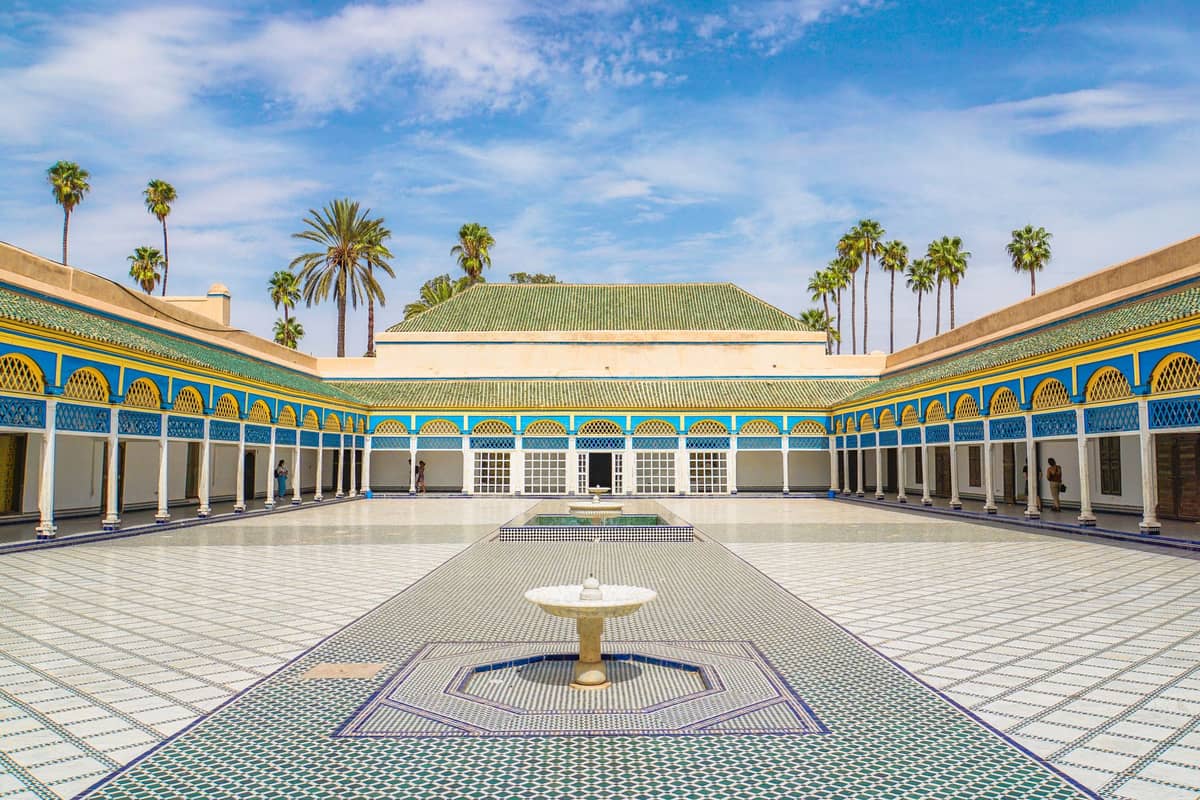
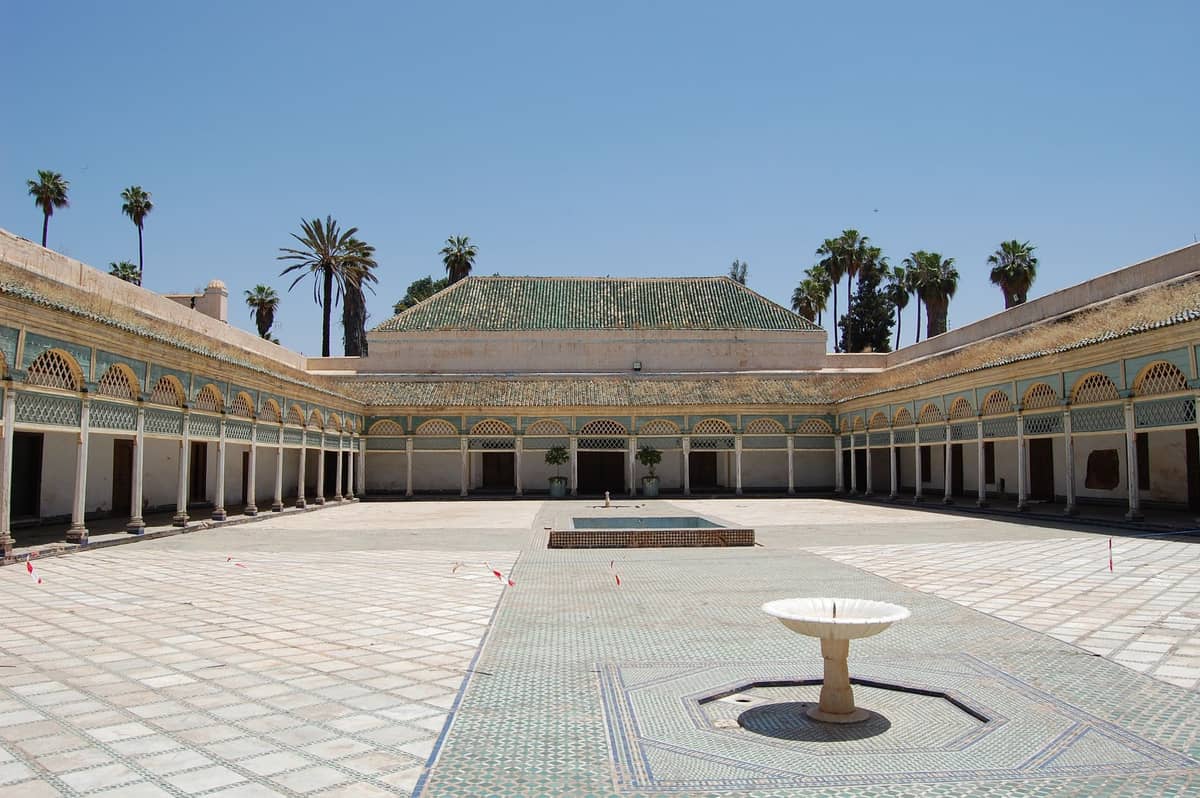
Built in two late-19th-century phases under grand vizier Si Moussa and his son Ba Ahmed (the main expansion ran roughly 1894–1900), Bahia Palace covers around 8,000 square metres, though only a fraction is open to visitors. The name translates loosely as 'the brilliant' or 'the beautiful', and the interior largely earns it. The route takes you through a series of courtyards — some intimate, some vast — past reception halls decorated with some of the finest tilework and painted ceilings in Morocco. The Great Courtyard, paved in Italian marble and surrounded by carved plaster arcades, is the visual centrepiece.
What surprises most visitors is the domestic scale. This was a working household palace, not a ceremonial monument, and you can still move through the rooms where Ba Ahmed held court, where his four wives and 24 concubines had separate quarters, and where French colonial officials later installed themselves after the 1912 Protectorate. The French additions are subtle but present if you know to look for them. The palace today functions as a public museum — there is no royal family in residence.
💡 Local tip
Arrive at Bahia Palace when it opens at 09:00. By 10:30, the main halls fill with tour groups and the noise level rises sharply. The early light through the courtyard screens is also better for photography. Last entry is around 16:30.
- Opening hours Daily 09:00–17:00. During Ramadan, hours reduce to approximately 09:30–15:00 — confirm on-site.
- Tickets (foreign visitors) 100 MAD adults, 50 MAD children aged 7–13, free for under-7s and visitors with reduced mobility.
- Tickets (Moroccan nationals/residents) 30 MAD adults, 10 MAD children 7–13. Free entry every Friday and on the first day of national and religious holidays.
- Where to buy At the gate, or through the Ministry of Culture's e-services portal (e-services.minculture.gov.ma). Tour platforms bundle guiding services on top of the standard ticket price.
- Time needed A self-guided visit takes 45–75 minutes. An audio guide or licensed guide adds 30–45 minutes but significantly increases what you understand.
El Badi Palace: The Grandest Ruin in Marrakech
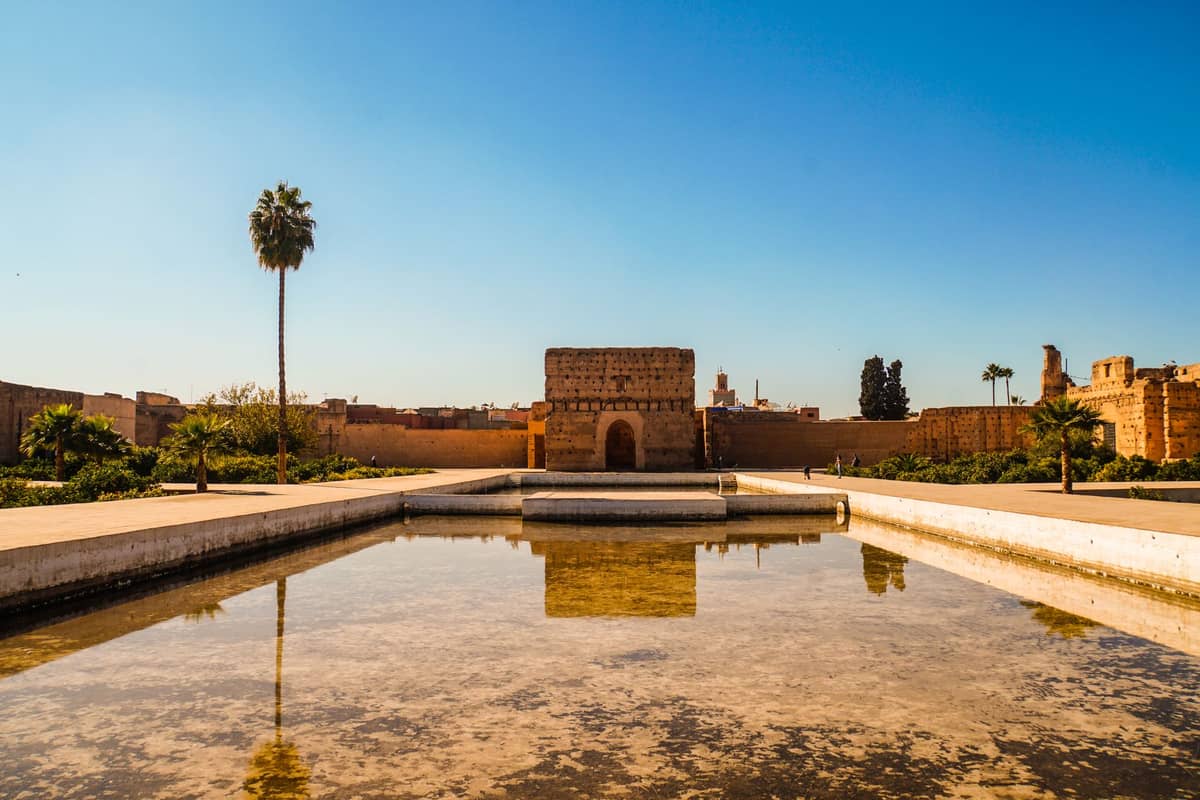
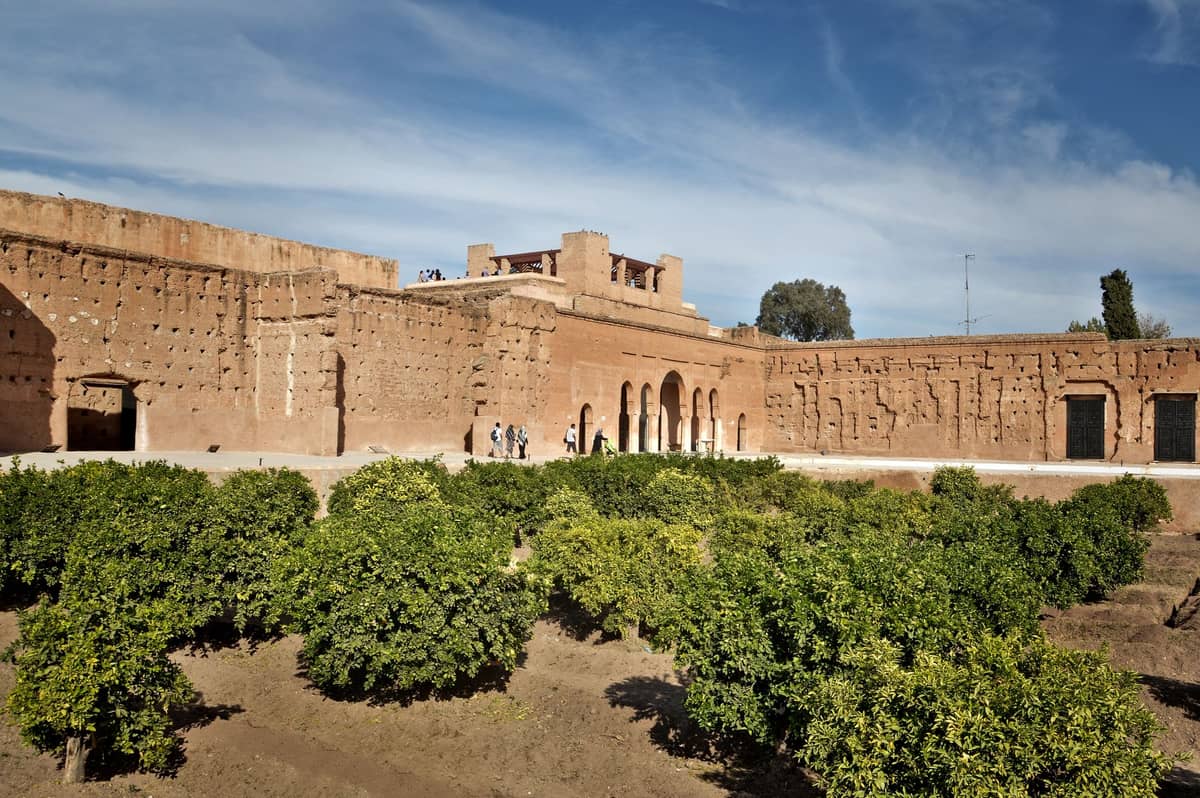
El Badi was constructed by Sultan Ahmed al-Mansour beginning in 1578, partly financed by a ransom paid by Portugal after the Battle of the Three Kings. At its peak, it was considered one of the most spectacular palaces in the world — 360 rooms, onyx and gold leaf from Italy, marble from Carrara, a central pool 90 metres long flanked by four sunken gardens. The Moroccan scholar Ibn al-Qadi described visiting ambassadors as speechless. Then, in 1696, Sultan Moulay Ismail had it stripped to build his new imperial capital at Meknes. What remains are the walls, the sunken gardens, and the basic structure — all still immense.
El Badi is not a museum in the Bahia sense. There are no furnished rooms or preserved ceilings to admire. What you get instead is scale and atmosphere: climbing the ramparts for panoramic views over the medina and the Atlas Mountains, wandering through the central courtyard that once held 300 tons of Italian marble, and visiting the small pavilion that now houses the original carved minbar (pulpit) from the Koutoubia Mosque. That minbar alone — 11th-century Andalusian craftsmanship, moved here for protection — justifies the entrance fee for anyone interested in Islamic woodwork.
⚠️ What to skip
El Badi's main courtyard is almost entirely open to the sky. In July and August, by 10:00 the temperature in the ruins can be brutal. Bring water, wear sun protection, and visit early or late in the day. The rampart walk in full summer sun is not comfortable for everyone.
- Opening hours Daily 09:00–17:00, last entry around 16:30. Ramadan hours typically 10:00–16:00.
- Tickets (foreign visitors) 100 MAD adults, 50 MAD children aged 7–13, free for under-7s and visitors with reduced mobility.
- Tickets (Moroccan nationals/residents) 30 MAD adults, 10 MAD children 7–13. Free Fridays and on first days of national and religious holidays.
- Time needed Allow 60–90 minutes, including the rampart circuit and the minbar pavilion.
- Getting there El Badi is in the Kasbah district, roughly 15–20 minutes on foot south of Jemaa el-Fna. It sits adjacent to the Mellah (Jewish Quarter) and a short walk from the Saadian Tombs.
The Saadian Tombs: The Essential Add-On
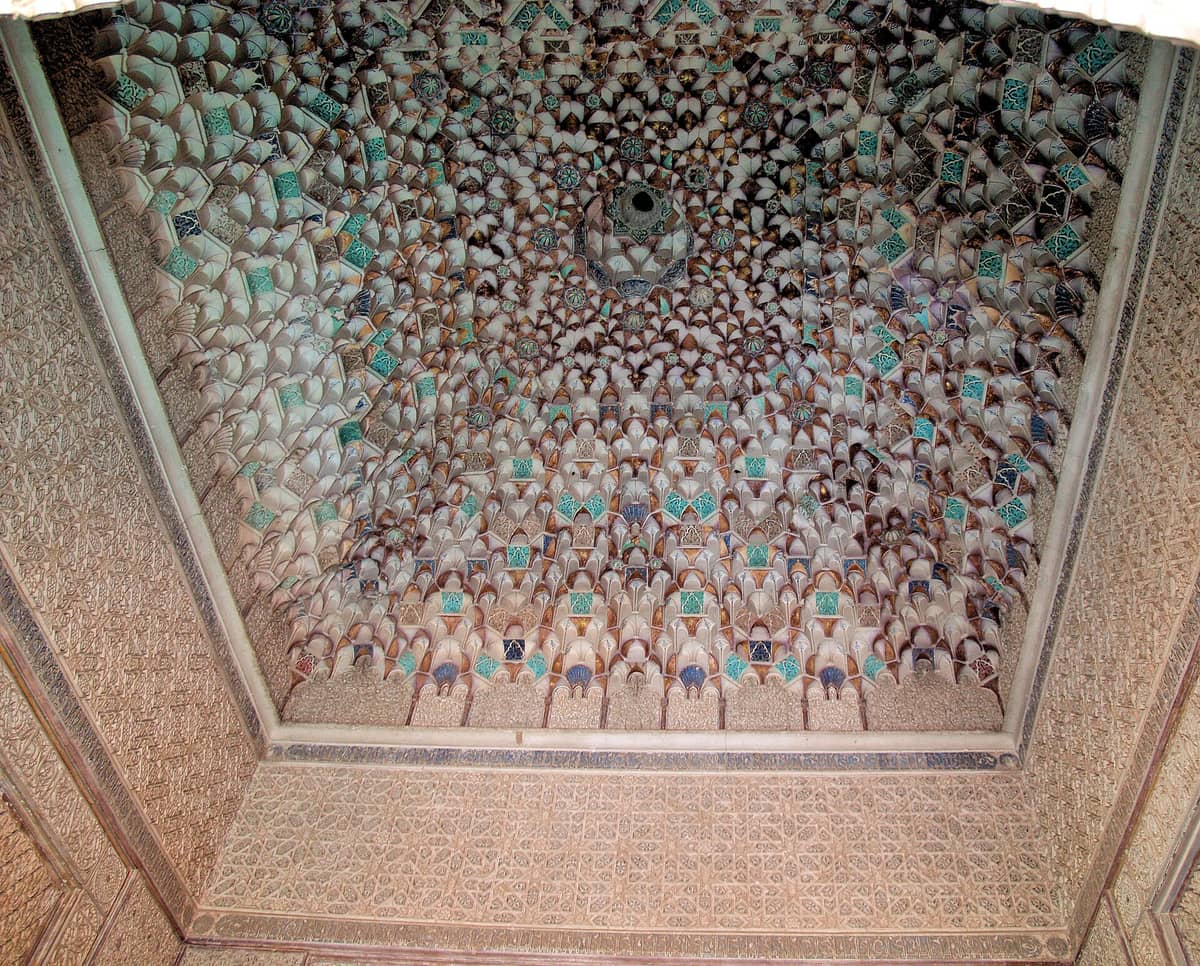
The Saadian Tombs are a 10-minute walk from El Badi Palace, inside a narrow passage off Rue de la Kasbah. They contain the mausoleums of the Saadian sultans and their families, built in the same late-16th-century period as El Badi's construction. What makes them remarkable is that they were sealed off by Sultan Moulay Ismail — presumably to avoid glorifying his predecessors — and only rediscovered by French aerial survey in 1917. They survived centuries of neglect in near-perfect condition.
The Chamber of the Twelve Columns, where Sultan Ahmed al-Mansour himself is buried, is among the finest examples of Saadian decorative craftsmanship in existence: carved plaster honeycomb vaulting, cedar screens, and Italian Carrara marble columns. The site is small — you will see everything in 30–40 minutes — but the density of craftsmanship per square metre is exceptional. Ticket pricing mirrors that of Bahia and El Badi (100 MAD for foreign adults, 30 MAD for Moroccan nationals), with the same Friday free-entry policy. Hours are 09:00–16:45 daily, with last entry around 16:30.
✨ Pro tip
Combine El Badi Palace and the Saadian Tombs in the same morning. Start at El Badi when it opens at 09:00, spend 90 minutes there, then walk to the Saadian Tombs before the main tour groups arrive around 10:30. From there, it's a 20-minute walk north through the Kasbah district to reach Bahia Palace for the afternoon — or save Bahia for a separate visit to avoid museum fatigue.
Other Historic Palaces and Monuments Worth Your Time
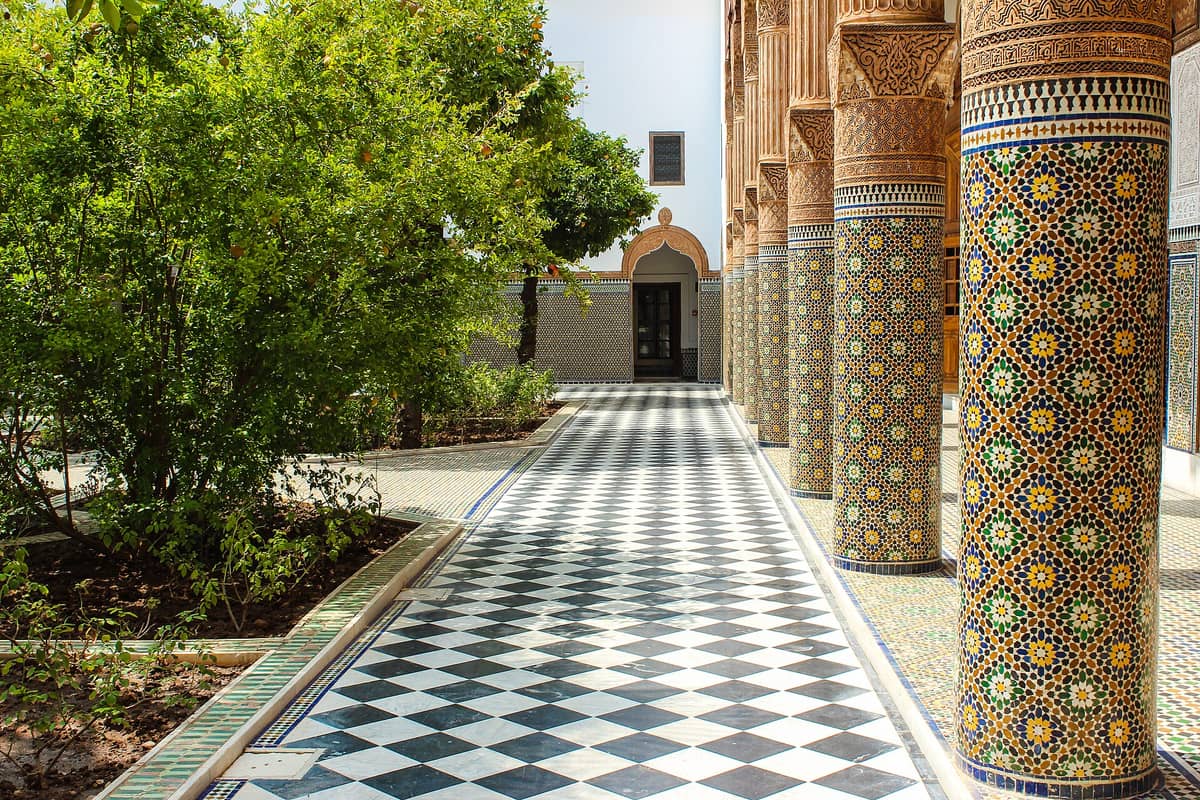
Marrakech has more palatial heritage than the three headline sites. The Dar el Bacha (Musée des Confluences) is an early 20th-century palace that once belonged to the powerful Glaoui clan and now operates as a museum of Moroccan cultural heritage. The architecture is spectacular — especially the tiled courtyard and reception halls — and it receives far fewer visitors than Bahia Palace despite being broadly comparable in decorative quality. If you want the palatial experience without the tour groups, this is the strongest recommendation.
The Dar Si Said Museum (now reorganized as the Maison des Arts et Métiers) occupies another late 19th-century palace near Bahia and houses an important collection of Moroccan decorative arts — carpets, jewelry, weapons, and woodwork. The building itself is worth seeing, even if the collection's presentation is somewhat dated. Entry is inexpensive and it's rarely crowded. It sits just 5 minutes on foot from Bahia Palace, making it a natural pairing.
Outside the medina, the Agdal Gardens to the south of the medina walls are a UNESCO-listed royal garden complex attached to the Royal Palace. The gardens themselves open to visitors on Fridays and Sundays (when the royal family is not in residence), offering a quieter, greener counterpoint to the intensity of the palace circuit. The Royal Palace itself is not open to visitors, but the walled compound and the adjacent Mellah (Jewish Quarter) are worth exploring on foot.
Practical Logistics: Getting There, Timing, and What to Know
All three main palace sites sit within the southern medina, clustered around the Kasbah district. From Jemaa el-Fna, Bahia Palace is roughly a 20-minute walk southeast through the souks and the Mellah, or a short petit taxi ride (set the meter — the fare from Jemaa el-Fna to Bahia is typically 15–25 MAD). El Badi and the Saadian Tombs are another 10–15 minutes southwest of Bahia on foot. The medina's streets narrow and twist significantly in this area, so a basic map or offline navigation is genuinely useful.
Visiting during Ramadan changes the experience considerably. All three sites reduce their hours, typically closing around 15:00–16:00 instead of 17:00. The medina itself is quieter in the mornings but transformed at sunset. If you're visiting in summer, see the best time to visit Marrakech guide for a full seasonal breakdown — July and August temperatures regularly exceed 35°C and the open courtyards of El Badi in particular become unpleasant by mid-morning.
ℹ️ Good to know
Moroccan currency (MAD, Moroccan dirham) is the only accepted payment at palace ticket booths. There are ATMs near Jemaa el-Fna and in the Mellah, but carry cash before heading to the Kasbah district. As of 2026, none of the palace sites accept card payment at the gate.
If you're planning a broader itinerary, the palace circuit pairs well with the Ben Youssef Madrasa in the northern medina — covered in more detail in the Ben Youssef Madrasa attraction page. That site represents Marinid and later Saadian religious architecture at its most refined, and visiting it alongside Bahia and El Badi gives you a more complete picture of Marrakech's architectural history across different dynasties and functions. A full day covering all four sites is ambitious but achievable if you start early.
FAQ
Do I need to book Bahia Palace or El Badi Palace tickets in advance?
No advance booking is required for either site. Tickets are sold at the gate during opening hours. The Ministry of Culture's online portal (e-services.minculture.gov.ma) offers official online purchase, but walk-up tickets are readily available except during peak periods like spring school holidays. Tour operators sell bundled 'ticket + guide' packages starting from around 110–499 MAD depending on inclusions, but the ticket itself is always 100 MAD for foreign adults.
How long should I allocate for Bahia Palace?
A self-guided visit typically takes 45–75 minutes. If you hire a licensed guide or use an audio guide, add another 30–45 minutes. Bahia has more to read contextually than to simply observe, so guidance genuinely adds value here. Arrive at opening (09:00) to avoid tour group congestion, which peaks from around 10:30 onwards.
Can I visit El Badi Palace and the Saadian Tombs on the same day as Bahia Palace?
Yes, and this is the most efficient approach. El Badi and the Saadian Tombs are a 10-minute walk apart in the Kasbah district. Bahia Palace is around 15–20 minutes on foot from El Badi. A logical route: start at El Badi (09:00), walk to the Saadian Tombs mid-morning, then proceed to Bahia for late morning or early afternoon. Budget around 3–4 hours total including walking time.
Are the palaces open during Ramadan?
Yes, but with reduced hours. Bahia Palace typically operates around 09:30–15:00 during Ramadan; El Badi Palace approximately 10:00–16:00. The Saadian Tombs follow a similar pattern. Hours can vary by year depending on when Ramadan falls, so check the gate posting on arrival. Mornings during Ramadan are generally quieter and can actually be a pleasant time to visit.
What's the difference between Bahia Palace and El Badi Palace — which is better?
They deliver fundamentally different experiences. Bahia Palace is largely intact, with richly decorated rooms, carved stucco, painted ceilings, and tiled courtyards — it reads as a palace. El Badi is a 16th-century ruin that was deliberately stripped of its materials in 1696; what remains is an enormous footprint, atmospheric walls, and the outstanding minbar from the Koutoubia Mosque. If you prefer decorative Islamic architecture in good condition, prioritize Bahia. If you respond to scale, history, and ruins, El Badi is the more powerful site. Both are worth visiting if you have the time.
Tickets & tours
Live prices and dates from our booking partner. If you book, we may earn a commission at no extra cost to you.
Planning a trip? Discover personalized activities with the Nomado app.