Hongdae & Mapo is western Seoul's most energetic creative district, centered on Hongik University and spreading across Seogyo-dong, Hapjeong-dong, and the surrounding Mapo District streets. It draws students, artists, and travelers with a dense mix of live music venues, independent cafés, street food alleys, and a nightlife scene that runs well past sunrise on weekends.
Hongdae is where Seoul's art school energy collided with commercial ambition and never quite separated. Named after Hongik University, one of Korea's most respected fine arts institutions, the neighborhood radiates outward from its campus gates in a tangle of murals, record shops, club basements, and café-lined streets that feel completely different at 10am than they do at 10pm.
Orientation
Hongdae & Mapo sits on the northern bank of the Han River in western Seoul, roughly 5 kilometers west of the historic center around Gwanghwamun. The neighborhood falls within Mapo-gu, one of Seoul's 25 autonomous districts, and its core covers the residential and commercial blocks of Seogyo-dong, Hapjeong-dong, and Seogang-dong.
The geographic anchor is Hongik University Station, which sits at the southeastern edge of the main shopping and nightlife zone. From the station, the terrain fans out in all directions: north and west toward the university campus and the older residential lanes behind it, south toward Hapjeong and the Han River banks, and east toward Mapo-daero. The Gyeongui Line Forest Park, a long linear greenway converted from a former railway corridor, cuts through the area on a roughly north-south axis, giving the neighborhood an unusually walkable spine.
Hongdae connects directly to several other key Seoul neighborhoods. Sinchon and Ewha, two more university districts, are just one or two stops east on Line 2. Hapjeong, immediately to the south, has become its own micro-district of cocktail bars and brunch spots. Yeouido and its riverside parks are reachable in about 15 minutes by subway. For a broader view of how Hongdae fits into the city's geography, the where to stay in Seoul guide breaks down every major neighborhood by traveler type.
Character & Atmosphere
Hongdae's identity was built by art students and it still shows. Walk the blocks between the university's main gate and Eoulmadang-ro on a weekday morning and the neighborhood is calm enough to notice the details: a convenience store where a staff member is restocking shelves to the sound of indie pop, a café where the chairs are each a different color, a mural taking up the full side of a four-story building. There is a self-conscious creativity to the streetscape that never feels accidental.
By afternoon, the pedestrian-friendly section along Eoulmadang-ro fills steadily. Street performers set up early — a guitarist, a dance crew warming up, sometimes a full acoustic act with a small crowd gathered in a loose circle. The light in late afternoon hits the painted building facades at an angle that makes everything look slightly more cinematic than it actually is. Younger Koreans, tourists, and university students mix naturally here in a way that does not feel forced.
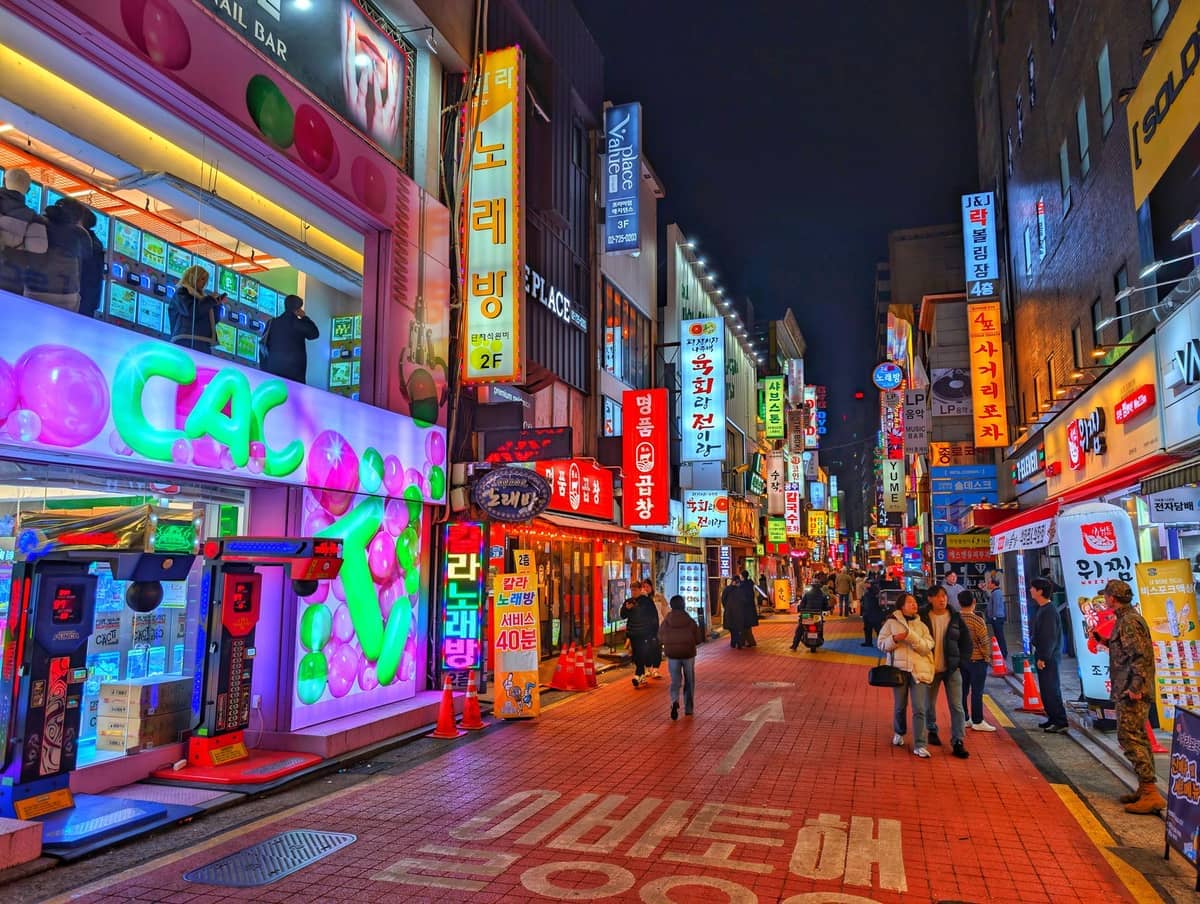
After dark, the character shifts significantly. The streets narrow psychologically as neon signs take over, and the club and bar district around the main lane becomes loud, crowded, and very youthful. On Friday and Saturday nights between midnight and 3am, Hongdae is one of the most concentrated nightlife zones in the entire city. This energy is part of the appeal for many travelers, but it is worth knowing before you book: if you are staying in the core area on a weekend, noise is not a minor inconvenience, it is a defining feature of the neighborhood.
⚠️ What to skip
Hotels and guesthouses on or immediately adjacent to the main Hongdae lane can be extremely noisy on Friday and Saturday nights until 4am or later. If you are a light sleeper or traveling with children, look for accommodation one or two blocks back from the pedestrian street, or consider the quieter Hapjeong sub-district to the south.
On Sunday afternoons, Hongdae has a noticeably different rhythm. The Gyeongui Line Forest Park fills with couples, families with strollers, and older residents doing laps on the path. The clubs are shuttered and silent. Some of the street-level cafés open late but fill quickly with people nursing hangover coffees and reading. This version of Hongdae is quieter and more local-feeling than the weekend night version, and equally worth experiencing.
What to See & Do
The neighborhood's street life is itself the primary attraction. The Hongdae pedestrian-friendly street along Eoulmadang-ro is designed for wandering, with small shops selling handmade goods, accessories, and independent clothing labels tucked between international food stalls and chain cafés. Street performances happen regularly in the designated performance spaces, particularly on weekend afternoons, and are free to watch.
The Gyeongui Line Forest Park deserves more attention than it typically gets in travel coverage. The park runs along the former Gyeongui rail line and has been developed into a green corridor with cycling paths, outdoor seating, public art installations, and small gardens. On weekday mornings it is genuinely peaceful. The section closest to Hongik University Station is the most developed and easiest to access, but walking north along the path takes you into quieter residential stretches of Mapo that feel far removed from the tourist zone.
A short walk south of the main Hongdae strip brings you into Hapjeong-dong, which functions as a somewhat more relaxed extension of the neighborhood. The waterfront area along the northern Han River bank is accessible from here, and the broader Hangang Park system is reachable by foot or a brief bike ride. Renting a bike from one of the public stations near the riverside is a practical and popular way to cover more ground along the water.
Hongdae Pedestrian Street (Eoulmadang-ro, Seogyo-dong): the main commercial and performance strip
Gyeongui Line Forest Park: linear greenway for walking, cycling, and outdoor art
Hongik University campus area: explore the streets around the main gate for galleries and studio shops
Hapjeong-dong: the quieter, more café-focused extension of the Hongdae zone to the south
Seoul World Cup Stadium: located northwest in Mapo, home to FC Seoul and a major entertainment complex
Hongdae is also one of the best neighborhoods in Seoul for K-pop related experiences. Several dance academies and fan merchandise shops are concentrated in the area, and the neighborhood's general energy makes it a natural fit for the K-pop experiences in Seoul that many visitors are specifically seeking out.
Eating & Drinking
The food scene in Hongdae runs from excellent to purely functional, and it helps to know the difference. The streets immediately around the pedestrian lane have a high concentration of chain restaurants, Korean fried chicken joints, and international fast food targeting the late-night crowd. These are convenient and cheap but rarely memorable.
The better eating tends to happen one or two streets back from the main strip, in the residential lanes of Seogyo-dong where smaller, owner-operated restaurants have lower rents and more interesting menus. Look for Korean barbecue spots where the charcoal is actually charcoal, tteokbokki pojangmacha stalls operating out of a cart or a narrow shopfront, and the kind of hand-pulled noodle place that has been in the same location for twenty years and has no English menu.
Hongdae has one of the densest café cultures in Seoul, which is saying something given the competition citywide. Independent coffee shops here tend to have stronger design concepts than elsewhere in the city, reflecting the art school influence. Some operate on unusual hours, opening in the afternoon and running until 2am, which suits the neighborhood's rhythms. The broader context for Seoul's extraordinary café scene is worth exploring in the Seoul café culture guide.
💡 Local tip
For street food, the area around the Hongdae main entrance and the Gyeongui Line Forest Park has a good concentration of vendors selling hotteok (sweet filled pancakes), tteokbokki, and Korean corn dogs. Prices are reasonable and competition keeps quality generally honest. Go in the early evening before the main weekend crowds arrive for the best experience.
The bar scene divides roughly into two categories. The club district on the main strip operates at high volume with cover charges on weekends and a very young crowd. The cocktail bars in Hapjeong, a ten-minute walk south, tend to be smaller, quieter, and more focused on the drinks themselves. Both have their place depending on what you are looking for. Beer, soju, and makgeolli are available everywhere and remain the most popular choices at street-level pojangmacha tents on warmer evenings.
If you want to understand how to eat well across Seoul rather than just in one district, the what to eat in Seoul guide provides a useful framework. For Korean barbecue specifically, the Korean BBQ guide covers the different styles you will encounter and what to order.
Getting There & Around
Hongik University Station (홍대입구역) is the main transport hub for the neighborhood. It is served by three separate lines: Seoul Metro Line 2 (the green loop line), the Gyeongui-Jungang Line, and the Airport Railroad (AREX). The AREX connection is particularly useful for travelers arriving from or departing to Incheon International Airport, which is roughly 50 to 60 kilometers to the west. The journey from Incheon to Hongik University Station takes approximately 40 to 50 minutes on the AREX, making Hongdae one of the more conveniently airport-accessible neighborhoods in central Seoul.
Exit 9 from Hongik University Station puts you almost directly onto Eoulmadang-ro and the pedestrian street. Exit 4 is closer to the Gyeongui Line Forest Park entrance. The station itself is large and busy, and the exits are well signed in Korean and English. On weekends, the plaza outside the main exits fills with street performers and vendors, effectively extending the neighborhood's energy right to the station entrance.
For getting around the wider city from Hongdae, Line 2 is the most useful route: eastward toward Sinchon and Ewha, or eastward past City Hall and toward Seoul Station. Kakao T is the most widely used ride-hailing app in Seoul and works reliably in this area. For a full overview of how the subway system works and how to buy and use transit cards, the getting around Seoul guide is the best starting point.
ℹ️ Good to know
The T-money transit card works across the Seoul subway, buses, and many convenience store purchases. You can load it at any subway station kiosk. It is the most practical payment method for public transport and significantly cheaper per ride than buying individual tickets.
Within the neighborhood, most points of interest are walkable from Hongik University Station. The Gyeongui Line Forest Park path makes cycling a practical option, and public bike-share stations are available near the park and along the main streets. The terrain in the core Hongdae area is flat, which makes it easy to cover ground on foot even when moving between the northern and southern parts of the district.
Where to Stay
Hongdae has a wide range of accommodation options, from international brand hotels near the station to small guesthouses and design hostels tucked into the residential side streets. The concentration of budget and mid-range options makes it popular with younger travelers and backpackers, but several newer hotels with stronger design credentials have raised the ceiling in recent years.
Location within the neighborhood matters more here than in most Seoul districts. Staying directly on or next to the main pedestrian street gives you proximity to restaurants and nightlife but commits you to significant noise on Thursday, Friday, and Saturday nights. The blocks north and west of the university campus are residential and quiet but require a few extra minutes of walking to reach the action. The Hapjeong sub-district to the south is the best middle ground: close enough to walk to Hongdae's bars and restaurants, but far enough to sleep on a weekend night.
Hongdae is a strong base for travelers who want to explore both the western neighborhoods and the historic center. From Hongik University Station, Gyeongbokgung Palace is about 20 minutes by subway. The airport connection via AREX is a genuine advantage for late arrivals or early departures. For a full comparison of where to base yourself in Seoul, the where to stay in Seoul guide provides a detailed breakdown across all major neighborhoods.
Nightlife at Kulturang Pang-gabi
Hongdae's nightlife is among the most well-known in Seoul and for good reason. The club district on the main lane runs late on weekends, with several venues operating until dawn. The music spans electronic, hip-hop, and Korean indie depending on the venue and the night. For a deeper orientation to Seoul's after-dark culture including how cover charges and club entry typically work, the nightlife in Seoul guide covers the practicalities.
Beyond the clubs, Hongdae is also one of the best neighborhoods in Seoul for noraebang, the private karaoke room experience that is an essential part of Korean social life. Noraebang venues are scattered throughout the district, range from budget to surprisingly upscale, and are open until very late. Groups of all ages use them, and they are genuinely easy for non-Korean speakers to navigate since the song catalogs include extensive English-language options.
The live music scene, while smaller than it was in the early 2000s when Hongdae was the undisputed center of the Korean indie movement, still exists in small venues and basement clubs throughout the neighborhood. Check local listings for smaller gig nights. For a practical guide to the noraebang experience, the noraebang Seoul guide explains everything from pricing to song selection.
TL;DR
Hongdae is best for travelers who want to be in the middle of Seoul's youth culture, street food scene, and nightlife without sacrificing transit convenience.
The AREX airport rail connection at Hongik University Station makes it one of the most practical bases in the city for arrivals and early departures.
Noise on weekend nights is a real factor: choose accommodation away from the main pedestrian strip if you need to sleep before 4am on Fridays and Saturdays.
The neighborhood rewards exploration beyond the main strip: the Gyeongui Line Forest Park, the Hapjeong sub-district, and the residential lanes near the university campus have a completely different character from the tourist-facing commercial zone.
Less suited to travelers primarily interested in Seoul's historical or palace-focused sights, though these are accessible by subway in under 30 minutes.
Three days is enough to get a real feel for Seoul, if you plan by neighborhood instead of trying to crisscross the city. This itinerary covers historic Joseon-era Seoul, the commercial and cultural center, and the newer districts that define the city's contemporary identity, with practical logistics at every step.
Five days is enough to experience historic Seoul, its modern neighborhoods, and at least one compelling excursion beyond the city. This guide organizes each day by district to minimize transit time, with a clear take on what's worth it and what isn't.
Seoul has a deep museum scene, from Korea's vast national collection in Yongsan to cutting-edge contemporary art spaces and sobering historical sites. Whether you have a day or a week, these are the essential museums to put on your itinerary.
Seoul rewards visitors differently depending on the season. Spring brings cherry blossoms and mild temperatures, autumn delivers golden foliage and clear skies, summer is hot and monsoon-affected, and winter is cold but cheap. Here is exactly what to expect, month by month.
Seoul rewards those who look up, climb high, and stay out past sunset. This guide covers the city's finest panoramic viewpoints — from paid observation decks at record-breaking towers to free hilltop parks where locals gather at dusk to watch the city lights come on.
Bukhansan National Park sits inside Seoul's city limits yet delivers genuine mountain terrain, granite ridges, and a 836-meter summit. This guide covers the best trails, transit access, seasonal closures, and practical tips for first-timers and returning hikers alike.
Seoul's location in northwestern South Korea makes it a surprisingly strong base for day trips. From UNESCO fortresses reachable by subway to ancient capital cities served by KTX, this guide covers the best options with honest travel times, costs, and seasonal advice.
The Demilitarized Zone is one of the most visited sites in South Korea, yet most travelers arrive underprepared. This guide covers tour types, current prices, booking logistics, what you'll actually see, and the honest drawbacks before you commit.
Seoul is one of the most rewarding cities in the world to explore on a tight budget. From UNESCO-listed palaces and ancient city walls to world-class museums and sprawling riverside parks, an enormous amount of what makes Seoul great costs absolutely nothing to experience.
Seoul has one of the most efficient urban transit networks in the world, covering virtually every corner of the city by subway and bus. This guide breaks down fares, card options, airport connections, and the practical details that make the difference between a smooth trip and an expensive mistake.
Gwangjang Market is one of Seoul's oldest and most celebrated food destinations, known for bindaetteok, mayak gimbap, and raw beef yukhoe. This guide covers every dish worth ordering, how much to pay, when to go, and how to navigate the market like someone who has been there before.
Renting a hanbok in Seoul is one of the most photogenic things you can do in the city, and it costs less than a decent lunch. This guide covers where to rent, how much to pay, what to expect, and how to get the most out of your few hours in traditional dress.
Seoul preserves several distinct hanok districts, each with its own character. This guide covers the main options, practical logistics, seasonal crowd patterns, and a clear picture of what to expect before you visit.
Seoul rewards curious travelers who look past the obvious. This guide covers the city's lesser-visited neighborhoods, transformed industrial spaces, street art villages, and local markets — with practical logistics, seasonal advice, and a clear take on what's worth your time.
Seoul is one of the few world capitals where you can summit a real mountain, walk a 600-year-old fortress wall, and be back in the city for dinner. This guide covers the best trails for every level, from challenging granite peaks to gentle hilltop park strolls.
Seoul's jjimjilbangs are far more than bathhouses. They are all-hours social institutions where locals come to soak, sweat, eat, sleep, and decompress. This guide covers how they work, what everything costs, the unwritten rules of etiquette, and how to make the most of your visit whatever the season.
Seoul is the global epicenter of skincare innovation, and shopping for beauty products here is a genuinely different experience from buying Korean brands abroad. This guide covers the best stores, the smartest districts, what to prioritize buying, and how to avoid the common traps that leave tourists overpaying at airport duty-free.
Korean BBQ in Seoul is one of the city's defining food experiences, but navigating it well takes more than just showing up hungry. This guide covers the best restaurants by type, how to order confidently, what everything costs, and the etiquette mistakes that mark out first-timers.
Seoul is the undisputed capital of K-pop, but knowing where to actually go matters more than the hype suggests. This guide covers free landmarks, fan-friendly museums, live show recordings, shopping districts, and bookable experiences — with a clear take on what's worth your time.
From palatial five-star hotels in the historic north to slick Gangnam towers, this guide covers where to stay, eat, and spend at the top end — with a clear take on what's special and what's just expensive.
Seoul nightlife runs later, harder, and more diversely than almost any other city in Asia. From Hongdae's student club strips to Gangnam's bottle-service mega-clubs and Itaewon's underground electronic scene, this guide breaks down every major district, what to expect, and how to navigate a night out without the rookie mistakes.
Noraebang are private karaoke rooms at the heart of Seoul's nightlife culture. This guide covers the difference between coin and standard noraebang, where to find the best venues, what to expect, and how to get the most out of the experience without overpaying.
Seoul preserves five Joseon-era royal palaces within its city limits, each with a distinct character and history. This guide covers all five in depth, plus the essential sites, shrines, and neighborhoods that complete a palace-focused visit to the city.
Seoul's café scene is one of the most developed in Asia, divided across distinct neighborhoods where each district has its own personality. This guide breaks down the best coffee districts and concept cafés by area, with honest advice on timing, crowds, and what to actually order.
Seoul offers far more romantic depth than its reputation for K-pop and street food suggests. This guide covers the best things to do in Seoul for couples, from iconic landmarks and scenic parks to low-key neighborhood strolls, with seasonal advice and practical logistics throughout.
Autumn is widely considered the best time to visit Seoul, with crisp temperatures, golden ginkgo avenues, blazing maple trails, and a packed cultural calendar. This guide covers peak foliage timing, the top spots to see autumn color, seasonal festivals, practical logistics, and what most visitors overlook.
Spring is Seoul's most photogenic season, with cherry blossoms peaking in early April and festivals filling the city's parks and riversides. This guide covers bloom timing, the best viewing locations, what the weather is really like, and how to plan around the crowds.
Seoul winters are cold, dry, and genuinely rewarding for travelers who come prepared. From palace snow views to late-night pojangmacha street food, this guide covers everything you need to know about visiting Seoul from December through February.
Seoul's market scene spans centuries and neighborhoods, from ancient covered halls serving mung bean pancakes to weekend flea markets spilling out under highway overpasses. This guide covers the best traditional, flea, and night markets in the city, with practical details on what to buy, what to eat, and when to go.
Seoul is far more affordable than most people expect. This guide breaks down real daily costs, the cheapest ways to get around, where to eat well for under ₩10,000, and which world-class attractions cost nothing at all.
Seoul ranks among the safest major cities in the world for international visitors, but that does not mean zero risks. This guide covers emergency contacts, common scams, neighborhood dynamics, seasonal hazards, and practical precautions so you can travel confidently in Seoul Special Metropolitan City.
Seoul's street food scene is one of the best reasons to visit the city. This guide breaks down the top markets, the snacks worth lining up for, what things actually cost, and the practical details that most guides skip.
Seoul holds a remarkable concentration of sacred sites within its modern boundaries. This guide covers the city's finest Buddhist temples, Confucian shrines, shamanist sites, and other places of spiritual significance — from the lantern-lit courtyards of central Jogyesa to the granite ridges of Inwangsan.
The Seoul to Busan corridor is one of the most-traveled routes in South Korea. This guide breaks down every realistic option, from the KTX high-speed train to intercity buses and flights, with fares, journey times, and practical booking advice.
Seoul is one of Asia's most practical cities for family travel, with a deep mix of free outdoor parks, indoor rainy-day backups, cultural experiences, and full-day theme parks. This guide covers the top family activities across every age group, with real advice on pricing, crowd timing, and seasonal planning.
Seoul's shopping scene is one of the most varied in Asia, spanning underground mega-malls, centuries-old traditional markets, and indie streetwear boutiques. This guide breaks down every major district by what you'll actually find there, how much to spend, and when to go.
Seoul rewards first-time visitors and repeat travelers equally. This guide covers the city's essential experiences across history, food, neighborhoods, and nature, with practical details on costs, timing, and what to skip.
Seoul is one of the world's great eating cities, and knowing what to order makes all the difference. This guide covers the essential Korean food you need to try, from market snacks under ₩5,000 to slow-cooked soups worth planning your day around.
Choosing where to stay in Seoul shapes your entire trip. This guide breaks down the top neighborhoods by traveler type, covering transit access, hotel options, price ranges, and the trade-offs so you can pick the right base before you book.