Mangwon Market: Seoul's Neighborhood Market Done Right
Mangwon Market (망원시장) is a working daily market in Mapo-gu where locals actually shop for groceries, banchan, and street snacks. It lacks the fame of Gwangjang or Namdaemun, which is precisely what makes it worth the short subway ride.
Quick Facts
- Location
- 27 Poeun-ro 6-gil, Mapo-gu, Seoul 04011
- Getting There
- Line 6, Mangwon Station, Exit 2 — approx. 350 m walk (5–6 min)
- Time Needed
- 45 minutes to 1.5 hours
- Cost
- Free entry. Budget ₩5,000–₩15,000 for snacks and small purchases
- Best for
- Food lovers, slow travelers, anyone curious about everyday Seoul life
What Mangwon Market Actually Is
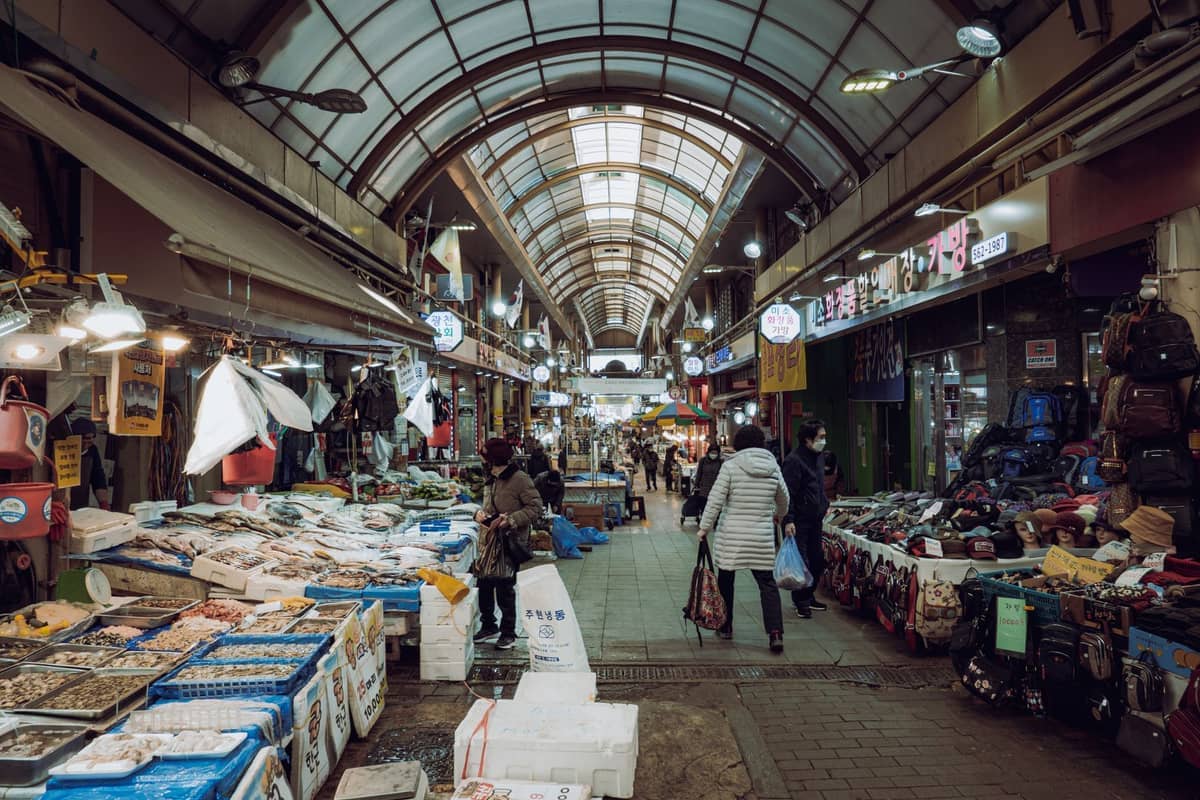
Mangwon Market (망원시장) is a covered neighborhood market that serves the residential streets of Mapo-gu in western Seoul. This is not a tourist market. The stalls sell the things people in the surrounding apartments actually need: fresh vegetables, cuts of pork and beef, dried fish, tofu made the same morning, ready-made banchan in plastic containers, and tteok (rice cakes) wrapped for dinner. It sits about five minutes on foot from Mangwon Station on Line 6, tucked between low-rise apartment blocks and small coffee shops in a part of Seoul that most short-stay visitors never reach.
The contrast with Seoul's better-known markets is instructive. Gwangjang MarketGwangjang Market in Jongno has become a destination in its own right, with tourist crowds and prices that reflect it. Namdaemun tilts heavily toward wholesale. Mangwon stays genuinely local. Most vendors have little or no English on their signs, prices are written in Korean won without a tourist markup, and the clientele on a Tuesday afternoon is almost entirely made up of neighborhood residents.
💡 Local tip
Opening hours are listed as daily 10:00–21:00, but individual stalls set their own hours. The market is most fully open and lively between midday and early evening. Go too early on a weekday and you'll find many shutters still down.
How the Market Looks, Sounds, and Smells
The main market runs through a covered arcade about two lanes wide. Fluorescent lighting gives way to natural light where vendors prop open the corrugated roof panels. The floor is damp near the fishmongers, and the smell shifts within a few steps: sesame oil and chili paste from the banchan stalls, the iron-and-salt smell of raw meat from the butchers, then something sweeter near the tteok vendors where steamed rice dough sits in shallow wooden trays.
Vendors call out to regulars by name. Ajumma in aprons stack dried anchovies in neat pyramids. An older man in rubber boots hosing down the fish section doesn't pause when you pass. The sounds are practical rather than performative: the slap of a cleaver on a cutting board, the hiss of oil in a flat pan where a vendor fries hotteok (sweet filled pancakes), the beep of a card reader. Nobody here is playing Korean folk music for ambiance.
Tickets & tours
Hand-picked options from our booking partner. Prices are indicative; availability and final rates are confirmed when you complete your booking.
DMZ and Lake Majang Suspension Bridge Tour from Seoul
From 57 €Instant confirmationFree cancellationHalf Day DMZ Tour from Seoul, 3rd Tunnel, Observatory and More
From 47 €Instant confirmationFree cancellationSeoul zombie city exploration game and private tour
From 10 €Instant confirmationFree cancellationLuggage Storage in Seoul
From 7 €Instant confirmationFree cancellation
What to Eat and Buy
Street food at Mangwon is priced for the local market, which means it is inexpensive by any standard. Hotteok is a reliable first stop: the thick, crispy-edged version filled with brown sugar and chopped peanuts costs around ₩1,000–₩2,000 and comes wrapped in a paper sleeve. Tteokbokki (rice cakes in spicy sauce) is sold from low carts near the entrance alleys. Sundae (Korean blood sausage) often appears alongside it.
Beyond the snacks, the banchan stalls reward slow browsing. Dozens of small side dishes sit in stainless steel trays: seasoned spinach, fermented radish, three or four types of kimchi, stir-fried dried squid, soybean paste preparations. Vendors sell by the 100-gram scoop into plastic containers. If you have access to a kitchen or a rental apartment, this is one of the most cost-effective ways to eat well in Seoul.
The fresh produce section runs along one side of the main arcade. Prices are notably lower than convenience stores or supermarkets, and seasonal items dominate: perilla leaves and chrysanthemum greens in summer, mushroom varieties in autumn, citrus in winter. There is no fixed rule about what is available, which is part of the appeal.
How the Experience Changes Through the Day
Arrive before noon on a weekday and the market is operational but not at full pace. Some food stalls take time to set up. The light is cooler, the crowd is thinner, and you can move through the arcade without being squeezed past stacked crates. This is a good time for photography if you prefer cleaner compositions.
The midday-to-late-afternoon window from roughly 12:00 to 17:00 is when the market hits its stride. Vendors are fully stocked, hot food is actively being cooked, and the mix of shoppers includes retirees, parents picking up groceries, and the occasional student from the nearby university areas of Mapo-gu. This is the window that best captures how the market actually functions.
Evenings bring a different crowd. After about 18:00, working-age residents stop in on their way home. Some stalls begin discounting perishables. A few prepared-food vendors extend their hours. The covered sections stay lit and active, but the fresh produce area starts to thin out. Weekend afternoons, particularly Saturdays, see the heaviest foot traffic overall.
ℹ️ Good to know
Mangwon Market became more widely known after appearing in a popular Korean variety program. Weekend crowds have grown as a result, particularly on Saturday afternoons. If you want the quieter, purely local version, a weekday between 13:00 and 16:00 is the better call.
Getting There and the Surrounding Neighborhood
Take Seoul Subway Line 6 to Mangwon Station and use Exit 2. The market is approximately 350 meters away, about a five-to-six minute walk through residential side streets. The walk itself is part of the experience: low-rise apartment buildings, small laundromats, old-school Chinese restaurants, and a density of independent coffee shops that reflects the broader Mapo-gu character. The area sits within the larger Hongdae and Mapo district, which covers everything from student nightlife near Hongik University to quieter residential pockets like the streets around Mangwon.
Hangang Park (the Mangwon section) is within walking distance — roughly 10 to 15 minutes on foot heading south from the market. This makes a natural pairing: buy snacks at the market, then carry them down to the riverbank. On warm evenings, this is exactly what many local residents do.
If you are building a day around this part of the city, consider combining Mangwon Market with a walk along Hangang Park or a browse through the Seongsan-dong coffee alley nearby. The neighborhood rewards a slow afternoon more than a sprint.
Practical Notes: What to Know Before You Go
Entry is free. There is no ticketing, no gate, and no organized tour required. Cash is useful and sometimes necessary at smaller stalls, though card readers are increasingly common. Bring small bills: ₩5,000 notes cover most individual purchases.
Accessibility information for the market is not detailed in official sources. The covered arcade has a flat floor surface through most of its length, but the entrance approaches from the side streets involve kerb drops and uneven paving in places. Wheelchair users should approach with that in mind and verify current conditions on arrival.
English signage inside the market is minimal. Pointing, showing quantities on your fingers, and having a translation app ready on your phone will handle almost every transaction. Vendors are generally patient with visitors who are clearly making an effort. For broader context on how to approach Seoul's various market types, the Seoul markets guide covers the distinctions between traditional, wholesale, and night markets across the city.
⚠️ What to skip
Most stalls are closed or operating on reduced hours on public holidays. If your visit falls on Chuseok, Seollal, or other major Korean holidays, check ahead or expect a significantly quieter market.
Who Should Skip This
Mangwon Market is not a good choice if your priority is variety show spectacle, curated photo opportunities, or English-language explanations of what you're looking at. Travelers with very limited time in Seoul who are prioritizing palaces, major museums, or the historic core of Jongno and Bukchon should weigh whether the transit time to Mapo-gu is worth it on a short trip. The market is also not especially suited to families with very young children during peak weekend hours, when the narrow aisles get genuinely packed.
For travelers who have already seen the headline attractions and want to understand how Seoul actually functions day to day, Mangwon Market is one of the more honest places in the city. The experience is ordinary in the best sense of the word.
Insider Tips
- The hotteok vendor near the main entrance tends to draw a line on weekends. Arrive before 13:00 or after 16:30 to skip the wait.
- Banchan stalls will often let you try a small taste before buying. A slight nod toward the container and eye contact with the vendor is usually enough to ask.
- The market is covered, which means it stays operational in light rain. It is one of the few outdoor-feeling Seoul experiences that doesn't get ruined by a drizzle.
- Combine the visit with the Mangwon section of Hangang Park, about 10–15 minutes on foot heading south. Buy food at the market and eat it at the river.
- If you want to photograph vendors at work, late morning on a weekday offers the best light from the open roof panels and the least crowded frames.
Who Is Mangwon Market For?
- Food travelers who want to eat what Seoul residents actually eat, not a tourist-facing version of it
- Slow travelers and digital nomads based in Mapo-gu looking for fresh ingredients and ready-made meals
- Repeat visitors to Seoul who have already covered the major sights and want something more textured
- Anyone pairing a market visit with time at Hangang Park on a relaxed afternoon
- Budget travelers: a full and satisfying meal here costs a fraction of restaurant prices
Nearby Attractions
Other things to see while in Hongdae & Mapo:
- Haneul Park
Perched on the slopes of a former landfill in Mapo-gu, Haneul Park is one of five parks within World Cup Park and offers some of the most expansive open-sky views in Seoul. Free to enter and accessible via subway, it rewards visitors with silver grass meadows in autumn, wildflower fields in spring, and a panoramic cityscape that stretches from the Han River to the distant mountains.
- Seoul Botanic Park
Seoul Botanic Park opened in 2019 as Korea's first botanical park, bringing together a climate-controlled greenhouse, lakeside wetlands, and a sprawling open forest in the Gangseo district. It rewards slow walkers and plant enthusiasts, but also works surprisingly well as a half-day escape from central Seoul's crowds.