Gwangjang Market: Seoul's Oldest Covered Market and Its Famous Food Alley
Established in 1905, Gwangjang Market in Jongno is Seoul's oldest continuously operating covered market. It draws visitors for its legendary street food stalls — bindaetteok, mayak gimbap, yukhoe — as much as for its wholesale fabric halls and secondhand clothing floors.
Quick Facts
- Location
- 88 Changgyeonggung-ro, Jongno-gu, Seoul 03195
- Getting There
- Subway Line 1, Jongno 5-ga Station, Exit 8 (approx. 62m walk); also Euljiro 4-ga Station (Lines 2 & 5), Exit 4
- Time Needed
- 1.5 to 3 hours depending on whether you eat, shop, or both
- Cost
- Free entry; food stalls roughly 3,000–10,000 KRW per item
- Best for
- Korean street food, textile shopping, local market culture
- Official website
- http://www.kwangjangmarket.co.kr/en
What Gwangjang Market Actually Is
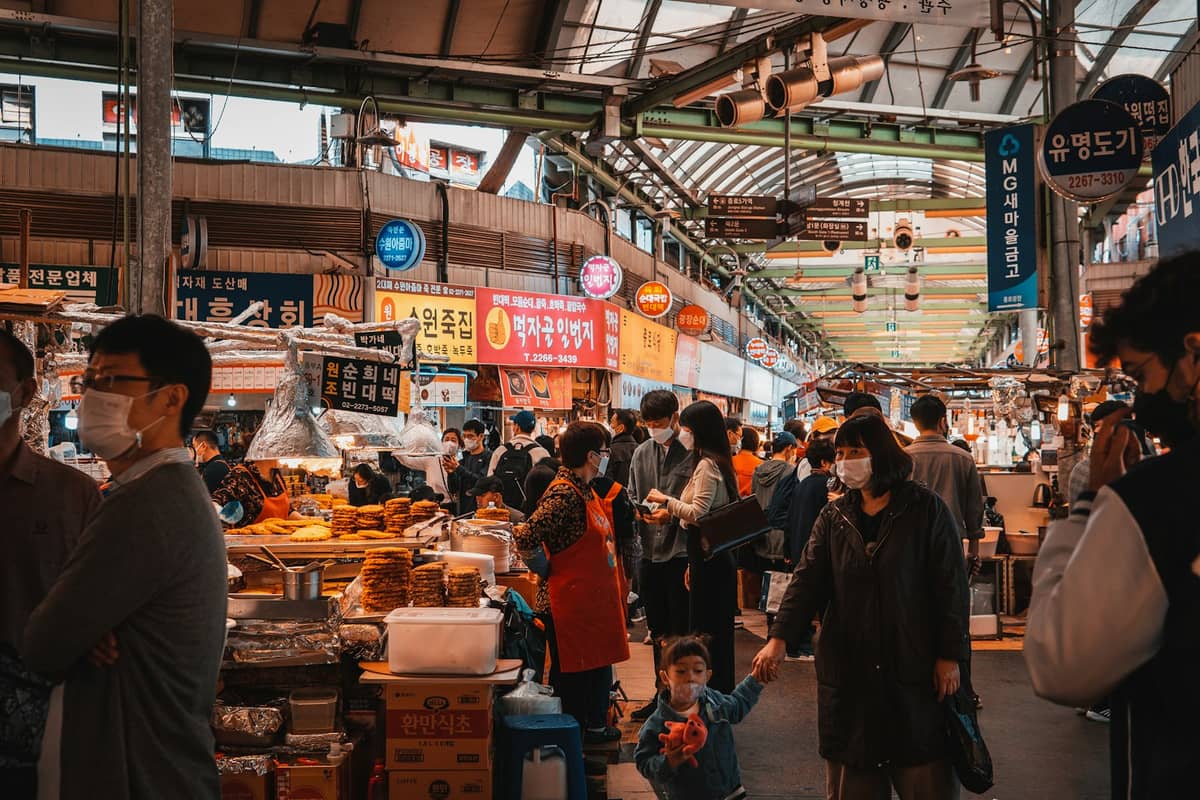
Gwangjang Market is Seoul's oldest covered market, founded in 1905 during the late Joseon period. It is known for a variety of foods, including mung bean pancakes, mayak gimbap, and beef tartare. Today it operates across multiple sections: a ground-floor food alley, textile and fabric floors where merchants sell bolts of silk, linen, and hanbok cloth wholesale and retail, and a secondhand clothing district that draws both vintage hunters and local traders. Today it operates across multiple sections: a ground-floor food alley packed with vendors serving hot food from early morning, textile and fabric floors where merchants sell bolts of silk, linen, and hanbok cloth wholesale and retail, and a secondhand clothing district that draws both vintage hunters and local traders.
Gwangjang sits in the historic Jongno district, within walking distance of Cheonggyecheon Stream and the main palace corridor. That context matters: this is not a tourist-created attraction but a working commercial market that has absorbed visitor interest without losing its original function. The majority of stalls on the fabric floors cater to wholesale buyers, seamstresses, and hanbok makers, not tourists.
ℹ️ Good to know
Food alleys typically run into the evening and stay open on Sundays; fabric and vintage sections often close Sundays. Hours can vary by vendor and season — confirm on arrival.
The Food Alley: What to Eat and What to Expect
The food alley runs through the market's ground floor and is the primary reason most visitors come. The smell reaches you before you see it: frying mung bean pancakes, sesame oil, and the faint sweetness of steamed rice. Stalls are set up along narrow corridors with low plastic stools and shared tables, sometimes just a few inches from the vendor's griddle.
The signature dish is bindaetteok, a thick mung bean pancake fried in oil until the outside crisps and the inside stays dense. Vendors cook them continuously on large flat griddles; you can watch each one pressed and turned. They arrive still sizzling, often cut into sections, served with a small bowl of kimchi on the side. They are heavy, oily, and satisfying in a way that light street food is not.
Mayak gimbap — small, tight rice rolls the size of a thumb, dipped in yellow mustard sauce — is a Gwangjang favorite. Expect queues at well-known stalls, particularly on weekday mornings and weekend lunchtimes. Yukhoe, seasoned raw beef served with egg yolk, is another Gwangjang specialty that is harder to find at street level elsewhere in the city. For those unfamiliar with raw meat dishes, the texture is smoother than tartare and the seasoning (sesame oil, soy, garlic, pear) is assertive enough to reassure hesitant first-timers.
💡 Local tip
Arrive before 11:00 on a weekday for the best seat selection and shorter waits. After noon, particularly on Saturdays, the central corridor becomes genuinely crowded and vendors get busy enough that service slows. Weekday mornings are the most relaxed time to eat.
Tickets & tours
Hand-picked options from our booking partner. Prices are indicative; availability and final rates are confirmed when you complete your booking.
DMZ and Lake Majang Suspension Bridge Tour from Seoul
From 57 €Instant confirmationFree cancellationHalf Day DMZ Tour from Seoul, 3rd Tunnel, Observatory and More
From 47 €Instant confirmationFree cancellationSeoul zombie city exploration game and private tour
From 10 €Instant confirmationFree cancellationLuggage Storage in Seoul
From 7 €Instant confirmationFree cancellation
The Fabric Floors: A Different Market Entirely
Climb to the upper floors and Gwangjang transforms. The food energy disappears and is replaced by a quieter, more purposeful atmosphere: rows of fabric merchants with bolts stacked floor to ceiling, rolls of silk, brocade, cotton, and hanbok-specific materials organized loosely by type. The light is fluorescent and flat, the floors are worn smooth, and conversations between vendors and regular buyers happen in rapid Korean.
For visitors with no intention of buying, the fabric section is still worth a floor or two of walking. The sheer volume and variety of textile goods — traditional patterned silk alongside modern synthetic stretch fabric, embroidery thread by the kilogram, lace sold by the meter — makes for an unexpectedly interesting visual environment. Prices are generally wholesale-oriented, and vendors are accustomed to both professional buyers and curious visitors, though don't expect much English. Pointing and a calculator work well.
If you're interested in wearing traditional Korean dress, this area connects logically to a broader hanbok experience in Seoul. Gwangjang is where many of the fabrics used in custom hanbok are sourced.
How the Market Changes Through the Day
By 09:00, the food alley is already operational. Vendors are frying, the steam from simmering tteokguk fills the corridor near the entrance, and the first wave of customers — many of them older local regulars — are already seated with coffee and pancakes. The market at this hour has a genuinely workaday rhythm that is easy to appreciate if you arrive without rushing.
Midday brings the tourist peak. From around 11:30 to 14:00, the food alley fills up, phones come out for photos, and some of the smaller stalls run out of their signature items. This is when the market can feel tight. If you want to navigate the fabric halls during this window, it's actually a useful escape: the upper floors thin out while the ground level is at its most hectic.
Late afternoon brings a quieter rhythm again. Some food vendors begin winding down inventory ahead of the 18:00 close, which means fewer options but also more space. The secondhand clothing section (Guie Shopping Street) runs later and attracts a younger crowd in the evening, including vintage resellers and thrift shoppers who work methodically through the racks.
Getting There and Getting Around
The most direct subway access is Jongno 5-ga Station on Line 1, Exit 8. The main market entrance is very close to the exit, making it one of the most straightforward market approaches in Seoul. You will see the covered market structure and the flow of foot traffic before you need to check a map.
Euljiro 4-ga Station on Lines 2 and 5 (Exit 4) is an alternative entry point, useful if you are coming from central Seoul.
Gwangjang connects naturally to a broader Jongno itinerary. Cheonggyecheon Stream is a short walk south and makes a logical pairing for an afternoon that combines market food with a riverside walk. The market is also well-positioned for visitors coming from Changgyeonggung Palace to the north.
Photography, Accessibility, and Practical Notes
Photography in the food alley is common and vendors are generally accustomed to it, though pointing a camera directly at someone's face without acknowledgment is still considered poor form. The overhead lighting in the covered sections is unflattering for food photography; morning light near the entrances or open sections produces better results. The fabric floors, with their stacked bolts and repetitive geometry, photograph well at almost any time.
Accessibility facilities are listed as available by the official Visit Seoul source. The ground floor food alley has a generally flat surface, but the market overall is a multi-story building with varying conditions across floors. Travelers with mobility considerations should plan for narrow corridors and crowded passages during peak hours.
There is no admission fee to enter Gwangjang Market. Cash remains widely useful at food stalls and smaller vendors, though some larger merchants on the fabric floors accept cards. Bring Korean won in small denominations.
⚠️ What to skip
Gwangjang's food alley stays open on Sundays; some fabric and vintage sections close. Confirm the section you care about before you go. If your Seoul itinerary falls on a Sunday in Jongno, plan for alternative food and market options — Namdaemun Market has different operating days.
Honest Assessment: What Gwangjang Is and Isn't
Gwangjang Market became significantly more internationally known after appearing in a popular Netflix food series. That exposure brought new visitors and, inevitably, some adjustment in how certain stalls present and price themselves. It remains an authentic working market with genuine wholesale commerce on its upper floors. But the food alley, particularly around the most-filmed stalls, now has a self-aware quality that wasn't there before. You will see vendors holding up signs in English, menus with photos, and occasional premium pricing at stalls with a visible online following.
This does not make the market worth avoiding. The food is still good. Bindaetteok at Gwangjang still tastes like it should. But visitors expecting a purely unmediated local experience may want to wander past the most prominent stalls to find vendors with lines of Korean regulars rather than tourists with phones. The market rewards the slightly more curious visitor.
For a broader picture of Seoul's traditional markets, including how Gwangjang compares to others, the Gwangjang Market food guide and the Seoul markets guide cover the full landscape of options across the city.
Insider Tips
- The mayak gimbap stalls nearest the main entrance get the longest queues. Walk two or three rows deeper into the alley and you will often find the same dish with shorter waits and identical quality.
- If you want to buy fabric, bring reference photos of what you are looking for. Vendors communicate more easily when they can see an image of the material type or pattern you need, even across a language gap.
- The secondhand clothing section (Guie Shopping Street) is worth visiting after 19:00 on weekdays, when the vintage reseller crowd tends to be most active and the best-curated racks are usually restocked from earlier in the day.
- The market's upper floors have a small number of food stalls selling meals to workers and fabric merchants. These are rarely photographed and almost entirely local. Prices are lower and portions are larger than the ground-floor tourist corridor.
- Weekday mornings between 09:00 and 10:30 are the closest Gwangjang gets to feeling like it did before international food media coverage. Older vendors, local regulars, less noise — the atmosphere is noticeably different.
Who Is Gwangjang Market For?
- Food travelers who want to eat iconic Korean street dishes in context rather than at a sanitized food hall
- Textile enthusiasts, designers, or anyone looking for quality Korean fabric at competitive prices
- Travelers on a budget who want a filling, inexpensive meal in a historic setting
- Vintage and secondhand clothing hunters with patience for unorganized racks
- First-time Seoul visitors doing a Jongno day combining palaces, stream walks, and a market lunch
Nearby Attractions
Other things to see while in Jongno & Bukchon:
- Bukchon Hanok Village
Bukchon Hanok Village (북촌한옥마을) is a preserved residential district of roughly 860 traditional Korean hanok houses in central Seoul, situated between Gyeongbokgung and Changdeokgung palaces. Unlike a museum or theme park, it is a real neighborhood where people still live, which shapes every aspect of visiting it. Entry is free, but access to certain alleys is restricted to protect residents.
- Changdeokgung Palace & Secret Garden
Changdeokgung Palace is the best-preserved of Seoul's five Joseon-era royal palaces, and its rear garden — the Huwon, known as the Secret Garden — remains one of the most atmospheric green spaces in the entire city. Together, they form a UNESCO World Heritage Site that rewards visitors who plan ahead.
- Changgyeonggung Palace
One of Seoul's five grand Joseon-era palaces, Changgyeonggung Palace sits in Jongno-gu and offers a quieter royal grounds experience. With late evening opening hours, low admission, and centuries of layered history, it rewards visitors who arrive without high expectations and leave with quiet satisfaction.
- Gwanghwamun Square
Gwanghwamun Square stretches 40,300 square meters through the center of Seoul, framed by Gyeongbokgung Palace to the north and the distant peaks of Bugaksan beyond. It is free, open 24 hours, and carries more historical weight than most visitors realize on first pass.