Gwanghwamun Square: Seoul's Civic Heart, Explained Honestly
Gwanghwamun Square stretches 40,300 square meters through the center of Seoul, framed by Gyeongbokgung Palace to the north and the distant peaks of Bugaksan beyond. It is free, open 24 hours, and carries more historical weight than most visitors realize on first pass.
Quick Facts
- Location
- 03154 B 175 Sejong-daero, Jongno-gu, Seoul
- Getting There
- Seoul Metro Line 5 — Gwanghwamun Station, Exit 2
- Time Needed
- 45 minutes to 2 hours depending on pace and interest
- Cost
- Free, open 24 hours
- Best for
- History, photography, orientation walks, understanding modern Seoul
- Official website
- gwanghwamun.seoul.go.kr/ghm-eng/main.do
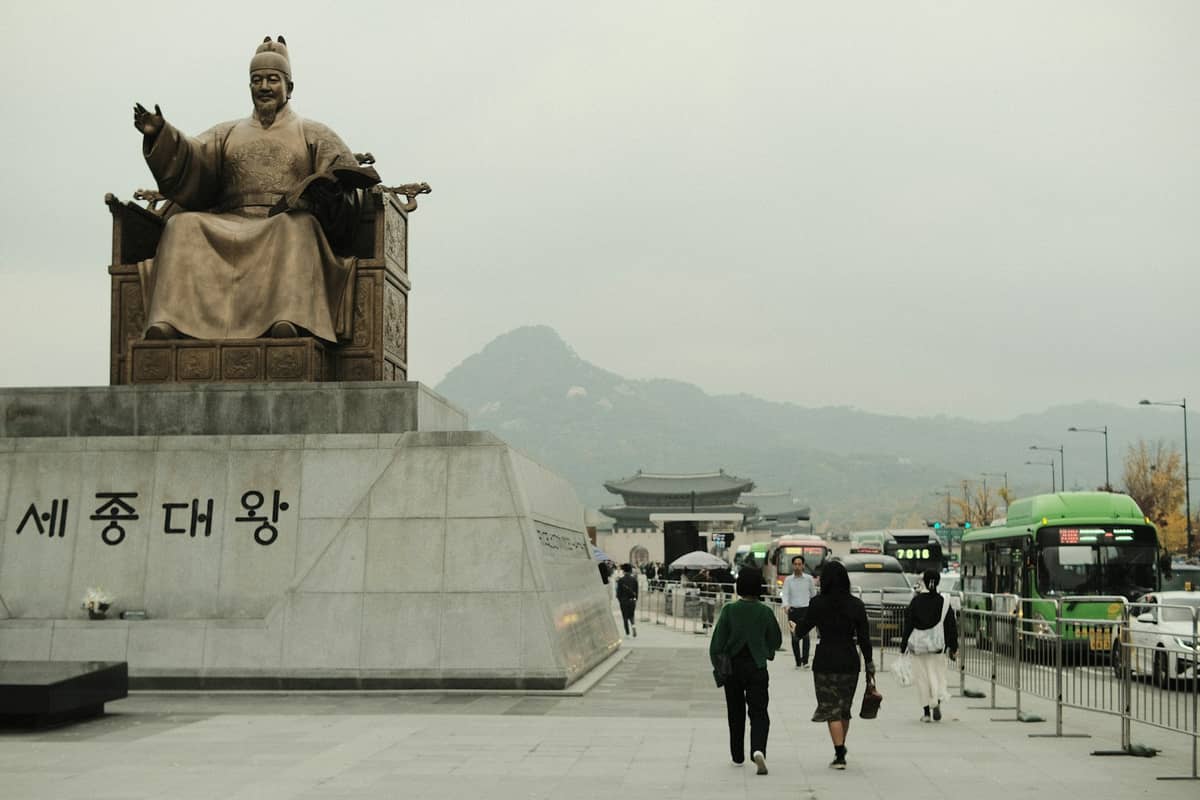
What Gwanghwamun Square Actually Is
Gwanghwamun Square (광화문광장) is a 40,300-square-meter public open space running along Sejong-daero in the heart of Jongno-gu. Reopened in August 2022, it occupies the former road corridor that once cut directly in front of Gwanghwamun Gate, the main southern entrance to Gyeongbokgung Palace., it occupies the former six-lane road corridor that once cut directly in front of Gwanghwamun Gate, the main southern entrance to Gyeongbokgung Palace. The conversion of that traffic artery into a pedestrian-priority civic square was one of the most significant urban planning decisions in Seoul's modern history.
The square is not an enclosed park. It is a wide, formal promenade bisected by light and shadow, flanked by government ministries on one side and major office buildings on the other. Two monumental bronze statues anchor the space: King Sejong the Great, who commissioned the creation of Hangul, the Korean alphabet, in the 15th century, and Admiral Yi Sun-sin, who led naval resistance against Japanese invasions in the 1590s. Both figures are significant beyond decoration — they represent the two most consistently celebrated figures in Korean national identity.
💡 Local tip
The clearest view of Gwanghwamun Gate from the square is from the area directly south of the King Sejong statue, looking north along the central axis. Arrive before 9:00 AM on weekdays for an unobstructed foreground without tour groups.
The Axial View: Why the Layout Matters
The square is deliberately aligned on the central axis of Gyeongbokgung Palace, a principle rooted in Joseon-era urban planning. When the Joseon dynasty founded Seoul as its capital in 1394, the palace was positioned at the northern end of this axis with Gwanghwamun Gate facing south down the main boulevard. Standing at the southern end of the square and looking north on a clear day, the view runs from the gate, through the middle of the square, and up to the ridgeline of Bugaksan mountain directly behind the palace complex. This alignment is not accidental — it reflects the geomantic principles (pungsu-jiri) that guided the placement of the entire capital.
Understanding this axis makes the square considerably more interesting to visit. You are standing on one of the most intentional pieces of urban geometry in East Asia, looking down a sight line that has been considered symbolically significant for over 600 years. For more on the palace itself, the Gyeongbokgung Palace guide covers the full interior, changing-of-the-guard schedule, and practical entry details.
Tickets & tours
Hand-picked options from our booking partner. Prices are indicative; availability and final rates are confirmed when you complete your booking.
DMZ and Lake Majang Suspension Bridge Tour from Seoul
From 57 €Instant confirmationFree cancellationHalf Day DMZ Tour from Seoul, 3rd Tunnel, Observatory and More
From 47 €Instant confirmationFree cancellationSeoul zombie city exploration game and private tour
From 10 €Instant confirmationFree cancellationLuggage Storage in Seoul
From 7 €Instant confirmationFree cancellation
How the Square Changes Through the Day
Early morning, between roughly 6:00 and 8:30 AM, the square takes on a different character entirely. Office workers cut through on foot, elderly residents do slow walking laps, and the light hits the face of Gwanghwamun Gate at a low golden angle. The sound environment is dominated by birds and the distant hum of the city waking up rather than traffic. This is the most photogenic window for architectural shots, and the least crowded for simply standing in the space and absorbing it.
By midday on weekends, the atmosphere shifts considerably. Tour groups congregate around the Admiral Yi statue, selfie sticks appear in numbers, and the pavement near King Sejong's statue fills with visitors reading the interpretive panels about Hangul. Summer afternoons in particular can feel relentlessly exposed — the square offers very little shade, and the stone surface radiates heat from around 11:00 AM onward. Visitors sensitive to direct sun should plan accordingly.
Evenings from around 7:00 PM bring a noticeably different mood. The gate and statues are illuminated, and the nighttime reflection of Gwanghwamun Gate on the wet pavement after rain is one of the most photographed images of central Seoul. Locals sit on the steps near the fountain areas, food carts operate on nearby streets, and the formality of the space softens.
⚠️ What to skip
The square is also a major venue for public demonstrations and political gatherings, which are a longstanding part of Seoul civic life. During large events, access routes may be altered and the surrounding roads closed. This is worth noting but not a reason to avoid the area — demonstrations here are typically peaceful and even photojournalistically interesting.
Historical Weight: More Than a Photo Backdrop
The ground beneath Gwanghwamun Square has seen several defining episodes of Korean history. During the Japanese colonial period (1910–1945), the colonial government moved Gwanghwamun Gate from its original location and installed the Japanese Government-General Building directly in the palace courtyard, deliberately breaking the symbolic axis. After liberation and through decades of partition, the area around the gate became a site of political significance. The Government-General Building was eventually demolished in the 1990s, and the gate was restored in a later reconstruction project that preceded the square's redevelopment.
Beneath the King Sejong statue, the Sejong Story exhibition space offers free entry and provides more detailed context on his reign and the development of Hangul. Nearby, Jongmyo Shrine preserves the royal ancestral tablets of the Joseon kings and is a UNESCO World Heritage Site worth pairing with a visit here.
The square's 2009 opening was also politically significant in a contemporary sense. The decision to reclaim road space for public use in the middle of one of the world's most car-dependent city centers represented a clear statement about the direction of Seoul's urban identity. A major renovation reopened in 2022, further expanding pedestrian areas and improving connections to surrounding streets and underground passages.
Getting There and Moving Around
The most direct subway access is Seoul Metro Line 5 to Gwanghwamun Station. Exit 2 deposits you closest to the square's midpoint near the Admiral Yi statue.
The square connects naturally to the surrounding area on foot. Cheonggyecheon Stream begins just a few blocks east and makes for an excellent continuation of a morning walk. To the north, Gyeongbokgung Palace is a 10-minute walk from the square's northern edge. Insadong, with its galleries and tea houses, is roughly 15 minutes east on foot.
ℹ️ Good to know
T-money cards (transit smart cards) are the easiest way to pay for subway trips. They can be loaded and used across all Seoul metro lines, buses, and some convenience stores. Pick one up at any subway station convenience store on arrival.
Photography: What Works and What to Avoid
The most effective compositions at Gwanghwamun Square require patience with timing. The gate facade faces south, which means the front is in shadow during morning hours and lit from midday onward. For the classic north-facing shot with the mountain behind the gate, morning light from the east creates side-lighting that gives the mountains texture. Blue hour (15 to 20 minutes after sunset) is consistently the best window: the gate's warm interior lighting balances against the deep blue sky, and the two statues are lit from below.
Wide-angle lenses suit the scale of the space, but the challenge is the constant foot traffic through the central axis. A longer focal length from the southern end compresses the distance and makes the gate appear closer to the mountains, which is visually more dramatic than the wide-angle alternative. During major public events, the square fills in ways that make formal architectural photography impractical but candid crowd photography exceptionally interesting.
Who Will and Will Not Get Much from This
Travelers who come to Gwanghwamun Square expecting the scale and intimacy of, say, Bukchon Hanok Village will find it quite different: this is a formal, government-district civic space, not a neighborhood to wander. It rewards people who engage with the historical context, who are interested in the sight line toward the palace, or who are using it as a geographic anchor to understand where Seoul's historic center actually is.
Visitors looking for a relaxed, shaded park experience should adjust expectations. The square is open and exposed, and much of the appeal is conceptual and historical rather than sensory. Families with young children may find the underground Sejong Story exhibition more engaging than the surface-level promenade. Travelers who have already visited and feel indifferent to Korean history may spend 20 minutes here and feel done, which is a legitimate outcome.
Insider Tips
- The underground Sejong Story exhibition is free — a useful refuge in midsummer heat or winter cold, and genuinely informative about Hangul's development.
- The best unobstructed axial photograph of Gwanghwamun Gate requires standing on the central median line of the square, roughly level with the Admiral Yi statue, and shooting north. Most visitors stand too close to the gate and lose the mountain backdrop entirely.
- On major national holidays including the Lunar New Year and Chuseok, traditional performances and guard-changing ceremonies are held at the gate with extended schedules. These are free to watch and draw significant local attendance.
- The stretch of Sejong-daero running south from the square toward City Hall passes several important government buildings and the Sejong Center for the Performing Arts. It is one of the more architecturally coherent stretches of boulevard in central Seoul and worth walking in full rather than taking the subway one stop.
- If you visit during winter, the square occasionally hosts seasonal light installations and ice-related events around New Year. The combination of illuminated statues and cold clear air makes for a very different atmosphere than the summer crowds.
Who Is Gwanghwamun Square For?
- First-time visitors to Seoul wanting to understand the city's historical and civic geography
- Photographers targeting the Gwanghwamun Gate and Bugaksan mountain axis at blue hour
- History-focused travelers interested in Joseon-era urban planning and Korean national symbols
- Walkers building a full day itinerary connecting the palace district, Insadong, and Cheonggyecheon
- Travelers visiting during national holidays when ceremonies and performances animate the space
Nearby Attractions
Other things to see while in Jongno & Bukchon:
- Bukchon Hanok Village
Bukchon Hanok Village (북촌한옥마을) is a preserved residential district of roughly 860 traditional Korean hanok houses in central Seoul, situated between Gyeongbokgung and Changdeokgung palaces. Unlike a museum or theme park, it is a real neighborhood where people still live, which shapes every aspect of visiting it. Entry is free, but access to certain alleys is restricted to protect residents.
- Changdeokgung Palace & Secret Garden
Changdeokgung Palace is the best-preserved of Seoul's five Joseon-era royal palaces, and its rear garden — the Huwon, known as the Secret Garden — remains one of the most atmospheric green spaces in the entire city. Together, they form a UNESCO World Heritage Site that rewards visitors who plan ahead.
- Changgyeonggung Palace
One of Seoul's five grand Joseon-era palaces, Changgyeonggung Palace sits in Jongno-gu and offers a quieter royal grounds experience. With late evening opening hours, low admission, and centuries of layered history, it rewards visitors who arrive without high expectations and leave with quiet satisfaction.
- Gwangjang Market
Established in 1905, Gwangjang Market in Jongno is Seoul's oldest continuously operating covered market. It draws visitors for its legendary street food stalls — bindaetteok, mayak gimbap, yukhoe — as much as for its wholesale fabric halls and secondhand clothing floors.