Cheonggyecheon Stream: Seoul's Urban Waterway, Explained
Cheonggyecheon Stream is an 11-kilometer restored waterway cutting through central Seoul, offering a rare ground-level escape from the city's elevated streets. Free to access around the clock in normal conditions, it draws early-morning joggers, evening strollers, and weekend families in equal measure.
Quick Facts
- Location
- 37, Mugyo-ro, Jongno-gu, Seoul (03187)
- Getting There
- City Hall Station (Lines 1/2), Exit 4 — approx. 384m to the stream entrance
- Time Needed
- 30 minutes (short stroll) to 2.5 hours (full western section)
- Cost
- Free. Open 24 hours, 7 days a week in normal conditions
- Best for
- Evening walkers, photography, escaping street-level noise, autumn and spring visits
- Official website
- english.seoul.go.kr/service/amusement/stream
What Cheonggyecheon Stream Actually Is
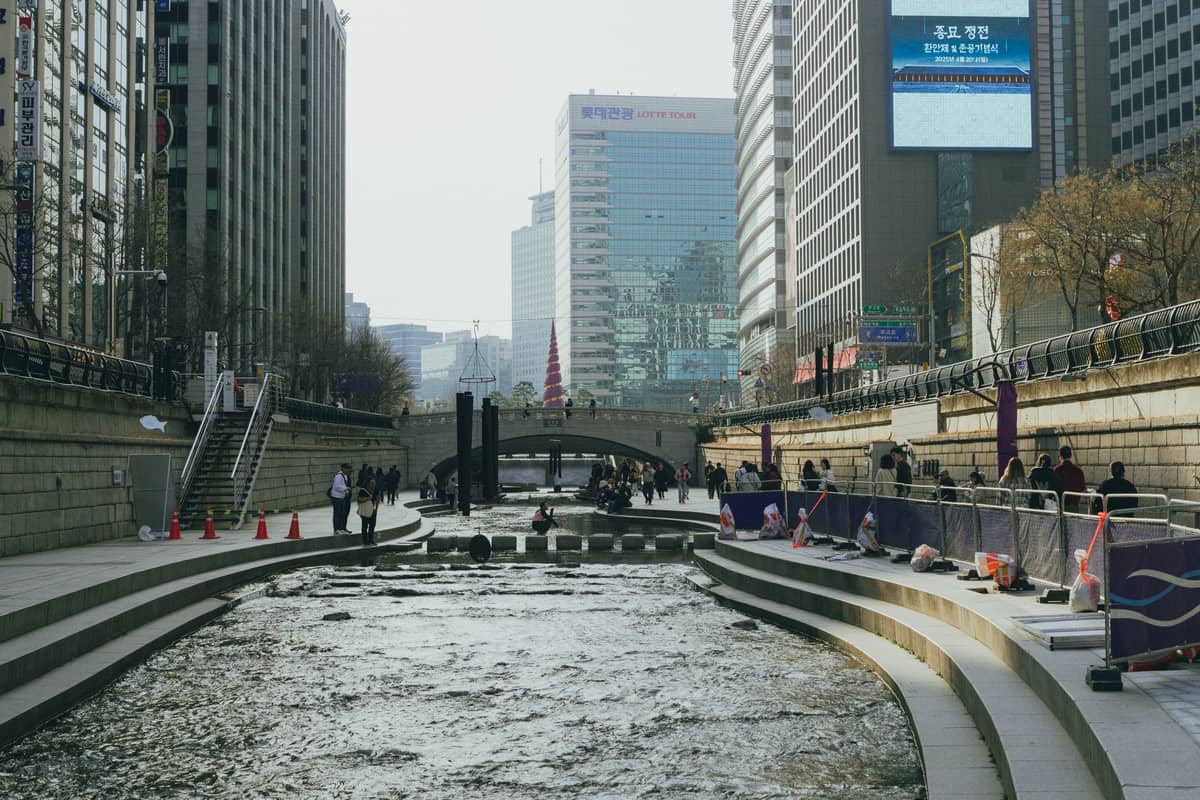
Cheonggyecheon Stream is a restored urban waterway running approximately 11 kilometers through the heart of Seoul, from Cheonggyecheon Plaza near City Hall eastward through Jongno and Jung-gu districts. The stream sits several meters below street level, which is one of the first things that surprises first-time visitors: you descend stone staircases from the busy road above, and within seconds the traffic noise drops noticeably. What greets you is a narrow channel of flowing water flanked by stone and concrete walkways, willow trees, native grasses, and a long series of stepping stones and small bridges.
The stream is not a natural feature in the conventional sense. For most of the 20th century, Cheonggyecheon was buried under an elevated highway that carried heavy commuter traffic through central Seoul. In 2003, the city demolished that highway and excavated the stream beneath it, completing the restoration project in 2005. The project is widely cited as an urban regeneration case study, credited with reducing surface temperatures in the immediate area, improving local air quality, and transforming one of the city's most congested corridors into a linear public park.
💡 Local tip
The most scenic and walkable section is the western stretch between Cheonggyecheon Plaza and Gwanggyo Bridge. If time is limited, walk east from the plaza entrance for 20–30 minutes, then return. The stream changes character as you continue farther east, becoming quieter and less polished.
How the Stream Changes Through the Day
Early mornings, particularly before 8am, belong to regulars. Older residents walk the length of the western section at a deliberate pace. Joggers use the path as a traffic-free route. The water catches whatever light filters between the office towers above, and the sound of the current is easy to hear without competing with crowd noise. This is also when you notice the small ecological details: water birds occasionally forage along the shallow edges, and the planted grasses along the banks are dewy and undisturbed.
By midday, especially on weekdays, the path fills with office workers from the surrounding districts taking lunch breaks. The stretch between the Plaza and the first few bridges is the densest at this hour. On warm days, some visitors sit on the stone steps leading down to the water to eat. The atmosphere is sociable and relaxed, though the path itself can get narrow in places.
Evenings are when Cheonggyecheon earns its reputation. After sunset, the bridges and stream banks are lit in soft colors, the water reflects the illuminated murals painted on the retaining walls, and couples, friend groups, and families cluster around the stepping stones. The city above disappears more completely in the dark, and the effect is one of genuine seclusion despite being steps from a major commercial district. Friday and Saturday evenings see the largest crowds; if you prefer a quieter version of the same atmosphere, a Sunday or weeknight visit works better.
Tickets & tours
Hand-picked options from our booking partner. Prices are indicative; availability and final rates are confirmed when you complete your booking.
DMZ and Lake Majang Suspension Bridge Tour from Seoul
From 57 €Instant confirmationFree cancellationHalf Day DMZ Tour from Seoul, 3rd Tunnel, Observatory and More
From 47 €Instant confirmationFree cancellationSeoul zombie city exploration game and private tour
From 10 €Instant confirmationFree cancellationLuggage Storage in Seoul
From 7 €Instant confirmationFree cancellation
The Seasonal Picture
Spring (April to early May) is consistently the most appealing season. Cherry blossom trees near the western entrance and the wider area around Gwanghwamun Square come into bloom, and the stream banks are planted with yellow forsythia and other flowering shrubs. Temperatures are mild enough for a slow walk without overheating, and daylight lasts into the evening. The spring season in Seoul is also when the city is at its photogenic best, and Cheonggyecheon benefits from that energy.
Autumn (September to November) runs spring close. The foliage along the banks turns amber and gold, the humidity drops, and the stream has a different quality of light in the lower sun. This is also when the annual Seoul Lantern Festival has historically been held along Cheonggyecheon, typically in November, transforming the stream with elaborate lit installations for several weeks. Festival dates and formats change yearly, so confirm the schedule through official Seoul tourism channels before planning around it. The general guide to visiting Seoul in autumn has broader seasonal context.
Summer brings heat and humidity that make a midday walk uncomfortable. The shade along the lower path does help, and the sight and sound of flowing water creates a modest cooling effect, but long sections of the route are exposed. If visiting in July or August, go early morning or after 7pm. Winter keeps the stream accessible (it is open year-round), but the water level can drop and the planted banks look sparse. Clear winter mornings with low light can produce good photography conditions.
Walking the Path: What to Expect
The promenade is a below-grade, linear walking path. You access it by descending stairs at designated entry points along the street above. Cheonggyecheon Plaza, near City Hall, is the most common starting point for visitors. Most visitors walk east from there. The path is paved and generally flat, following the stream on both banks connected by a series of pedestrian bridges and stepping stones. The stepping stones crossing the water at several points are a signature feature and popular for photographs, though they can be slippery when wet.
After the first kilometer or two, the stream passes through areas with public art installations, mosaic-tiled retaining walls, and planted native vegetation. The Cheonggye Plaza at the western entrance features a large sculptural fountain that marks the start of the route. Walking the full 11 km length to the eastern end takes most people around two to four hours at a relaxed pace, though the scenery becomes less curated after the midpoint. Most casual visitors cover 2 to 4 kilometers and exit at one of the street-level access points., though the scenery becomes less curated after the midpoint. Most casual visitors cover 2 to 4 kilometers and exit at one of the street-level access points.
There is no food or retail directly on the path. The streets immediately above, particularly around Cheonggyecheon-ro and the surrounding Jung-gu blocks, have convenience stores, cafes, and restaurants within a short walk. The nearby area of Insadong and its surrounding streets offer traditional tea houses and Korean dining options for those combining the stream walk with a broader cultural route.
⚠️ What to skip
The stepping stones across the stream are not suitable for wheelchairs or strollers, and some access stairways also lack ramp alternatives. The paved walking paths on either bank are flat and manageable, but full accessibility across the route cannot be confirmed. Check ahead if mobility requirements are a factor.
Historical and Cultural Context
Before the highway was built above it in the post-war decades, Cheonggyecheon was a working waterway at the center of a dense commercial and residential neighborhood. Hundreds of small vendors, workshops, and informal settlements lined its banks. The decision to bury the stream was driven by post-war modernization pressure, and for decades the elevated highway above it was considered a symbol of Seoul's economic development. When then-mayor Lee Myung-bak championed the restoration project in 2003, the demolition of that same highway was reframed as a symbol of post-industrial urban renewal.
The project displaced thousands of small businesses that had occupied the surrounding streets, a process that generated significant controversy at the time and remains a point of debate among urban scholars. The stream as it exists today is not a natural ecosystem restoration but a managed waterway, with water pumped in from the Han River to maintain flow. That distinction matters: Cheonggyecheon is more accurately described as an engineered linear park than a recovered natural stream. It functions well as public space, but visitors expecting a naturalistic river experience should adjust expectations. For a more genuinely wild outdoor setting, Bukhansan National Park offers a different quality of nature within the same city.
Photography and Practical Tips
The stream is consistently photogenic at blue hour, roughly 20 to 40 minutes after sunset when the sky holds ambient light and the path illuminations are active. The reflection of lit bridges in the water and the long perspective down the stream corridor are the most-photographed compositions. A wide-angle lens or the standard camera on a modern smartphone handles the conditions well; the lighting is soft rather than harsh. For daytime shots, the best natural light is on the eastern-facing sections in morning and western sections in late afternoon.
Dress for walking: flat or low-heeled footwear is practical on the stone paths, and the stepping stones require reasonable balance. In summer, bring water and sunscreen for the exposed sections. In winter, the path can be cold given its below-grade position. Cheonggyecheon sits within easy reach of Myeongdong and Jung-gu, making it a natural addition to any itinerary that also covers the palace district or Namdaemun area. If you are planning a broader walking day, the main Seoul attractions guide outlines how the stream fits into a multi-stop route.
Is Cheonggyecheon Worth Your Time?
For visitors with more than two days in Seoul, yes, without hesitation. It is free, centrally located, and offers a perspective on the city you cannot get from street level or an observation deck. The experience of descending into the stream corridor and watching the city rise around you on both sides is distinctly Seoul.
For visitors on a very tight one- or two-day itinerary prioritizing palaces, museums, and major cultural landmarks, the stream works best as a walk-through connector rather than a standalone destination. If you are moving between Gwanghwamun and Dongdaemun, walking along Cheonggyecheon rather than taking the subway adds maybe 40 minutes to an hour and gives you a ground-level view of the city that no transit journey can replicate.
Those who want quiet, natural, and uncrowded should be aware this is a popular urban space, not a secluded retreat. Peak evening hours in the central section feel lively rather than peaceful. Travelers looking for Seoul's more subdued neighborhoods might prefer combining this walk with a visit to Ikseon-dong Hanok Village for contrast.
Insider Tips
- Exit the stream at Supyo Bridge (수표교 area) after walking east from the plaza for about 1.5 km. The architecture of the retaining walls changes here, and the crowd thins quickly. The section between the third and sixth bridges often has the best light for photography without other people in frame.
- The stepping stones are charming but genuinely slippery after rain. They are low to the water and a misstep means wet feet at minimum. Wear shoes you do not mind getting damp, or simply cross using the pedestrian bridges instead.
- November's lantern festival transforms the stream entirely. If your Seoul dates align with it, prioritize an evening visit — the installations extend for several kilometers and the crowd is worth tolerating for the spectacle. Check the Seoul Metropolitan Government's official site for that year's dates before your trip.
- The access stairs nearest City Hall Station Exit 4 deposit you directly at Cheonggyecheon Plaza, the formal western terminus with the fountain sculpture. This is the most logical starting point for a first visit, as the best-maintained section runs eastward from here.
- If you walk the stream in the early morning, look for the small egrets and grey herons that sometimes forage in the shallower eastern sections. The bird activity is more visible in spring and autumn and adds something unexpected to what is otherwise a very urban setting.
Who Is Cheonggyecheon Stream For?
- Evening walkers and couples looking for a lit, atmospheric route through central Seoul
- Photographers shooting at blue hour or dawn for strong reflections and low-crowd compositions
- Visitors combining multiple Jung-gu and Jongno-gu landmarks in a single walking day
- Families with older children who can manage the stepping stones and a sustained walk
- Autumn visitors, particularly during the November lantern festival period
Nearby Attractions
Other things to see while in Myeongdong & Jung-gu:
- Deoksugung Palace
Deoksugung Palace sits in the heart of Jung-gu, surrounded by modern Seoul yet preserved as a rare meeting point of Joseon tradition and early 20th-century Western architecture. At 1,000 KRW and open until 9pm (last admission at 8pm), it is one of the few palaces you can visit after work or after dinner.
- Gyeonghuigung Palace
Once a secondary palace for Joseon kings, Gyeonghuigung stands today as Seoul's least-visited royal site, which is precisely what makes it worth your time. Free to enter and rarely crowded, it offers a grounded, unhurried encounter with Korean dynastic architecture in the heart of the city.
- Myeongdong Cathedral
Myeongdong Cathedral is Seoul's most historically significant Catholic church and one of the city's finest examples of Gothic brick architecture. Founded in 1892 and completed in 1898, it sits on a hilltop above the commercial noise of Myeongdong, offering a rare moment of calm in the middle of one of Seoul's busiest districts. Entry is free.
- Namdaemun Market
Namdaemun Market (남대문시장) Namdaemun Market (남대문시장) has operated in the heart of Seoul's Jung-gu district since 1414, making it the largest traditional market in South Korea. Spread across a dense network of alleys and covered arcades, it sells everything from wholesale eyewear and kitchenware to street food and children's clothing — and it barely sleeps.